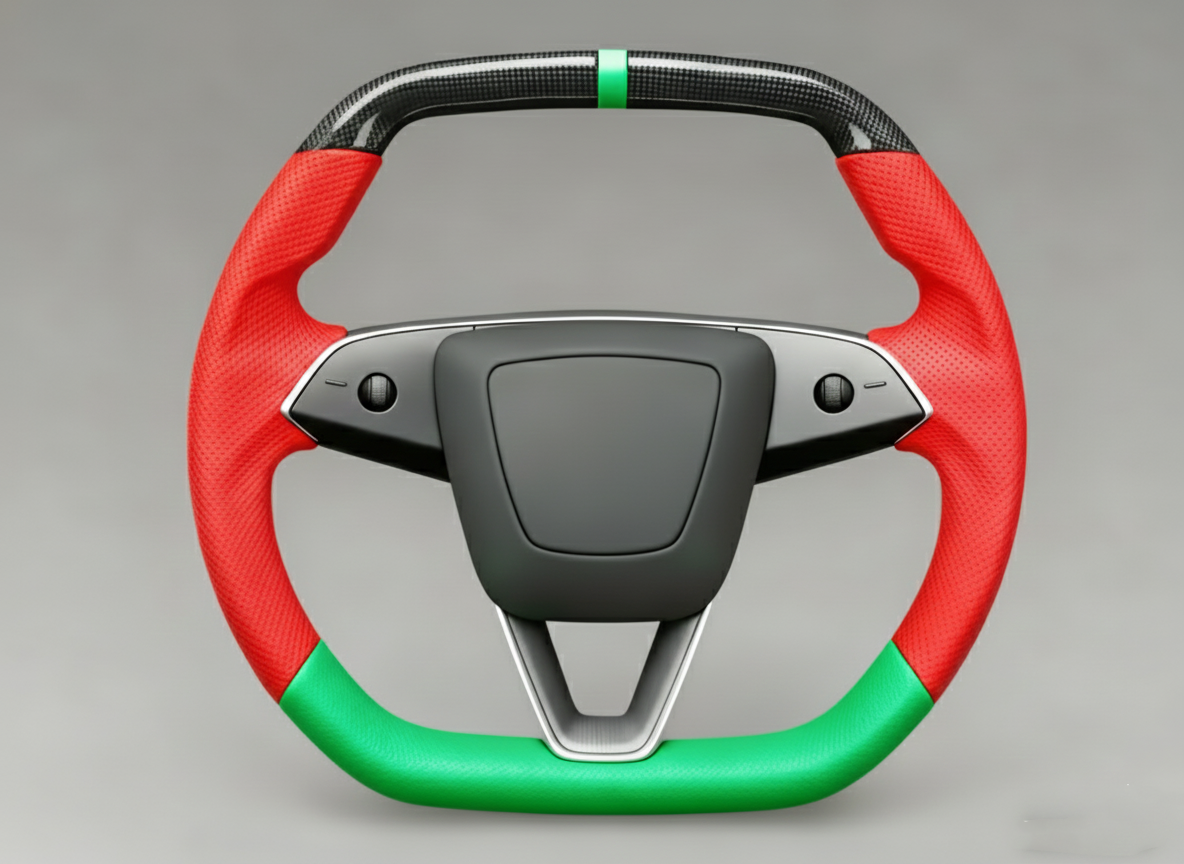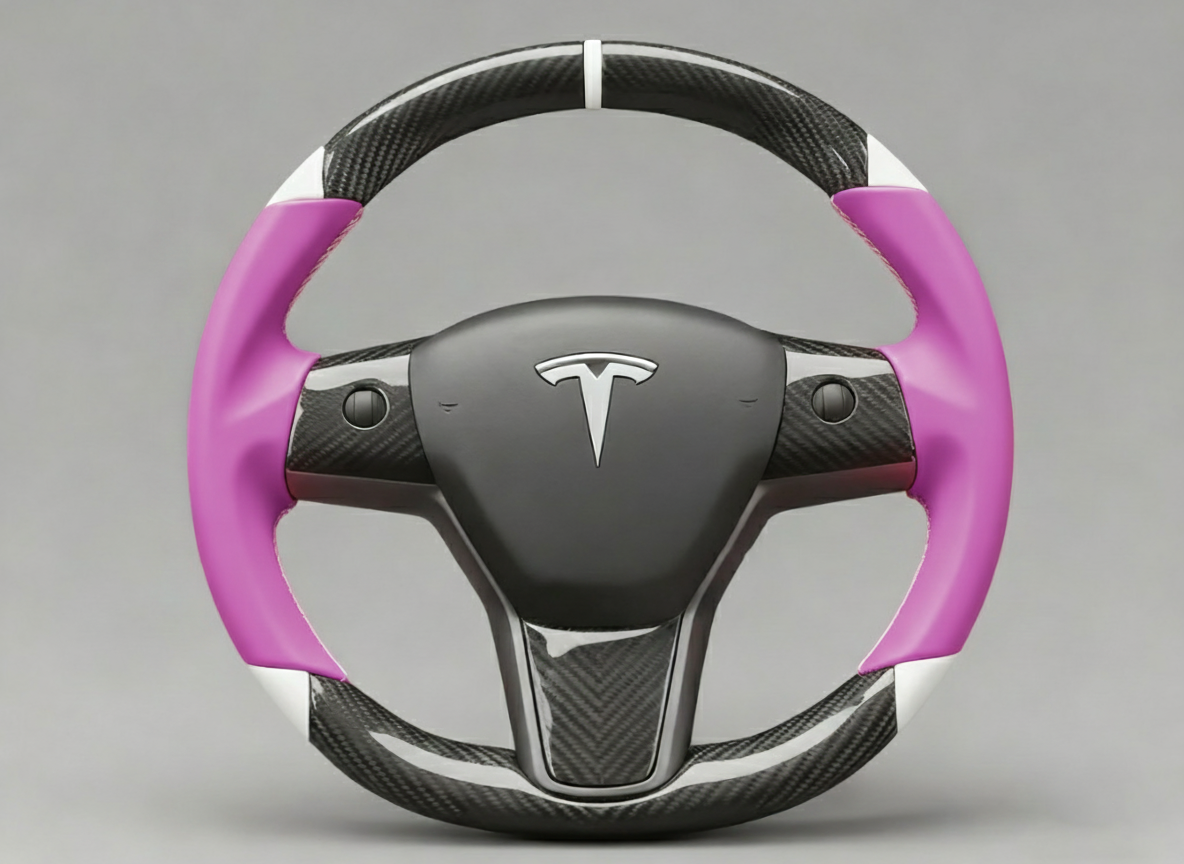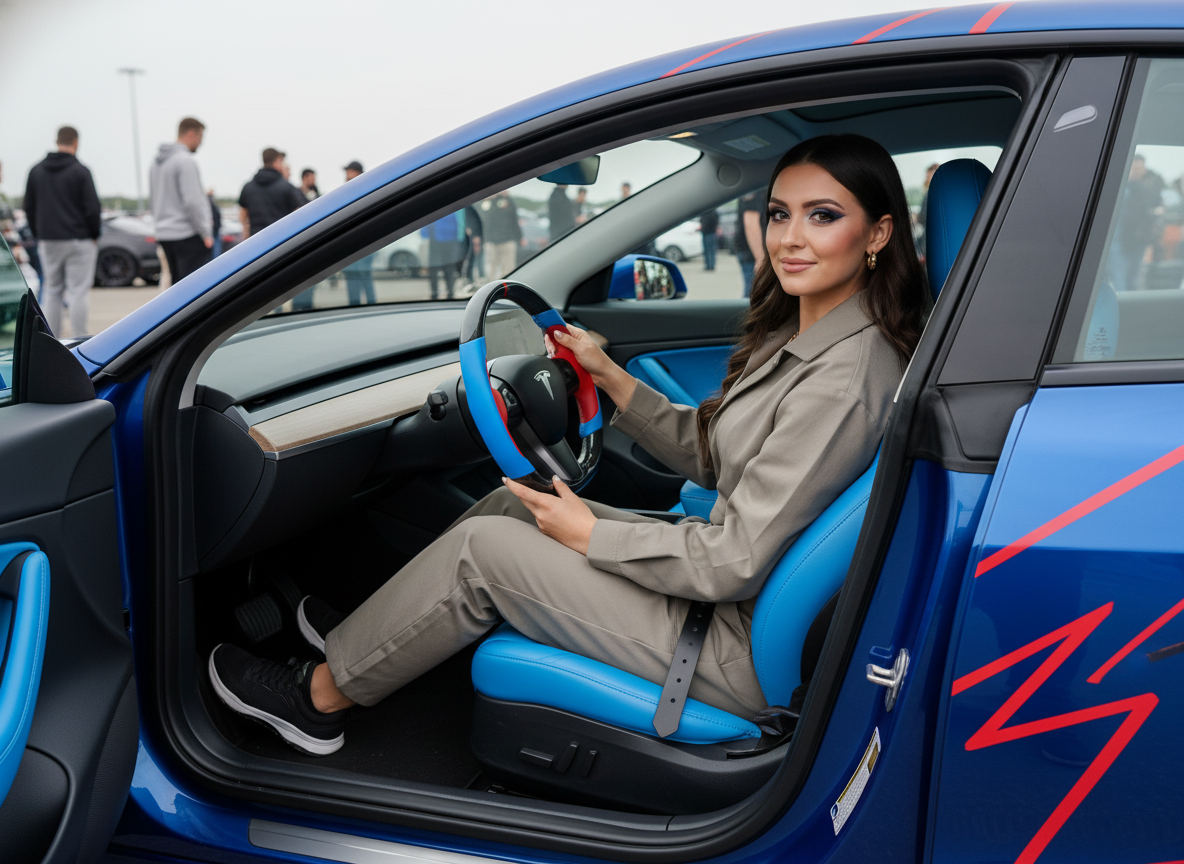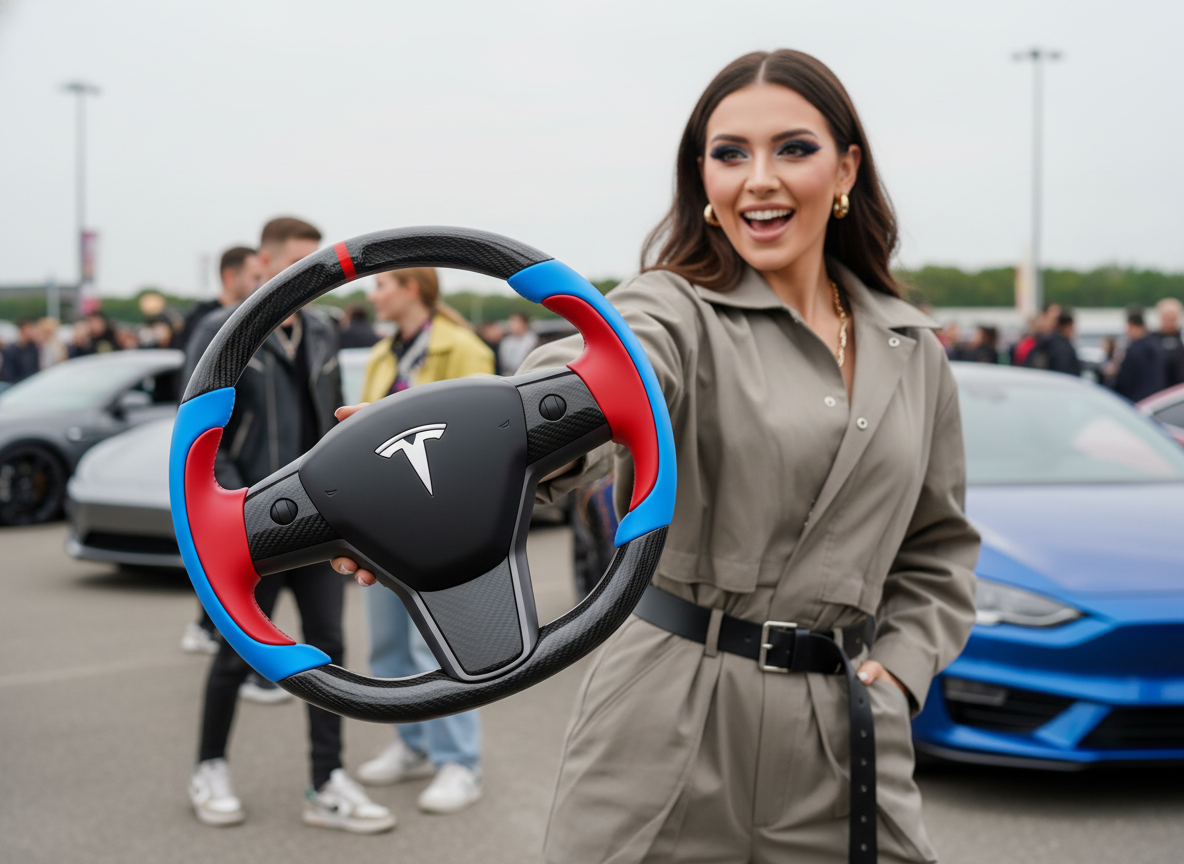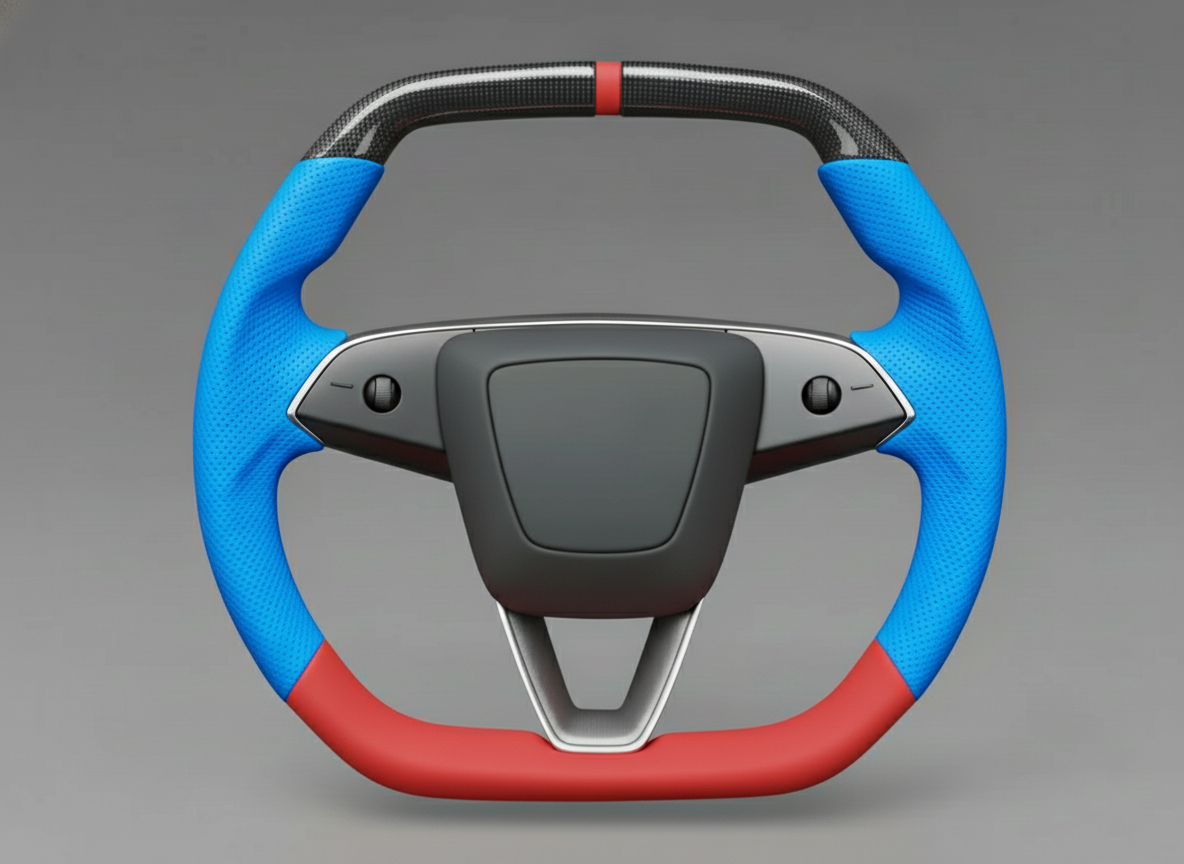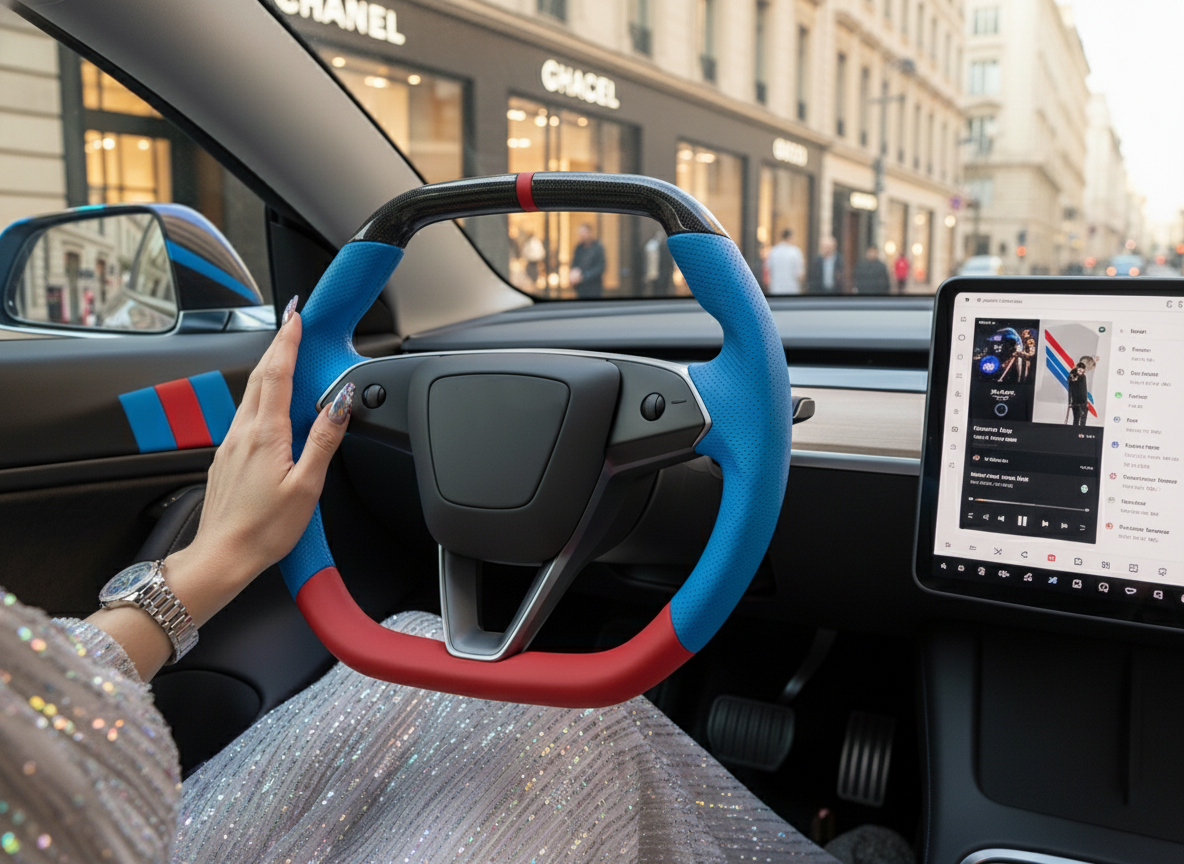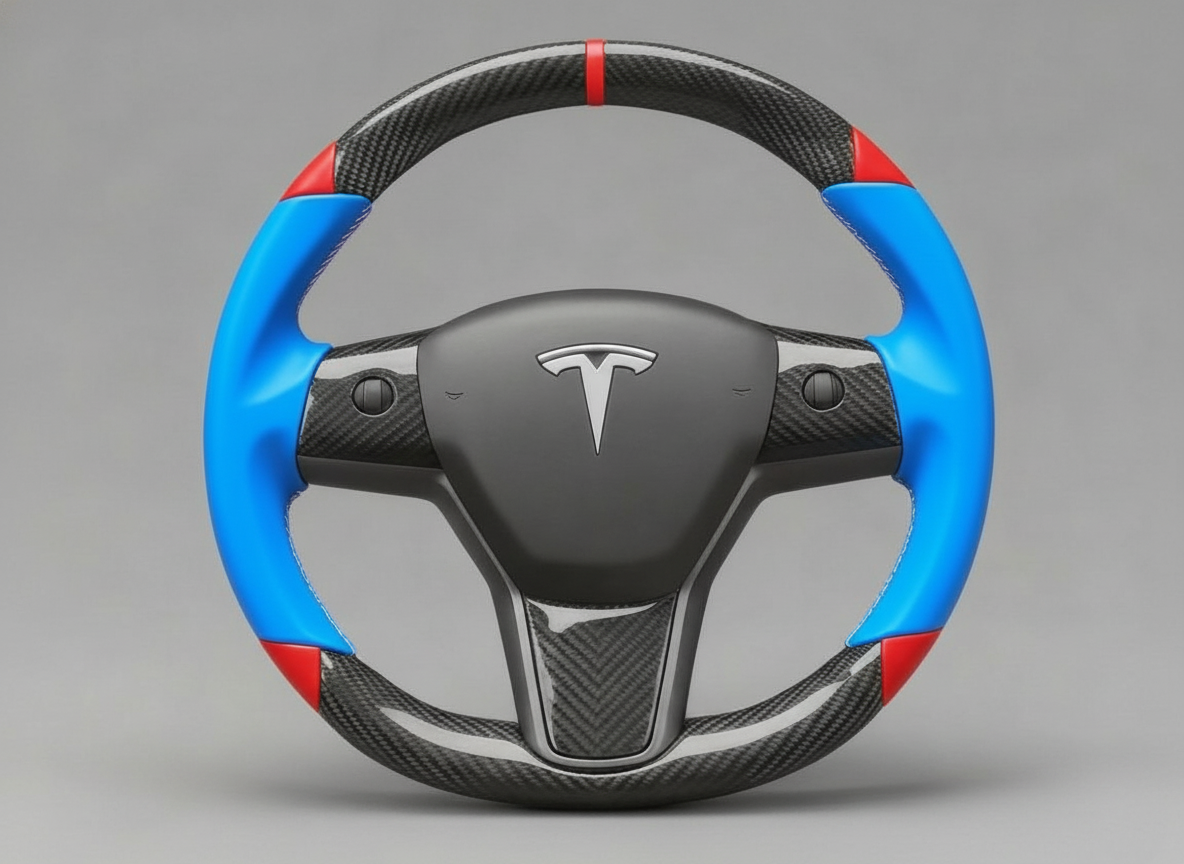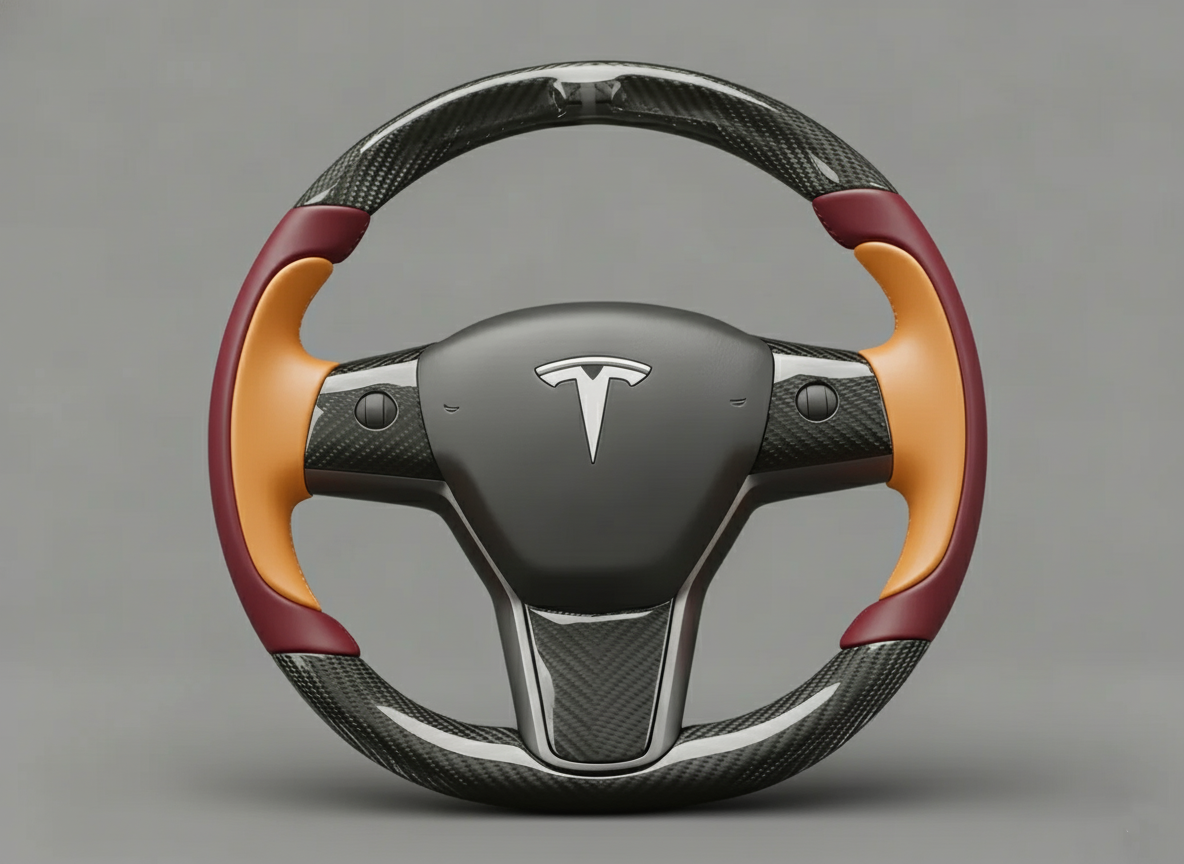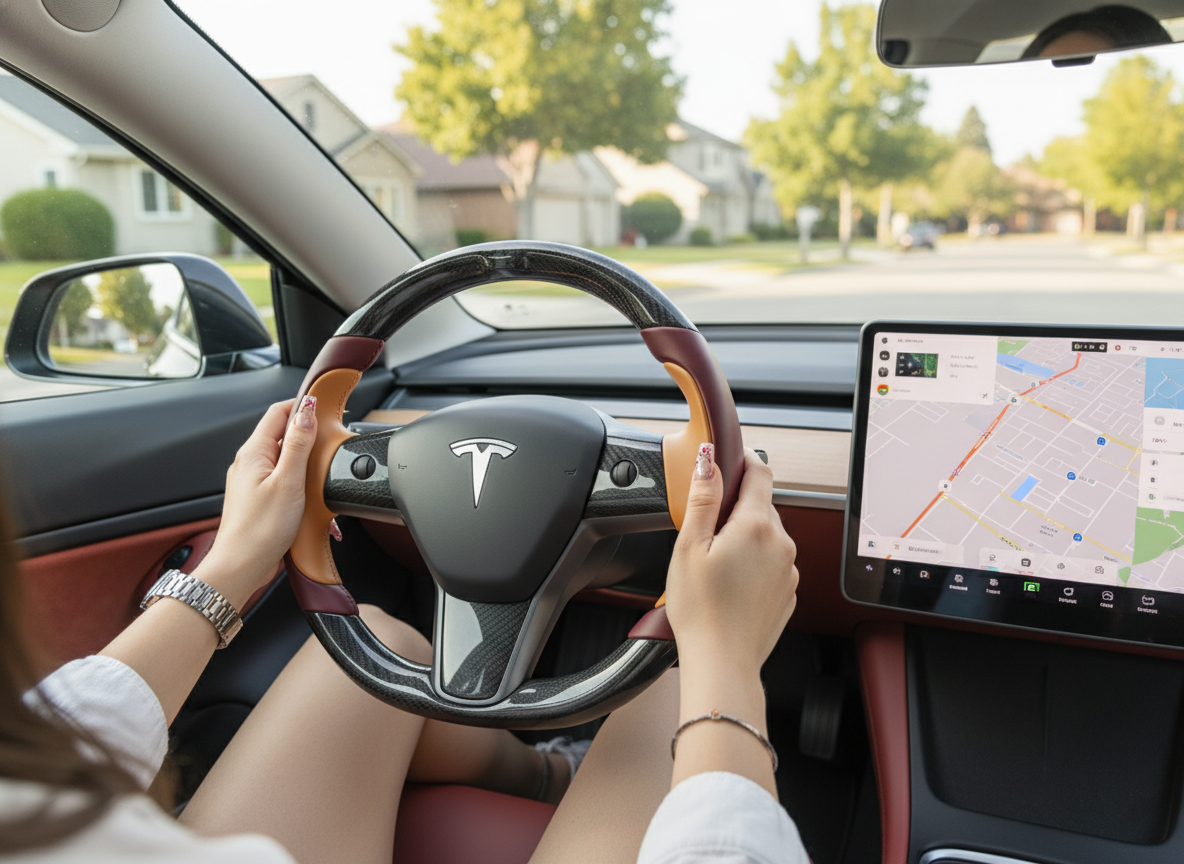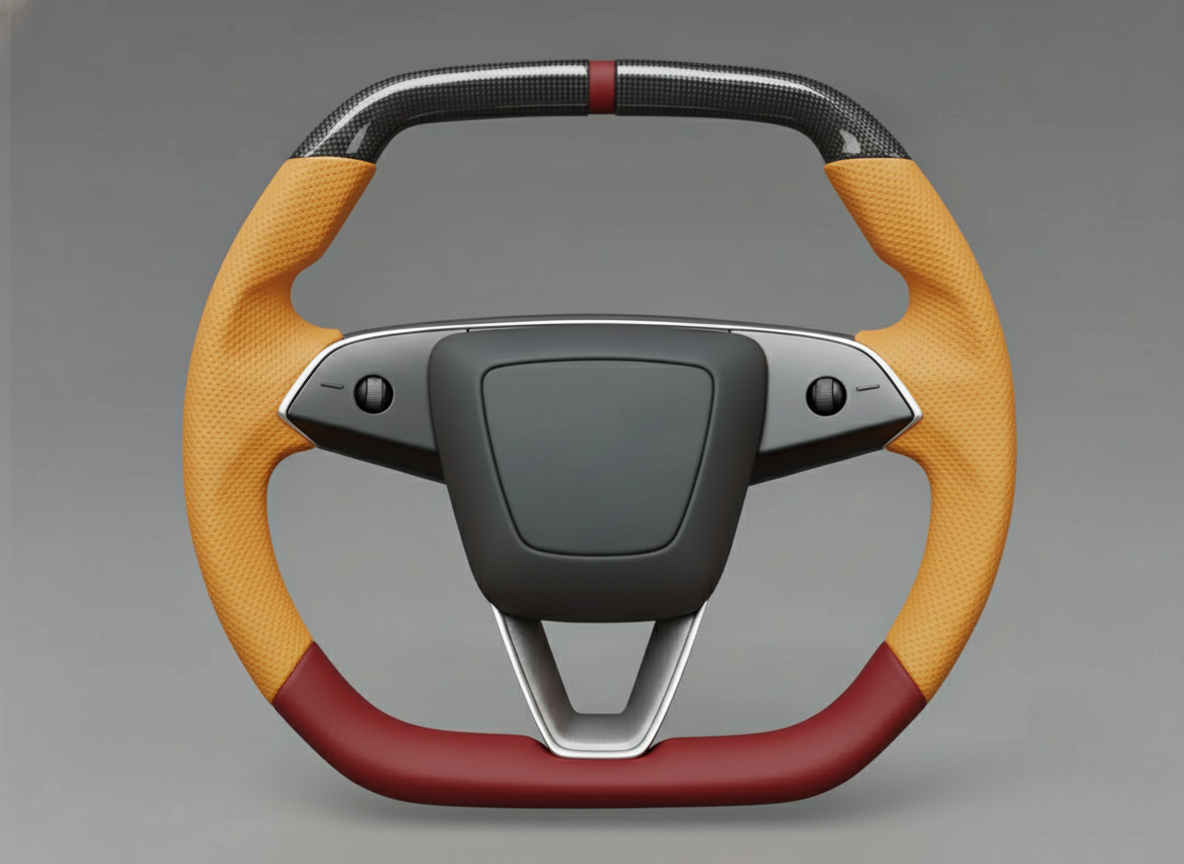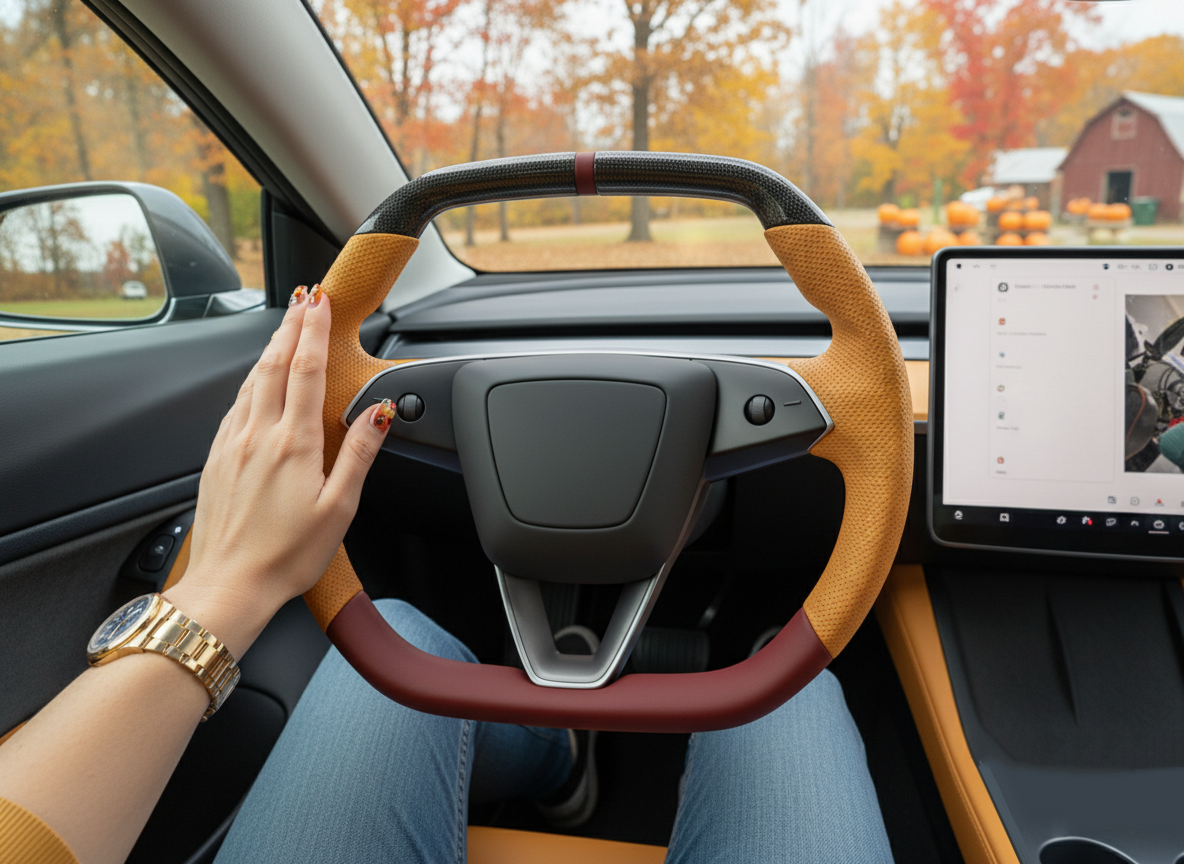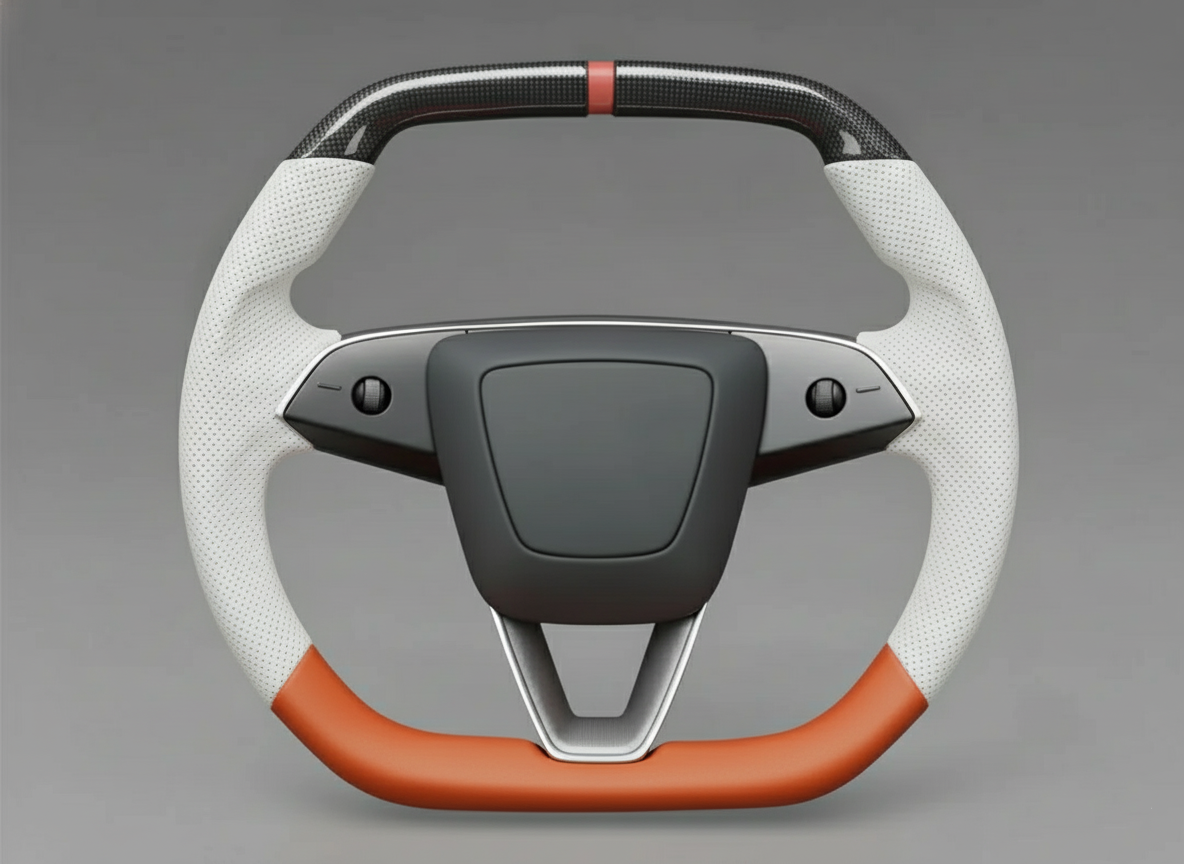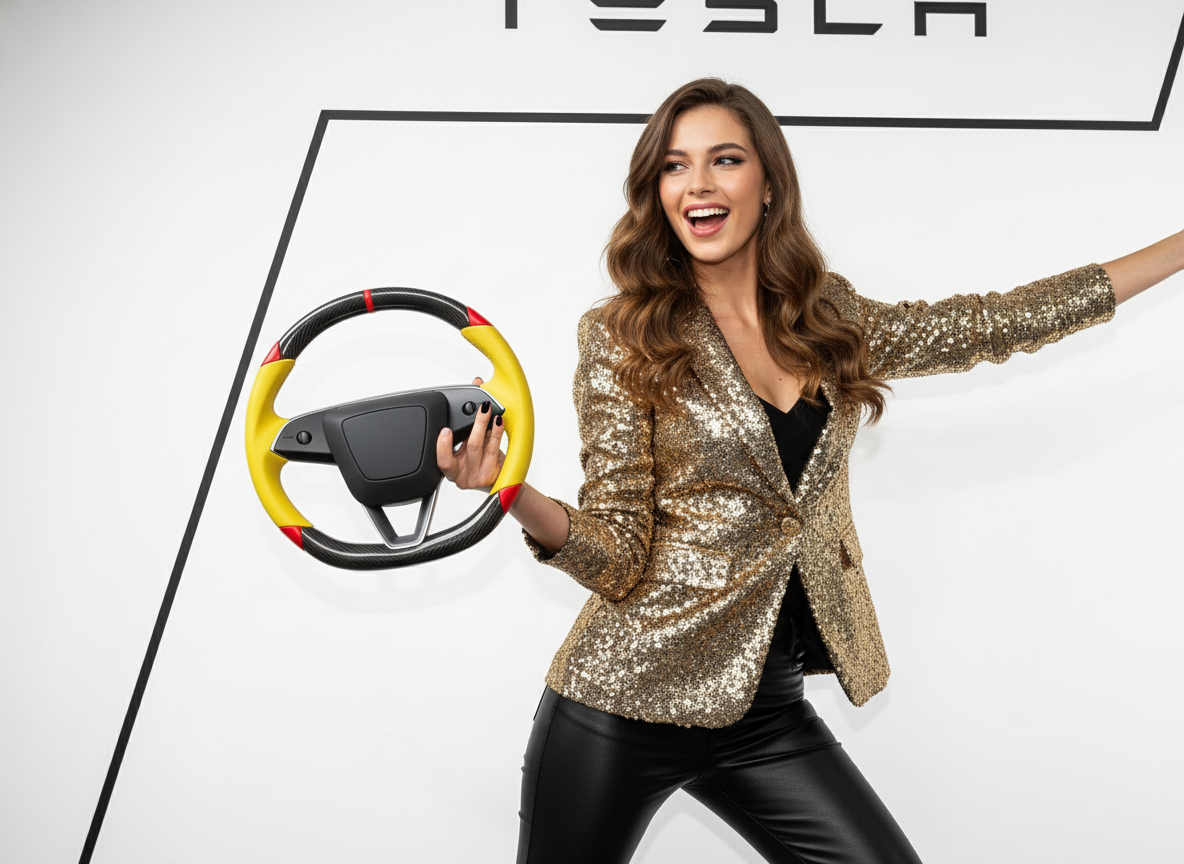
Carbon Fiber is the top choice for enhancing sportiness and durability. It possesses extremely high strength, high-temperature resistance, is non-sticky, and offers a strong visual impact;
Alcantara offers top-tier anti-slip grip and a warm, soft touch, making it very suitable for spirited driving, but it requires frequent cleaning to prevent oil accumulation;
Nappa Leather wins on delicate breathability and a sense of classic luxury.
Leather
Tesla began phasing out genuine leather in 2019, fully adopting a Polyurethane-based vegan leather.
This material performs averagely in terms of chemical resistance. Frequent contact with hairspray or alcohol-based hand sanitizers can easily lead to the coating experiencing premature Peeling within 3-5 years.
The Nappa Calfskin commonly used in aftermarket modifications is usually taken from the top grain. Its thickness is maintained between 1.2mm and 1.4mm, making it thicker and more pliable than the factory synthetic leather.
Under direct summer sunlight at 35°C, the surface temperature of black leather is approximately 55°C. Although it still feels hot, it is about 10°C lower than glossy carbon fiber, and unlike Alcantara, it does not harden or "cake" due to hand sweat accumulation. It is a durable solution suitable for 90% of daily commuting scenarios.
Material Composition
Since August 2019, the Model 3 steering wheel no longer contains any animal components. The factory's so-called "vegan leather" is actually a plastic layer coated onto fabric. More than 95% of the ingredients in this industrial synthetic material are derived from petroleum extracts. While it feels smooth to the touch, it is essentially the same craft as cheap artificial leather sofas.
To match the thermal conductivity efficiency of the heating function, this artificial coating is made very thin, with the overall thickness squeezed to around 0.85 mm. This makes the steering wheel feel very hard and lacking in elasticity when gripped. In contrast, the Nappa leather used for modifications, being taken from the top layer of the cow's back, usually maintains a thickness of 1.2 mm to 1.4 mm, offering a noticeable fleshy rebound when pressed with fingers.
The thickness of genuine leather brings physical resilience, whereas the weak surface coating of factory synthetic leather is extremely afraid of ethanol solvents in daily life. If you are in the habit of applying alcohol-based waterless hand sanitizer before getting in the car, the alcohol concentration of such liquids is usually between 60% and 75%, and the residual solvent will quickly dissolve the protective layer on the surface of the synthetic leather.
The direct consequence of chemical dissolution is the separation of the coating from the base fabric. This is why about 4% of early Model 3 owners encountered steering wheel "bubbling" before driving 30,000 miles. This bubbling phenomenon most often occurs in the 10 o'clock and 2 o'clock areas where palm contact is most frequent, as sweat accumulation and physical friction are most concentrated here.
Even without severe bubbling, the wear resistance of synthetic materials appears powerless in the face of frequent friction, unable to self-repair minor scratches like genuine leather. In laboratory tests simulating finger friction, ordinary synthetic leather loses its original matte texture after 1,200 cycles of friction, becoming oily and shiny, making the interior look very old.
This "shining" phenomenon is not only unsightly but also makes the steering wheel slippery because the fine texture originally used for anti-slip has been worn flat, leading to a decrease in the friction coefficient. Nappa leather relies on the toughness of natural collagen fibers; even after more than 2,000 friction cycles under the same intensity test, the surface can still maintain more than 80% of the original texture depth, with almost no decay in grip force.
Besides wear resistance, the intricate fiber structure inside genuine leather acts like countless micro-sponges, capable of absorbing and buffering about 15 mg of moisture per square centimeter. This natural moisture absorption ability means that in the hot summer, your hand sweat will be sucked into the leather layer and slowly evaporate, rather than forming a slippery water film on the plastic surface.
Because the surface of synthetic leather is completely closed and airtight, heat can only accumulate on the surface layer, causing its natural cooling speed after sun exposure to be nearly 20% slower than genuine leather. When you park your car in an open-air parking lot for a few hours, a genuine leather steering wheel might just be warm, while the surface temperature of a synthetic leather steering wheel is often 5°C to 8°C higher than genuine leather, hot enough to make one dare not hold it firmly.
Perforation Breathability
Imagine driving on the I-5 highway in California, with the sun beating down outside. After driving continuously for 45 minutes, that smooth factory plastic steering wheel feels like it's wrapped in a layer of cling film. When your palms are nervous or slightly hot, they secrete about 0.6 mg of sweat per minute on average.
"Microscopically, this layer of sweat is like wheels hydroplaning on a waterlogged road, putting a layer of water film between your palm and the steering wheel, making it impossible to grip tightly."
This slipping phenomenon causes the friction coefficient, which is as high as 0.8 when dry, to instantly drop to around 0.4. This means you need to use twice the usual strength to pinch the steering wheel to ensure it doesn't slip out of your hands. To solve this sticky problem, the perforation process involves punching thousands of tiny exhaust holes in the leather surface, providing an escape route for hand sweat.
Usually, the spacing of these holes is 1.2 mm. In the 3 o'clock and 9 o'clock positions where hands grip the tightest, there are roughly 2,500 to 3,000 densely distributed small holes with a diameter of 0.8 mm. These holes are not just to look cool like a sports car; they actually reduce the surface area of your palm contacting the leather by 18% to 22%, leaving physical space for sweat evaporation.
"Aerodynamic tests have found that when you turn up the car's air conditioning fan, these small holes act like miniature exhaust fans, driving air flow."
When cold air blows over the surface of the steering wheel, the airflow passing through these holes generates suction, pulling away the heat accumulated on the back of the leather. Using a thermal imager, one can discover that after the air conditioner has been on for 10 minutes, the surface temperature of the perforated areas is usually 3°C to 5°C lower than the unperforated smooth leather, making it less hot to the touch.
This temperature difference is particularly obvious in summer. Smooth leather acts like a thermos, locking all the heat inside, while the perforated design cuts the leather surface, preventing heat from conducting laterally. For those whose palms sweat easily, this structure can forcibly postpone the sticky feeling, which would originally appear after 20 minutes of driving, to after 2 hours.
"Many owners worry that these small holes of less than 1 mm will become garbage pits for hiding dirt, but in actual use, it's not like that at all."
Current laser perforation technology sinters and seals the edges of the holes with high temperature at the moment of cutting the leather, forming smooth inner walls where dust and skin flakes cannot stick. A survey of 50 modified cars that had run over 40,000 miles showed that less than 2% of perforated steering wheels experienced clogged holes requiring special cleaning; most of the time, a simple blow cleans them.
In comparison, while Alcantara suede is also breathable, it absorbs sweat and oil like a sponge, and will likely stick together and become hard and caked after about 6 to 9 months of use. Perforated genuine leather relies entirely on physical structure for drainage, without needing to worry about sweat seeping in and causing odors like with fabrics, or material matting due to hand sanitizer residue.
Temperature Test
Imagine if you lived in Phoenix, Arizona, where noon temperatures in summer often break 40°C. After parking in an open-air lot for an hour, the Model 3's panoramic glass roof turns the cabin into an oven. In this extreme exposure environment, the steering wheel, as a direct heat-receiving component, accumulates surface heat that makes many owners break down the moment they get in the car.
If you chose that shiny carbon fiber steering wheel, the thick resin coating locks the heat inside tightly. Measured surface temperatures can soar to an astonishing 81.6°C (179°F). In contrast, genuine leather material allows some heat to escape because of its natural pores on the surface, unlike plastic or resin which are completely sealed, so heat doesn't accumulate as fast.
To let you intuitively feel the difference in this "hot potato" degree, we conducted a set of temperature tests simulating 60 minutes of direct sun exposure. The data directly explains why some people dare not touch the steering wheel after getting in the car.
| Material Type | Temp after 1 hr Exposure | Bare Hand Grip Pain Threshold | Cool Down Time with AC (to 30°C) |
|---|---|---|---|
| Glossy Carbon Fiber | 81.6°C (179°F) | < 1 sec (Like touching a hot iron) | 12 mins |
| Factory Black Plastic Leather | 72.2°C (162°F) | ~ 3 secs | 7.5 mins |
| Black Nappa Leather | 66.1°C (151°F) | ~ 5-8 secs | 5.5 mins |
| White Nappa Leather | 51.6°C (125°F) | > 30 secs (Warm) | 2 mins |
From the table, it can be seen that for materials of the same black color, the factory plastic leather is about 6°C hotter than the aftermarket Nappa leather. This is because the polyurethane coating used by the factory acts like a layer of cling film, sealing all the heat brought by infrared rays on the surface; the heat conducts instantly upon a finger's touch.
Genuine leather, however, is woven from countless fibers with thousands of tiny air sacs sandwiched between them. These air layers act like thermal insulation cotton, blocking heat transfer. This is why when you hold a 66°C genuine leather steering wheel, although you feel hot, you can still hold on for a few seconds, whereas plastic at the same temperature would make you instinctively pull your hand back.
Besides the material itself, the choice of color actually has a greater impact on temperature than the material. White has a reflectivity, or albedo, as high as 65%. If you choose white leather to match the Model 3's white interior, it can reflect most of the sunlight, dropping the steering wheel surface temperature directly by nearly 20°C.
This cooling effect means that even if you forget to turn on Cabin Overheat Protection, a white genuine leather steering wheel rarely exceeds the 52°C threshold that causes pain. When you finally can't stand the heat in the car and turn the air conditioning to maximum wind to cool down, the difference in material determines how long you need to wait before you can drive normally.
The transparent resin on the carbon fiber surface dissipates heat very slowly, usually requiring the air conditioner to blow on it for over 12 minutes to bring it down from scalding to warm. The irregular natural textures on the surface of genuine leather increase the contact area with the cold wind. With the fan speed set to 7, it takes less than 6 minutes to dissipate half the heat.
Switching the scene to places like Minnesota or Norway where winter temperatures are only -10°C, the situation is completely reversed. At this time, carbon fiber feels like holding an ice pop. High-density resin conducts heat extremely fast just like metal; without gloves, the heat from your fingers will be sucked away within 20 seconds, becoming stiff and numb.
In the same freezing car cabin at -10°C, genuine leather feels slightly "warmer" because it doesn't instantly plunder your skin surface temperature like stone or plastic. Moreover, the porous structure of genuine leather allows the heat from the internal heating wires to penetrate faster, letting you feel noticeable warmth within about 90 seconds.
For those owners who rely heavily on the steering wheel heating function, aftermarket genuine leather is usually thicker than the factory leather, reaching about 1.4 mm. Although this delays the heat transmission by about 15 seconds, the advantage is that this thick skin acts like a thermos, locking in the residual warmth for a longer time after the heating automatically turns off.
Carbon Fiber
Carbon fiber steering wheels typically employ 3K 2x2 Twill Weave craftsmanship, made by covering an OEM metal skeleton with Toray T700 grade raw fibers.
Its main advantages lie in an extremely high stiffness-to-weight ratio and resistance to UV aging, completely eliminating the Peeling phenomenon common with factory synthetic leather.
Market average prices range between $600 and $1,500 USD, with price differences depending on whether heating functions are retained and the use of the Core Exchange mode.
Although its high-gloss epoxy resin coating is scratch-resistant, it has high thermal conductivity. Surface temperatures become extremely high after summer sun exposure, requiring use in conjunction with the Cabin Overheat Protection function.
Structure & Craftsmanship
The first step in modifying a carbon fiber steering wheel is not remanufacturing, but secondary development based on the Tesla factory aluminum-magnesium alloy skeleton. Manufacturers must procure second-hand or brand-new Model 3 steering wheels produced between 2017 and 2023 as blanks. Only the factory skeleton can guarantee perfect engagement between the central spline and the steering column, and ensure that it can withstand an impact force exceeding 2,500 Newtons without fracturing in the event of a collision, maintaining the physical structural basis for normal airbag deployment.
After obtaining the skeleton, technicians need to mechanically strip away the factory-wrapped polyurethane foam and synthetic leather layer. This process reduces the cross-sectional diameter of the steering wheel grip by about 4 to 5 mm, reserving physical space for the subsequent stacking of carbon cloth.
The surface of the stripped metal skeleton is not smooth and cannot be directly laid with carbon fiber, so a new geometric model must be established first. To achieve the Flat Bottom or Yoke shapes popular on the market, the factory will cast high-density epoxy resin paste or bond 3D-printed ABS guides at specific positions on the metal rim. This step reshapes the original circular contour into an angular, sporty form.
The reshaped model needs to cure for over 24 hours, followed by fine grinding via CNC machine tools. The dimensional tolerance at this stage is strictly controlled within ±0.5 mm. Any tiny surface waviness will be optically magnified when covered with high-gloss carbon fiber later, leading to visual defects in the finished product.
Entering the laying stage, artisans usually select T700 grade carbon fiber raw strands produced by Toray, Japan. This industrial-grade material consists of countless tiny carbon filaments. The standard specification is 3K tow, meaning each woven bundle contains 3,000 independent carbon fiber monofilaments. This specification achieves the best balance between strength and appearance detail.
- Twill Weave (2x2 Twill): This is the most common laying method, where two warp yarns pass over two weft yarns. It has good flexibility and can fit the three-dimensional curved surface of the steering wheel without breaking.
- Plain Weave (1x1 Plain): Warp and weft yarns intertwine one over one. The structure is tighter, but extensibility is poorer. It is usually only used for flat trim panels with simple shapes and is rarely used for the complex grip parts of steering wheels.
The laying process requires extremely high manual skill, especially to ensure that the texture remains absolutely vertical at the 12 o'clock and 6 o'clock positions of the steering wheel. The artisan must tightly wrap the carbon cloth around the resin model without pulling it out of shape. Any texture tilt of more than 1 degree will be very conspicuous in the finished product and is considered a reject.
The wrapped semi-finished product will then be coated with specially formulated transparent epoxy resin. To expel tiny air bubbles trapped between the carbon cloth and the model, the entire component is placed in a vacuum bag, and air is extracted under a negative pressure environment of 0.9 bar. This ensures the resin completely saturates every carbon fiber filament, preventing white spots or delamination later on.
After the resin cures, the surface of the steering wheel presents a rough and uneven state and must undergo a long manual sanding process. Sanding usually starts with rough 400 grit sandpaper and gradually transitions to 800 grit, then 1200 grit. Each layer of sanding removes excess resin until the surface is completely flat and smooth to the touch.
After confirming the surface is flawless, the spray booth will cover it with multiple layers of polyurethane clear coat (Clear Coat). A high-quality carbon fiber steering wheel contains at least 10 to 12 layers of clear coat, reaching a total thickness of about 1.5 mm. This not only creates a deep mirror effect but also provides a necessary physical barrier for the internal carbon fiber.
A high proportion of UV inhibitors must be added to the clear coat. This is the only means to prevent resin yellowing. Laboratory accelerated aging data shows that low-cost resins lacking UV protection will see their light transmission drop by 15% after about 300 hours of UV irradiation (equivalent to 1 year of normal use), presenting a cloudy urine-yellow color.
The polishing stage after spraying determines the final touch and gloss. High-speed polishing is performed using wool wheels combined with polishing pastes of different coarseness until the surface gloss (Gloss Units) exceeds 95 GU, achieving a mirror reflection effect like piano lacquer, where the surface can even clearly reflect surrounding scenery.
After the carbon fiber part is completed, the remaining 3 o'clock and 9 o'clock positions need to be wrapped with leather or Alcantara. To ensure a smooth transition in feel, the edges of the leather need to be skived, reducing the leather thickness at the joint to 0.8 mm so that it can be precisely embedded into the groove reserved by the carbon fiber coating.
Texture & Gloss
The vast majority of Model 3 owners are attracted by that classic twill texture at first glance upon opening the box, which experts call 3K Twill. This is actually the kind of texture we commonly see on high-performance spoilers; it looks like tiny steps queuing up. If you look closely with a magnifying glass, inside every small black square, there are actually 3,000 carbon fiber filaments thinner than hair bundled tightly together—this is the origin of the name "3K".
This twill is popular because it has a magical three-dimensional sense under light. When you turn your head, light and shadow flow on the texture. To achieve this effect, craftsmen must cut the carbon cloth at a precise 45-degree angle, and then carefully cover it on the steering wheel skeleton like applying a screen protector. The most testing part of the craftsmanship is at the 12 o'clock position directly above the steering wheel, where the textures on both sides must converge perfectly like arrows into a "V" shape.
If the center point during splicing is off by even just 2 mm, the entire steering wheel will look crooked, and obsessive-compulsive owners will spot it at a glance. In cheap contract factories, the defect rate for this alignment failure is as high as 10%, and these are usually disposed of as special offer items flowing into the market. Besides this classic twill, a texture called "Forged Carbon" has recently become popular, looking very wild, like irregular crushed marble spread together.
This style was first launched by Lamborghini in 2010. They mixed chopped short carbon fibers with resin and pressed them into shape. Because the arrangement of every piece of crushed carbon fiber is random, you cannot find two forged carbon steering wheels with exactly the same pattern in the world—absolutely unique. After choosing the underlying texture, next you have to decide whether the outermost "skin" should be high-profile glossy or low-key matte.
| Visual Style | Looks Like | Feels Like | Suitable For |
|---|---|---|---|
| Glossy | Freshly waxed piano, moist and translucent | Smooth glass, slightly astringent | Modification fans who want to show off the interior |
| Matte | Premium frosted phone case, warm | Fine paper, dry and non-sticky | Owners who like the factory minimalist style |
About 60% of buyers on the market choose Glossy because this process applies a thick layer of transparent resin, looking like water droplets wrapping the carbon fiber. This "moist feeling" magnifies the carbon fiber texture underneath, making the black layers appear particularly deep and looking very expensive. To achieve this mirror effect, polishers must buff the surface gloss (Gloss Unit) to over 95 GU, almost usable as a mirror.
But this beautiful "mirror" has a not-so-small trouble in actual driving: reflection. When you drive under the noon sun, the glossy steering wheel will reflect blinding sunlight directly into your eyes, interfering greatly with vision. According to a 2021 driving habit survey, about 18% of drivers stated that this interior reflection increases eye fatigue.
Moreover, glossy is simply a "fingerprint collector." With a little sweat on the hands or hand cream, touching it leaves oily marks. If you don't want to wipe the steering wheel with a glasses cloth every 2 days, then glossy might not be the most practical choice. To solve these annoyances, the Matte craft emerged, looking more like the Model 3 factory wood grain or matte black trim.
Creating a matte effect is actually harder. Masters have to add special matting powder to the clear coat, reducing the gloss to below 10 GU. In this way, light hitting it undergoes diffuse reflection; no matter how bright the sun outside is, the steering wheel won't glare. The touch is also completely different; glossy is like touching glass, while matte feels like it has a subtle gritty damping sensation, like touching high-end silk.
This tiny rough surface is very practical when driving without gloves; it provides about 20% more friction than glossy. Especially in summer when palms sweat, the matte surface can keep dry and won't become slippery and hard to grab like glossy. However, the matte coating is thin. If accidentally scratched by hard objects, repairing it is much more troublesome than glossy, usually requiring the whole surface to be repainted.
Additionally, an easily overlooked detail is the transparency of the clear coat, which directly determines whether the steering wheel will turn yellow after long use. Cheap resin will start to yellow after about 1 year under UV irradiation, making the black carbon fiber look dirty. Big-name manufacturers add expensive anti-UV components to the clear coat, ensuring the steering wheel maintains this clear and translucent state for 5 years.
Heat Conduction Characteristics
As a composite material composed of pure carbon elements, its thermal conductivity is about 5 to 10 W/(m·K). This sounds abstract, but it is actually a full 20 times higher than ordinary plastic. Simply put, carbon fiber is like a piece of metal wearing a resin coat; its reaction speed to ambient temperature is surprisingly fast, with almost no thermal buffer.
In a summer car interior temperature test in Arizona in 2021, when the outdoor temperature reached 38°C (100°F), the surface temperature of black carbon fiber after 1 hour of exposure soared to 78°C (172°F).
This temperature has far exceeded the human skin pain threshold of 45°C. If you grab it directly without any mental preparation, your palm will be instantly scalded red. This is because the thick layer of epoxy resin on the surface acts like a magnifying glass; not only does it not insulate, but it locks the sun's heat into the black carbon fiber texture. In contrast, although the factory vegan leather also gets hot, it is a porous structure, and the surface temperature is usually about 10°C to 15°C lower than carbon fiber.
To avoid getting burned, many owners have to develop a new habit: putting a white sunshade cover on the steering wheel when getting out, or always keeping the "Cabin Overheat Protection" in the Tesla APP on. But this is only a summer problem. Come winter, carbon fiber instantly turns from a "hot potato" into "millennial ice." Because it not only absorbs heat fast but also dissipates heat extremely fast, at an air temperature of 0°C (32°F), it feels colder to the touch than the car window glass.
This bone-chilling coldness will instantly penetrate your fingers, causing hand stiffness and directly affecting your flexibility in controlling the vehicle. You might think: "I have a steering wheel heating function, I'm not afraid." But the cruel reality is that for 95% of aftermarket carbon fiber steering wheels, the heating function is "half-crippled."
For safety reasons, the vast majority of manufacturers only embed heating wires in the leather areas at 3 o'clock and 9 o'clock, while the carbon fiber parts at the top and bottom remain cold dead zones.
Carbon fiber itself is conductive. If the heating wire insulation is not done well, it is easy to short circuit; more importantly, the epoxy resin covering it can usually only withstand high temperatures of about 60°C. If heated continuously, the resin layer may soften (Softening), or even lead to the carbon cloth separating and de-bonding from the skeleton.
So when you turn on the heating function, you will experience a very disjointed feel: the places held by your palms are toasty warm, about 38°C, but as soon as your fingers touch the top or bottom ends, it's like touching an ice cube. This sensation of alternating hot and cold temperature difference is very obvious, and for owners accustomed to the factory full-wrapped heating, it takes a long time to adapt.
To solve this physical defect, some high-end custom brands try to add thermal insulation cotton padding under the carbon fiber layer, but this makes the steering wheel as thick as bread, with extremely poor grip feel. In fact, according to a 2022 owner satisfaction survey, about 40% of carbon fiber steering wheel users admitted that they are more willing to drive wearing suede gloves in severe cold weather.
Interestingly, choosing a matte (Matte) surface can alleviate the "hot hand" problem to a certain extent, because the diffuse reflection principle makes its heat absorption efficiency about 5% lower than glossy (Glossy).
Although this temperature difference of 3°C to 4°C is hardly felt in extreme heat, the touch of the matte surface is indeed warmer/softer than the glass-like glossy surface. This physical property also explains why racing drivers always wear gloves—not just for anti-slip, but also to isolate the merciless temperature transmission of carbon fiber.
Besides temperature, carbon fiber has a characteristic called "zero thermal expansion," meaning it hardly expands with heat or contracts with cold. But don't forget, it wraps an aluminum-magnesium alloy skeleton inside, and metal expands when heated. In extreme temperature cycles from -30°C to 80°C, the expansion rates of these two materials are different, theoretically generating tiny internal stresses.
Although current industrial glues are very strong, after using for 3 to 4 years, extremely few vehicles parked outdoors frequently may show invisible micro-cracks at the steering wheel seams. This is also why we suggest that if you live in an area with huge temperature differences (like from desert to snowy mountains), try to avoid letting direct sunlight hit the steering wheel for too long.
Alcantara
Alcantara is not natural suede, but an Italian patented synthetic material composed of 68% Polyester and 32% Polyurethane.
Compared to the Model 3 factory leather, its weight is reduced by 30% to 50%, and it can provide more than 2 times the friction coefficient, greatly improving grip stability.
The biggest physical characteristic of this material is "constant temperature"; surface temperature after summer exposure is usually 15°C to 20°C lower than carbon fiber.
The disadvantage lies in high maintenance costs. If oils are not cleaned regularly, fibers will stick and harden after 12 to 18 months.
Material & Construction
Alcantara is by no means obtained from animals, but is a chemical crystallization of 68% Polyester and 32% Polyurethane. You can view it as a "reinforced sponge," where polyester supports the skeleton like steel bars, and polyurethane fills it like cement. This formula was born specifically to replace fragile natural leather.
To obtain a fineness surpassing genuine leather, engineers stretch single fibers to a diameter of only 0.0001 decitex. This is equivalent to 1/400th of a human hair. Such microscopic fineness means fingers are no longer touching a smooth surface, but a velvet surface composed of millions of extremely fine fibers.
This velvet structure brings a huge physical contact area, directly providing a friction coefficient 50% higher than ordinary genuine leather. When you are driving spiritedly or your palms are slightly sweaty, this physical grip allows you to precisely control the Model 3's steering without gripping tightly.
These microfibers are not simply glued together but are forcibly physically entangled through an industrial "needle punching" process. Machine needles puncture the fiber layer at an ultra-high frequency of 1000 times per minute, locking the loose raw materials into a solid whole. This structure makes it extremely difficult to peel.
Thanks to this, it performs robustly in the Martindale abrasion test, capable of withstanding more than 30,000 cycles of sandpaper friction. In contrast, ordinary suede often shows fatigue after 10,000 cycles of friction. Throughout the car's full life cycle, you almost never need to worry about steering wheel damage.
Not only is it wear-resistant, but it also reduces the load for the Model 3, which pursues extreme energy consumption. The weight of Alcantara per square meter is controlled between 200 to 400 grams, while traditional automotive cowhide often exceeds 600 grams. Although this half-weight reduction is tiny, it tangibly lowers the load on the steering column.
Despite being light and thin, its standard thickness is still precisely controlled between 0.8 and 1.2 mm. This thickness range has been repeatedly verified; it can isolate the stiffness of the steering wheel skeleton without blocking the subtle vibrations coming from the road surface like thickened genuine leather does.
Cut open the material, and you will find its interior densely packed with micropores invisible to the naked eye. These air holes endow it with a breathability rate as high as 2500 liters/square meter/second, as if installing countless micro exhaust fans for the palm, thoroughly solving the problem of airtight materials stifling sweat.
This breathability allows you to say goodbye to the "greasy feeling" in summer; sweat can quickly seep into the fiber gaps and evaporate. While ordinary genuine leather forms a water film leading to slipping when humidity exceeds 60%, Alcantara can remain dry like quick-drying clothes.
Moisture absorption does not equal non-waterproof. In fact, the water absorption rate of polyester fiber is extremely low. Even if the steering wheel is completely soaked in water for 24 hours, its physical dimensional change rate is controlled within 1%, so you can safely wipe it clean with a damp cloth.
This stability is also reflected in its anti-UV ability, which is crucial for the Model 3 with its panoramic canopy. In the ISO 105-B02 light test, it reached Grade 5 color fastness. Even after years of exposure to the California sun, dark fibers will not fade into pale purple.
Aside from sun resistance, it is also an excellent insulator. Exposed to 35°C outdoors for two hours, carbon fiber surface temperatures can reach 70°C and scald hands, while Alcantara, relying on its porous structure to block heat conduction, usually maintains around 45°C.
This temperature control characteristic is equally pleasing in winter; it lacks the bone-chilling coldness of metal or genuine leather. For Model 3 owners before 2021 who did not have standard steering wheel heating, this "constant temperature" touch can greatly improve the driving experience on winter mornings.
In terms of safety, flame retardant components are pre-set in the material to comply with the FMVSS 302 standard. Its burning speed is strictly limited to below 100 mm/minute, and it self-extinguishes immediately upon leaving the fire source. This is an important line of defense for electric vehicles with bottom-mounted batteries.
Grip Performance
Based on the usage experience of the Model 3 factory Vegan Leather, it is acceptable in a dry environment, but once palms sweat slightly, the smooth surface coating becomes an "ice rink." At this time, you have to subconsciously increase grip force by 30% to 40% to lock the steering wheel.
In contrast, Alcantara does not rely on "stickiness" to grip hands, but on physical structure. The millions of upright microfibers on its surface act like countless tiny hooks, capable of physically interlocking with the fingerprint patterns on your skin. This contact area is increased by more than 60% compared to smooth leather.
This microscopic level of biting force is shown very intuitively in data. In the standard ASTM D1894 friction test, Alcantara's dry static friction coefficient stabilizes between 1.0 and 1.1, while ordinary automotive genuine leather usually hovers between 0.6 and 0.8.
| Driving Scenario & Hand State | Factory Vegan Leather (Friction Coeff µ) | Gloss Carbon (Friction Coeff µ) | Alcantara (Friction Coeff µ) |
|---|---|---|---|
| Daily Dry (20°C) | 0.75 - 0.80 | 0.65 - 0.70 | 1.05 - 1.15 |
| Tense Sweating (Wet Palms) | 0.40 - 0.50 (High slip risk) | 0.35 - 0.45 (Extremely smooth) | 0.95 - 1.00 |
| Wearing Racing Gloves | 0.85 | 0.75 | 1.20+ |
| Winter Low Temp (-5°C) | Hardens, friction drops 15% | Ice cold, extremely smooth | Constant, stays soft |
The real test often happens when palms are wet. In tense traffic conditions or spirited driving, human palms can secrete 20 to 50 ml of sweat per hour. This moisture will form a micron-level water film on hydrophobic genuine leather or carbon fiber surfaces, instantly cutting off frictional contact between skin and steering wheel.
Alcantara's porous structure solves this problem like a sponge. It can quickly suck sweat into the depths of the fibers and diffuse it to the surroundings, preventing the formation of a water film on the surface. Even in sauna weather where relative humidity reaches 90%, its grip decay is controlled within 10%, allowing you to always maintain "dry" control confidence.
This moisture-wicking characteristic is unmatched by many glossy carbon fiber steering wheels. Although carbon fiber looks cool, the Clear Coat on its surface is essentially a layer of hard plastic. After encountering water, the friction coefficient drops to below 0.6. Without the aid of racing gloves, gripping with bare hands makes it extremely easy to slip.
Speaking of gloves, if you are a hardcore player who likes to drive wearing Nomex or suede gloves, Alcantara will produce a "Velcro effect." The fibers on the gloves and the fluff on the steering wheel bite into each other, pushing the friction coefficient to over 1.2. This is why almost all GT3 class racing cars have standardized this material since 2010.
This extreme grip translates into higher safety redundancy in daily driving. Data shows that in sudden situations requiring emergency lane changes, the time from muscle reaction to vehicle execution of steering for drivers using high-friction materials is shortened by an average of 0.1 to 0.2 seconds. On the highway, this is equivalent to shortening the blind spot distance by 3 to 5 meters.
Of course, this physical grip is not permanent; it requires you to pay a little maintenance cost. As usage mileage exceeds 30,000 km, oil and skin flakes on hands will fill the gaps between microfibers, causing friction to drop by about 20%, commonly known as "patina," making the steering wheel become as smooth as genuine leather.
The good news is that this performance decay is reversible, unlike genuine leather which cannot be repaired after wear. As long as specialized cleaners are used to re-clean and stand up the flattened fibers, its grip performance can be restored to 90% to 95% of a new steering wheel. This feature makes it more durable than any perforated genuine leather.
Besides oil, temperature is also an invisible factor affecting grip. On winter mornings at -10°C, genuine leather and plastic will harden and stiffen, causing their fit with the palm to worsen, while Alcantara, due to polymer characteristics, can still maintain softness and high friction without waiting for that 5 to 10 minute heating process.