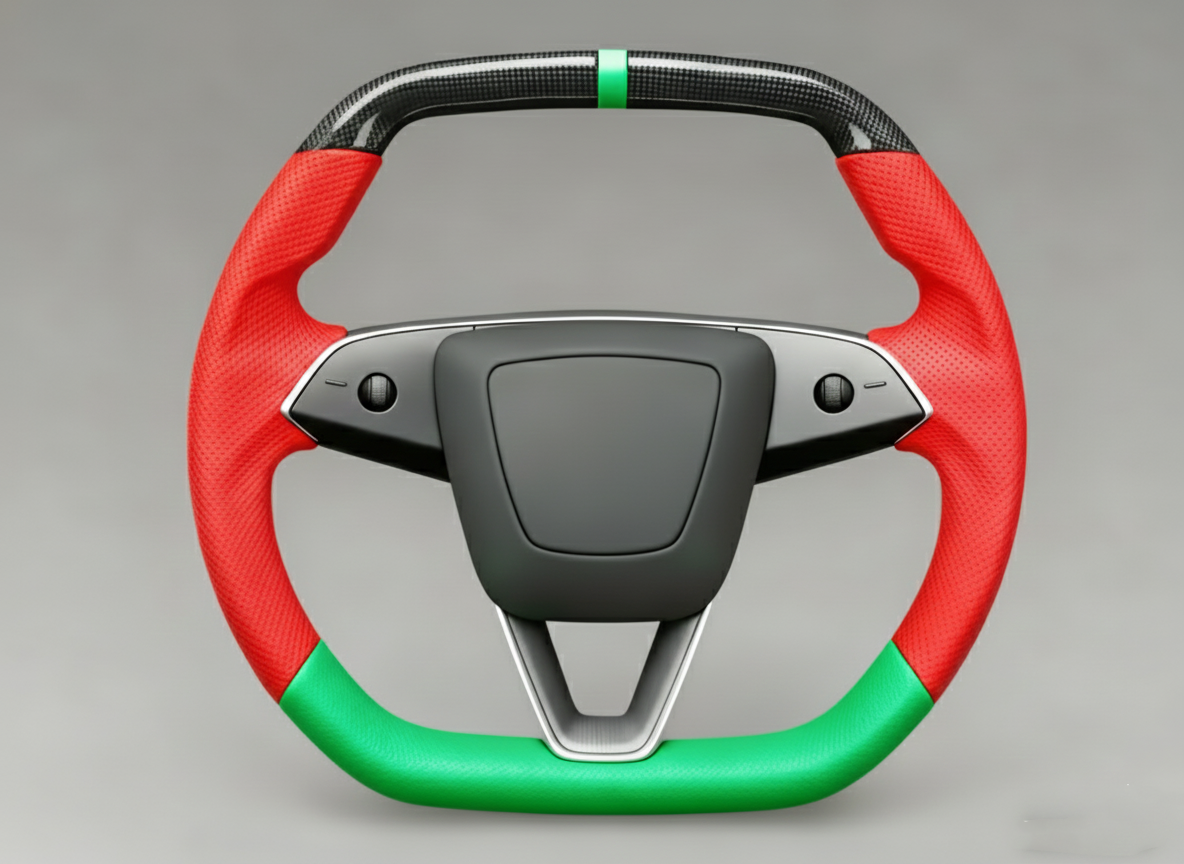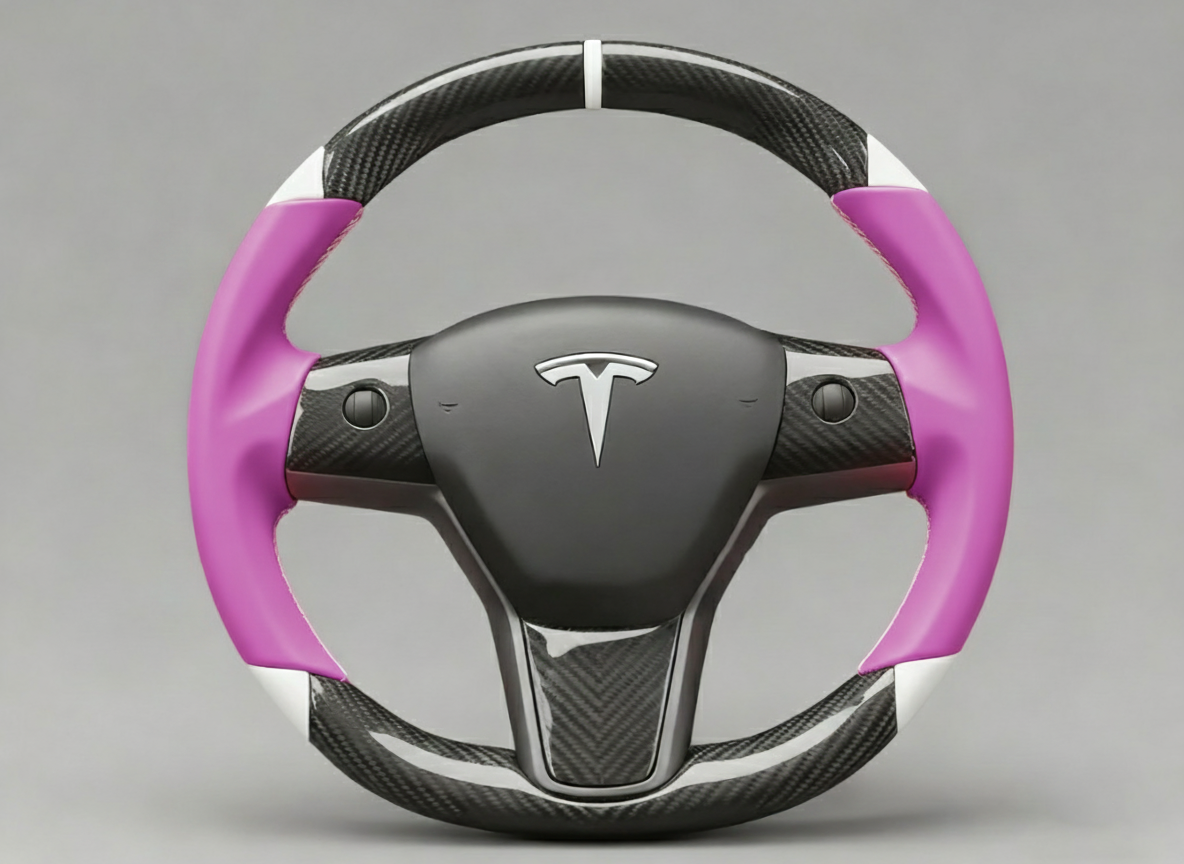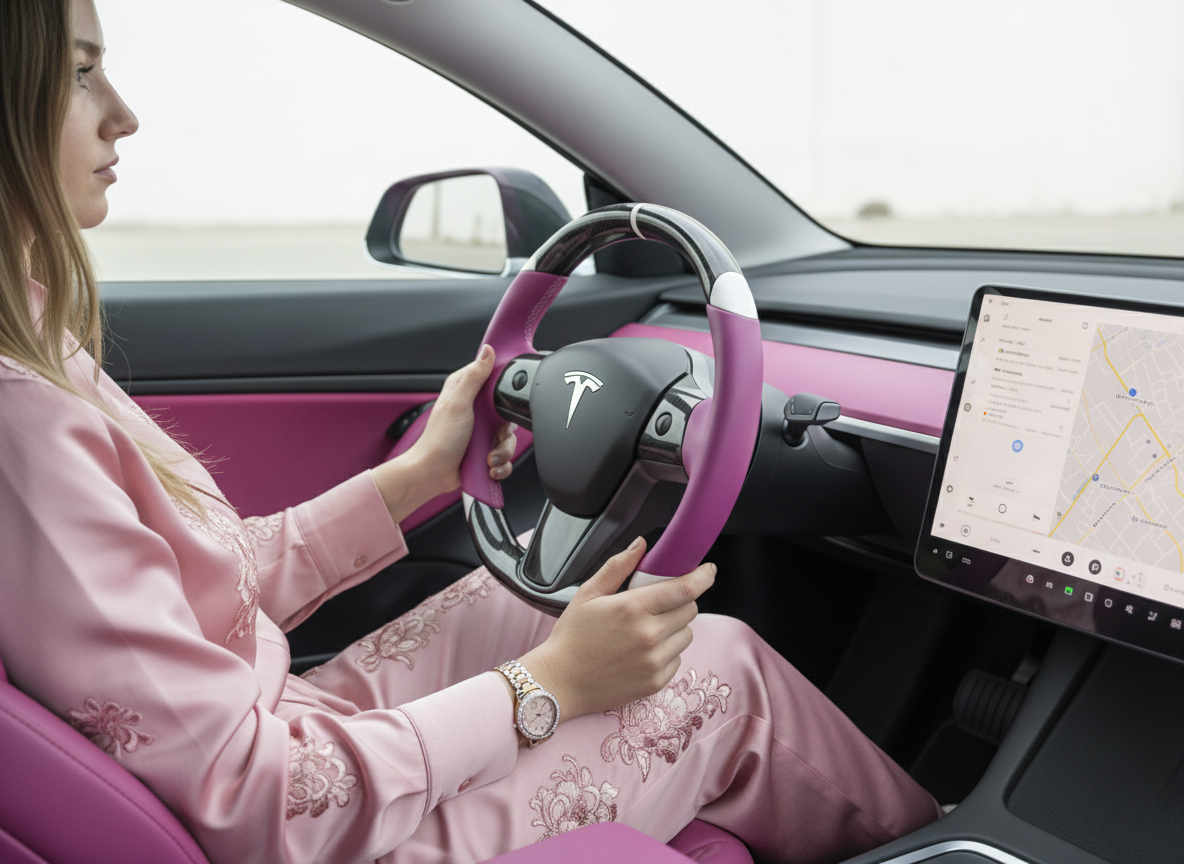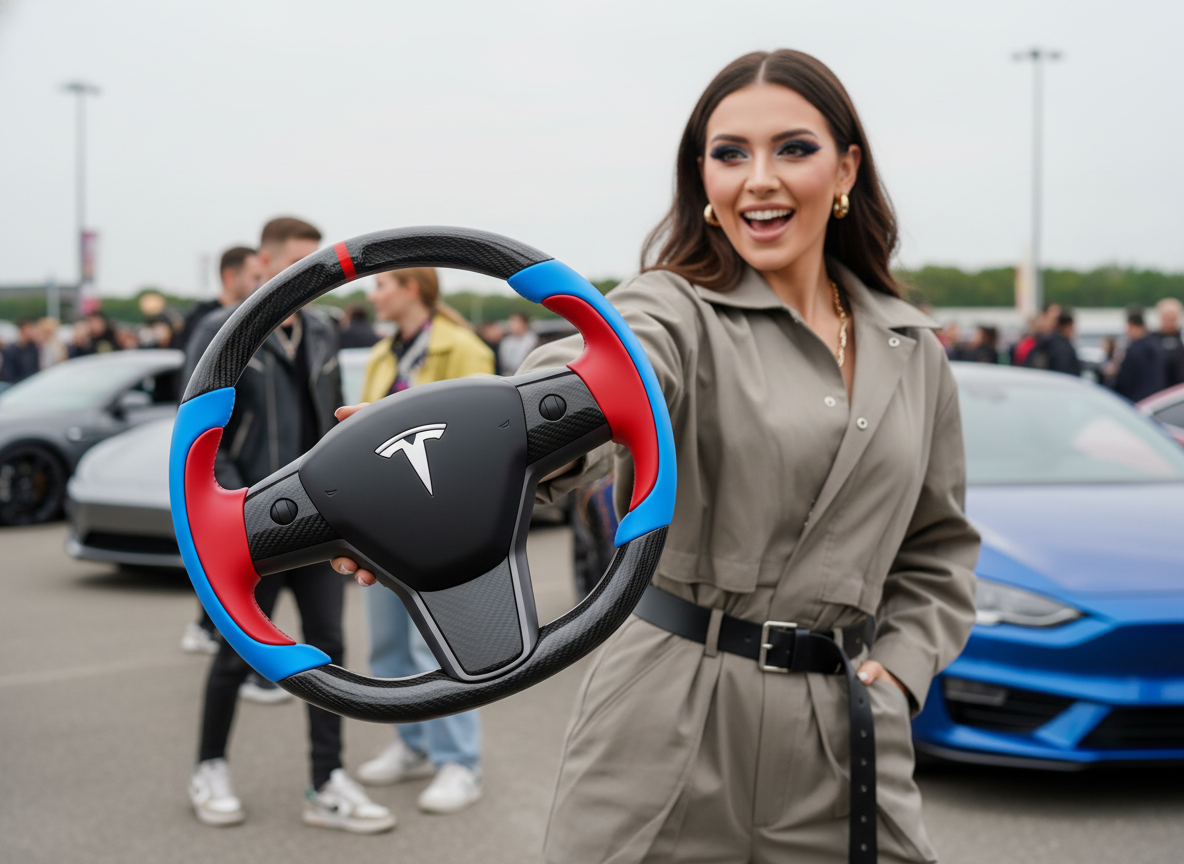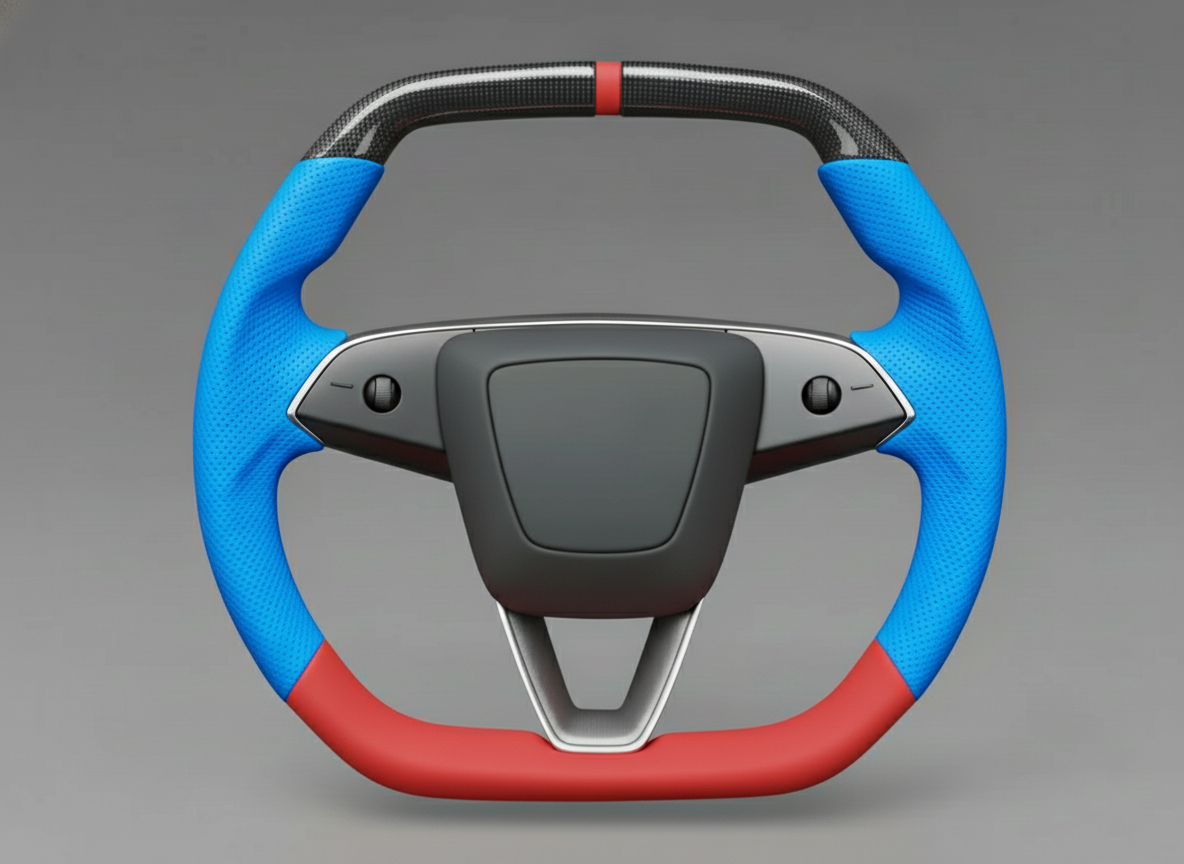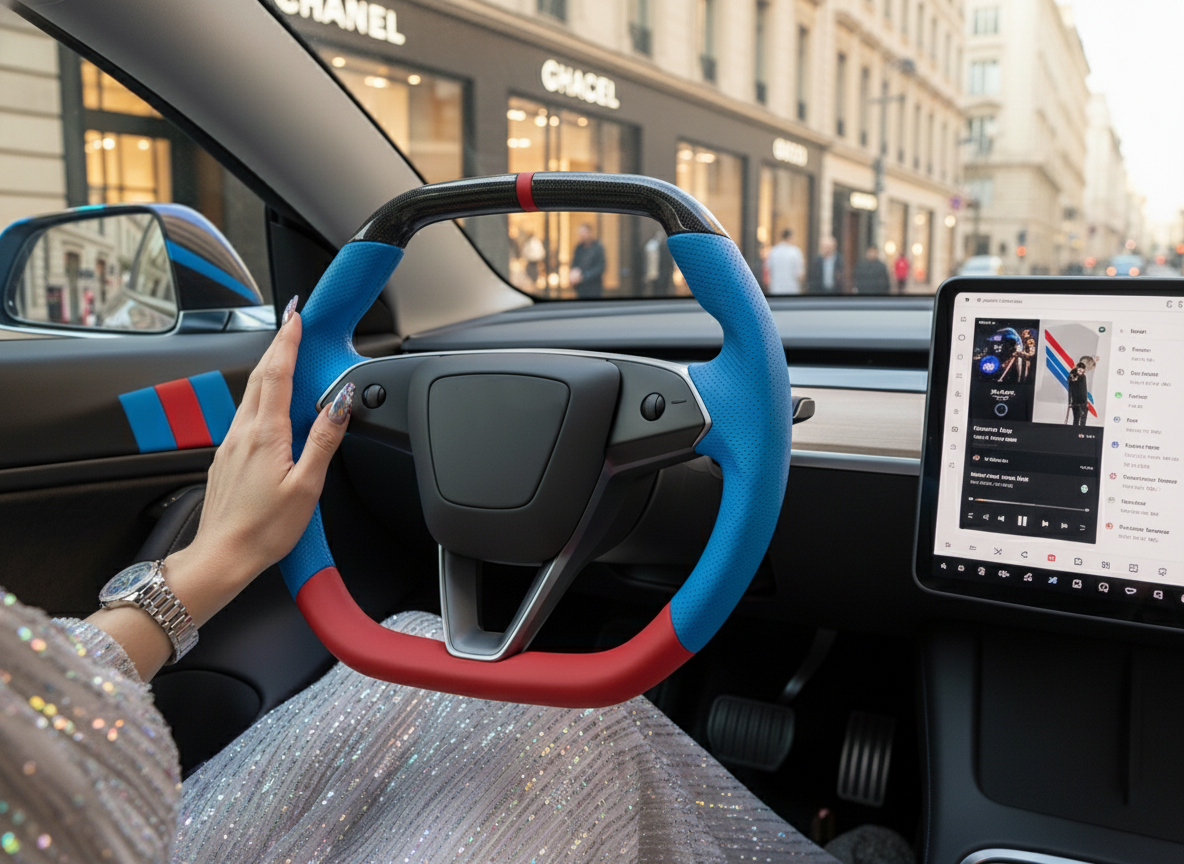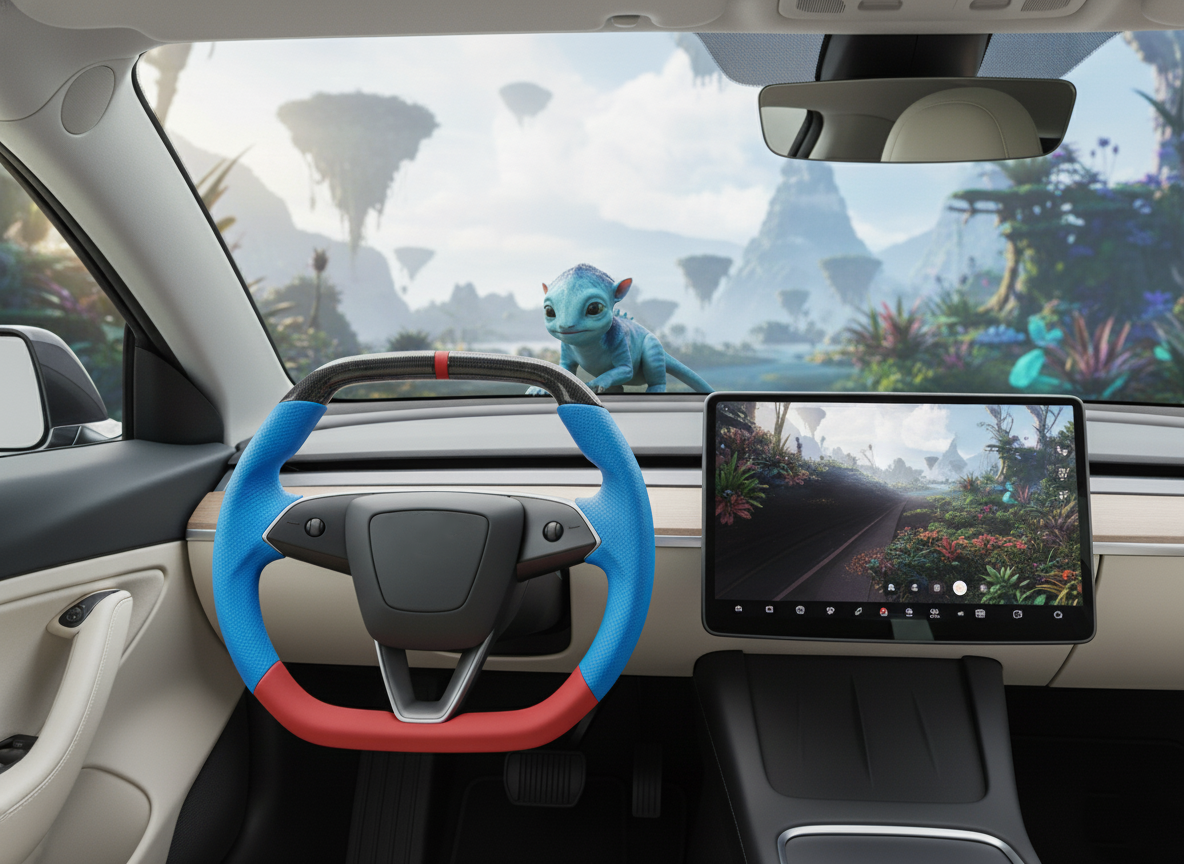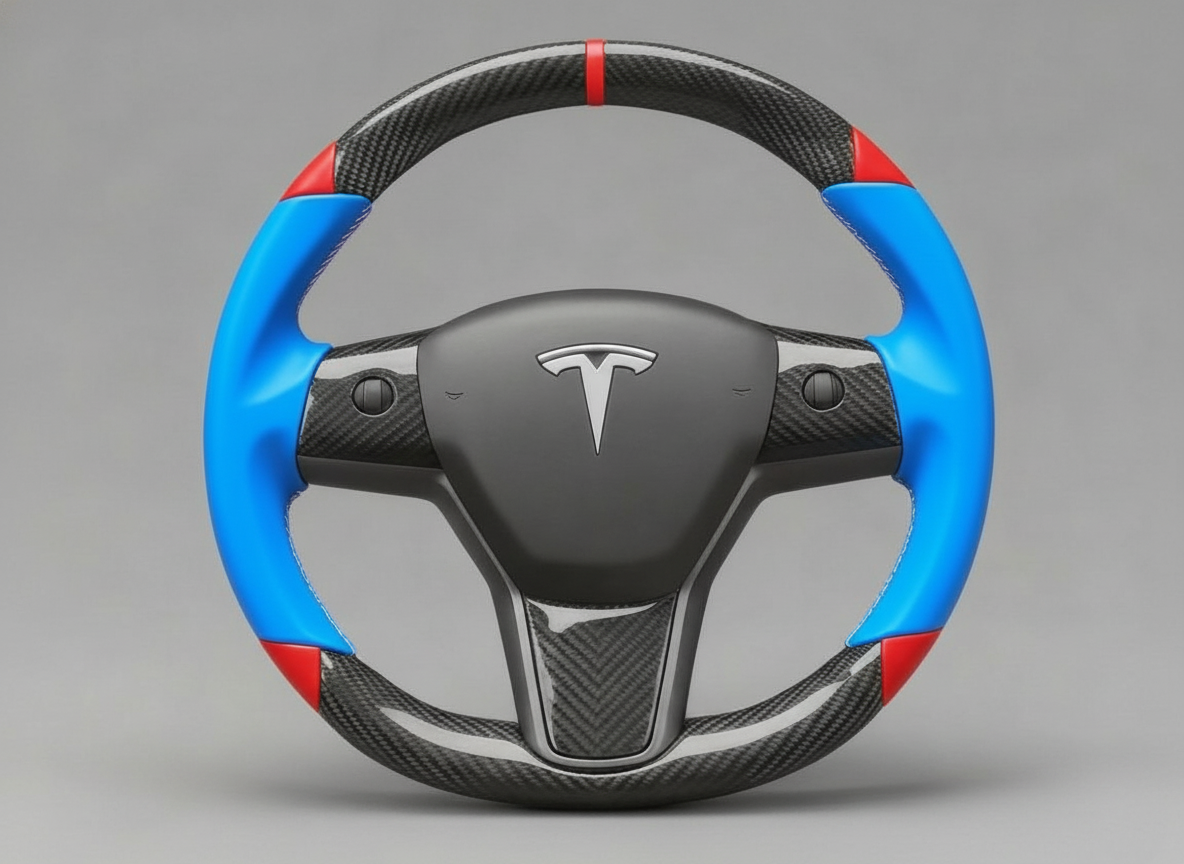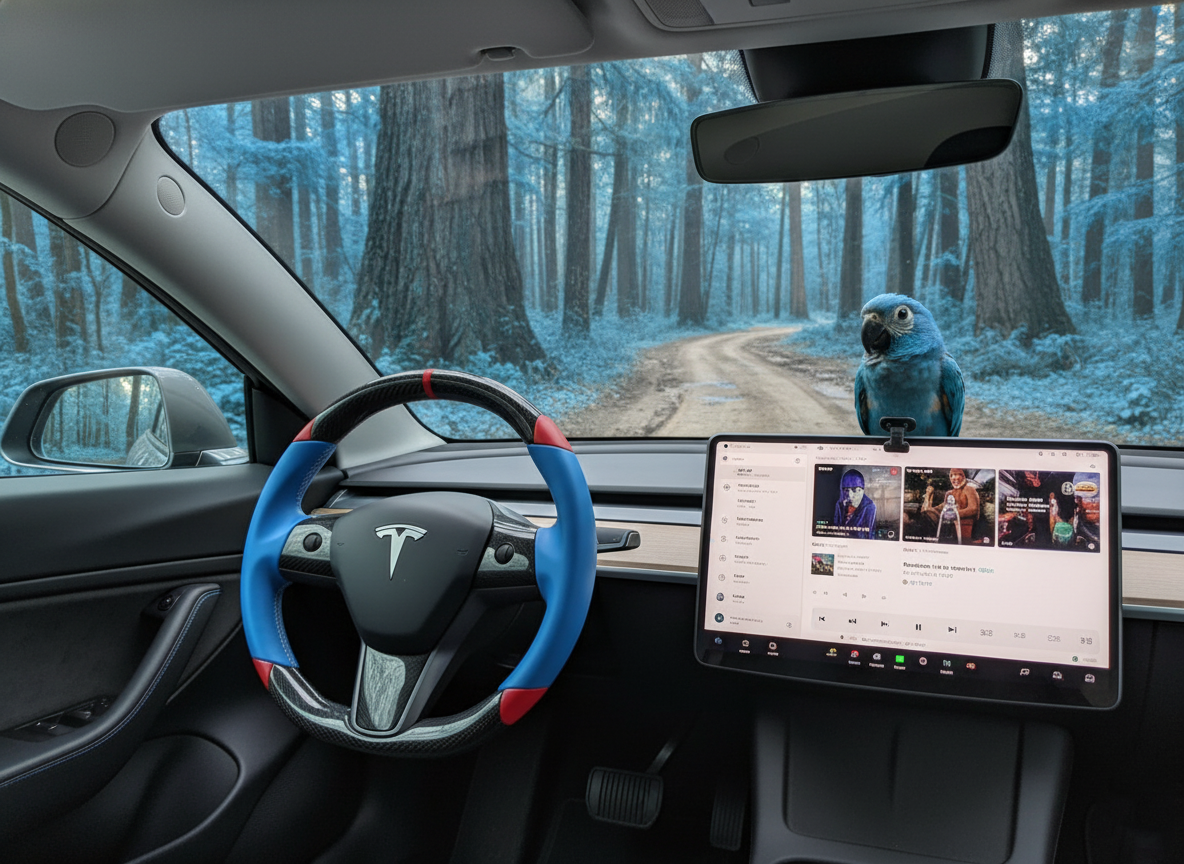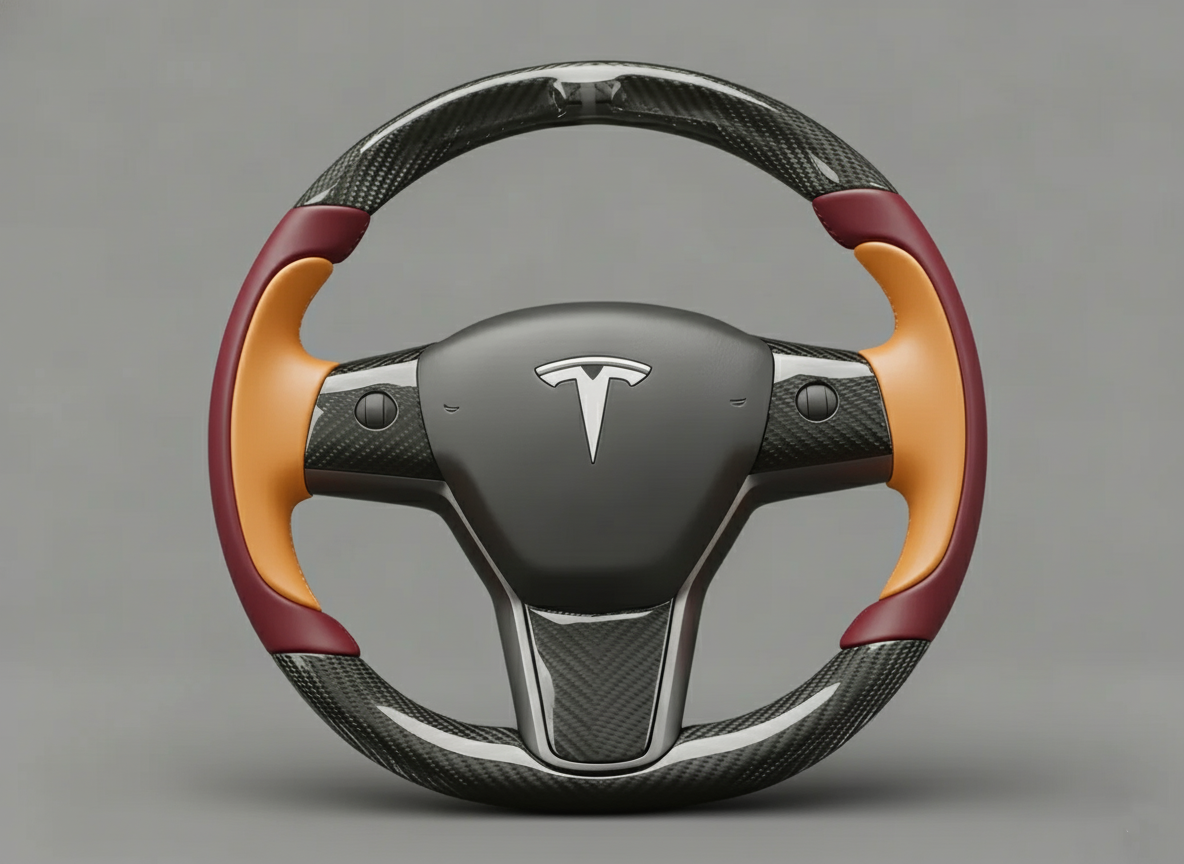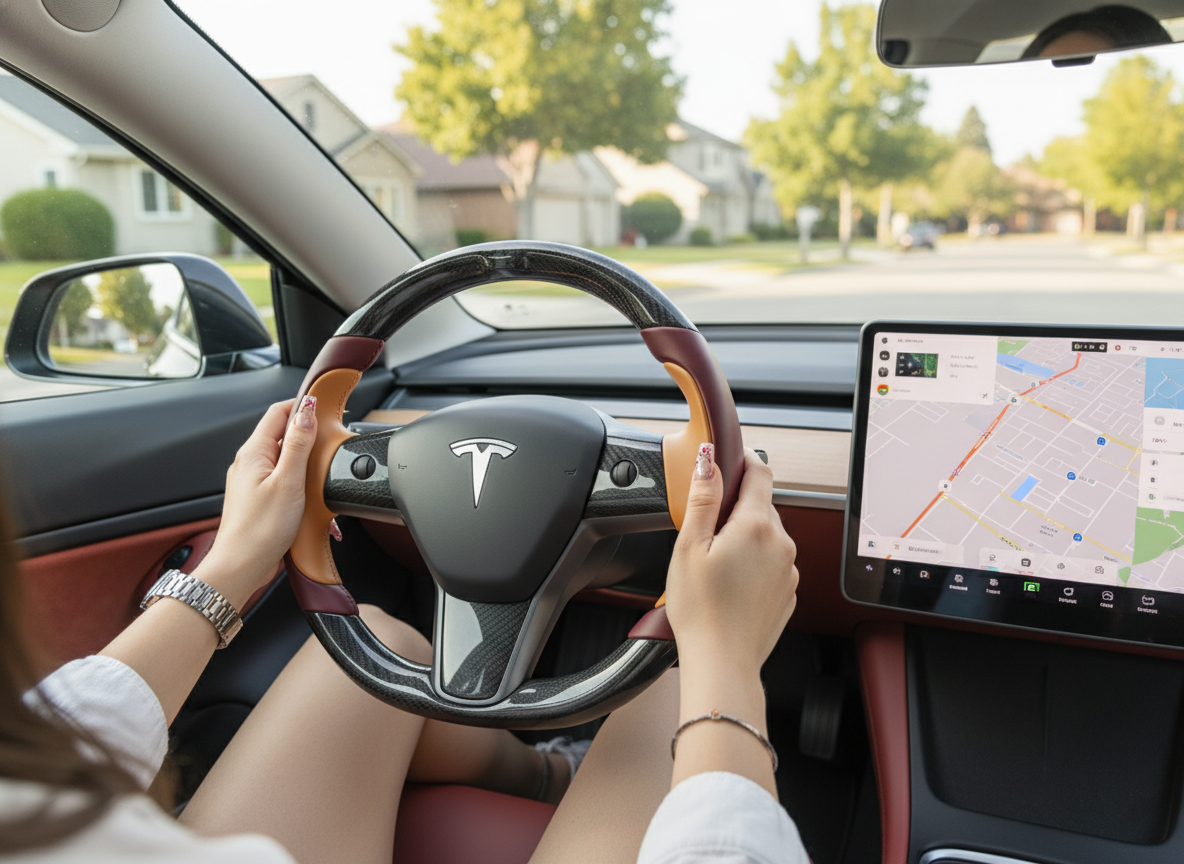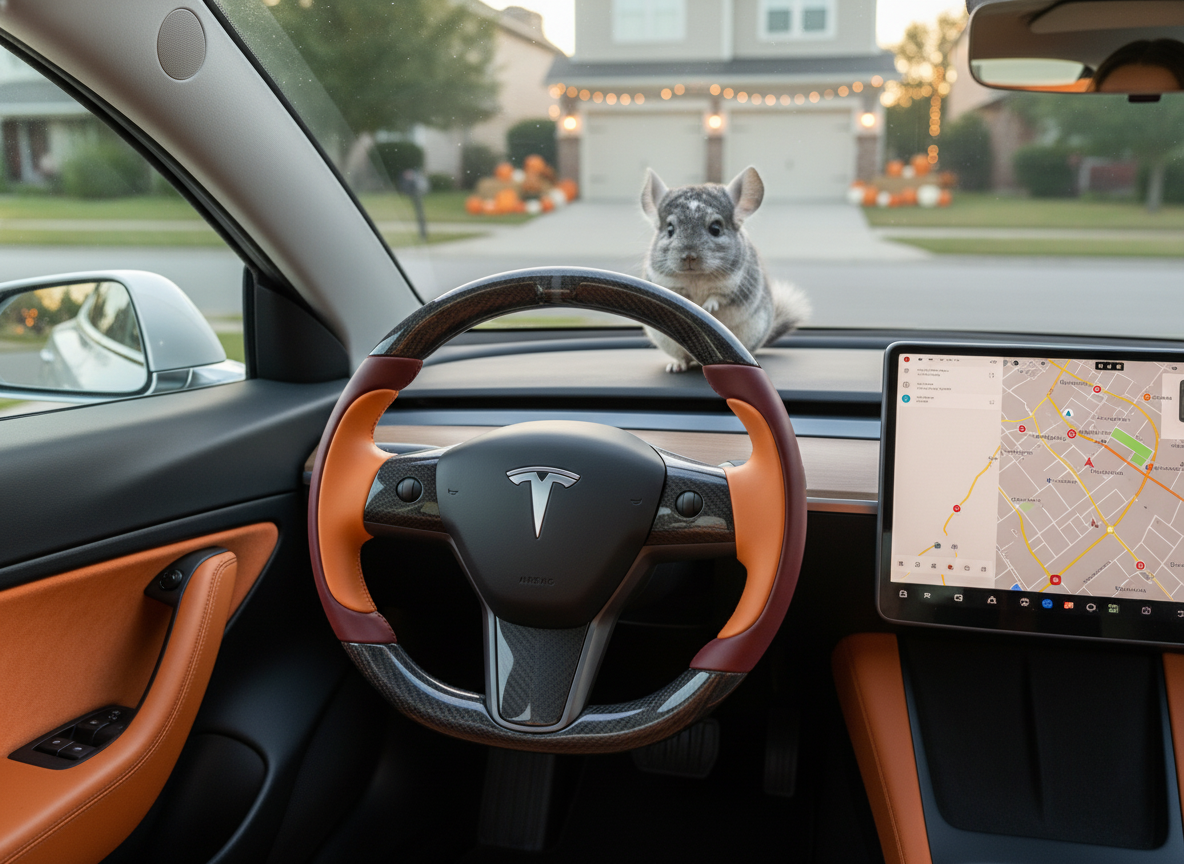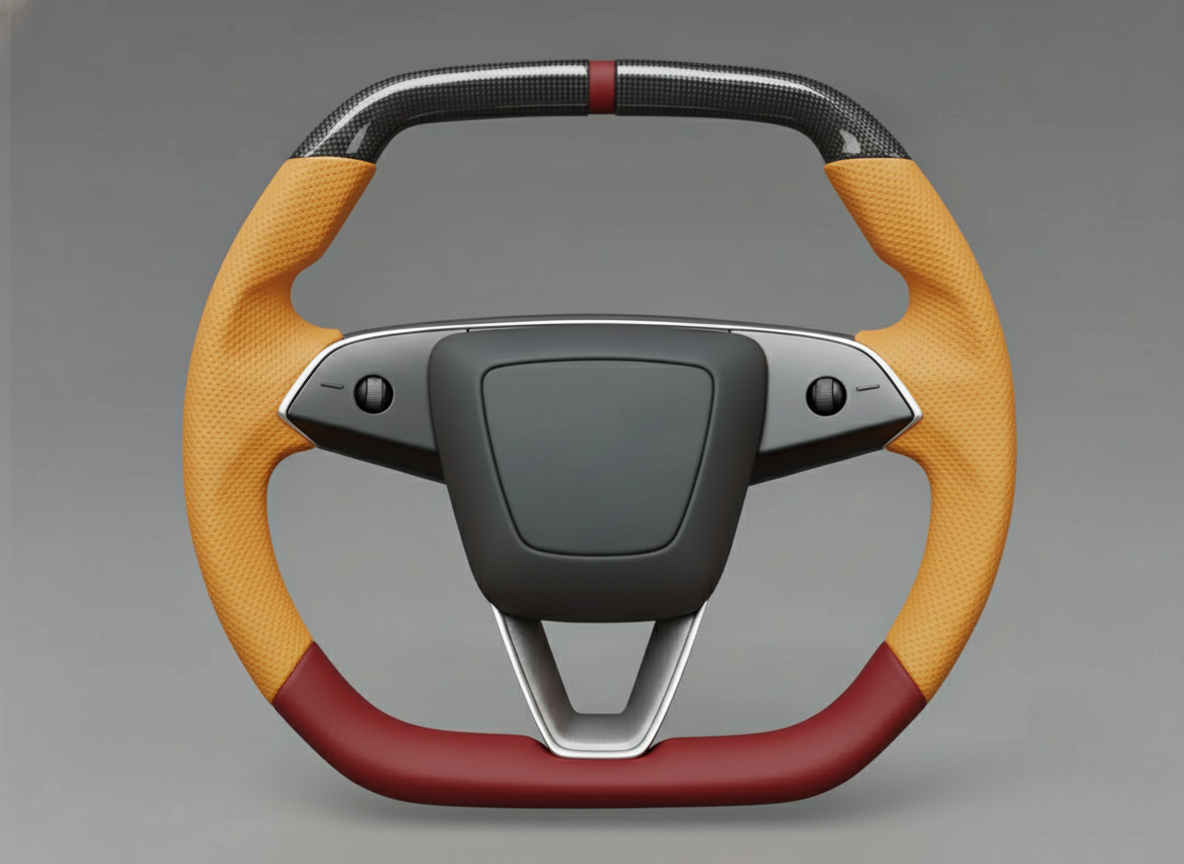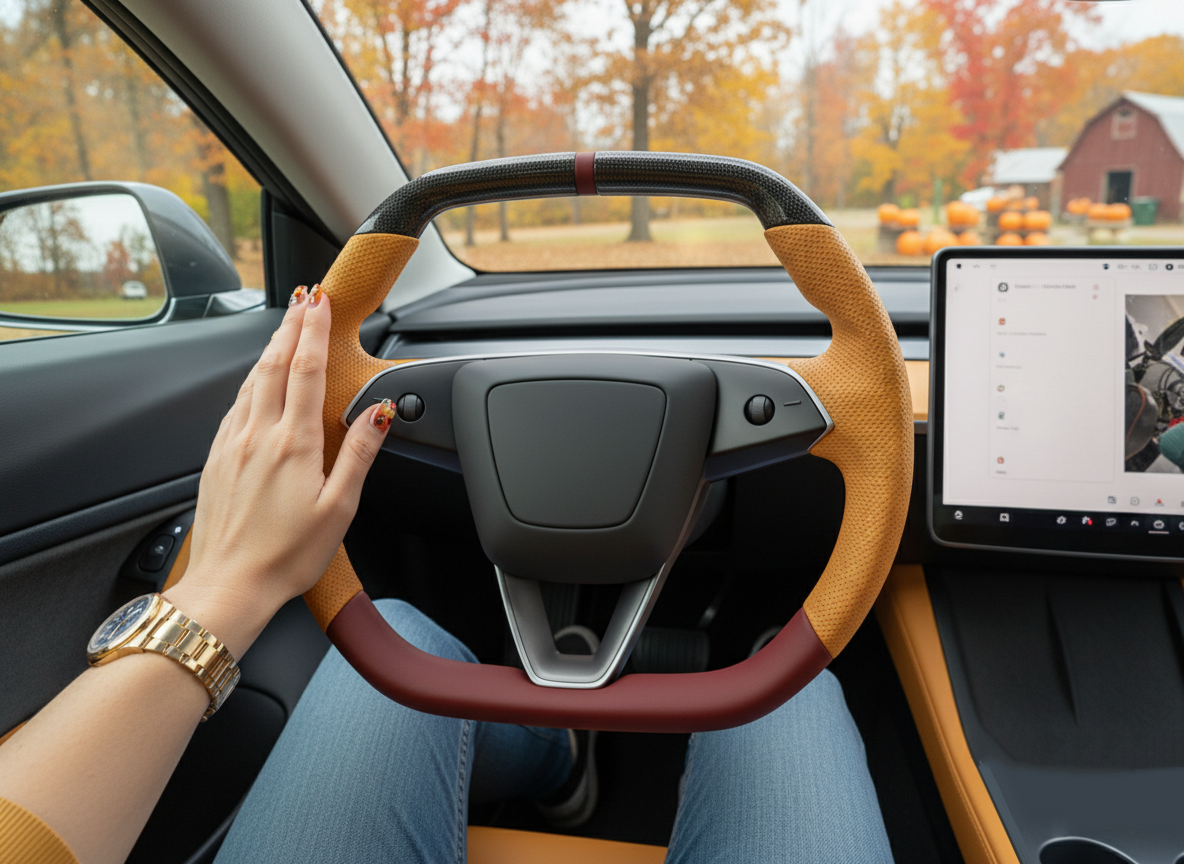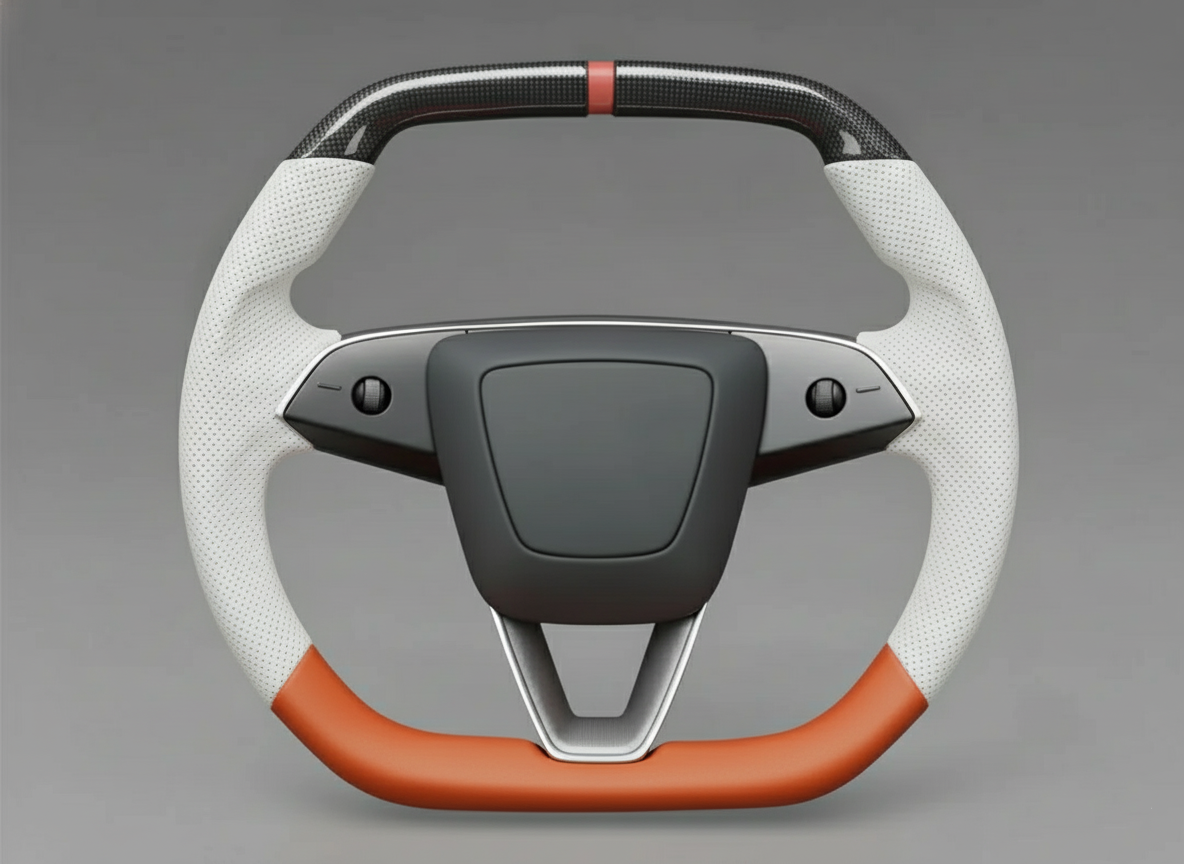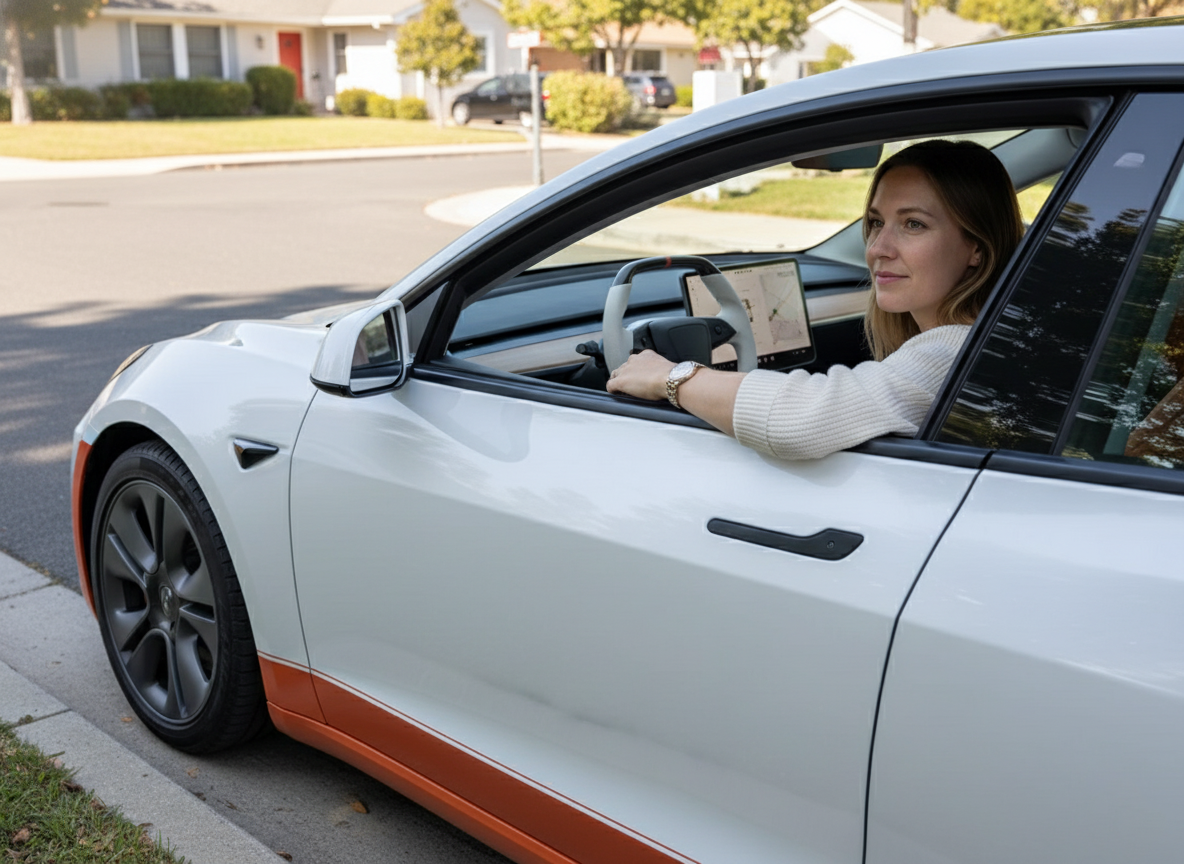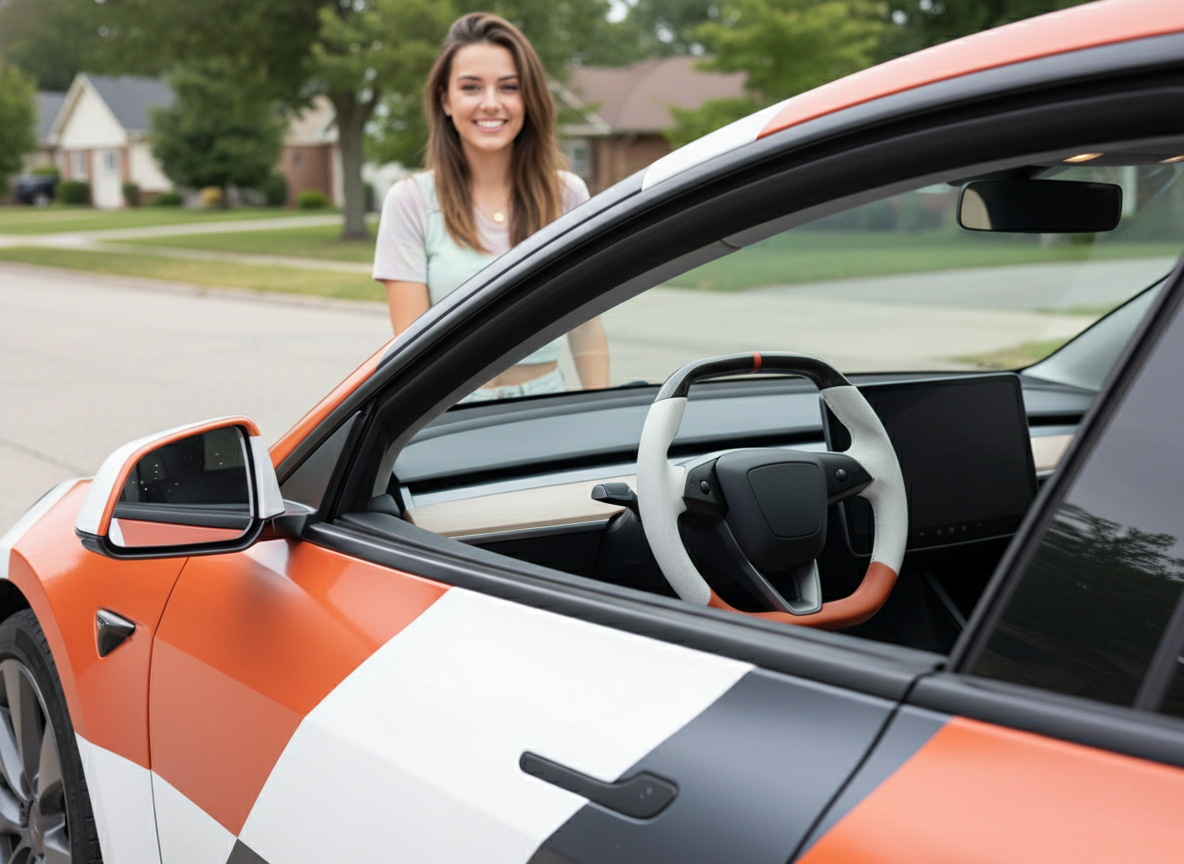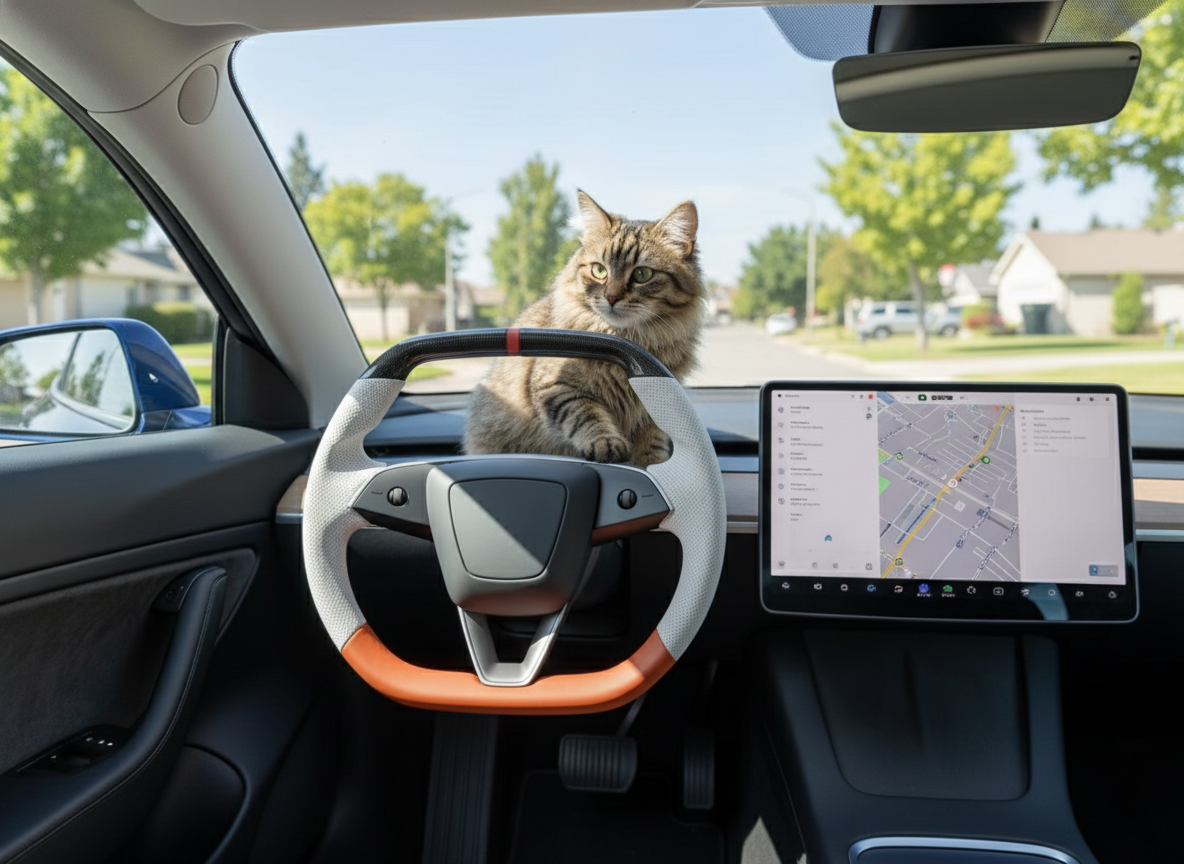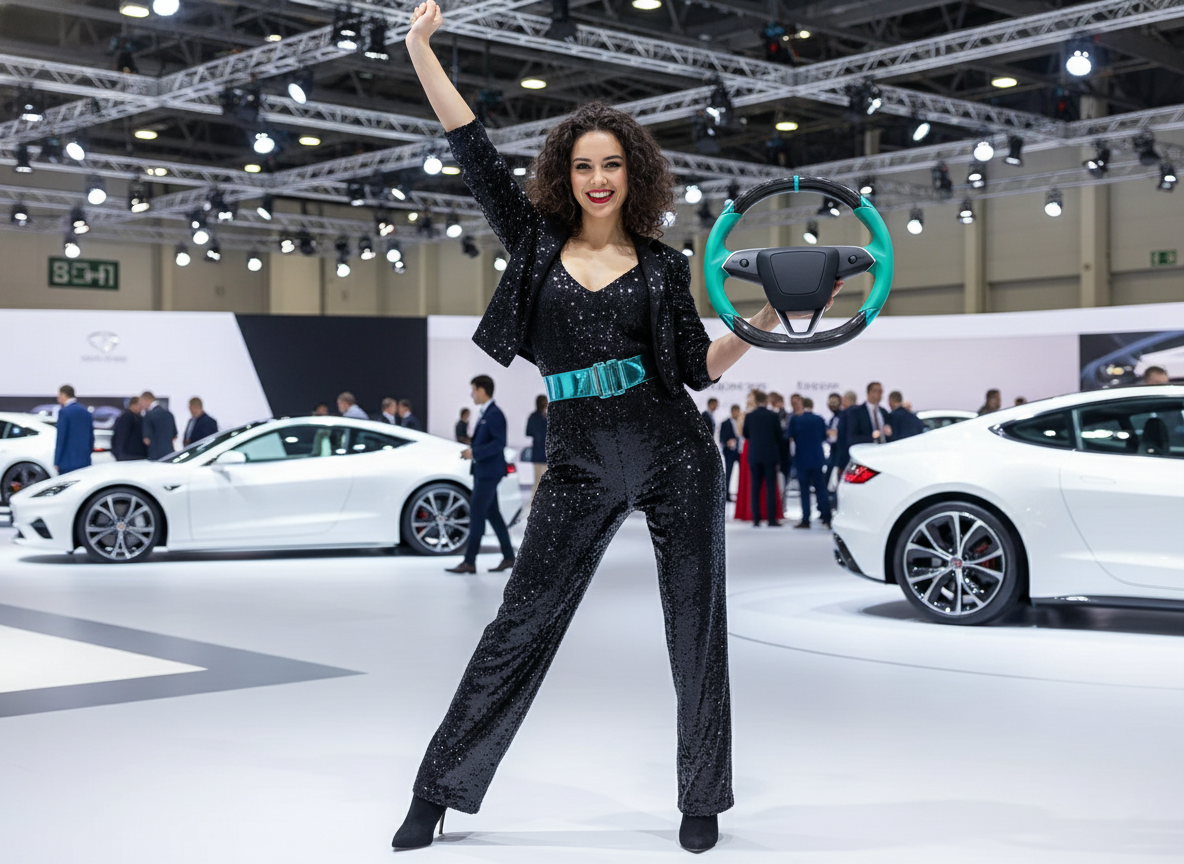
The new Tesla Model Y "Juniper" is expected to comprehensively eliminate traditional physical turn signal stalks in favor of a minimalist three-spoke steering wheel with integrated touch-sensitive buttons.
Utilizing high-precision linear motors to provide delicate haptic feedback and upgrading to eco-friendly perforated fabrics, this highly integrated HMI (Human-Machine Interface) logic aims to reduce physical stalk redundancy by 100% while significantly enhancing driver visual focus and the cabin's digital texture.
Design
The Juniper refreshed steering wheel completely removes traditional turn signal and gear stalks, highly integrating all control functions within the three-spoke frame.
Its button zones consist of two sets of pressure-sensitive touch positions with linear motor feedback, replacing the original two physical stalks.
The airbag cover area is reduced by approximately 20% compared to the current model, creating a more downward-shifted visual center.
In terms of materials, perforated polymer synthetic leather is introduced. While maintaining a standard diameter of 360mm to 380mm, a seamless wrapping process is utilized to enhance the visual transparency of the steering column area.
Interaction Layout
Tesla has significantly reconstructed the driver interaction logic in the Juniper refreshed Model Y, removing physical stalks from both sides of the steering column and integrating all driving operations into the steering wheel spokes and the center touchscreen.
The functions of the left turn signal stalk are now handled by two pressure-sensitive buttons on the left spoke: the upper button controls the left signal, and the lower button controls the right signal.
This layout requires drivers to change traditional stalk habits when turning or navigating roundabouts, relying on the thumb's tactile feedback to locate buttons.
The turn signal buttons feature independent force sensors and linear vibration motors, triggering at a pressure of approximately 2 to 5 Newtons.
Once pressed, the vibration motor generates a simulated mechanical "click" feedback within 15 milliseconds, allowing the driver to confirm the operation has taken effect without looking at the wheel.
The high-beam toggle is also located in the left area, replacing the previous push-pull stalk action with a single click to toggle or a long press to flash.
| Interaction Function | Current Model Y (Stalk-based) | Juniper Refreshed (Stalkless) |
|---|---|---|
| Turn Signals | Left physical stalk (Up/Down) | Two touch buttons on the left spoke |
| High Beams | Left stalk (Push/Pull) | Dedicated touch position on left spoke |
| Gear Shift (P-R-N-D) | Right gear stalk (Up/Down) | 15.4-inch screen slider / Ceiling backup buttons |
| Wiper Control | Button on end of left stalk | Right spoke touch button + Scroll wheel adjustment |
| Voice Assistant | Right scroll wheel press | Dedicated touch position on right spoke |
| Horn | Press center airbag area | Center airbag area (Some versions feature right-side button) |
The gear stalk originally located on the right of the steering column has been completely removed, replaced by a virtual shifting bar integrated into the left edge of the 15.4-inch center screen.
When the vehicle starts, the driver slides up on the screen edge to enter Drive (D), down for Reverse (R), and taps the top area for Park (P).
To handle extreme scenarios like screen failure or freezing, Tesla has placed physical backup gear buttons on the overhead control panel above the rearview mirror.
These buttons feature a capacitive backlit design, illuminating only when the vehicle detects that the center system is unavailable or the driver actively triggers them.
This dual redundancy ensures the vehicle maintains basic mobility even during electronic system anomalies.
Additionally, Juniper will introduce the "Auto Shift out of Park" feature, utilizing the vehicle's 8 cameras (HW4.0 system) to identify surrounding obstacles and automatically determine if the car should move forward or backward; the driver simply presses the brake to confirm.
The right spoke layout primarily serves multimedia and driver-assist functions.
The right scroll wheel retains a physical rotating entity, supporting left/right clicks to adjust follow distance or Autopilot speed.
Wiper control logic has been refined: a single click on the wiper icon on the right spoke triggers a single wipe and spray, while a menu pops up on the center screen allowing the driver to quickly toggle between Auto, Slow, Medium, and Fast modes via the scroll wheels.
The voice assistant button is positioned at the far right of the right spoke, providing direct activation for navigation settings, climate control, or window adjustments.
This design reduces the number of times a driver looks away from the road, restricting high-frequency operations to the thumb's reach at the 3 and 9 o'clock positions.
To improve durability, the button surfaces are covered with a high-strength polymer coating resistant to sweat corrosion and UV aging.
Physical separation between buttons is intentionally enhanced with micro-ridges, allowing fingers to distinguish between turn signals and light controls via touch.
In driver-assist modes, the steering wheel may upgrade from torque sensors to a capacitive sensing wrap.
This method monitors hand contact area and pressure distribution in real-time to judge driver attention more accurately, avoiding the need for the "steering wheel wiggle" to clear alerts.
The entire steering column area becomes very flat due to the disappearance of stalks.
This visual "white space," combined with a 120-degree steering column housing angle, frees up about 1.5 to 2 cm of additional legroom for the driver, improving entry and exit convenience.
The underlying HMI logic runs on high-performance chips within Tesla OS.
All button inputs are processed through filtering algorithms to distinguish between accidental touches and real intent.
For example, if the system detects the wheel is at a large turning angle, it temporarily increases the trigger pressure threshold for the turn signals to prevent accidental activation by the edge of the palm.
For veteran users accustomed to stalks, the learning curve for this layout is typically completed within 2 to 3 days of driving.
Haptic feedback intensity can be adjusted in three levels (Light, Standard, Strong) to meet different psychological expectations of a "click."
Tactile Materials
The thickness of this material is precisely controlled between 1.1 and 1.3 mm, with surface tension recalibrated to achieve a tensile strength exceeding 25 MPa at room temperature.
Compared to earlier versions, this new material increases the proportion of UV stabilizers, enabling it to withstand 2,000 hours of simulated sunlight aging without fading or cracking.
The surface texture features a fine simulated litchi grain, with grain depth controlled at 0.05 mm via high-precision embossing molds.
This micro-texture enhances the premium feel and improves air circulation between the palm and the wheel.
In the primary 3 and 9 o'clock grip areas, Juniper introduces laser-perforation with a hole diameter of 0.6 mm and 2 mm spacing.
This arrangement ensures structural integrity while significantly improving sweat dissipation, preventing a "sticky" feel during long drives.
- Surface Layer: 1.2 mm polymer composite coating with Grade 4+ scratch resistance.
- Tensile Modulus: Excellent elastic recovery at 20% deformation, ensuring the wheel maintains its shape.
- Chemical Resistance: Supports over 500 wipes with 70% isopropyl alcohol without peeling or yellowing.
- Thermal Conductivity: Optimized thermal resistance allows the heating system to raise the surface temperature to 35-40°C within 90 seconds.
- Friction Coefficient: Static friction coefficient of 0.6 to 0.8 with dry skin, providing stable grip.
The material exhibits a unique elasticity between genuine leather and high-grade fabric. When pressed, it yields by approximately 0.2 mm before quickly rebounding, providing a damping effect that reduces hand muscle pressure.
The internal cushioning layer uses high-rebound polyurethane foam with a density of 55 to 65 kg/m³.
This foam's Shore hardness is set between 45A and 55A, effectively absorbing high-frequency micro-vibrations from the road.
In the center airbag cover area, the material is replaced with a Thermoplastic Polyolefin (TPO) with a matte finish, reducing reflectivity below 0.5% to prevent glare under strong light.
The touch button areas on both sides use micron-level sandblasted polycarbonate, which offers high surface hardness and uniform light transmission, remaining scratch-free even under frequent fingernail contact.
The friction on the button surfaces is designed to be slightly higher than the rim material, allowing drivers to quickly locate functional zones by touch.
Internally, a flexible pressure sensor array (0.5 mm thick) supports multi-level pressure sensing, identifying 2N and 5N forces to trigger different interaction feedbacks.
- Internal Frame: Cast Mg-Al alloy, reducing weight by ~30% compared to steel frames to lower steering inertia.
- Damping Frequency: Acoustically optimized formula to filter road noise between 100 Hz and 400 Hz.
- VOC Levels: Odor grade controlled below 2.5 under 65°C sealed testing.
- Flame Retardancy: Meets FMVSS 302 standards, with horizontal burn speed below 100 mm/min.
- Button Lifespan: Touch area rated for over 100,000 cycles without physical deformation.
The touch area coating introduces oleophobic molecular structures, making it difficult for fingerprint oils to adhere; a simple dry microfiber cloth restores the matte texture.
The connection between the steering column shroud and the wheel uses high-density ABS composite plastic with gaps compressed within 0.5 mm.
The stitching process has moved from exposed seams to inverted edge stitching, performed by automated robots at 3mm intervals.
For versions equipped with heating, the internal heating wires use a serpentine layout covering the full 360-degree circumference, ensuring uniform heat supply to the entire hand in cold environments.
Visual Proportions
The Juniper steering wheel follows a strict symmetry logic in its geometric composition.
While the outer diameter remains in the standard 370mm to 375mm range, the angle of the internal spokes has been adjusted to change the visual stretch.
The central axes of the two horizontal spokes are at a slight 175-degree angle to the steering column center, a design choice intended to align visually with the horizontal LED ambient light strip on the dashboard.
From a standard driving posture, the upper arc of the steering wheel perfectly frames the distant view of the road without obstructing the speed display in the top-left corner of the center screen.
The airbag cover edges feature a 2mm radius fillet, resulting in a more compact proportion compared to the current wider circular design.
- Grip Cross-section: Oval section, 32mm horizontal by 36mm vertical, creating a visual sense of thickness.
- Spoke Angles: The bottom vertical spoke is perpendicular to the horizontal axis, tapering from 45mm at the top to 30mm at the bottom.
- Center Cover Depth: The depth difference between the airbag cover and the spoke plane is within 3mm, eliminating redundant visual shadows.
- Button Aspect Ratio: Left and right touch zones each occupy 60% of the spoke length, ensuring visual dominance.
- Fit & Finish: Gap between rim wrap and plastic parts is fixed at 0.5mm, presenting a high-precision industrial feel.
Observed from a side profile, the overall thickness of the Juniper wheel is reduced by about 15% compared to the current model.
Due to the removal of stalks, the steering column shroud volume is significantly retracted, forming a smooth rectangular profile approximately 140mm long and 80mm wide.
This visual "weight loss" makes the cabin legroom appear more open, psychologically alleviating the cramped feeling common in compact SUVs.
The visual centers of the scroll wheels are exactly in the middle of the horizontal spokes.
The 18mm diameter rollers protrude only about 2mm, distinguished from the surrounding black leather by the matte metal coating texture without needing decorative lines.
| Visual Element | Current Model Y Spec | Juniper Refreshed Spec | Visual Change % |
|---|---|---|---|
| Airbag Cover Area | ~14,500 mm² | ~11,200 mm² | ~22% reduction |
| Horizontal Spoke Width | 50 mm | 42 mm | ~16% reduction |
| Visible Column Volume | ~2,200 cm³ | ~1,650 cm³ | ~25% reduction |
| Roller Visual Spacing | 155 mm | 142 mm | ~8% narrowing |
| Outer Ring FOV Impact | 12% of dash view | 9.5% of dash view | ~2.5% FOV improvement |
Under high-light conditions, the matte treatment limits reflections to minute points. With a ~5% gloss level, the outline of the circular structure remains clear against the background without being intrusive.
Features
The Juniper version steering wheel eliminates the two physical stalks on the steering column, moving 8 functions—including turn signals, high beams, wipers, and voice assistant—to the wheel surface.
Utilizing capacitive sensing paired with vibration motors, the feedback latency is controlled within 50ms.
The material is upgraded to synthetic leather with a higher wear coefficient, featuring integrated three-stage automatic heating.
Hand detection has been upgraded from torque-based to full-circumference capacitive sensing, with monitoring frequency increased to over 10 times per second, reducing false alerts during Autopilot.
Control Key Layout
The left zone concentrates indicator controls, with vertically stacked turn signal buttons replacing the traditional up/down stalk movement.
The upper button controls the right turn, and the lower controls the left turn, matching the natural fan-shaped movement of the human thumb with an arc radius of exactly 45mm.
Each button is embedded with independent force-sensing resistors, allowing the system to distinguish between a light tap (flashing three times) and a heavy press (continuous signal).
In high-frequency driving, this capacitive interaction reduces mechanical wear, with an internal test life of 1 million presses.
| Control Component | Physical Spec/Parameter | Technical Logic | Interaction Feedback |
|---|---|---|---|
| Left Turn Buttons | 12x18mm rectangular area | Capacitive + Pressure sensing | 50Hz Linear motor vibration |
| Right Function Buttons | 10mm diameter circular | Single/Long-press multi-trigger | 30ms Fast response feedback |
| Aluminum Rollers | CNC machined 6061 Aluminum | 360° infinite + 4-way click | 0.1Nm damping feel |
| Sensing Layer | 0.8mm composite material | Multi-point capacitive array | Shields 500V static interference |
The two scroll wheels have been upgraded from rubber to CNC-machined aluminum with a sandblasted finish to increase friction.
These rollers support vertical scrolling and horizontal clicks.
In Autopilot, horizontal clicks adjust follow distance (1-7), while vertical scrolling adjusts speed in 1mph or 5km/h increments.
| Functional Module | Operation Action | Feedback Indicator | Software Mapping |
|---|---|---|---|
| Autopilot Follow | Left/Right roller click | 1-7 value bar on screen | Real-time radar/vision threshold |
| Mirror Adjustment | Roller scroll + click | 0.5-degree motor displacement | Saved to Driver Profile |
| Emergency Horn | Center pressure > 15N | 2.0mm physical compression | Triggers dual-tone air horn |
| Blind Spot Cam | Click right camera icon | Latency < 0.1s video stream | Side view on screen/cluster |
Addressing feedback regarding small horn buttons in early versions, the Juniper wheel returns to the traditional center-pressure horn.
The entire airbag cover is now a large pressure-sensing zone with a trigger threshold of 15 Newtons, responding to instinctive emergency reactions.
Materials & Hardware
Tactile improvements stem from an improved outer vegan leather material incorporating cross-linked polyurethane technology, increasing resistance to oil penetration by 40%.
In aging tests, it withstood 1,000 hours at 80°C without blistering or peeling.
| Material Category | Technical Parameter | Performance Gain | Env. Adaptation |
|---|---|---|---|
| Outer Vegan Leather | 1.4mm PU composite layer | 60% more wear-resistant | Alcohol & acid resistant |
| Fill Foam | 55kg/m³ closed-cell | Damping coeff. 0.45 | Shape-stable -30°C to 90°C |
| Stitching Thread | D69 industrial nylon | 150N tensile strength | Hydrophobic, sweat-resistant |
| Skeleton | AM60B Mg-Al Alloy | 18.5% lighter | High-strength impact resistance |
Sensor Technology
The new full-capacitive sensing layer is embedded 0.8mm beneath the surface, covering the 360-degree grip area.
Composed of 15 independent sectors, it allows the system to recognize if the driver is using one hand, both hands, or just fingertips, assigning different safety weights for driver assistance.
- Sampling layer uses 0.05mm flexible conductive silver paste circuits.
- Capacitive chip operates at 48MHz, supporting multi-touch suppression.
- Automatic calibration adjusts thresholds based on humidity and temperature.
- In extreme dry conditions, sensitivity compensates by 20% for thin gloves.
In the button zones, Force Sensing Resistors (FSR) replace mechanical micro-switches.
To prevent accidental triggers on bumpy roads, a multi-stage filter logic is applied: a light press (~1N) triggers tactile haptic warning, while a deep press (>3N) executes the command.
The Linear Resonant Actuator (LRA) is the foundation for haptic feedback.
Unlike standard eccentric rotor motors, the LRA starts and stops instantly, simulating a crisp physical click.
Juniper customizes LRA waveforms—e.g., a 50Hz pulse for turn signals and a stronger 1.5G continuous vibration for Autopilot alerts.
Expectations
The 2025 Juniper Model Y is expected to follow the Highland's lead in removing physical stalks.
North American markets are highly focused on the potential for a 48V steer-by-wire architecture, similar to the Cybertruck, achieving a 14:1 variable steering ratio at low speeds.
Steer-by-Wire Technology
The Juniper Model Y may discard the metal steering column in favor of an electronic signal chain.
This solution consists of three independent motors and a 48V high-voltage power system.
Sensors at the base of the column collect angle and force data at 1,000Hz, transmitting signals via redundant buses to front-axle execution motors.
This physical isolation allows the cabin firewall to move forward by ~120mm, increasing front passenger legroom.
The front-axle actuator contains two 250W brushless DC motors as backups for each other. If one fails, the other takes over within 5ms.
| Technical Parameter | Traditional Mechanical (2023) | Juniper Steer-by-Wire (Exp.) | Improvement Note |
|---|---|---|---|
| Voltage | 12V | 48V | Current -75%, Weight -2.3kg |
| Bus Freq. | 100Hz (CAN) | 1000Hz (Ethernet) | Latency 20ms to 1ms |
| Lock-to-Lock | ~2.1 Turns | ~0.5 Turns (Low speed) | No hand-over-hand turning |
| Mechanical Link | ~1.5m Column | 0m | Improved passive safety |
| Redundancy | Single Link | Triple Electronic | Indep. power, controllers, motors |
By simplifying the physical layout and adopting a modular assembly, Tesla reduces about 12 independent parts and connectors, lowering the failure rate for long-term maintenance.
The 48V architecture ensures stable instantaneous current to drive the 2-ton vehicle at a standstill with ease.