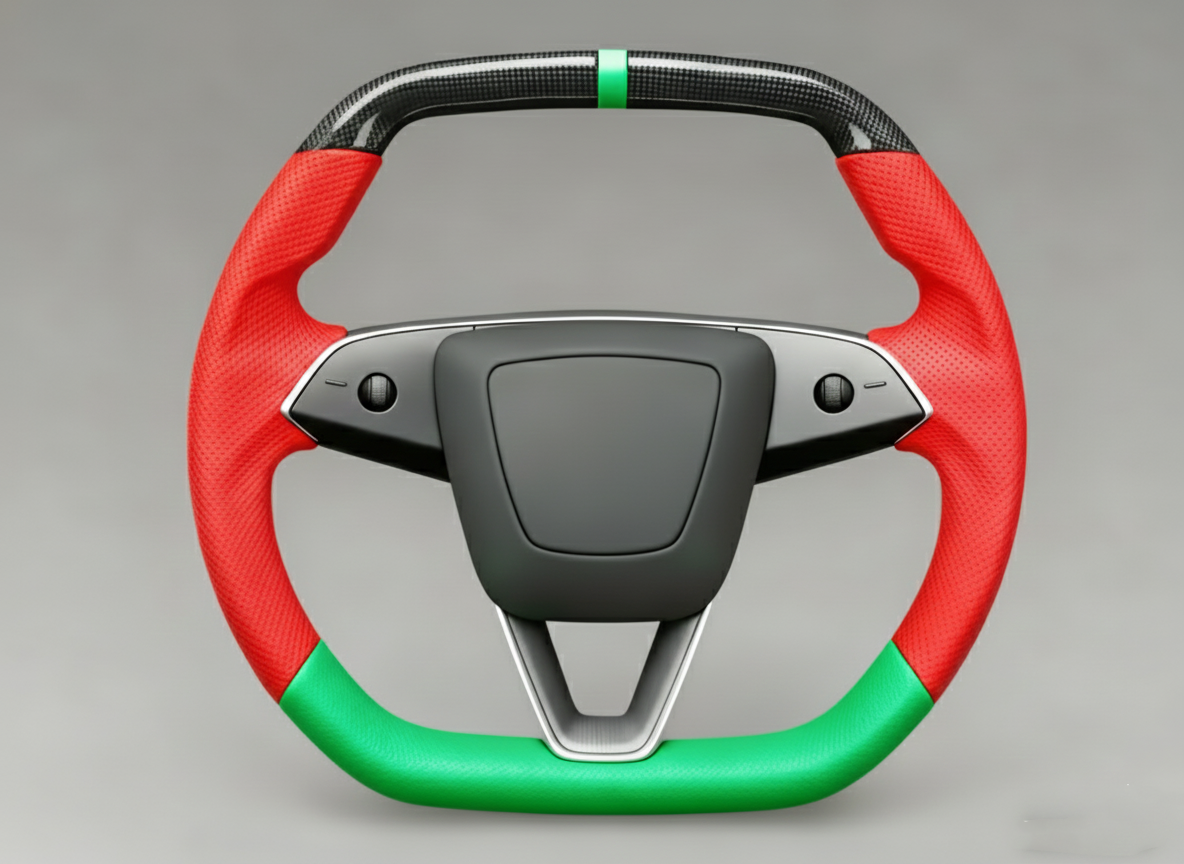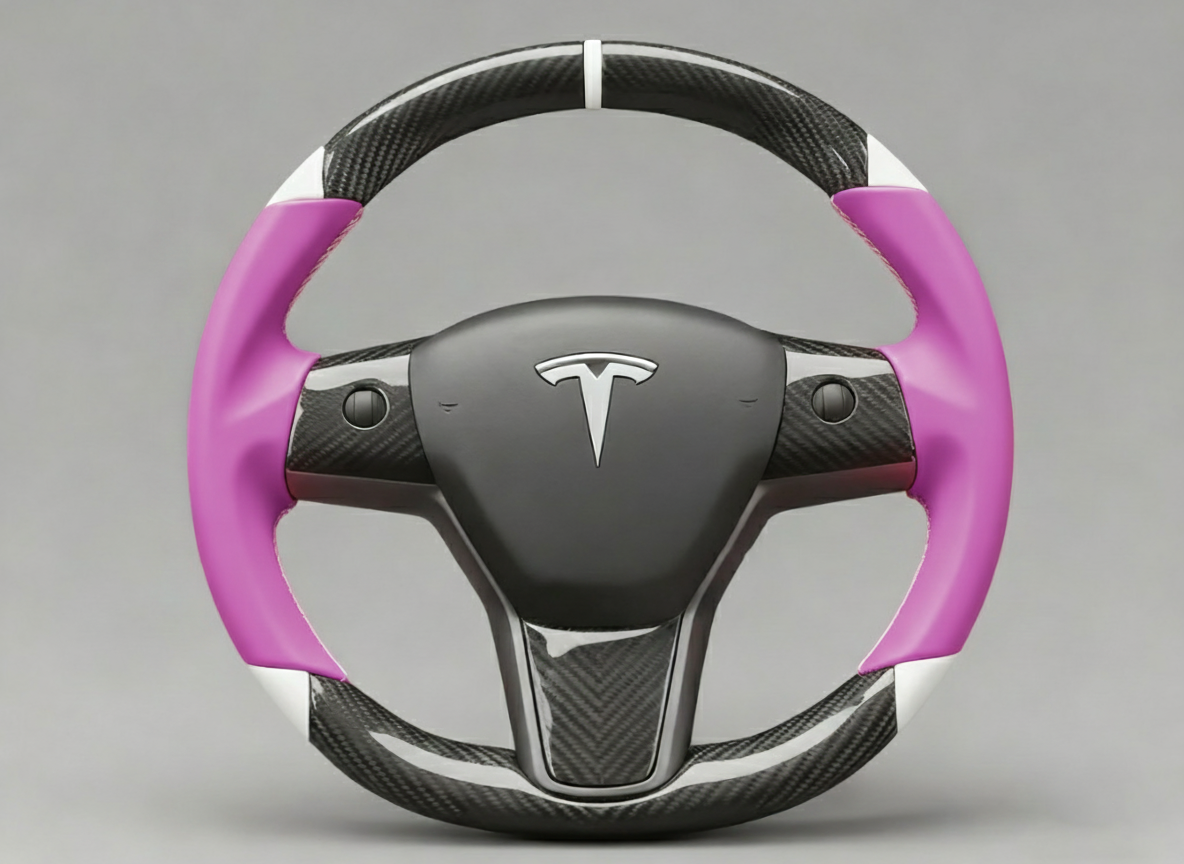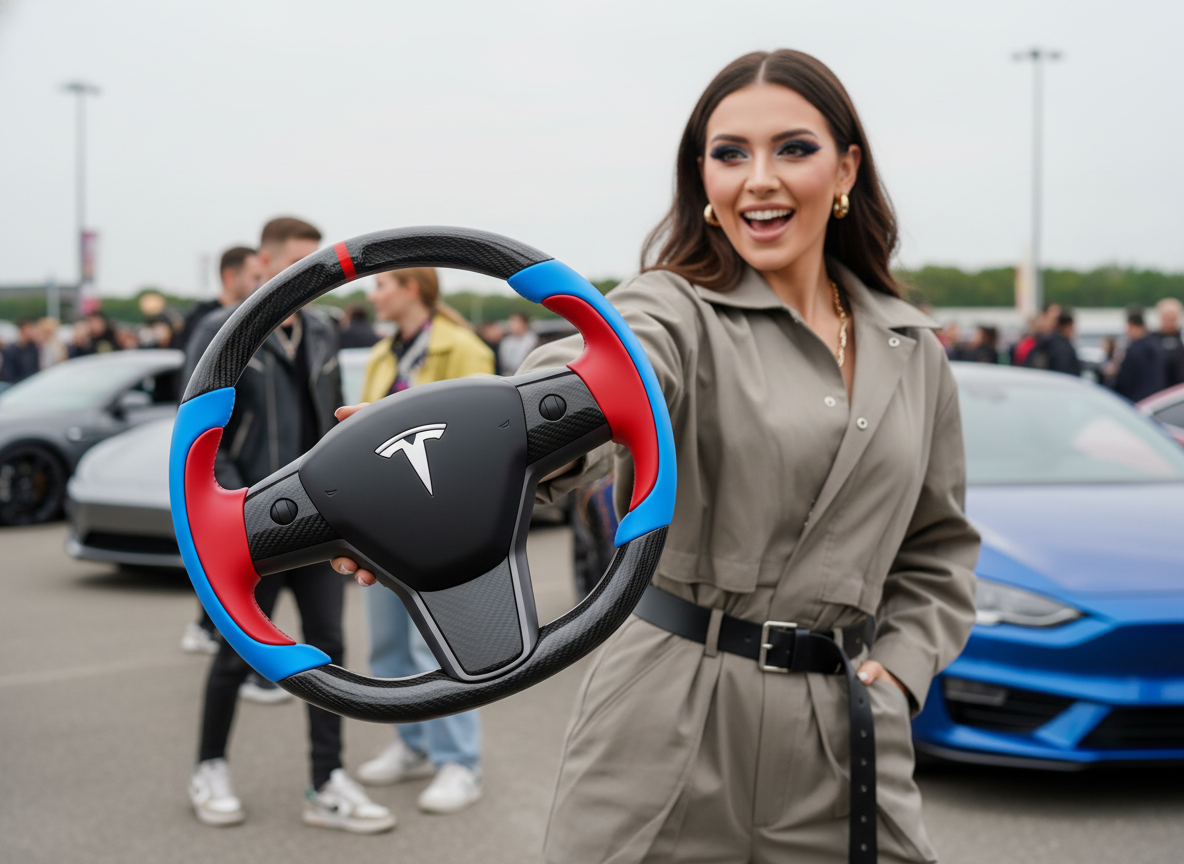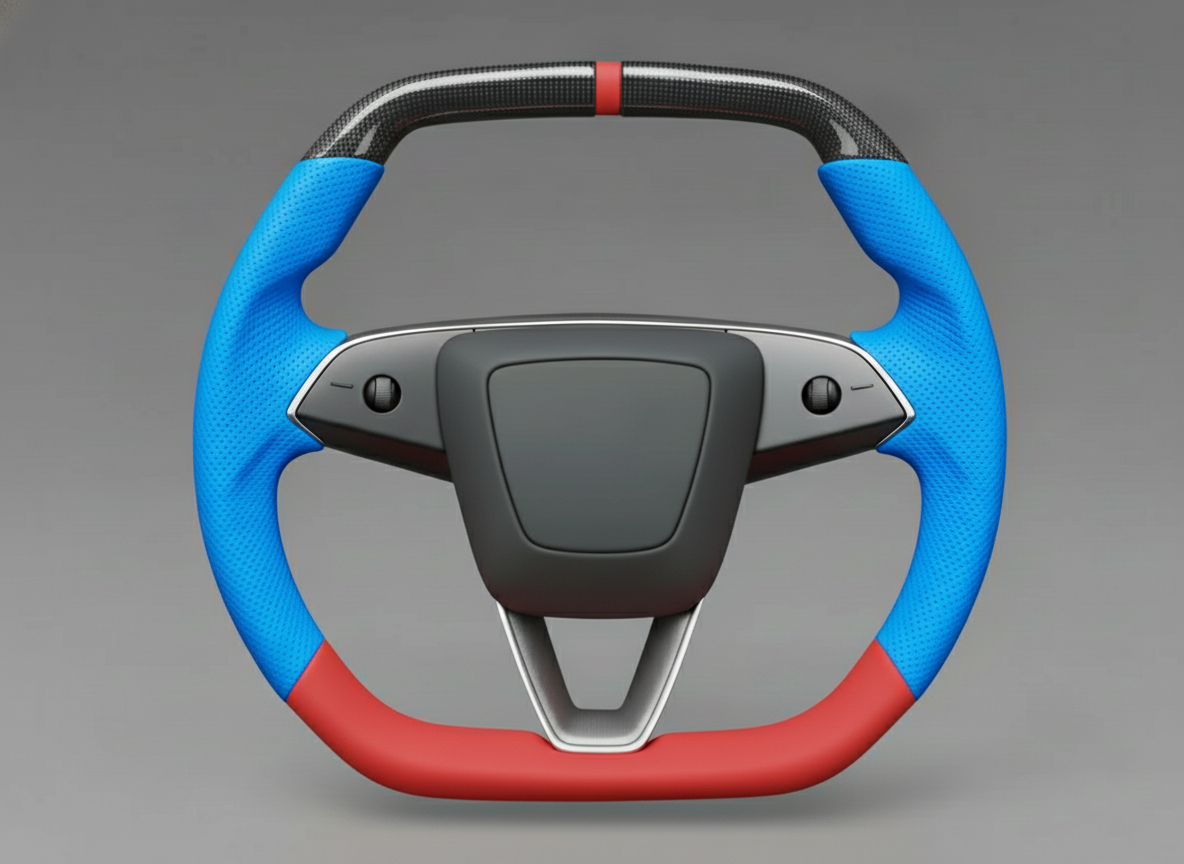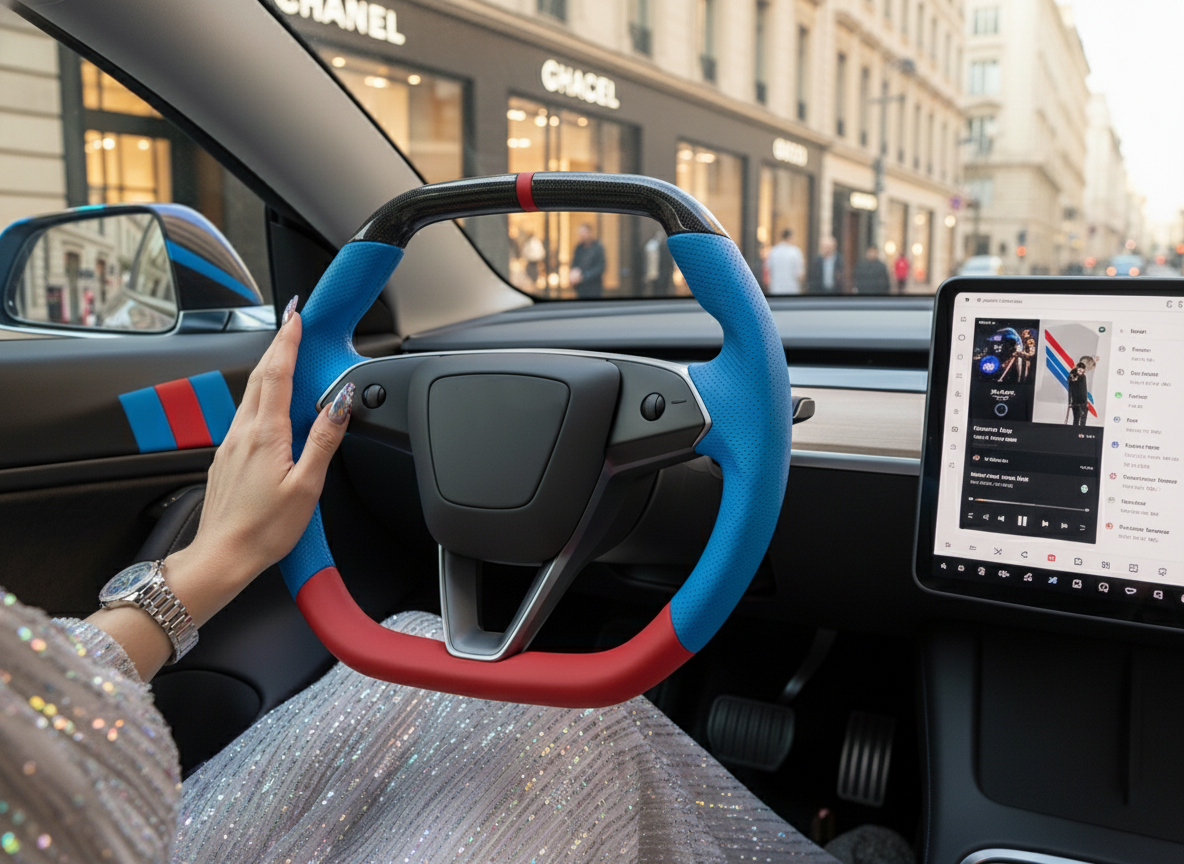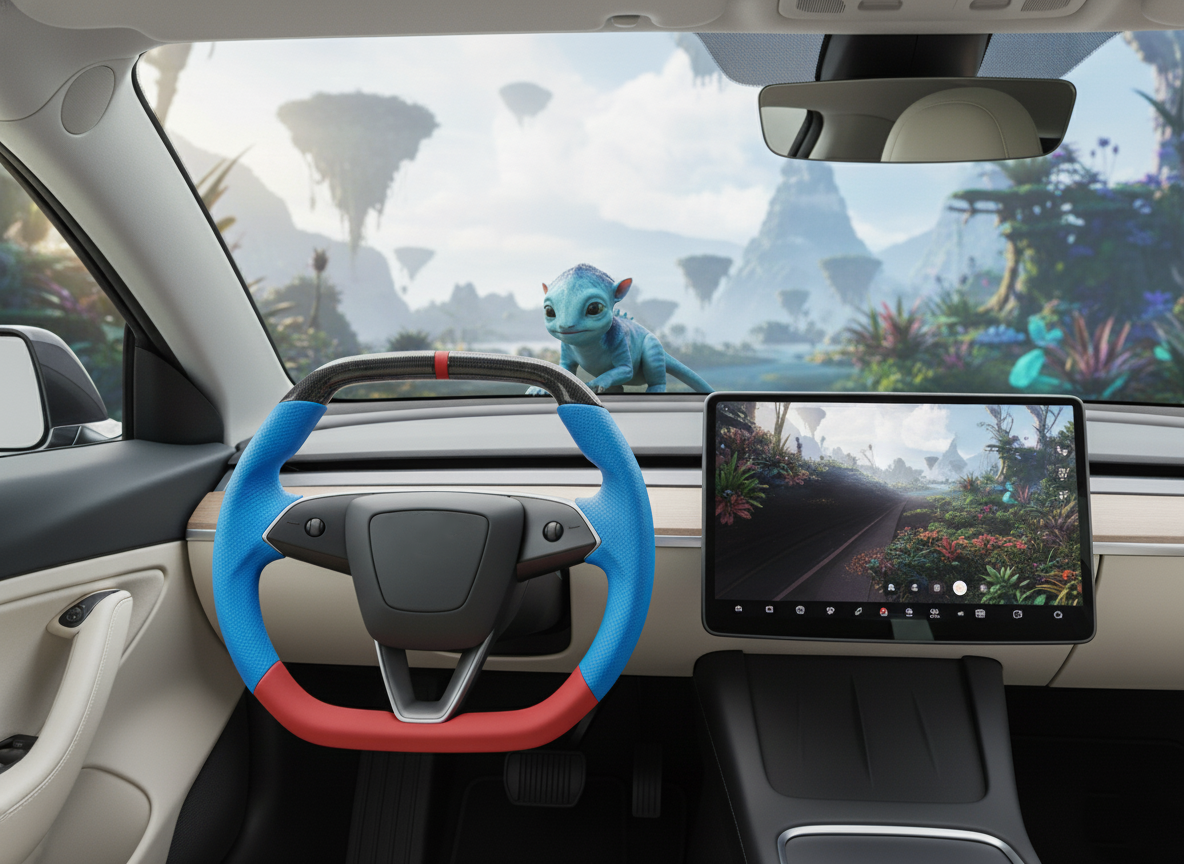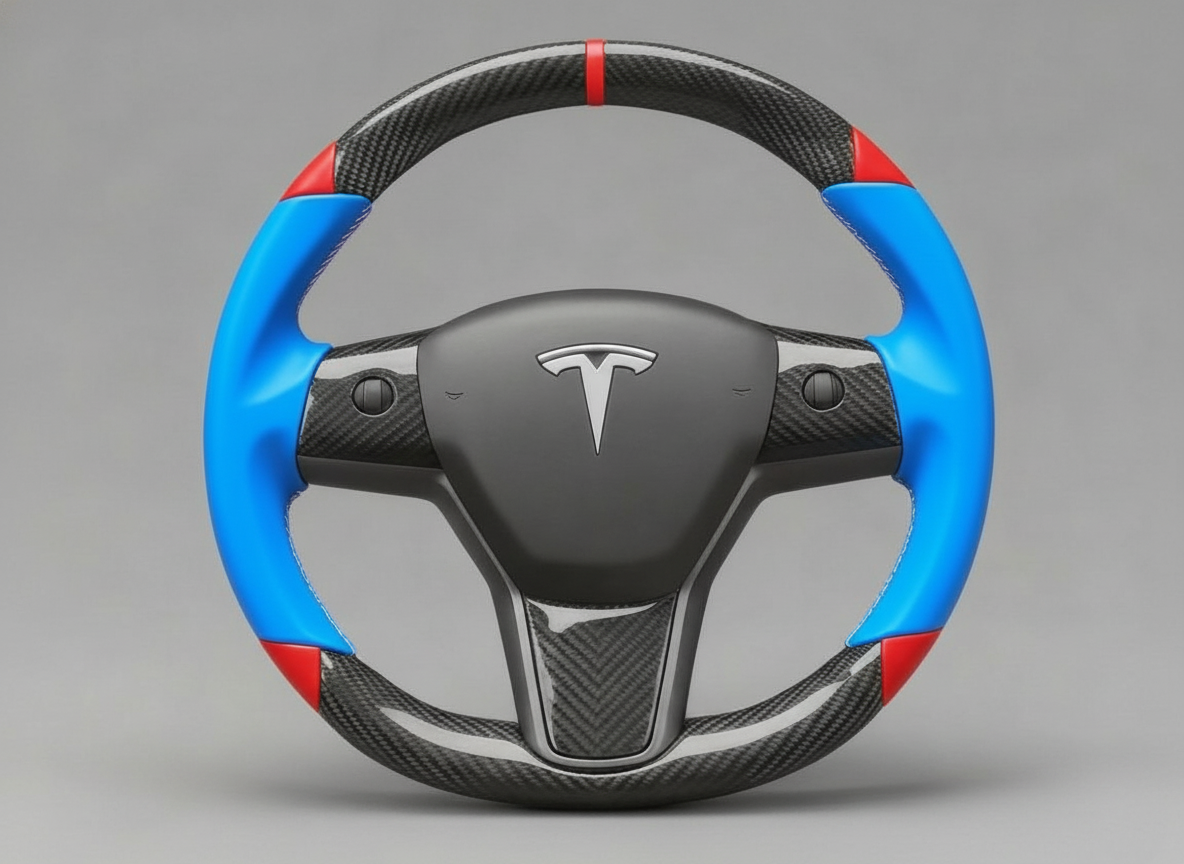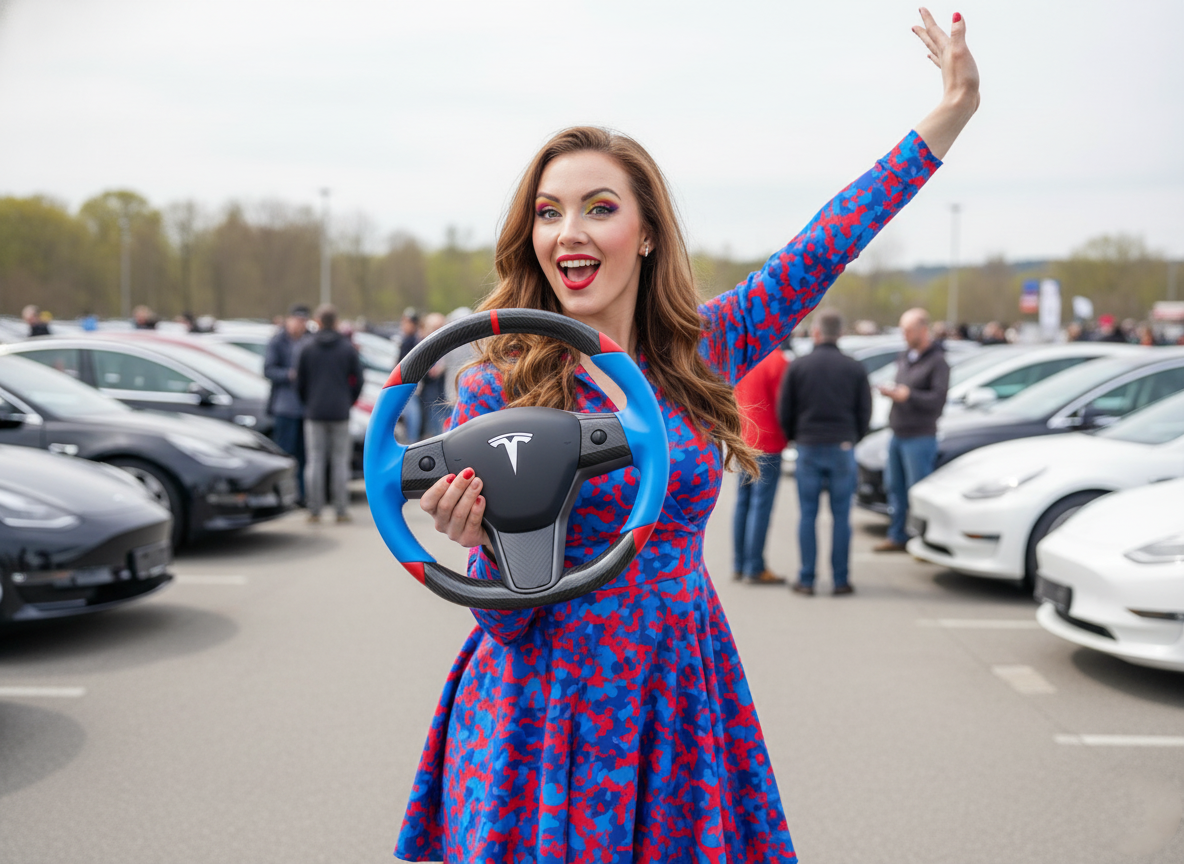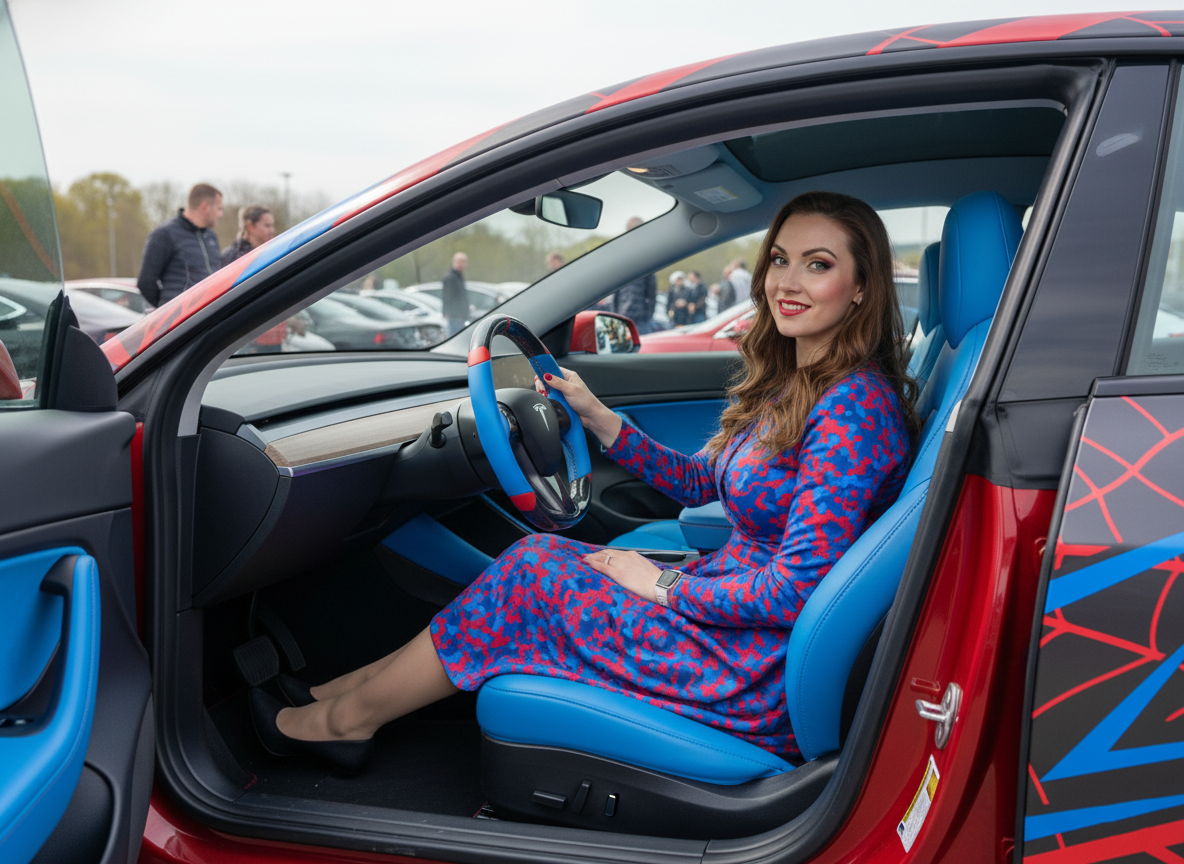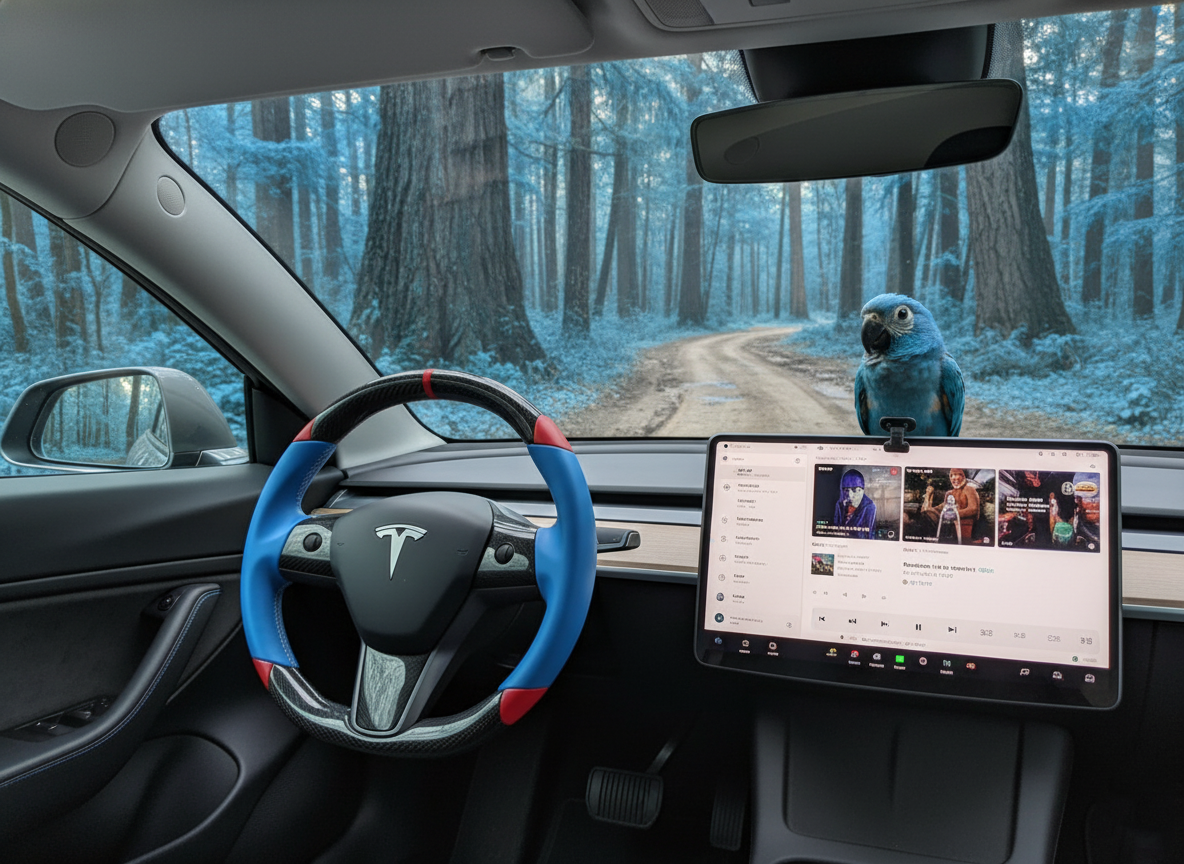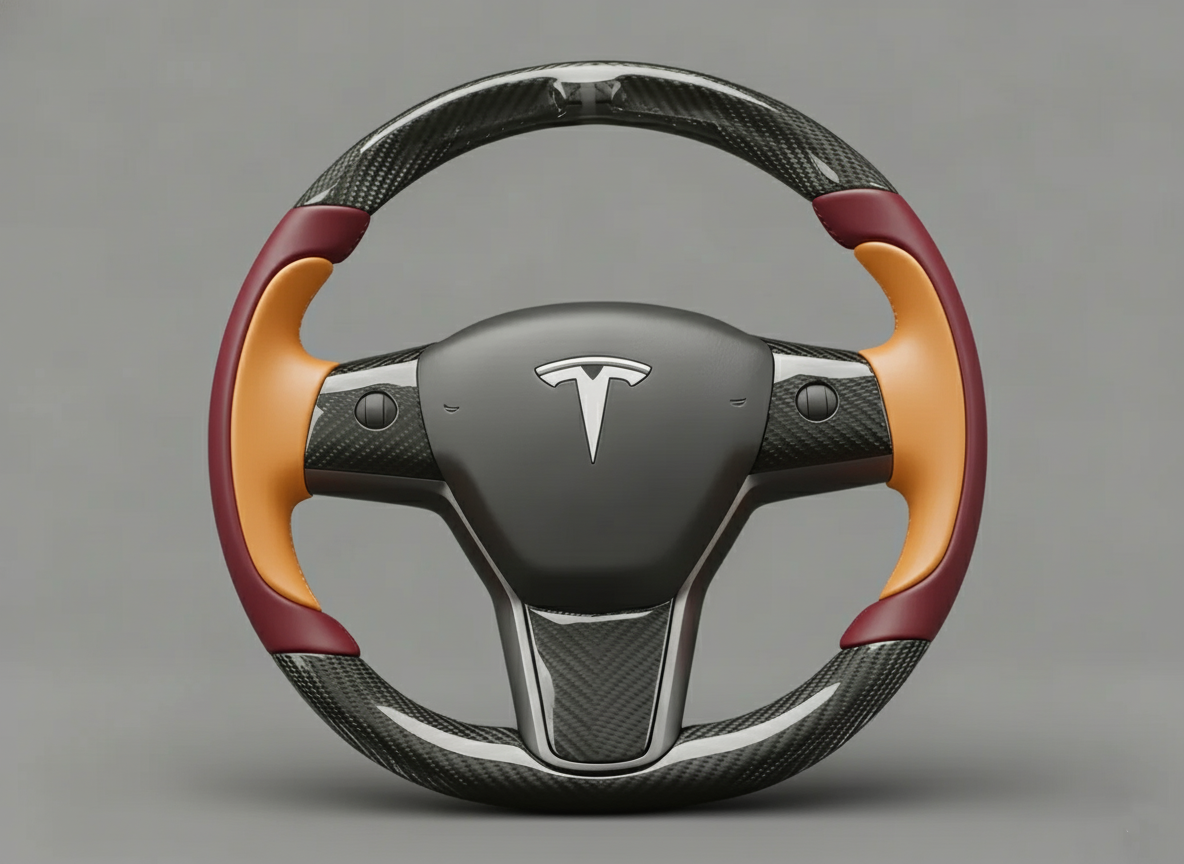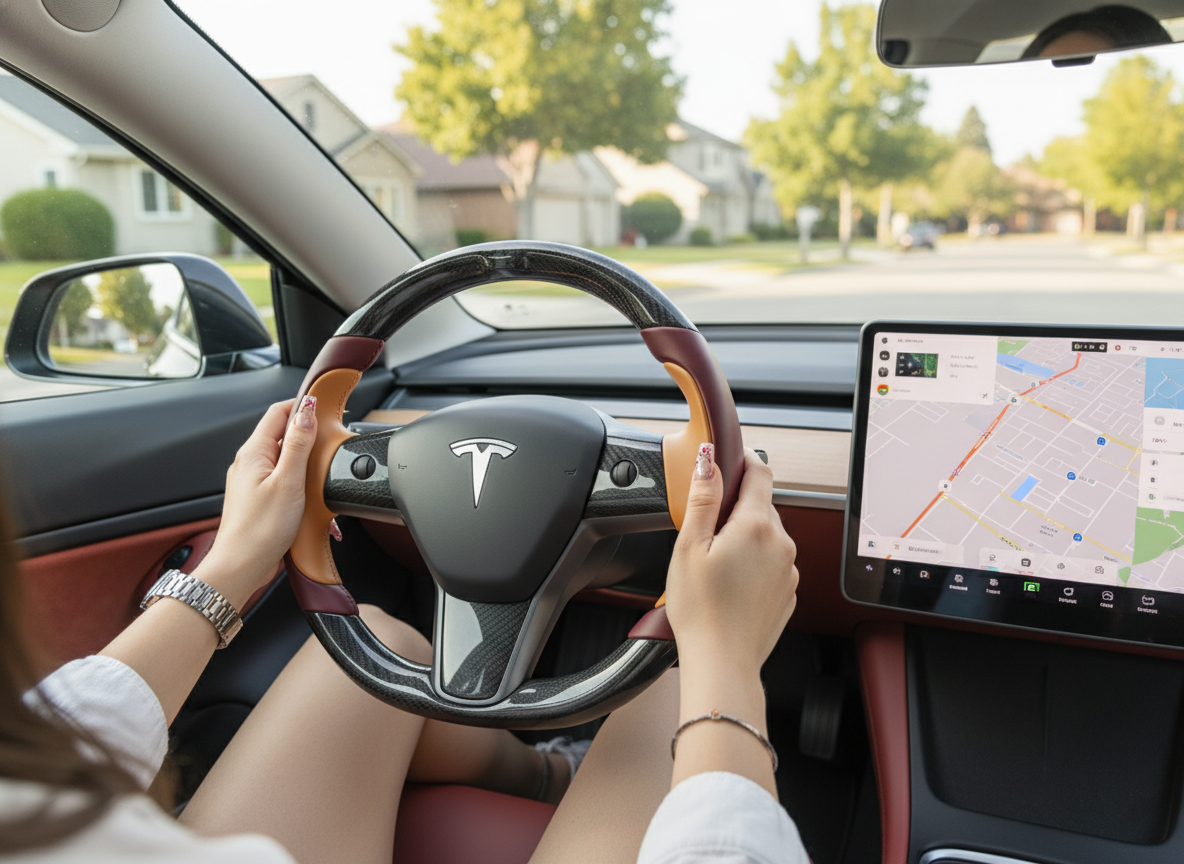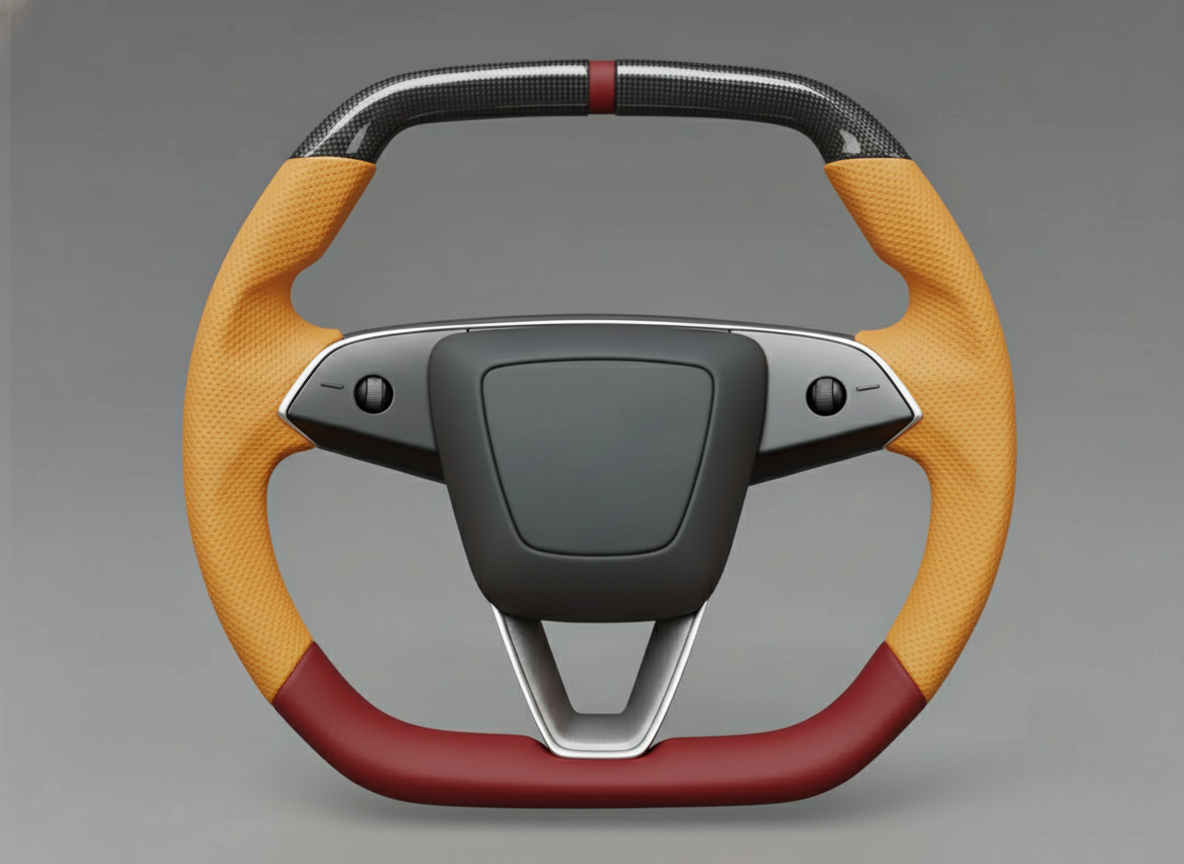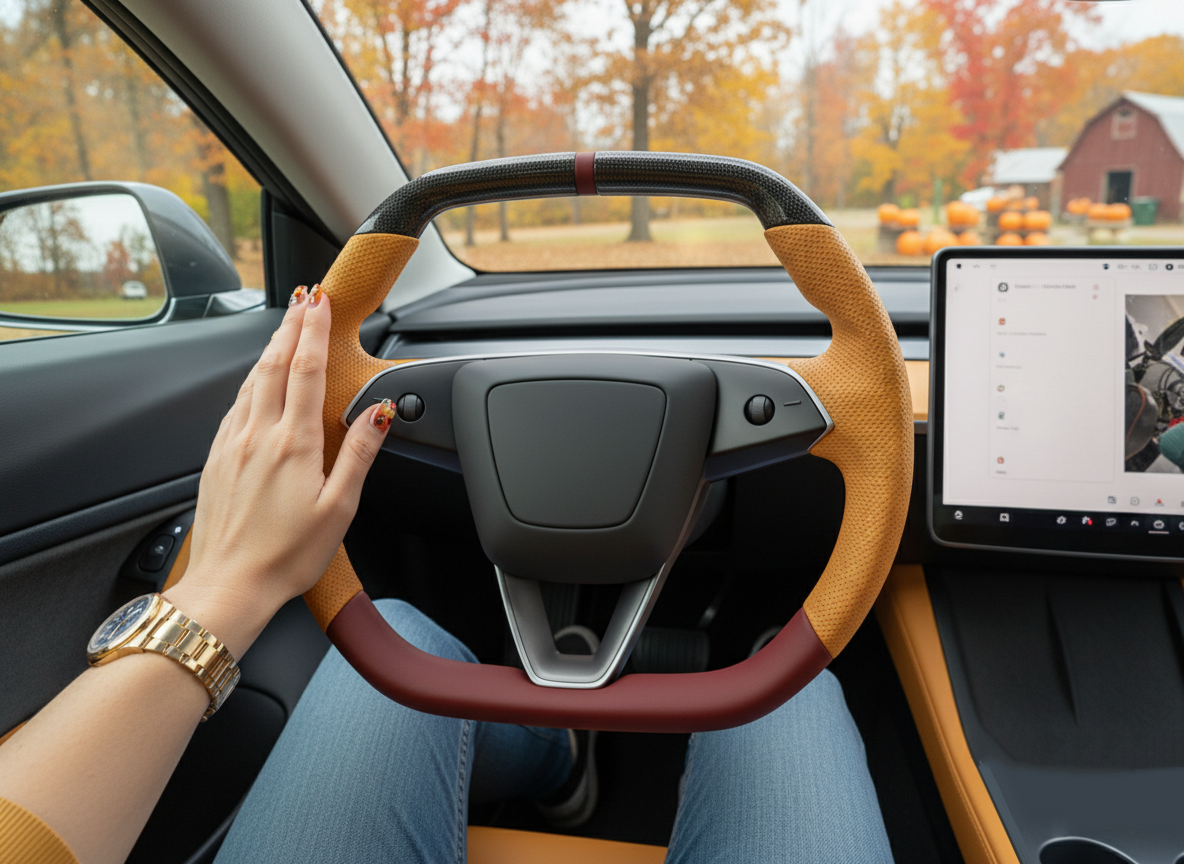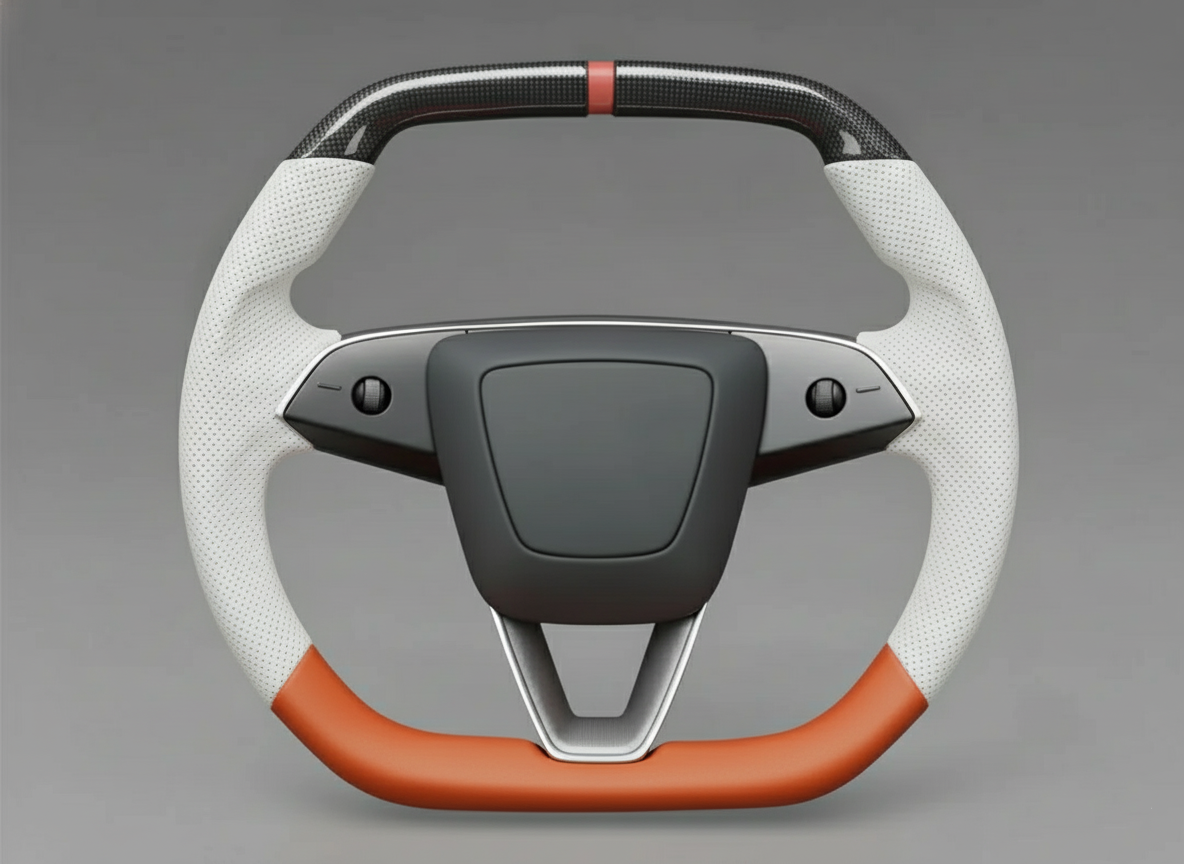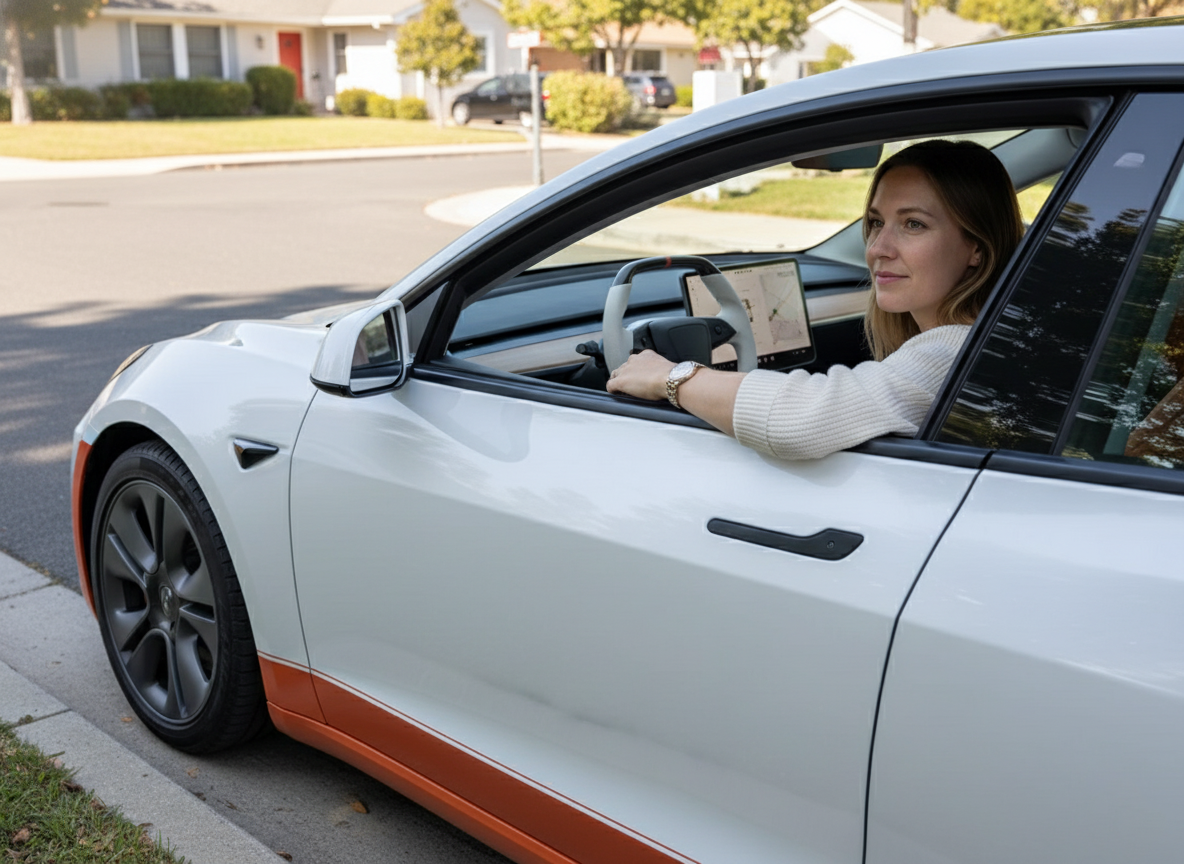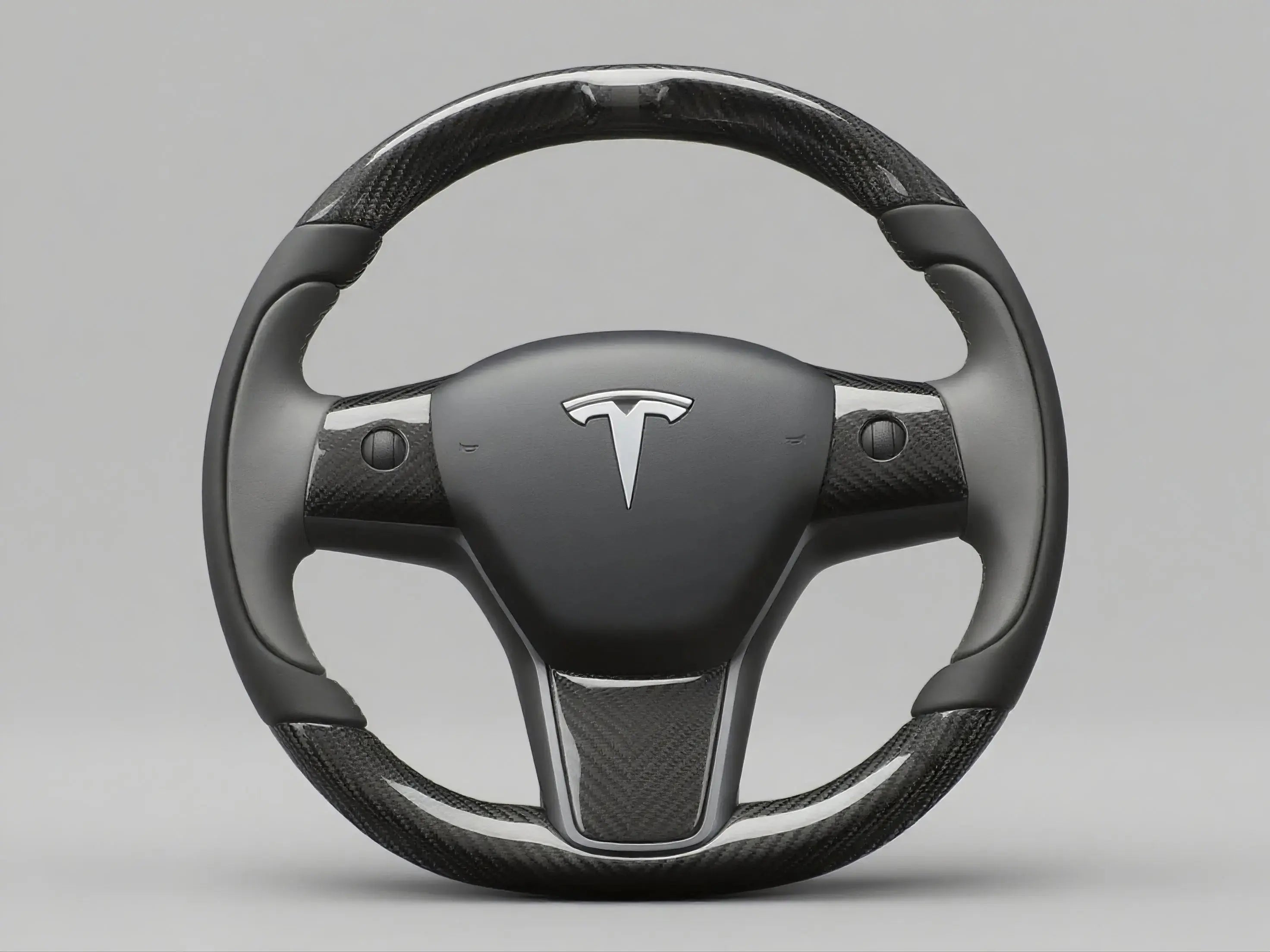
Select Carbon Fiber or Suede (Alcantara) for the material, and confirm the retention of the heating function.
For competitive racing modifications, a quick-release hub is an option.
Routine replacement requires only a T55 tool for disassembly, tightening to a torque of 80Nm, allowing for a non-destructive upgrade in just 30 minutes.
Material
Carbon fiber material reduces weight by approximately 20-30% compared to the factory Tesla steering wheel body, significantly reducing rotational inertia.
However, due to its high thermal conductivity, the surface temperature can reach over 80°C under direct summer sunlight.
Nappa leather originates from German or Italian tanning processes, with wear resistance tests typically exceeding 50,000 friction cycles.
Alcantara (68% polyester + 32% polyurethane) can provide 50% higher grip friction than genuine leather, but it requires maintenance with a specialized cleaner every two weeks to prevent fiber matting.
Carbon Fiber Craftsmanship
Fiber Bundle Specifications
The carbon fiber parameter you see most often in the modification market is 3K. This "K" represents how many single filaments are contained in a bundle of carbon fiber.
- 3K (3,000 filaments): This is the standard specification for automotive interiors and steering wheel modifications. The width of a single bundle is approximately 2mm to 3mm.
- 6K or 12K: The fiber bundles in these specifications are wider, resulting in a larger weave pattern that looks visually rougher. Although they are used often on large structural parts (like hoods), they are rarely seen on small-diameter rings like steering wheels because it is difficult to align the patterns, leading to low yield rates.
- 1K: Extremely fine texture, usually used for very precise models or watch dials. The cost is extremely high, and it is rarely used in automotive aftermarket parts.
Strength Grades
Most merchants only advertise "Japanese Toray Carbon Fiber," but the specific model is often glossed over.
- T300 Grade: This is the general industrial standard. Tensile strength is about 3,530 MPa (512 ksi), with a tensile modulus of 230 GPa. For a steering wheel that serves merely as a decorative overlay, the physical strength of T300 is completely excessive. 90% of aftermarket steering wheels on the market use this grade.
- T700 Grade: This is aerospace-grade material. Tensile strength is increased to 4,900 MPa (711 ksi). Its fiber surface is smoother, and resin wettability is slightly different. However, on a non-load-bearing structural part like a steering wheel (where the internal metal frame bears the load), T700 does not bring any difference in driving feel and is more of a marketing premium.
- Identification Method: The naked eye can hardly distinguish the difference between T300 and T700 woven cloth unless sent to a laboratory for destructive testing.
Weave Patterns
Carbon fiber cloth is not woven randomly; the direction of the texture determines the light reflection effect and the difficulty of construction.
- 2x2 Twill Weave: This is the classic "diagonal" pattern found on the Model Y Performance spoiler. Each fiber bundle crosses over two warp threads and then goes under two. This weaving method makes the cloth relatively soft with good drapability, allowing it to wrap well around the curved 3 o'clock and 9 o'clock grip positions of the steering wheel without easily causing broken patterns.
- 1x1 Plain Weave: Like a checkerboard, one over and one under. This cloth is very stable and not easily deformed, but precisely because it is too stiff, it is difficult to fit onto complex curved surfaces.
- Forged Carbon: This is actually not a woven cloth, but rather carbon fiber chopped into short strands (Chopped Strands), mixed with resin, and pressed. Visually, it looks like a chaotic marble pattern.
Process Flow
This is the watershed moment that decides whether the price is $500 or $1500.
1. Wet Layup
Currently, 80% of modified steering wheels on the market use this process.
- Method: Take an OEM steering wheel core, strip the leather, and brush on a layer of black epoxy resin base adhesive. When the base adhesive becomes tacky like double-sided tape, the craftsman manually applies the dry carbon cloth. After applying, multiple layers of transparent resin are brushed onto the cloth until the resin thickness completely covers the fibers. After curing, the surface is smoothed by hand sanding and polishing.
- Resin Content: This process cannot precisely control the amount of resin; usually, the weight ratio of fiber to resin is 50:50 or even more resin.
- Disadvantages: Because it is all hand-brushed, tiny air bubbles are easily mixed into the resin layer. You can't see them when it's newly made, but after sun exposure in summer, the air expands, and pinhead-sized white spots will appear on the surface.
2. Dry Carbon Hot Pressing (Autoclave)
This is usually used for high-end customization or racing parts.
- Method: Uses carbon fiber cloth pre-impregnated with resin by the factory (needs to be stored frozen). The cloth is laid in the mold, then covered with a vacuum bag to draw a vacuum, and placed in an autoclave.
- Parameters: Usually cured under a pressure of 6 bar (about 90 psi) and a high temperature of 120°C (250°F).
- Resin Content: The pressure squeezes out excess resin, and the final fiber content can reach 60% - 65%.
- Advantages: No bubbles, extremely lightweight, dense structure. However, in steering wheel modification, because it needs to adhere to a metal frame and the shape is complex, it is difficult to use the autoclave process for full wrapping, so it is usually only used for the trim panel at the bottom of the steering wheel.
Glass Transition Temperature (Tg) of Resin
- Cheap Resin: The Tg point may only be 50°C - 60°C. In a closed car exposed to the summer sun, the dashboard temperature easily exceeds 70°C, and the resin begins to transform from a glassy state to a rubbery state, becoming soft and deforming.
- High-Quality Epoxy Resin: High-temperature resistant resin systems used by major modification manufacturers typically have a Tg point set above 100°C - 120°C and undergo a Post-cure baking process to lock in performance.
- Clear Coat Thickness and Sun Protection
- Thickness Stacking: To create that deep 3D stereoscopic effect, craftsmen usually spray or brush a clear coat that is 1.5mm to 2mm thick.
- UV Stabilizers: Epoxy resin itself is not resistant to ultraviolet rays and will yellow over time. Qualified products must be sprayed with automotive-grade polyurethane clear coat containing UV Absorbers.
- Hardness Standard: The hardness of the clear coat after full curing should reach above Shore D 80 so that fingernails will not leave marks when scratching across it.
Leather Touch Comparison
Physical Properties of OEM Synthetic Leather
The standard Vegan Leather on the Tesla Model Y belongs to Polyurethane Composite in materials science.
- Structure: It consists of two layers. The bottom layer is a polyester fiber fabric (Polyester Backing) providing tensile strength; the surface layer is a 100% polyurethane coating used to simulate leather grain.
- Thickness: The standard thickness is usually around 1.2mm.
- Sealing: Because the surface layer is a completely sealed plastic polymer, its moisture absorption rate is 0%.
- Actual Feel: In a dry environment, the friction is acceptable. But once palms sweat, the sweat cannot be absorbed by the material and forms a micron-level water film on the surface. At this time, the Coefficient of Friction will drop sharply from 0.8 when dry to below 0.3, causing the steering wheel to slip.
- Bubbling Issue: The biggest weakness of this synthetic material is Hydrolysis Resistance. In high-temperature and high-humidity environments (such as a mixture of head oil and sweat), the polyurethane molecular chains will break, causing the skin to separate from the underlying fabric. This is the "bubbling" phenomenon often encountered by car owners. It usually occurs within a usage cycle of 30,000 to 50,000 kilometers.
Microscopic Touch of Nappa Leather
The "Nappa" mentioned in the modification market is not a specific type of cow, but a designation for a Chrome Tanning process. High-quality Nappa must be Full Grain leather.
- Pore Structure: Under a 20x magnifying glass, you can see irregularly distributed natural pores. These pores are not completely blocked by heavy coatings.
- Coating Technology: Top-tier Nappa (such as from suppliers like Hans Reinke in Germany or Pasubio in Italy) uses water-based polyurethane finishing with a thickness of only 0.02mm - 0.03mm.
- Touch Difference: Compared to the "slippery" feel of OEM synthetic leather, Nappa presents a Waxy Feel. This hand feel comes from the natural oils retained inside the leather and fatliquors added during the tanning process.
- Temperature Regulation: Genuine leather contains collagen fibers and has natural moisture absorption and release capabilities.
Impact of Perforation on Friction
Perforated Leather is not just for visual sportiness; it changes the physical topography of the surface.
- Hole Specifications: The most commonly used standard for modified steering wheels is a 1.2mm hole diameter with a pitch of 4mm or 5mm.
- Edge Effect: The edge of every tiny hole produces minor physical deformation when pressed by fingers, forming a mechanical interlocking effect. This actually increases the shear resistance between the skin and the steering wheel.
- Breathability Data: Although the Model Y does not have steering wheel ventilation like seat ventilation, physical holes break the fully sealed surface. According to tests, the Moisture Vapor Transmission Rate (MVTR) of the perforated area is about 40% higher than that of fully sealed Nappa.
- Cleaning Risks: The only physical disadvantage of perforated leather is that the holes easily accumulate skin flakes and oils. If not cleaned with a soft brush regularly (every 2-3 months), this dirt mixed with oil will clog the holes and turn into hard black spots, which is not only unsightly but also results in a loss of breathability.
Abrasion Resistance Test Data
In a laboratory environment, the Martindale Test is usually used to quantify durability.
- Test Standard: Standard wool felt is used to repeatedly rub the leather surface under a pressure of 12kPa.
- Synthetic Leather Performance: Typically, after 30,000 cycles, the surface texture begins to wear down and a "Shine" phenomenon appears; coating peeling may occur around 50,000 cycles.
- Automotive Grade Nappa: Qualified automotive-grade Nappa must pass at least 50,000 cycles without obvious wear. Some high-end custom leathers can withstand over 100,000 cycles.
- Stain Resistance: Regarding denim dye or coffee stains, synthetic leather's stain resistance is actually superior to Nappa because it is plastic. Nappa requires regular application of Leather Shield to form a sacrificial layer on the surface; otherwise, light-colored (e.g., white) Nappa is prone to Dye Transfer, and this staining is penetrating and difficult to clean.

Thermal Conductivity and Heating Function
For the heating function that Model Y owners are very concerned about, the thermal conductivity efficiency of different materials varies.
- Thermal Resistance: Genuine leather is full of air gaps (between collagen fibers), making it a natural insulator. However, since automotive Nappa is skived down to 1.1mm - 1.2mm, heat penetration is still very fast.
-
Heating Curve: Turning on steering wheel heating in a 0°C environment:
- OEM Synthetic Leather: Reaches 30°C in about 90 seconds.
- Nappa Leather: Reaches 30°C in about 100 - 110 seconds. Slightly slower, but due to the larger specific heat capacity of genuine leather, its heat retention time after heating is turned off is about 3-5 minutes longer than synthetic leather.
- Perforated Leather: Due to reduced material mass, its heating speed is between the two, and the sensation of heat radiation is more direct.
Grip Softness Adjustment
It is not just the leather that determines the hardness or softness of the feel, but also what is underneath the leather.
- Factory Setting: The Tesla factory steering wheel does not have a thick sponge layer under the leather; the feel is on the harder side, directly feeding back the hardness of the frame.
- Modification Process: Before wrapping with Nappa, high-quality modification shops will first apply a layer of 2mm thick closed-cell Neoprene or high-density sponge to the frame.
- Result: This increases the Grip Circumference by about 4mm.
Suede (Alcantara) Maintainability
Not Real Leather, But High-Tech Plastic
First, a concept must be corrected: Alcantara is not leather; it has absolutely nothing to do with animals. It is a synthetic composite material, scientifically named "Ultra-microfiber synthetic leather."
- Component Ratio: Approximately 68% Polyester provides strength and wear resistance, and 32% Polyurethane provides a soft touch and color.
- Manufacturing Process: It uses a technology called "Island-in-the-sea" spinning. You can imagine it as a very thin thread wrapping even thinner threads. After chemical dissolution treatment, the diameter of a single fiber is only about 0.0001 mm.
- Density Data: These extremely fine fibers are stacked together, creating a huge surface area. Every square centimeter of Alcantara surface may have millions of tiny fiber ends.
Friction Coefficient
- Dry Friction Coefficient: Ordinary leather is about 0.8 - 1.0, while Alcantara can reach over 1.2.
- Wet Friction Coefficient: This is the key point. When palms sweat, the friction of genuine leather will plummet to 0.4 (slipping), while Alcantara can maintain a friction coefficient of around 1.0 because those tiny fibers can absorb sweat into the gaps.
- The Price: This sponge-like absorption ability means it not only absorbs sweat but also absorbs oils, dead skin cells, and hand cream residues. These things mix together like glue, sticking the originally upright fibers together causing them to lay flat on the base.
Looking "Bald" Is Actually Just Dirty
Many car owners find that the 3 o'clock and 9 o'clock positions of the steering wheel become black and shiny after half a year, feeling hard and slippery to the touch, and think the fibers have been Worn out.
Absolutely wrong. Alcantara is much more wear-resistant than genuine leather.
- Physical Truth: That is Matting. That shiny layer is a hard crust formed by oil mixed with dust, pressing the fibers flat. The fibers underneath are usually intact.
- Recovery Test: As long as the correct solvent is used to dissolve and remove this "grease glue," the fibers can stand up again and restore the original matte texture.
Compulsory Course: Daily Dry Clean
If you want to keep your Alcantara steering wheel looking like new, perform this action every two weeks, taking 2 minutes.
You need a soft brush. Do not use hard plastic brushes or metal brushes; a horsehair brush or a specialized interior Detailing Brush is best.
- Technique: No water, no chemicals. Just take the dry brush and brush in one direction to comb the fibers.
- Purpose: This pops out the dust hidden deep in the fibers, preventing dust particles from cutting at the fiber roots like sandpaper.
Advanced Course: Wet Clean
Frequency is about every 3 months or every 3000 kilometers.
- Cleaner Selection: Never use All-Purpose Cleaner (APC), because many APCs are alkaline and will burn the fibers, causing them to harden. You must choose specialized Alcantara cleaners like Sonax, Dr. Beasley's, or Colourlock. If unavailable, warm water mixed with a tiny amount of dish soap (100:1) can be used in an emergency, but the effect is discounted.
- Towel Taboo: Must use a White Microfiber Towel. Because Alcantara has very strong adsorption, if you use a red towel, the steering wheel might be dyed pink.
-
Standard Process:
- Spray on Cloth: Never spray the cleaner directly onto the steering wheel. Liquid seeping in dries with difficulty and can cause internal mold or damage the heating wire. Spray the cleaner on the towel to moisten it, do not let it drip.
- Press and Wipe: Wrap the towel around the steering wheel grip, squeeze firmly, and rub gently. You will see the towel turn black; that is the oil being transferred out.
- Sorb Moisture: Switch to a dry towel and press firmly to absorb residual chemicals and moisture.
- Fluff Up: While the fibers are still slightly damp, use a dry brush to stand the fibers up.
Rescue Course: Pilling Treatment
After two or three years of use, high-frequency friction areas may develop small pilling balls. This is formed by broken polyester fibers tangling together, which is normal physical wear.
- Treatment Tools: Extremely fine sandpaper (1500 - 2000 grit) or a high-quality Fabric Shaver.
-
Operating Technique:
- Sandpaper Method: Gently sand the pilling area in one direction. Do not press down hard; the goal is to cut the pills, not wear down the base.
- Fabric Shaver: No need to explain much, just go over it like shaving a beard.
- Effect: After treatment, perform a wet cleaning. The feel can be restored to about 90% of a new wheel.
| Maintenance Item | Frequency Suggestion | Tool | Purpose |
|---|---|---|---|
| Brushing | Every 1-2 weeks | Soft brush | Prevent fiber matting, remove floating dust |
| Degreasing | Every 3 months | Special cleaner + White towel | Dissolve body oils, restore grip |
| Deep Refurbishment | As needed (approx. 2 years) | 2000 grit sandpaper | Remove pilling, smooth surface |
Life Expectancy Data
If you are a "lazy person" who never cleans the steering wheel:
- 6 - 8 Months: The grip area becomes completely shiny, feels greasy, and grip is lost.
- 12 - 18 Months: Fibers begin to become brittle and fall off due to long-term immersion in acidic sweat, causing irreversible bald spots.
Functional
The steering ratio of the Tesla Model Y is fixed at 10.3:1, and the steering wheel turns from lock-to-lock in about 2.0 turns.
Without the support of Steer-by-Wire technology, modifying to a Yoke (half-width) steering wheel leads to difficulties in hand-over-hand operation during low-speed parking or large-angle turns, creating physical operational blind spots.
Functional assessment must prioritize heating system compatibility. Model Ys produced after 2021 come standard with steering wheel heating.
Modification parts must feature built-in heating wires and temperature control modules that match the original factory voltage; otherwise, the function cannot be activated via the central control screen.
In addition, ergonomic modifications usually thicken the grip cross-section from the original oval to a 38mm-40mm perfect circle to increase grip friction at the 3 o'clock and 9 o'clock positions.
Steering Ratio Limitations
OEM Mechanical Structure Constraints
The Model Y's steering system is based on a traditional Rack and Pinion mechanical structure, with a direct physical connection between the steering wheel and the front wheels.
This is fundamentally different from the Steer-by-Wire system used in the Cybertruck or the new Model S/X. The Model Y's Steering Ratio is set at around 10.3:1.
This number means: if you turn the steering wheel 10.3 degrees, the front wheels will only deflect 1 degree.
In daily driving, this ratio is tuned towards "sportiness," being more sensitive than ordinary family cars (usually 14:1 or 16:1).
However, in the scenario of modifying to a semi-width (Yoke) steering wheel, this fixed mechanical ratio becomes the biggest physical limitation.
Because no matter what shape of steering wheel you install, the physical travel of the Steering Rack remains unchanged.
To turn the wheels from lock-to-lock, the driver still needs to turn the steering wheel about 2.0 turns (approx. 720 degrees).
Physical Risk of Grabbing Air
When the steering wheel shape changes from circular to rectangular (Yoke) or semi-circular, the upper rim from the 11 o'clock to 1 o'clock position disappears.
When fine-tuning direction on the highway (only needing to turn 5-10 degrees), this has no impact and even feels better due to the open view.
The problem is entirely concentrated in scenarios involving turns greater than 90 degrees.
On a standard round steering wheel, drivers are accustomed to using the "Hand-over-Hand" method to turn.
When one hand turns the steering wheel past the central axis, the other hand naturally reaches for the 12 o'clock position to continue pulling.
But after installing a Yoke on a Model Y, when you need to turn through an intersection or enter/exit a roundabout, your hand will habitually reach for the 12 o'clock position, only to grab air.
Operational Burden During Parking
The most extreme test occurs during low-speed parking or Three-point turns. At this time, you need to frequently turn the steering wheel all the way to the lock.
- Round Steering Wheel: You can press the steering wheel rim with your palm (Palming) with one hand and rub it quickly to complete 2 rotations.
- Irregular Steering Wheel: Since the Yoke is not a continuous circle and has sharp corners, you cannot use the "palm rubbing" method. You must grab the handles at 3 o'clock and 9 o'clock alternately with both hands like operating an industrial valve, or grab the flat bottom of the lower part.
Data shows that completing a standard parallel parking maneuver requires the driver to perform substantial hand-over operations 4 to 6 times on average.
Using a Yoke steering wheel increases the time for this process by about 30%, and because leverage cannot be utilized efficiently, the wrist has to bear greater torque, especially when turning the wheel while stationary.
Roundabout Awkwardness
On roads with dense roundabouts in Europe or the US, the disadvantage of a fixed steering ratio is magnified.
When the vehicle enters a roundabout and needs to maintain a continuous steering angle (e.g., turning left 120 degrees), drivers using a Yoke steering wheel will find their hands in an extremely awkward "crossed lock" state.
At this point, the left hand has turned to the lower right, and the right hand has turned to the upper left, with both arms crossed in front of the chest.
If a sudden situation in the roundabout requires emergency avoidance or course correction, this crossed-arm state severely limits your reaction speed and range of motion.
A round steering wheel, however, allows you to slide your hands to uncross your arms while maintaining the steering angle, always keeping a "maximum torque" power posture.
The Absence of Steer-by-Wire
To understand why Model Y modifications have limitations, we need to look at what technology truly adapts to a Yoke.
The Steer-by-Wire technology used in the Lexus RZ450e or Tesla Cybertruck features Variable Steering Ratio capabilities.
| Feature | Model Y (Mechanical Steering) | Cybertruck (Steer-by-Wire) |
|---|---|---|
| Physical Connection | Rigid connecting shaft | None (Electrical signal transmission) |
| Low Speed Steering Ratio | Fixed 10.3:1 | Extremely low (approx. 3:1 ~ 4:1) |
| Lock-to-Lock Turns | 2.0 Turns (720 degrees) | < 1 Turn (approx. 340 degrees) |
| Hand-over Operation | Must change hands | Hands never leave wheel (9 & 3 o'clock) |
As shown in the table, a true Yoke-adapted system allows the wheels to turn fully with less than 180 degrees (half a turn) of steering wheel rotation.
The driver's hands never need to leave the 3 o'clock and 9 o'clock positions, so there is simply no need to reach for the non-existent 12 o'clock rim.
The Model Y lacks this system, directly leading to a separation of "form" and "function" after Yoke modification.
The modification parts can only mimic the appearance but cannot change the physical fact that the steering rack requires multiple rotations.
Emergency Posture Correction Difficulty
When driving on slippery surfaces or in snow, if the vehicle experiences a slide (Oversteer), the driver needs to counter-steer to save the car.
On a round steering wheel, drivers usually relax their palms, allowing the steering wheel with self-aligning torque to spin back quickly in their hands (Self-centering spin), and then grab it at the appropriate angle.
On a Yoke steering wheel, due to uneven weight distribution (heavy bottom, empty top) and irregular shape, you would never dare to let go and let it spin at high speed in your hands.
The protruding handle ends can easily injure fingers or snag sleeves.
You must hold it tightly with both hands at all times and actively turn it back to the center position.
In a split-second loss-of-control recovery scenario, this increases operational complexity and the probability of error.
Impact of Size on Torque
Besides shape, size is also part of the steering ratio experience. The factory Model Y steering wheel diameter is about 360mm.
Many Yoke or racing steering wheels on the aftermarket, in pursuit of visual impact, will make the width wider (e.g., 370mm) or make the height extremely flat (vertical height only 280mm) to free up legroom.
- Leverage Change: With a wider horizontal size at the 3 and 9 o'clock positions, your lever arm becomes longer, and turning feels slightly lighter.
- Vertical Blind Spot: However, when performing large turns where hands have to grab the upper and lower edges of the steering wheel (if they exist), the extremely flat vertical height makes you feel the lever arm suddenly shorten, instantly increasing steering resistance.
Heating Function Matching
Hardware Generation Gap Differences
Before discussing heating, you must figure out which production period your Model Y belongs to.
Tesla does not follow traditional "Model Year" logic on the production line; hardware changes often happen silently.
For heated steering wheels, the Model Y has two main hardware version cut-off points:
- Pre-2021 Old Models: Early Model Ys (mostly produced in 2020) did not come standard with heated steering wheel hardware, and there was not even pre-laid wiring in the hardware. The Clock Spring in these models lacks the pins required to transmit high current for heating. Modifying these models requires replacing the entire Steering Column Control Module (SCCM), which is extremely expensive, and 90% of heated steering wheels on the aftermarket do not directly support these older cars.
- 2021 and Later (Major Cut-off): Starting from early 2021, factories in Shanghai and Fremont successively began making heated steering wheel hardware standard on all Model Ys. Even if some entry-level versions (like the RWD version) had the feature software-locked at delivery, the hardware (heating wire and harness) is present.
The technical trap here is: although they are all 2021+ models, the wire harness interface has changed.
- Old Interface: Some early 2021 models use traditional resistive heating logic.
- New Interface: 2022+ and newer Model Ys fully shifted to control logic based on LIN bus communication.
If you buy the wrong version, for example, installing a steering wheel with old logic onto a 2023 model car, not only will the heating not work, but it may also trigger vehicle alarms (VCFRONT error) because the car's computer detects an abnormal resistance load.
Transplant vs. Built-in Heating Wire
In steering wheel modification, there are two completely different paths for implementing the heating function, which directly determines durability and heating uniformity.
Path 1: Transplanting Factory Heating Layer (Rare and Risky)
Very few manual workshops will try to peel open the factory steering wheel leather and carefully tear off the heating pad (Heating Element) with resistance wires, then paste it onto the new frame.
- Risk: The heating wire is very fragile, less than 0.5mm thick. Invisible breaks are extremely likely to occur during the peeling process.
- Consequence: It might work initially, but after two months of use, the break will form a high-resistance Hot Spot, potentially burning through the leather.
Path 2: Using Aftermarket Built-in Heating Module (Mainstream Solution)
Mature modification brands (like Hansshow, T-Sportline) prefabricate brand new heating layers on newly molded frames.
- Power Matching: The Model Y factory heating power is usually set between 45W and 60W, capable of raising the surface temperature to around 38°C (100°F) within 1-2 minutes.
- Thermistor (NTC): In addition to the heating wire, an NTC thermistor sensor must be buried inside the steering wheel. It is the "eye" of the vehicle's temperature control system. If the modified wheel does not have this sensor, or the sensor parameters are incorrect (e.g., factory is 10kΩ, aftermarket used 50kΩ), the vehicle will think the steering wheel is overheated and cut off power, or think the steering wheel is cold and heat indefinitely, causing it to become scalding hot.
Compatibility of Software Control
Many car owners find that after modification, the "Steering Wheel Heating" icon on the central control screen is grayed out or unresponsive. This is usually not a physical wiring issue, but a handshake protocol failure.
Tesla's software system (especially v11 and later versions) has strong hardware self-check capabilities. When the heating button is clicked, the Body Controller sends a pulse current for detection.
- Cold Resistance Detection: The controller measures the circuit resistance. If the modified steering wheel's heating wire resistance is too low (e.g., less than 2Ω), it is judged as a short circuit; if too high (greater than 10Ω), it is judged as an open circuit.
- LIN Bus Handshake: For newer Model Ys, the heating command is a digital signal. The modified steering wheel must have a Decoder Chip inside to "trick" the computer into thinking it is connected to an OEM part.
This leads to a typical fault: Heating turns off automatically after 30 seconds. This is because the car computer sent the command but did not receive the correct feedback signal, forcing a power cut for safety reasons.
Impact of Material on Thermal Conductivity
The wrapping material you choose will greatly affect the heating performance.
The factory uses polyurethane synthetic leather (Vegan Leather), which has uniform thickness and acceptable thermal conductivity.
Common materials for modification are:
- Nappa Leather: Although it feels good, natural leather is usually thicker than synthetic leather (approx. 1.2mm - 1.4mm). If the modification shop does not increase the heating power accordingly, you will feel the heat comes very slowly, like lukewarm water.
- Alcantara / Suede: This is one of the materials with the worst thermal conductivity. Its internal structure is full of air (insulator). At the same power, the surface temperature of an Alcantara steering wheel may be 5°C - 8°C lower than a leather version. If you live in extremely cold regions like Minnesota or Canada and must choose Alcantara, ensure the supplier uses a High Output Heating Pad specifically for this material.
-
Carbon Fiber Areas: This is even more complicated. For the vast majority of carbon fiber steering wheels, the carbon fiber part is not heated.
- Physical Reason: The carbon fiber surface is covered with a thick layer of epoxy resin (Clear Coat). It is difficult to lay heating wires underneath, and the resin tends to yellow or soften when heated.
- Driving Experience: In winter, while the leather areas at 3 and 9 o'clock are warm, touching the carbon fiber areas at 12 or 6 o'clock inadvertently will feel like touching an ice block.
- Full Heating Option: Only very few high-end custom options (usually priced at $1500+) offer "all-wheel heating" technology, treating the carbon fiber layer internally, but this significantly increases manufacturing difficulty and cost.
Hardware Transplant Logic
Since I Only Bought the "Frame," How Do I Move the Rest?
When you receive that expensive delivery box and open it, usually lying inside is a "bare wheel" with only the metal structure and leather wrapping.
This is the so-called Core Exchange logic. 95% of custom steering wheels on the market—whether entry-level models for $500 or high-end ones for $2000—sell you only a processed magnesium-aluminum alloy casting.
You need to move all the electronic organs from the original car steering wheel to this new frame seamlessly, like performing a surgical transplant.
This process is much more complicated than turning a few screws; any tiny tolerance deviation will lead to stuck buttons or airbag failure.
Disassembly and Backfilling of Airbag Module
The Model Y Driver Airbag Module is "grabbed" onto the steering wheel frame by internal spring clips, without any screw fixation.
- Disassembly Technique: You need two slender tools (usually hex keys or flathead screwdrivers) to poke into the release holes on the side and bottom of the steering wheel simultaneously.
- Power-off Protection: Before starting, you must cut off the vehicle's low-voltage power supply (12V or 16V lithium battery). If you unplug the yellow main airbag plug while powered on, the vehicle's RCM (Restraint Control Module) will immediately record an uncleareable Hard Code.
- Backfilling Tolerance: When you press the airbag into the new custom steering wheel, you must hear two crisp "clicks." Some inferior modified wheel frames have poor casting precision, with locking pin position deviations exceeding 1mm, causing the airbag to be impossible to press down no matter how hard you try, or one side is high and the other low after pressing.
Precision Trap of Scroll Wheel Control Modules
The left and right Scroll Wheels are the physical interface for Model Y human-machine interaction.
They are not just two wheels, but complete assemblies containing circuit boards, microswitches, and plastic housings.
When transplanting this part, you will encounter an extremely common problem: Stuck Buttons.
The button holes of the factory steering wheel are designed based on ordinary plastic or thin leather wrapping.
Custom steering wheels, especially carbon fiber versions, are covered with a layer of Epoxy Resin and Clear Coat.
- Thickness Conflict: This extra coating is usually 0.8mm to 1.2mm thick. If the manufacturer did not pre-calculate this Shrinkage Allowance on the mold, the new holes will be too small.
- Consequence: When you force the factory scroll wheel module in, the plastic frame around the scroll wheel gets squeezed and deformed. You will find that the wheel can scroll but is hard to press down (click to confirm function), or it won't pop up after being pressed.
- Solution Logic: Experienced installers will measure the hole diameter of the new wheel with a caliper before transplanting. If found too tight, fine sandpaper is needed to carefully sand the inner side of the clear coat until the scroll wheel module can slide in without resistance.
The "Art of Routing" Internal Wiring
Inside the magnesium alloy frame of the steering wheel, there are various grooves and clips used to fix the wire harnesses connecting the airbag and buttons.
- Preventing Interference: You cannot stuff wires randomly here. The Model Y steering wheel back has a floating Damper module, and the airbag itself is also floating. The wiring must strictly follow the preset grooves.
- Pinching Risk: If you leave wires outside the grooves, when the driver presses the horn hard or the airbag deploys, the metal frame might act like scissors and directly cut the wires, or wear through the insulation causing a short circuit.
- Connector Fragility: The Model Y uses extremely fine ribbon cable connectors internally. Especially the white plug connecting the scroll wheel module, its pins are very soft. Never pull the wire when unplugging; you must use a fingernail or plastic pry bar to push against the locking tab of the plug.
Steering Column Spline and Center Bolt
When you put the new steering wheel onto the Steering Column, this involves pure mechanical connection safety.
- Spline Alignment: Both the steering column and the center of the steering wheel have dense teeth (Splines). There is usually a "wide tooth" as a fool-proof design to ensure you can only install it at one angle.
-
Torque Spec:
- The steering wheel is secured by a huge 10mm Hex Bolt.
- Standard Torque: Tesla's service manual requires this bolt to be tightened to 80 Nm (approx. 59 ft-lbs).
- Threadlocker: During secondary installation, the old glue has failed. Although many people just tighten it and call it a day, the standard practice is to clean the old glue and apply new medium-strength threadlocker.
The Absolute Taboo of the Clock Spring
Although the Clock Spring remains on the car and is not part of the steering wheel itself, it is the "high-value victim" most easily damaged during the transplant process.
- Position Maintenance: After you pull off the old steering wheel, that black disc exposed is the clock spring.
- Do Not Rotate: Without the restriction of the steering wheel, the clock spring can rotate freely. Do not get itchy hands and turn it! The length of the ribbon cable inside the clock spring is limited. If it is accidentally rotated one full turn (360 degrees) during disassembly, although the position looks unchanged, the internal cable has been pulled tight.
- Catastrophic Consequence: When you install the new steering wheel and turn it to Full Lock for the first time, the pre-tensioned internal cable will snap instantly.
Quick-Release Systems
Modifying with NRG Gen 2.5 or Works Bell Rapfix and other quick-release components requires the removal of the Model Y factory driver's side SRS Airbag.
This will result in the vehicle failing the US OBD-II annual inspection or the EU MOT test, and may render insurance policies immediately void.
Due to the physical disconnection, you must cut the two main control wire harnesses on the steering wheel.
The direct consequence is the inability to adjust side mirrors, steering column position, and volume.
Unless a custom Bluetooth control module is soldered additionally, 90% of the vehicle's human-machine interaction functions will be unusable.
Track & Anti-theft Requirements
Roll Cage Blocking Legs
To meet safety regulations for track days, Model Y owners typically install a four-point or six-point Roll Cage behind the B-pillar.
- Impact of Side Bars: The side impact bar (Door Bar) of the roll cage is usually located 20 to 30 centimeters above the door sill.
- Limitations of Fixed Bucket Seats: When combined with Recaro or Sparco fixed-back bucket seats (Bucket Seat), the seat rails are usually locked in a specific driving position and cannot slide back like factory seats.
- Space Conflict: In this case, the distance between the lower edge of the steering wheel and the thigh support cushion of the seat may be only 15 centimeters left.
Adjusting Steering Wheel Distance
The factory Model Y steering wheel Telescoping range is only about 40 mm to 50 mm.
For drivers with taller stature or special arm length proportions, when strapped firmly into the seat by a seatbelt, they often cannot reach the top edge of the steering wheel.
- Leverage Principle: Competitive driving requires elbows to be bent at around 90 degrees to complete 180-degree crossover steering without leaving the seat back.
-
Spacer Effect: Installing a quick-release system essentially acts as a "steering column extender."
- Short Hub: Occupies about 45 mm length.
- Quick Release Body: Occupies about 60 to 65 mm length (e.g., Works Bell Rapfix II).
- Steering Wheel Dish: The racing steering wheel itself may have a depth of 0 to 90 mm.
- Result: This combination can bring the steering wheel more than 100 mm closer to the driver's chest.
Physical Isolation Signal Hijacking
Although Tesla is equipped with Sentry Mode and PIN-to-Drive functions, theft technologies targeting keyless entry systems are also upgrading.
- Signal Relay Attack: Thieves use signal amplifiers to capture the Bluetooth signal of the car key or phone inside the house, tricking the vehicle into unlocking and starting.
- OBD Port Injection: More advanced methods involve injecting codes through the OBD-II port to simulate authorization.
- Barrier of Missing Hardware: The quick-release system provides absolute defense at the physical level. When you take the steering wheel into the house, thieves face a bare steering column spline shaft. No tool can clamp onto this smooth metal shaft less than 20 mm in diameter and generate enough torque to turn a 2-ton vehicle.
Only Ball-Lock Structures Are Reliable
Quick-release structures on the market are mainly divided into two types. For high-horsepower electric cars like Tesla, the choice of structure directly affects steering feel.
-
Ball-Lock Type: Recommended. Such as NRG Gen 2.0/2.5/3.0 or Works Bell. Relies on 4 to 8 steel balls snapping into grooves to lock.
- Connection Stiffness: This structure can withstand extremely high torque, and as it wears with use, its self-locking mechanism automatically eliminates gaps, maintaining "zero play" over the long term.
- Operation Speed: Pressing the safety button and pulling the sleeve with one hand can complete disassembly within 1 second.
-
Spline-Type: Common in cheap knockoffs or karting accessories. Relies on gear meshing.
- Wear Issues: Aluminum alloy gears will wear out after frequent disassembly, causing slight wobbling of the steering wheel at the start of turning. With the Model Y's extremely sensitive 10.3:1 steering ratio, this tiny wobble is magnified, leading to a significant drop in confidence when driving at high speeds.
- Alignment Difficulty: It is hard to align the gear angle at once in dark environments, lacking the blind-operation guidance of the ball-lock type.
Hardware Adaptation Details
Must Count Spline Teeth Clearly
The first step in installing a quick-release hub is to remove the factory steering wheel, exposing the metal shaft of the steering column. The end of this shaft is covered with fine teeth, called Splines.
- Universality Trap: Many people mistakenly believe that Tesla shares spline specifications with certain Japanese cars (like Honda or Nissan), but this is usually wrong. Although visually similar, tiny differences in tooth count and diameter will cause the hub to fail to insert, or strip the teeth after forced insertion.
- Model 3 & Y Commonality: Model 3 and Model Y produced from 2017 to 2023 share the same steering column specifications. If you are looking for a Hub Adapter on eBay or Amazon, you must confirm that its part number explicitly states support for "Tesla Model 3/Y".
- NRG SRK-190H Parameters: This is currently the most mainstream adapter hub in the North American modification market. Its internal splines are precision machined to tightly mesh with Tesla's steering shaft.
- Clock Spring Positioning Is the Biggest Trouble
The airbag Clock Spring is a plastic disc located behind the steering wheel, with flat cables coiled inside responsible for connecting airbag, horn, and button signals.
- Factory Structure: On the Model Y, the back of the steering wheel has specific grooves to engage the clock spring so it moves with the wheel.
- Lack in Modified Hubs: Most racing Short Hubs have a flat back without corresponding slots.
- Consequence: If you tighten the center nut directly, the back of the hub will press dead against the clock spring disc, causing the steering wheel to be unable to turn, or instantly snapping the internal cables when forced to turn.
- Solution: You must check if the Short Hub you bought (like NRG SRK-190H) has two positioning holes reserved for the Tesla clock spring on the back. If not, you need to use a Dremel tool to manually cut two 5 mm deep grooves in the aluminum alloy back of the hub to allow the positioning pins on the clock spring to insert.
Torque Wrench Cannot Be Skimped
Tesla's steering column nut is a huge hex nut, usually requiring a 10 mm hex socket or a 21 mm socket wrench to remove.
- Factory Torque: The tightening torque during factory assembly is about 50 Newton-meters (37 lb-ft). Although not large, due to the threadlocker, the instantaneous torque required for removal can be significant.
- Installation Torque: When installing an aluminum alloy short hub, absolutely do not use an Impact Gun. Aluminum alloy is much softer than the factory steel frame. Using an impact gun is extremely likely to strip the aluminum splines in the center of the hub, causing the steering wheel to spin freely on the shaft.
- Operational Standard: A manual torque wrench must be used, set to around 40 Newton-meters (30 lb-ft). This is an empirical value that ensures locking without crushing the aluminum alloy material. Applying a small amount of blue Loctite 242 threadlocker to the threads is a standard operation to prevent loosening.
How to Connect the Resistor to Trick the Computer
The Model Y's Restraint Control Module (RCM) monitors the resistance of the airbag circuit in real-time.
When the yellow airbag plug is unplugged, the resistance becomes infinite, and the RCM determines it as an open circuit fault.
- Resistor Specs: This is an extremely sensitive value. Usually, a resistor between 2.0 Ohms and 3.3 Ohms is needed, with a power of 0.25 Watts being sufficient. Most high-quality quick-release hub kits (like Works Bell) will include this resistor.
- Wiring Method: The airbag plug usually has two Pins. You need to insert the two ends of the resistor into these two holes respectively to form a closed loop.
-
Securing the Resistor: Vibration during driving can easily cause the resistor to fall out.
- Bend the resistor leads into a U-shape and insert into the plug.
- Use electrical insulation tape (Electrical Tape) to wrap the resistor and plug tightly together.
- Use a Zip Tie to secure this bundle of wires in the void inside the hub to prevent it from banging and making noise or being cut by the hub during steering.
- Warning Light Reset: Even if the resistor is plugged in, if the operation was done while powered on (12V/16V low voltage battery not disconnected), the airbag light may still be on.
Horn Wire Needs DIY Modification
The factory Model Y horn trigger is integrated into digital signals, but physically, the hub still provides a single horn ground contact.
- Single Wire Grounding: Racing steering wheel horn buttons are usually single-wire grounded. When the button is pressed, the circuit grounds and conducts, triggering the horn.
- Harness Conversion: The harness included with the hub usually has a red wire (positive) and a black wire (negative). You need to find out which pin on the hub corresponds to the horn signal wire in the factory plug.
- DIY Difficulty: Tesla's wire harness colors may change with the year. You need a multimeter to test continuity when someone presses the horn (or simulates connection). Typically, you need to pull a non-airbag wire from the factory plug and connect it to the metal ring of the quick-release hub, using the hub's metal contact to transmit current.
Functional Deficit Comparison
Assisted Driving Becomes a Nightmare
Model Y's Autopilot and FSD (Full Self-Driving Capability) systems rely heavily on the Torque Sensor and capacitive grip sensor on the steering wheel.
- Grip Detection Failure: The factory steering wheel rim has a capacitive sensing layer buried inside; as long as a hand is on it, the system knows you are watching the road. After switching to an OMP or Momo metal steering wheel, this signal source completely disappears.
-
Torque Input Difficulty: Current Autopilot requires you to apply slight steering torque every 15 to 45 seconds to confirm the driver is online.
- Factory State: The torque sensor is sensitive; just a gentle twist eliminates the blue flashing reminder on the screen.
- Quick-Release State: The sensor is in the factory steering wheel, which you have already thrown in the trunk. The vehicle can only detect your input through resistance changes in the Steering Rack.
- Result: The vast majority of owners who install quick releases will be forced to completely abandon using Autopilot because the constant blue flashing alerts and ear-piercing beeps will lead to a breakdown.
Mirrors Cannot Be Adjusted
This is the most easily overlooked, but the consequences are the most maddening functional loss.
- Logic Loop Broken: In traditional cars, there are physical rockers on the door panel to adjust mirrors. On the Model Y, you must click the "Mirrors" menu on the screen, and then the system prompts you: "Scroll the left scroll wheel to adjust position".
- Dead Loop: You are now facing a bare racing steering wheel with no left scroll wheel. You look at the prompt on the screen but cannot give the vehicle any commands.
- Position Locked: If you did not adjust the mirrors to the perfect position before removing the factory steering wheel, or if a different driver needs to readjust, you will be helpless.
- Only Solution: Dig out the factory steering wheel, unplug the quick-release steering wheel, temporarily plug the factory wheel back into the hub, connect the harness, adjust the mirrors, disconnect the harness, and put the quick-release wheel back on. This is an extremely ridiculous and inefficient process.
Steering Column Adjustment Stuck
Exactly the same as the mirror issue, the Model Y's steering wheel forward/backward (Telescoping) and up/down (Tilt) adjustments are also completed through the screen menu in conjunction with the left scroll wheel.
- Ergonomic Disaster: After installing a quick-release hub, the steering wheel will protrude towards the driver. Logically, you should retract the steering column towards the dashboard to offset the thickness of the hub.
- Inoperable: But because there is no scroll wheel, you cannot control the steering motor to work. You are forced to accept the current steering column position. If the previous setting was relatively far back, adding the quick-release hub might cause the steering wheel to almost touch your chest, leading to an extremely distorted driving posture.
Audio and Voice Control Completely Cut
Although this looks non-fatal, touching the screen while driving significantly increases distraction risks.
- Volume Adjustment: You can no longer adjust music volume by scrolling your thumb. You must reach out to click the tiny speaker icon at the bottom right of the screen and then operate on the slider.
- Song Skipping: Cannot switch Spotify or Apple Music tracks by flicking the scroll wheel left/right.
- Voice Wake-up: The factory right scroll wheel press wakes up the voice assistant ("Open Glovebox", "Navigate to home"). After losing this button, you must click the microphone icon on the screen, or enable "Always Listen" mode (if the software version supports it), but this increases power consumption and privacy concerns.
Cold Weather Package Disabled
The Model Y's factory steering wheel heating function is very efficient, capable of heating the surface temperature to over 30 degrees Celsius within 60 seconds.
- Physical Disconnection: Racing steering wheels are usually made of aluminum alloy frames wrapped in Alcantara or leather, with no internal resistance heating wires.
- Power Loss: Even if you buy an extremely rare custom modified wheel with heating functions, the physical structure of the quick-release hub (ball-lock or spline) cannot transmit the high current required for heating.
- Software Blocking: The vehicle cannot detect the resistance value of the heating element and may automatically gray out the heating icon on the APP or central control screen, or there is no response after clicking.