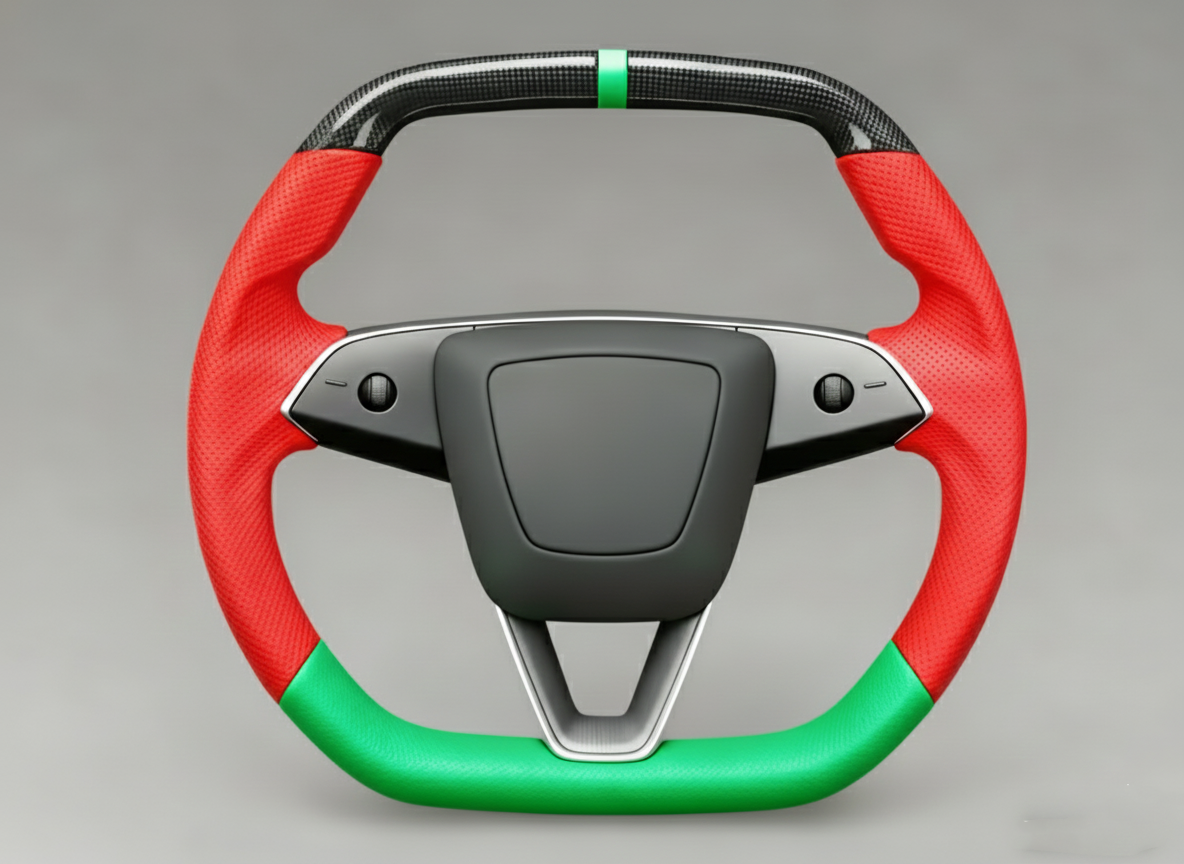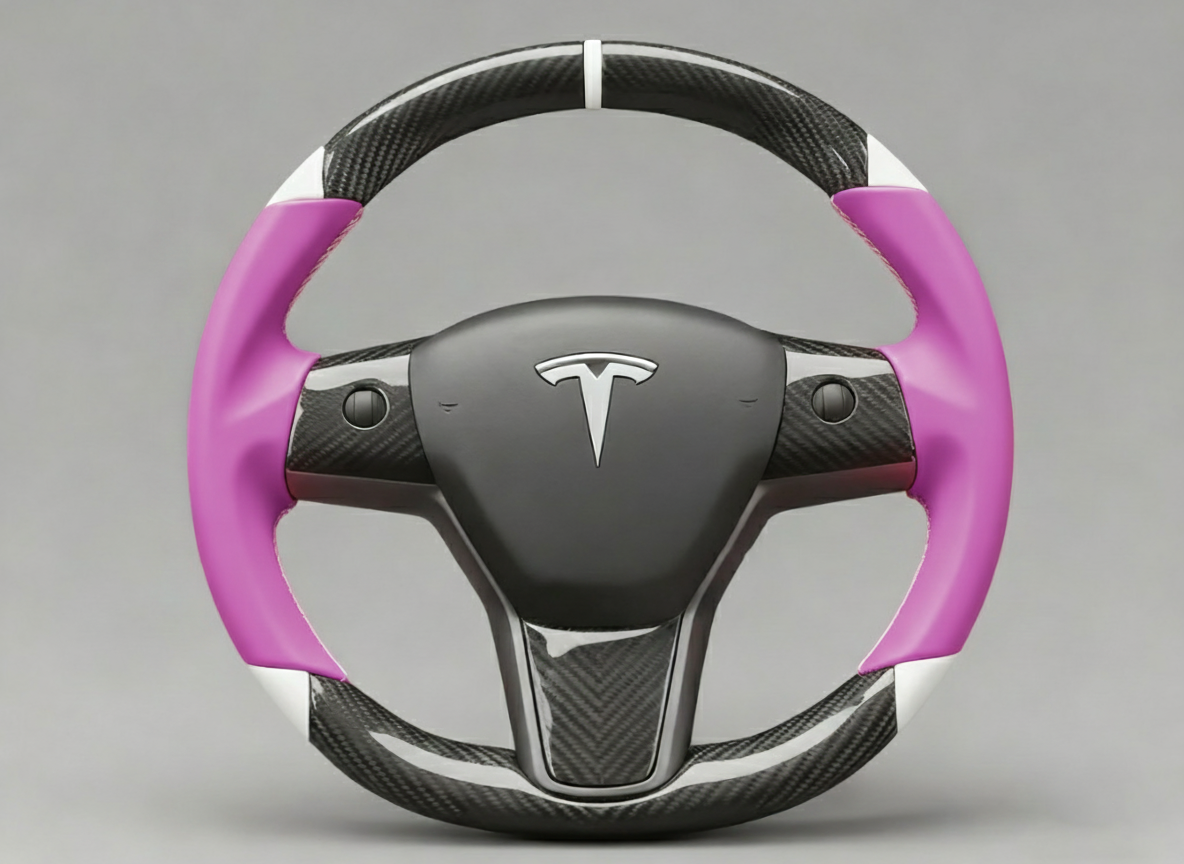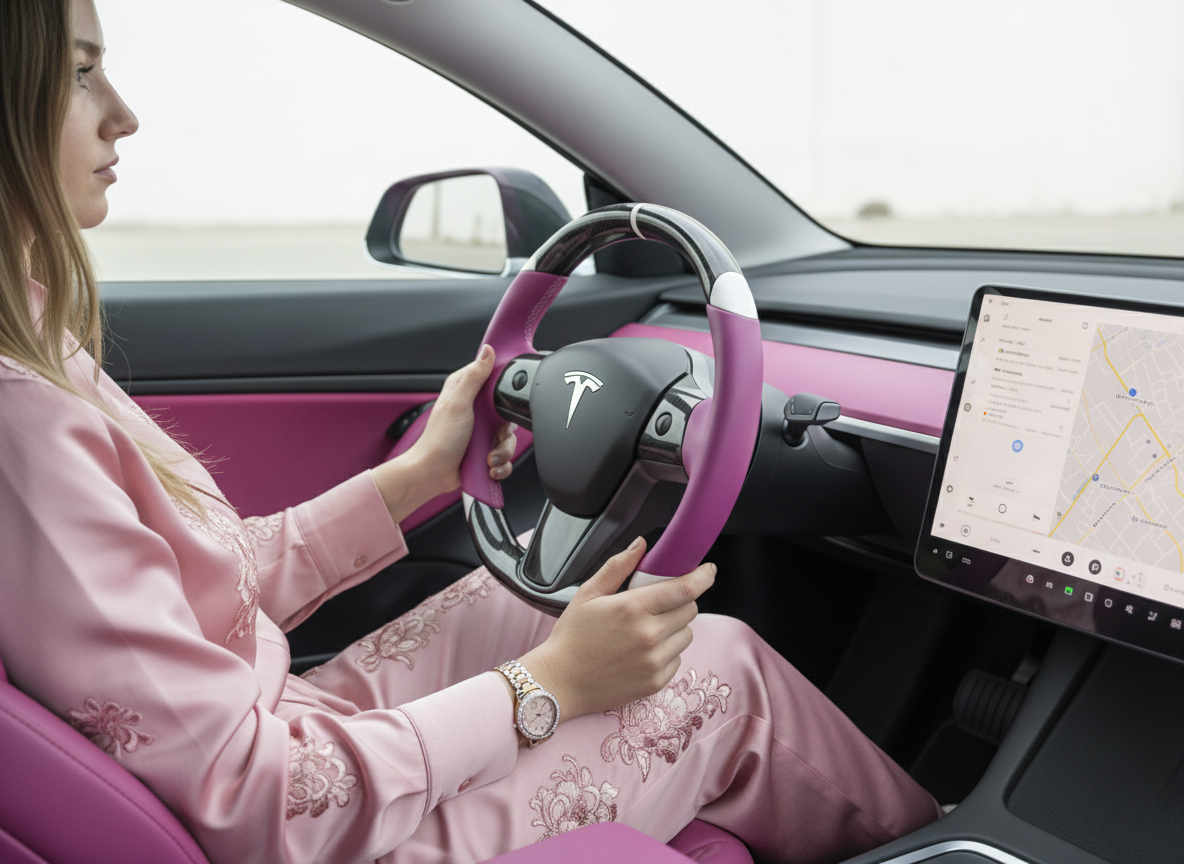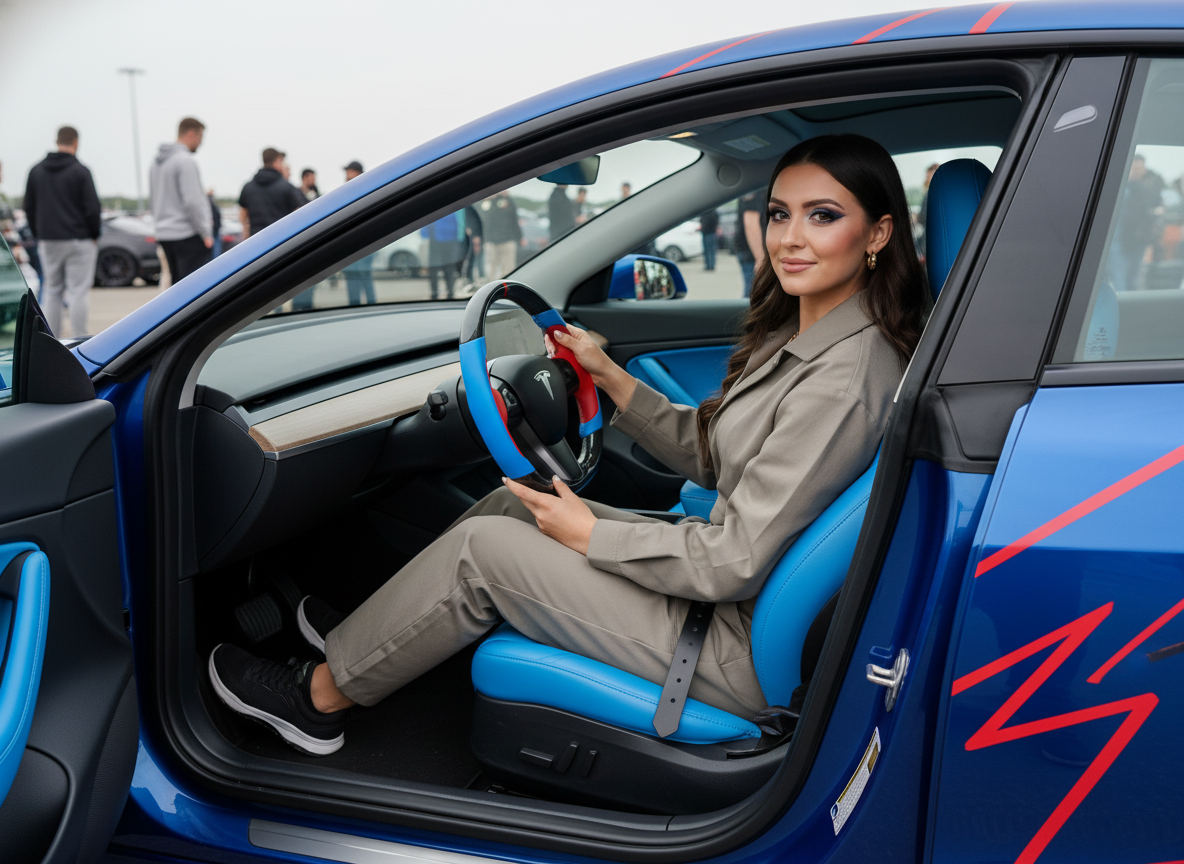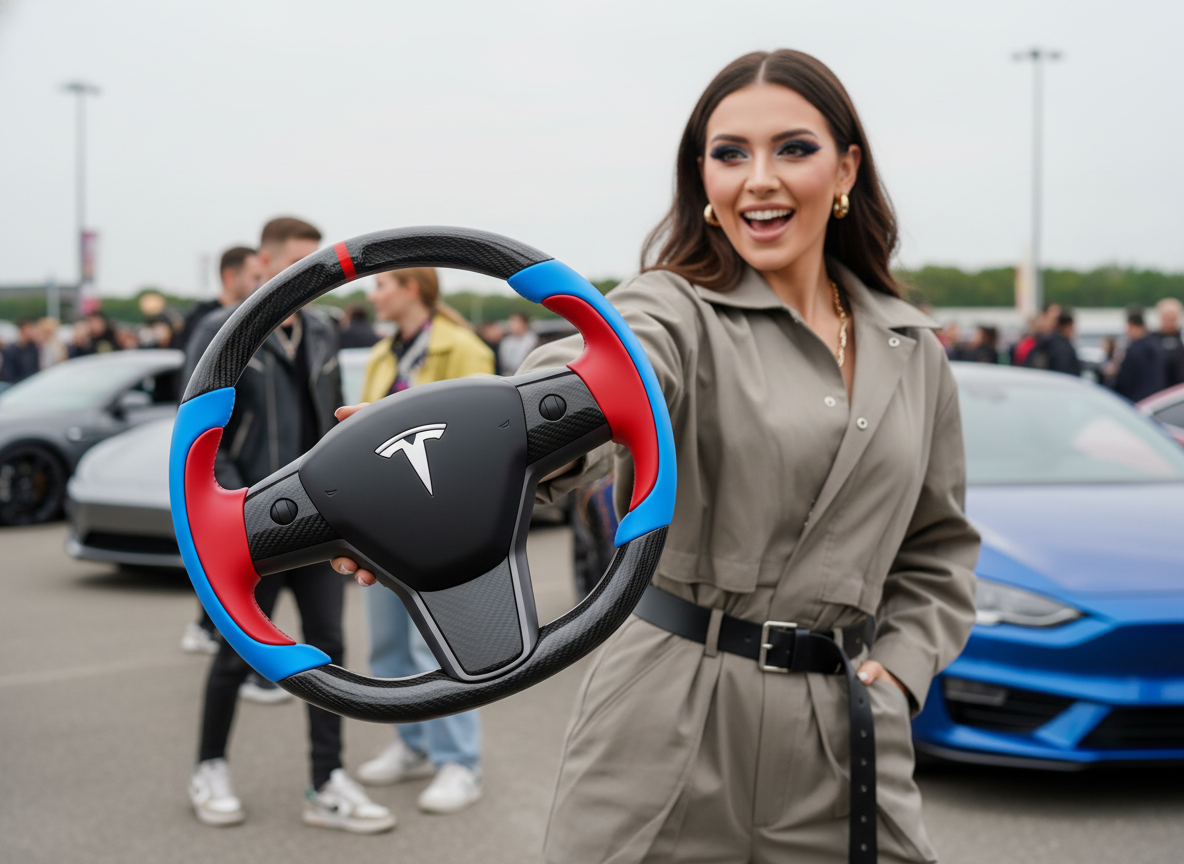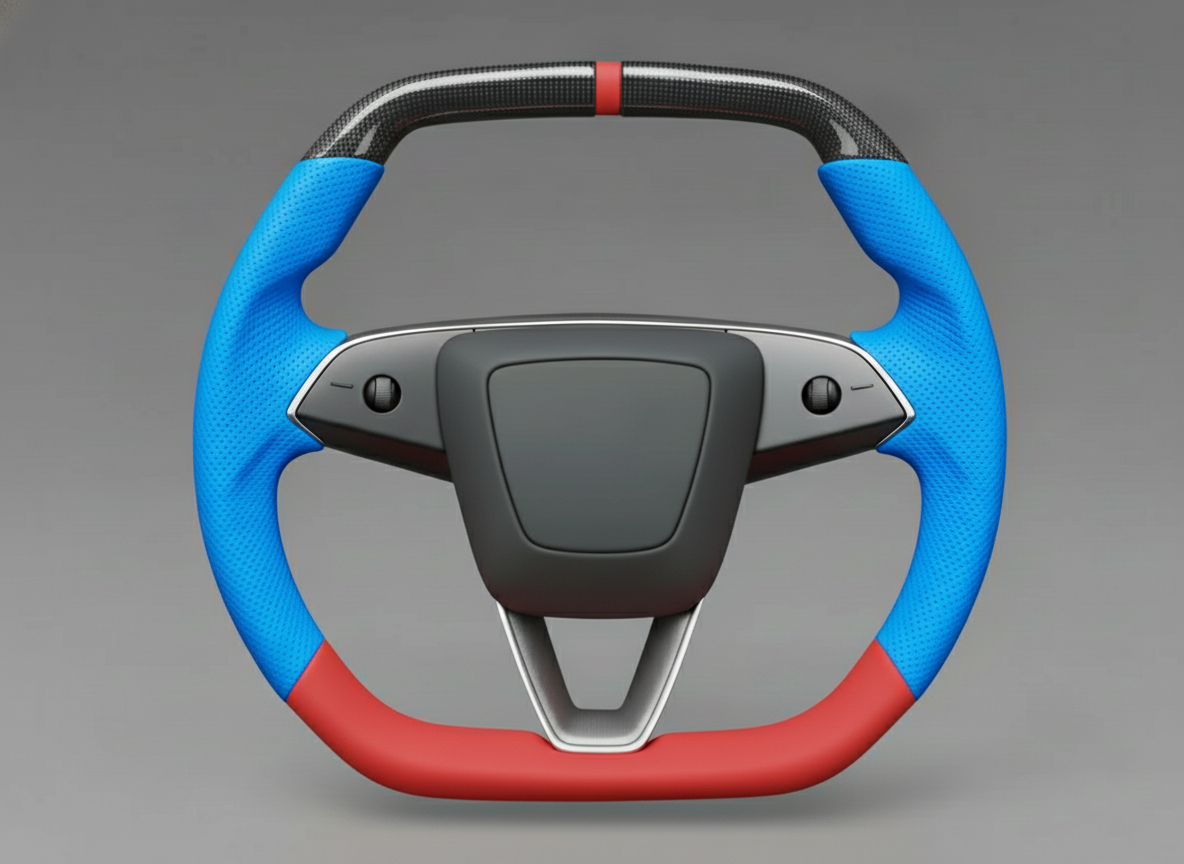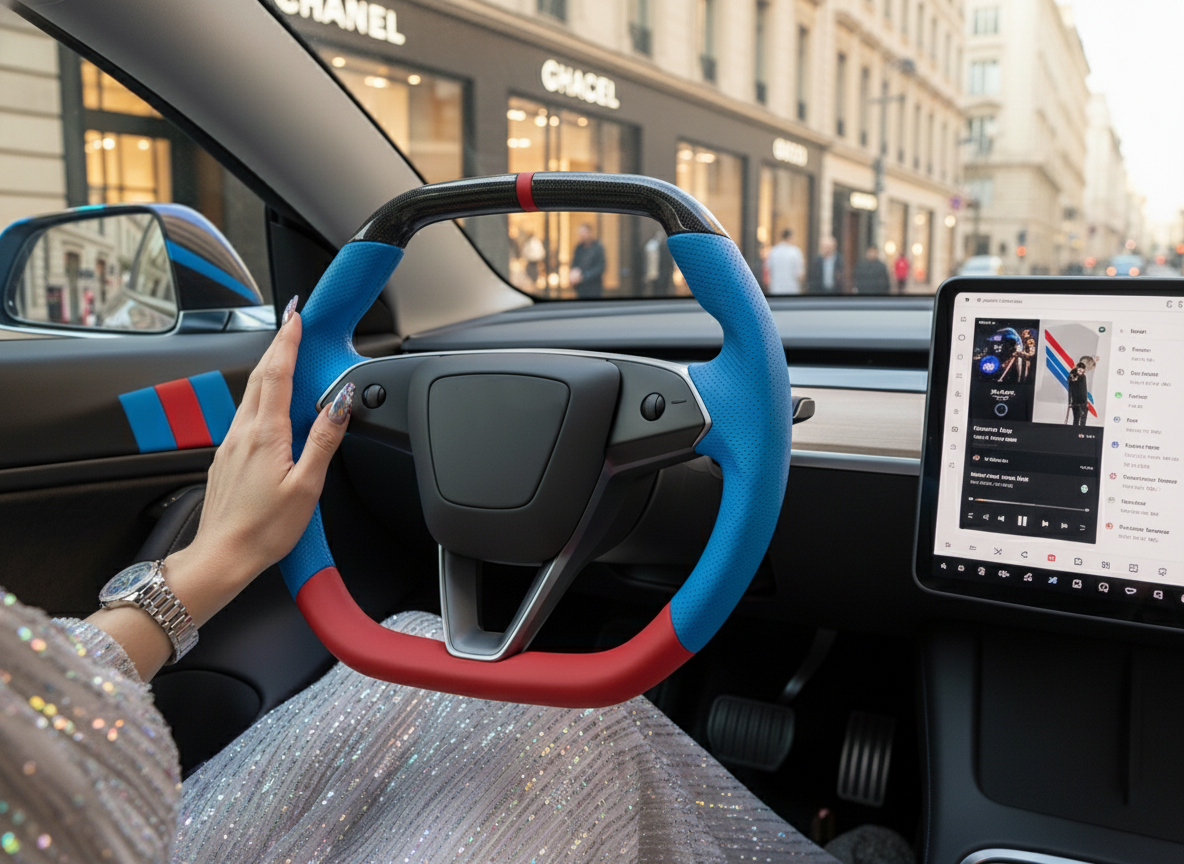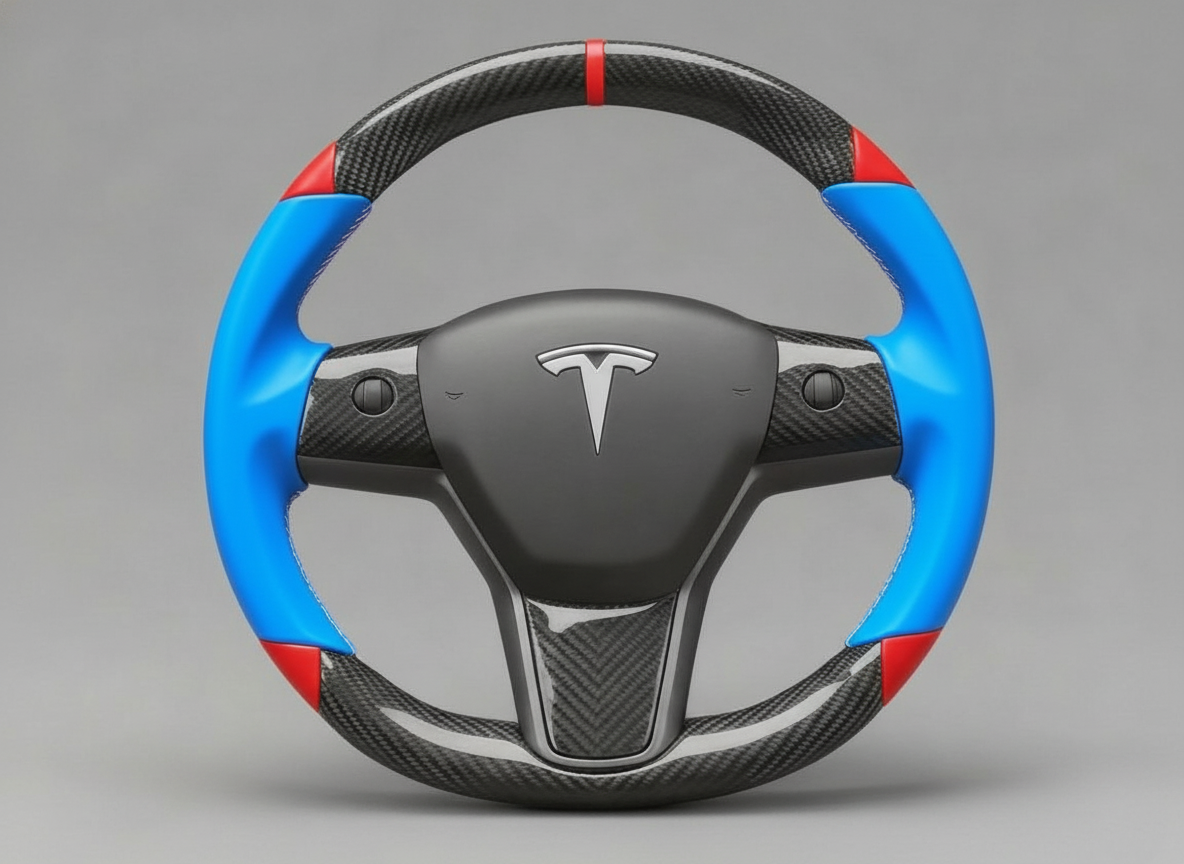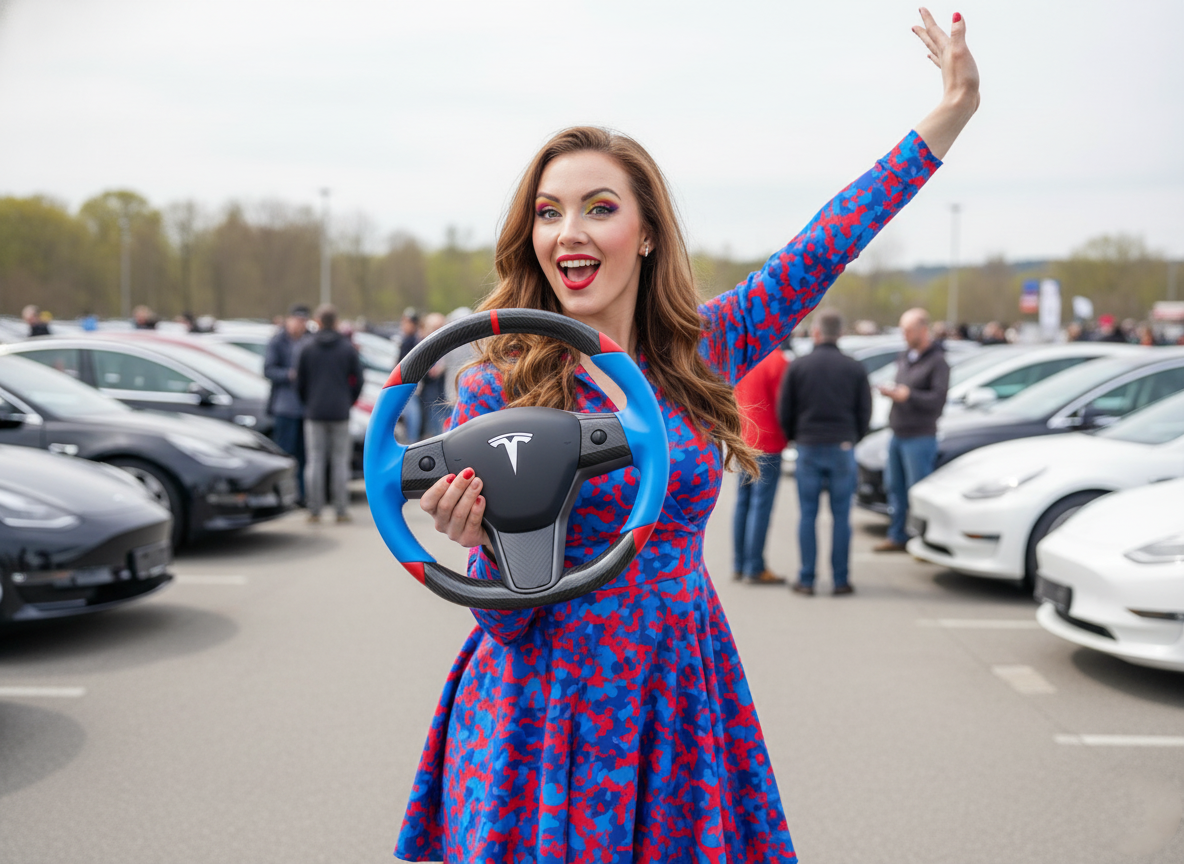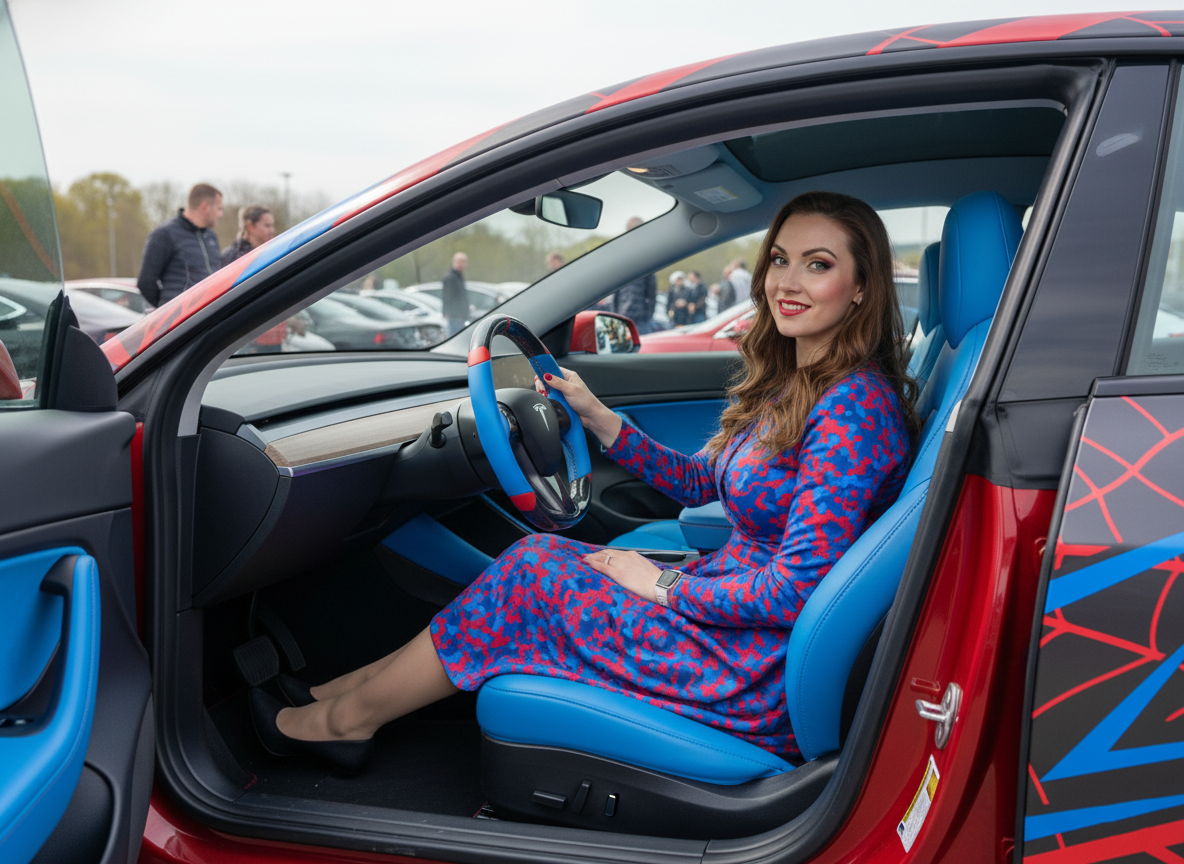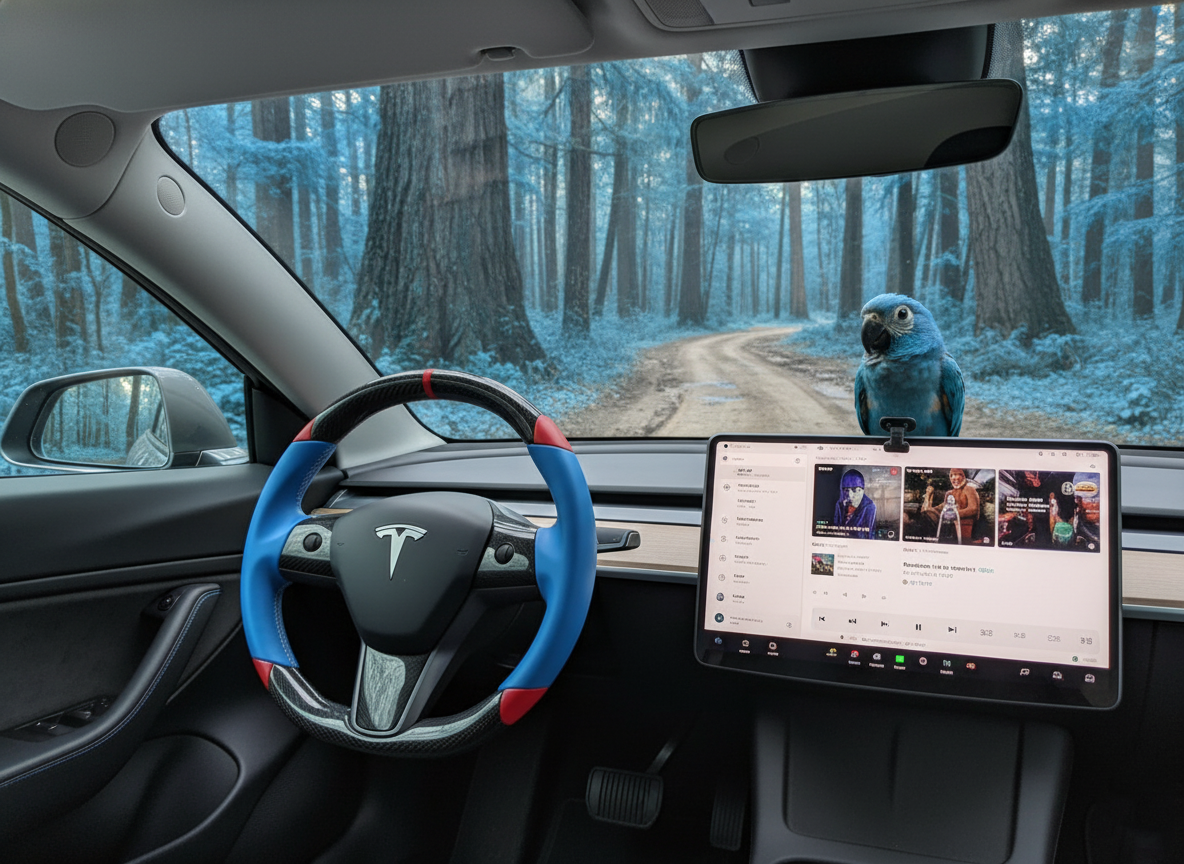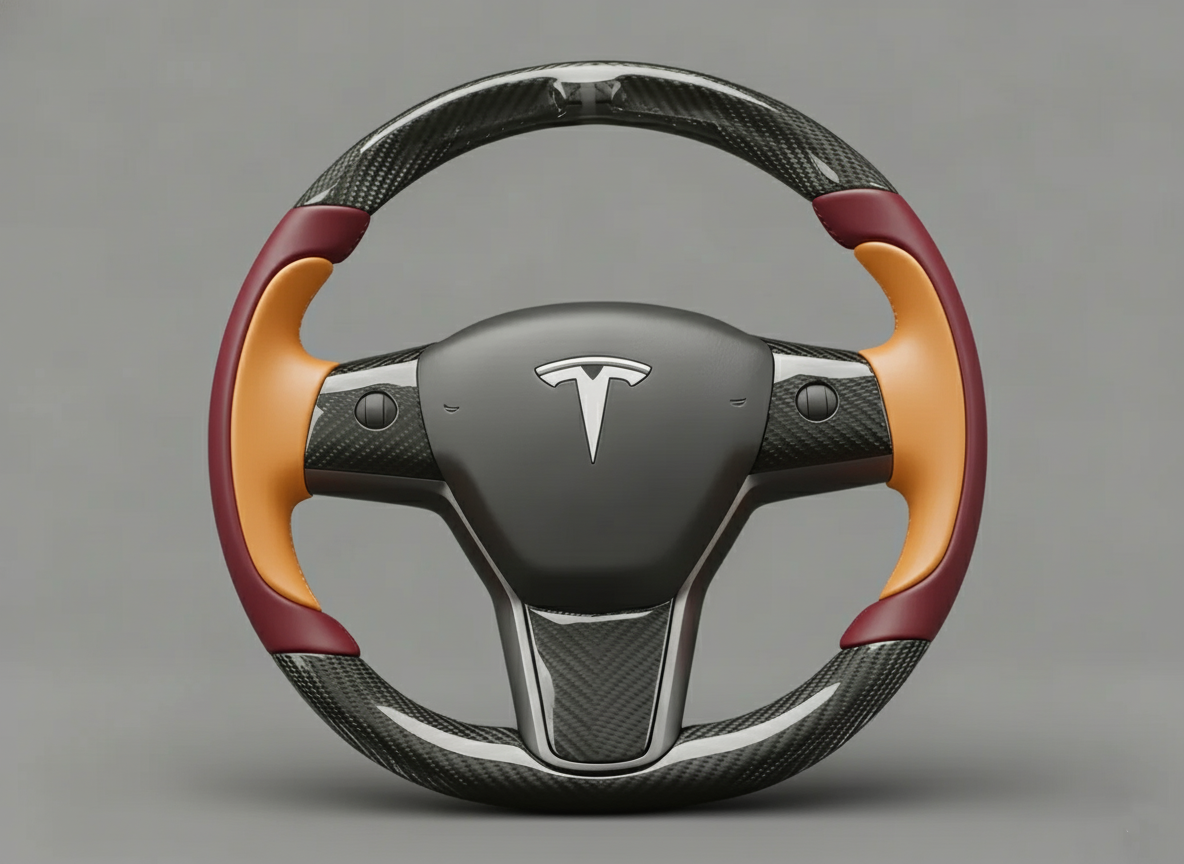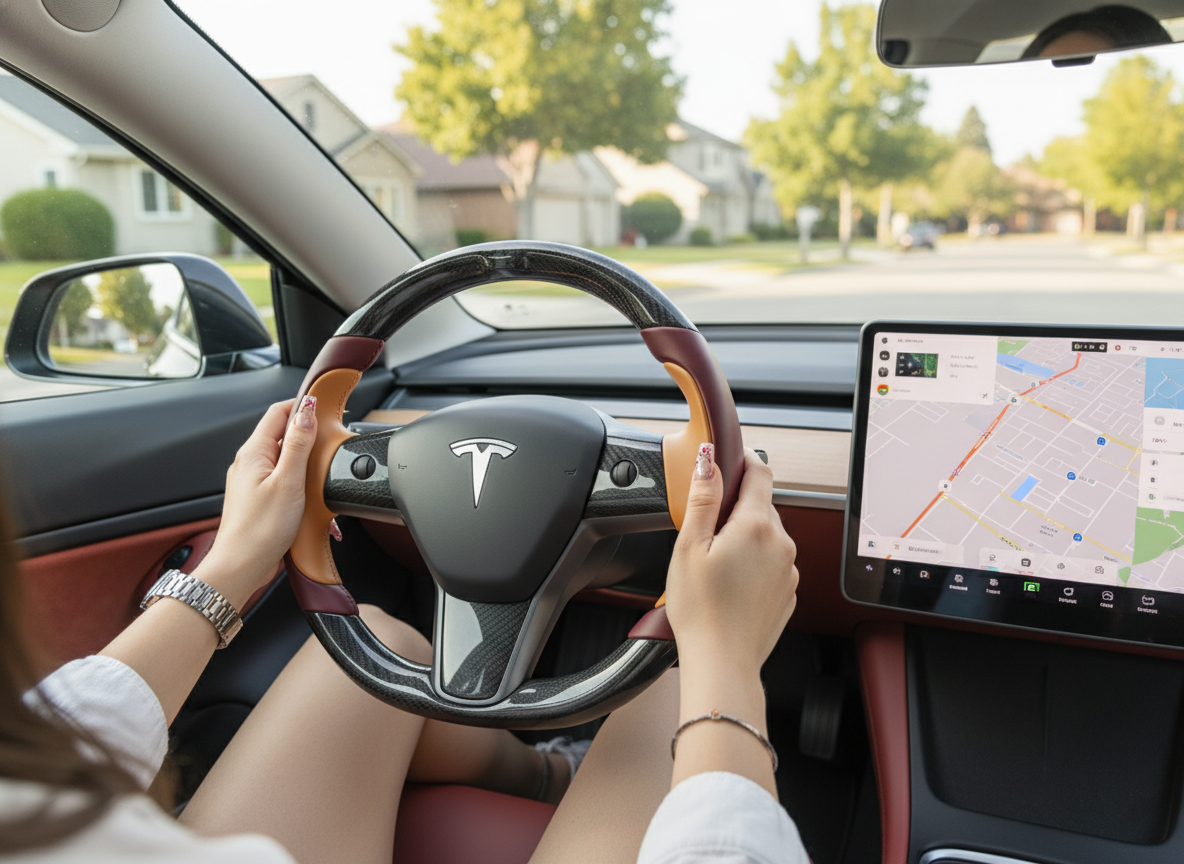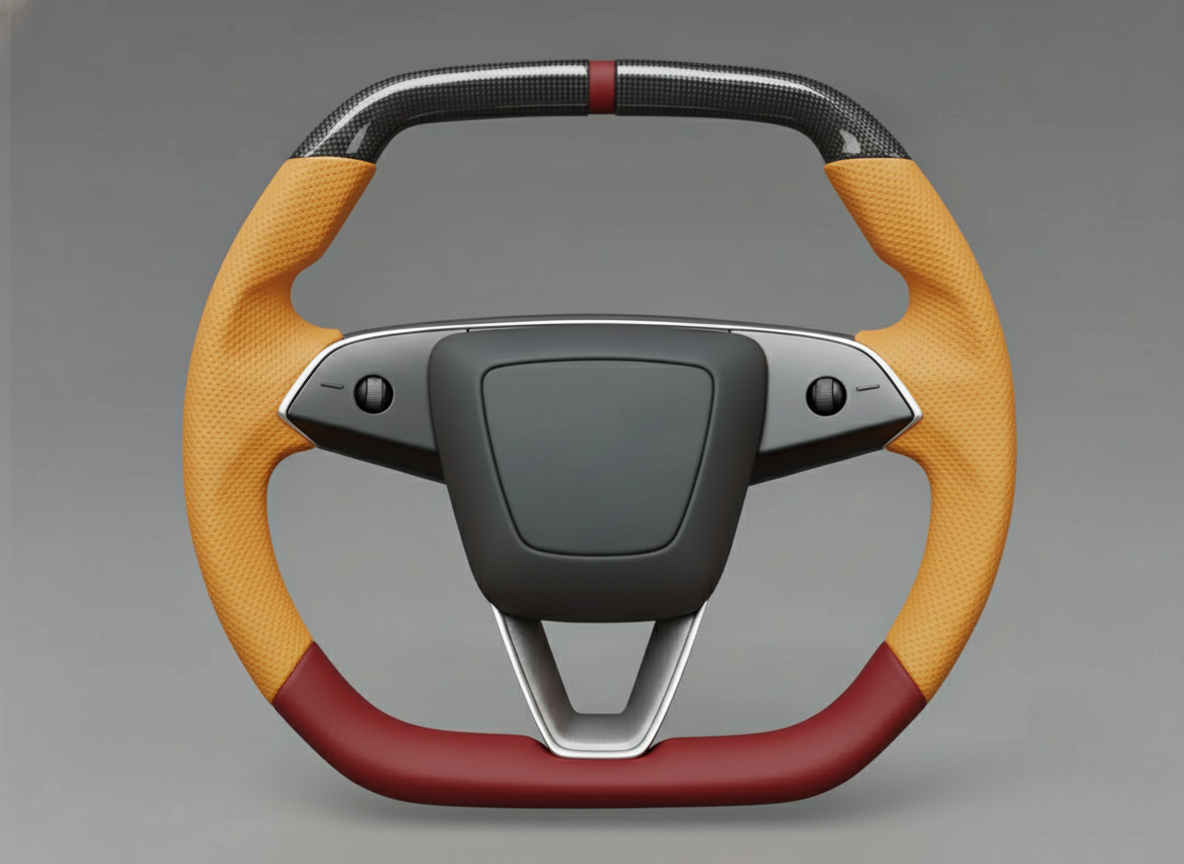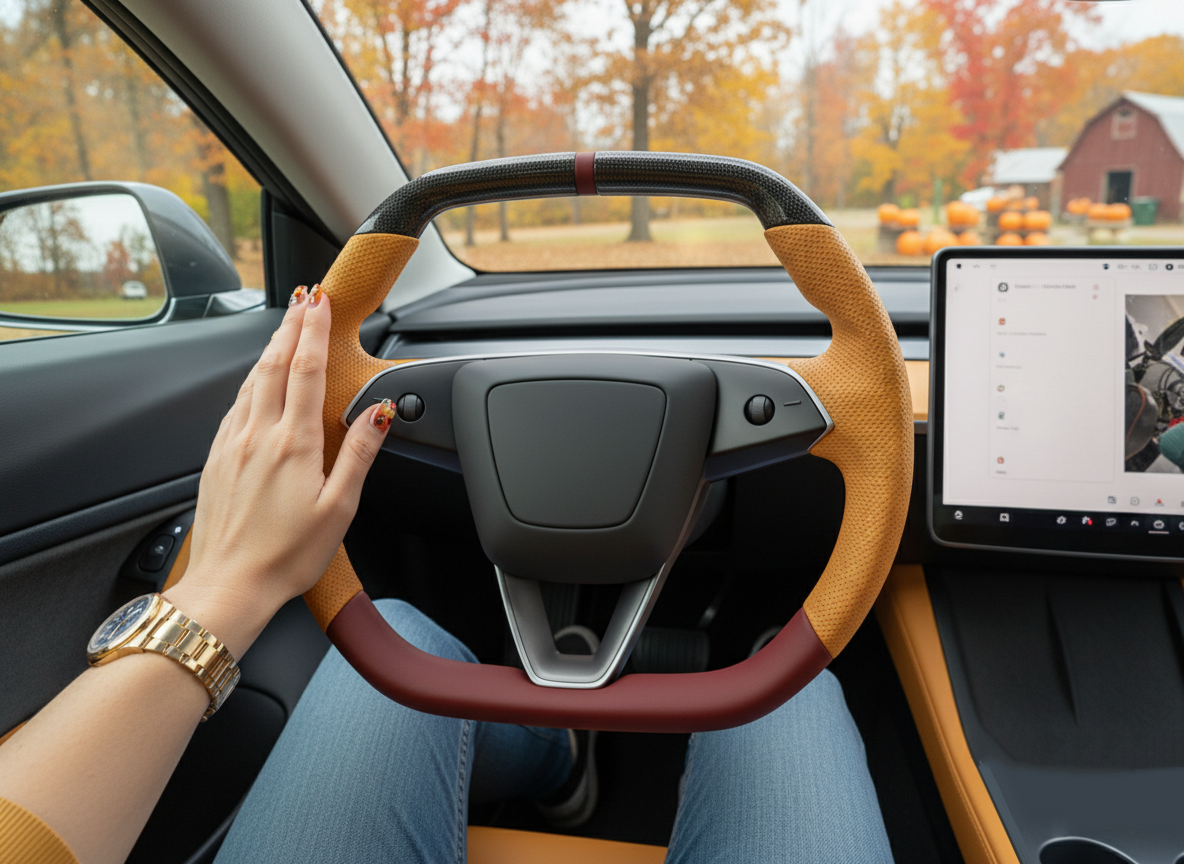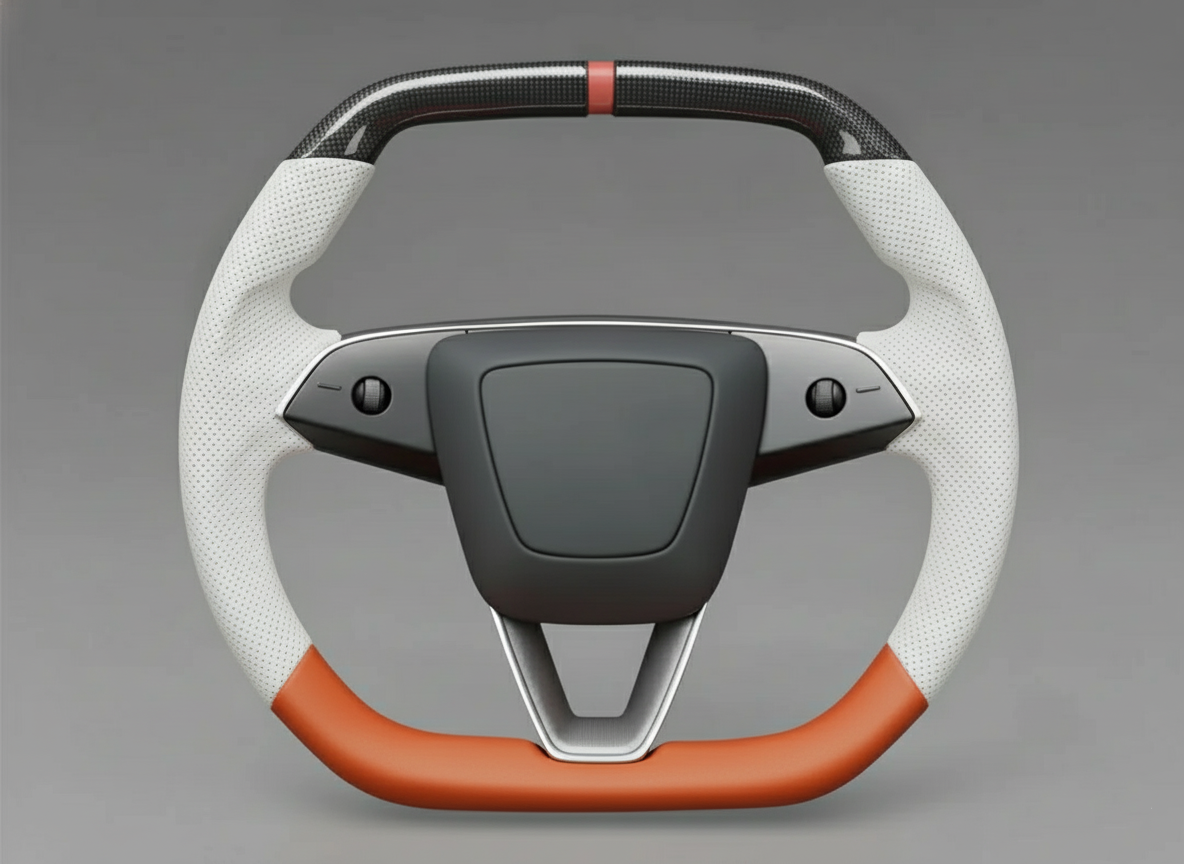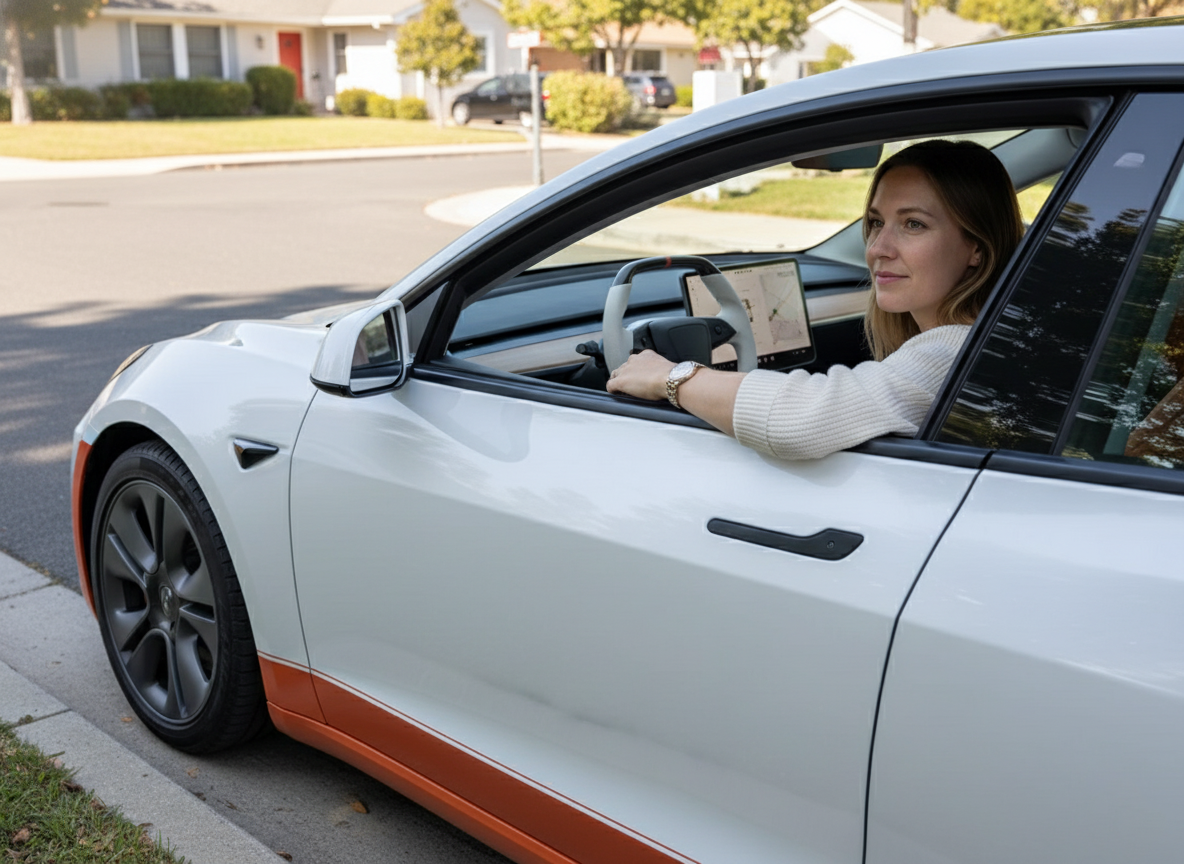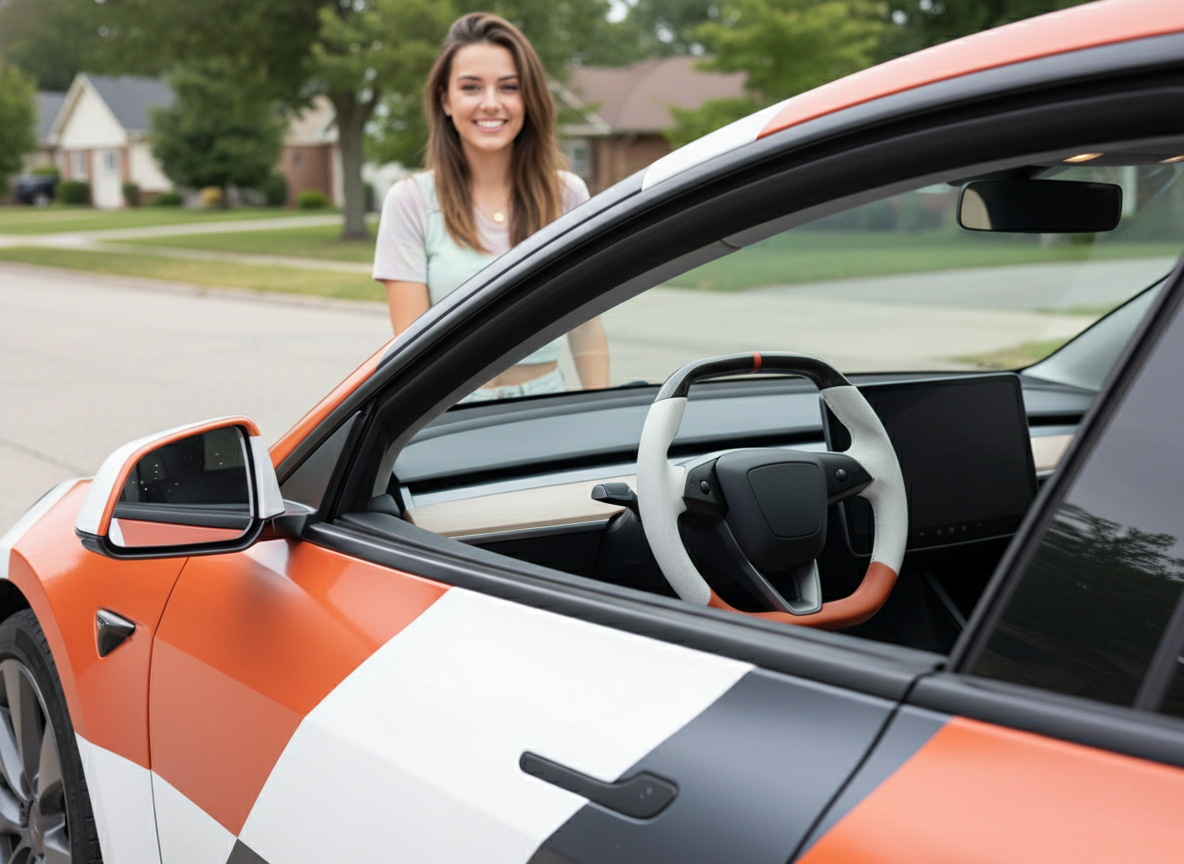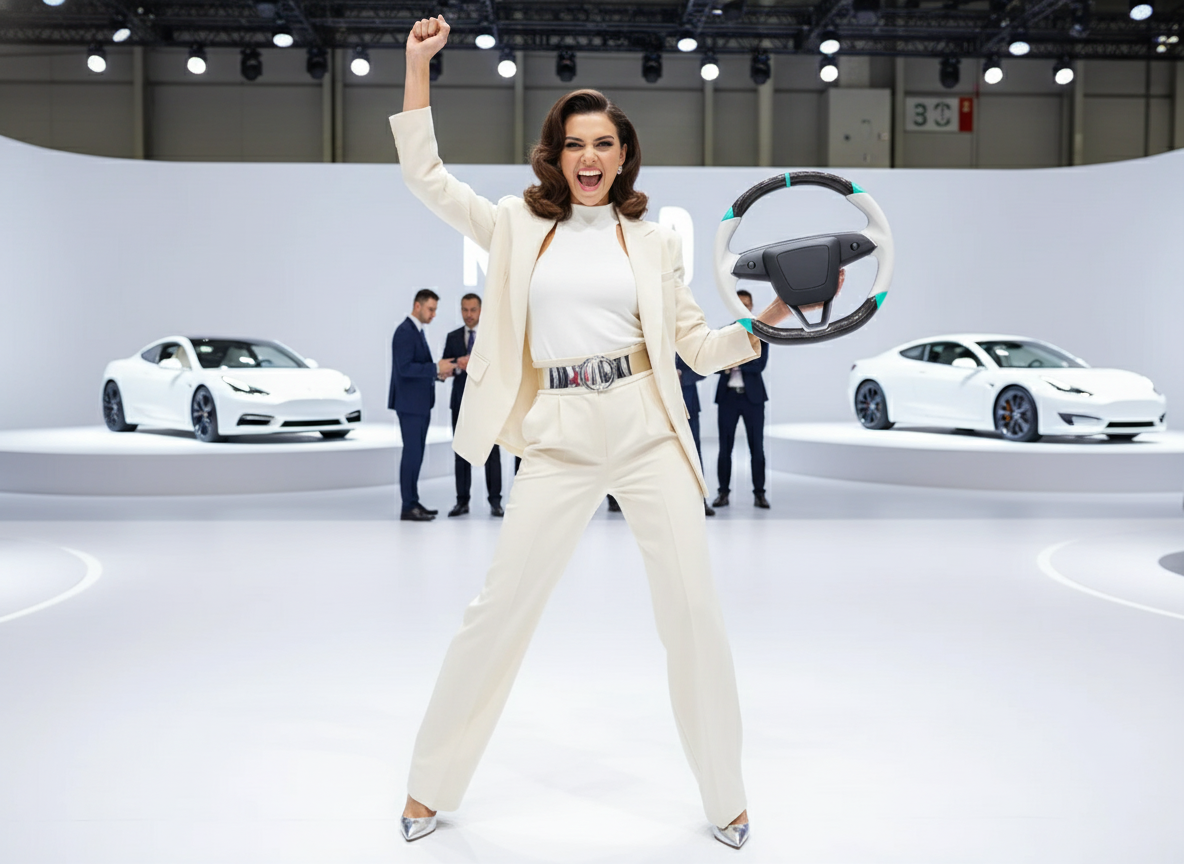
The 2024 refreshed Model 3 has upgraded its standard equipment to a flat-bottom steering wheel that balances sportiness with legroom, replacing the early classic round version.
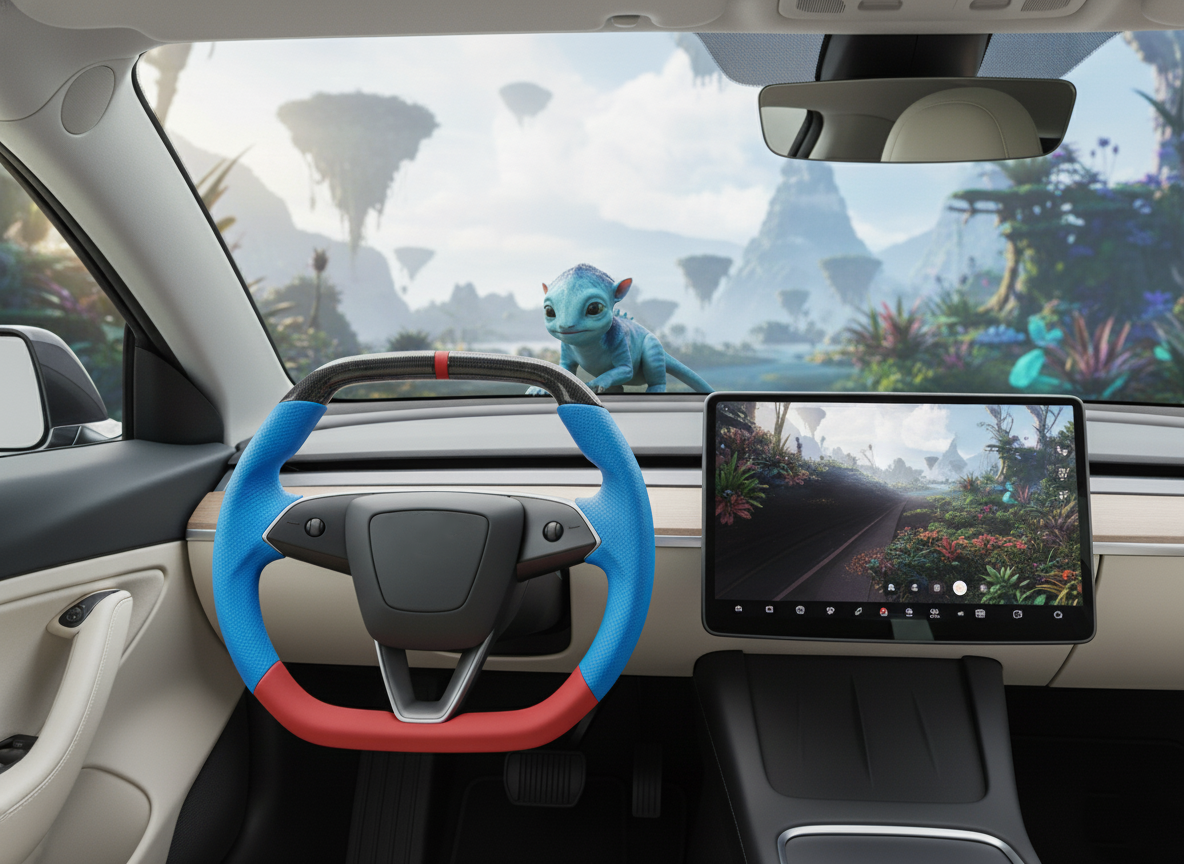
Meanwhile, a Yoke design is available as a paid option, utilizing a top-less construction to greatly broaden the driver's field of vision and the cabin's technological feel.
Round
The 2024 Model 3 standard round steering wheel has a diameter fixed at 355 mm (approx. 14 inches) and utilizes a three-spoke architecture.
According to delivery statistics from the North American and European markets, over 92% of users chose this specification when placing their orders.
Its steering ratio is set at 10.3:1, with a total of approximately 2.0 turns from the center position to the left and right lock points.
Control Logic
In the 2024 Model 3 design update, Tesla completely removed all physical stalks from the steering column, integrating all operational logic for turn signals, wipers, high beams, and gear switching into a digital interaction system.
This change concentrates previously dispersed mechanical operations onto the horizontal spokes of the steering wheel and the 15.4-inch central touchscreen.
The control areas on the steering wheel utilize pressure-sensitive buttons paired with linear motors.
When a finger applies approximately 2 to 5 Newtons of pressure, the built-in vibration module generates haptic feedback within 15 milliseconds, simulating the downward press of a physical button.
This electronic control logic eliminates over 10 mechanical connecting parts, transforming the turn signal activation logic into pure electrical signal commands.
| Control Module | Physical Position | Logic & Feedback Data | Hardware/Sensors Involved |
|---|---|---|---|
| Left Turn Signal | Upper part of the left spoke | Tap to trigger 3 flashes; deep press for continuous flashing | Pressure sensor + Linear vibration motor |
| Right Turn Signal | Lower part of the left spoke | Same logic as above; automatically cancels via vision system after lane change | HW 4.0 Cameras + Steering angle sensor |
| High Beam Toggle | Left side of the left spoke | Single click to toggle; long press for Auto High Beam | Ambient light sensor + Front camera |
| Wiper Control | Right side of the left spoke | Single click for mist/wipe; pops up on-screen wiper menu | 15.4" Screen + Vision-based rain algorithm |
| Voice Assistant | Upper part of the right spoke | Activation latency below 200ms; supports natural language | Microphone array + Local voice engine |
| Autopilot | Right spoke scroll wheel | Single/Double click to enable (based on settings); scroll for speed | 8 External cameras + Neural processor |
The metal scroll wheels on both sides of the steering wheel support multi-axis input. The left scroll wheel is used not only for volume and track switching but also for adjusting side mirrors or steering wheel tilt through lateral toggling.
During reversing or parallel parking, the damping of the scroll wheel is dynamically adjusted via software based on vehicle speed to ensure adjustment precision.
The right scroll wheel is primarily responsible for parameter settings of the Autopilot system, supporting cruise speed adjustments in units of 1 mph (or 1 km/h) and following distance adjustments (1 to 7 levels) via lateral pressing.
These scroll wheels have undergone over 1 million cycle life tests, maintaining consistent damping and rebound force in extreme environments ranging from -20°C to 75°C.
The change in gear shifting logic is the most significant evolution in control. The vehicle defaults to using Auto Shift out of Park to assist in decision-making.
When the driver sits in the seat and buckles the seatbelt, the onboard computer scans the surrounding environment via 8 cameras. If an obstacle like a wall exists ahead, the system automatically presets "R" (Reverse) on the left side of the screen.
The driver only needs to press the brake pedal and observe the vertical bar on the left edge of the screen: sliding up represents Drive (D), and sliding down represents Reverse (R).
The touchscreen refresh rate is 60Hz, ensuring visual fluidity during gear sliding operations.
| Gear Shift Method | Operational Medium | Logic Details | Applicable Scenario |
|---|---|---|---|
| Screen Sliding | Left side of 15.4" screen | Slide up (D), Slide down (R), Tap top (P) | Standard driving starts and U-turns |
| Auto Shift | Vision perception algorithm | Auto-selects gear based on 360-degree obstacle detection | Initial start from Park |
| Physical Backup | Overhead console (above mirror) | Capacitive touch buttons with backlighting | Screen failure or forced manual override |
| Parking Brake | Screen icon or long-press backup | Auto-activates after stopping; manual trigger via menu | Long-term parking or hill parking |
Regarding turn signal cancellation, Model 3 Highland introduced vision-based automatic cancellation.
When the system detects steering wheel centering via the Steering Angle Sensor (SAS), or confirms the vehicle has crossed a lane line and entered the center of the target lane via B-pillar and fender cameras, the electronic signal terminates immediately.
In roundabout scenarios, the system identifies the exit maneuver and precisely turns off the flashing signal using high-precision maps and path-planning algorithms.
Driving Environment
In typical North American urban road layouts, standard lane widths are usually 3.7 meters. When performing 90-degree intersection turns or entering narrow parallel parking spots, drivers frequently utilize the full 2.0-turn lock-to-lock range.
The round structure ensures that at any instantaneous angle between 180 and 360 degrees of rotation, the hand obtains a perfectly symmetrical physical pivot, avoiding uneven force during rapid consecutive hand-over-hand maneuvers.
According to a driving habit survey of 5,000 North American users, in low-speed urban environments, drivers spend 65% of their time with their hands in positions other than 3 or 9 o'clock. The round rim provides full-range physical coverage for these non-standard temporary grips, reducing the complexity of maneuvering in tight spaces.
When the vehicle travels at 70 mph, the Model 3 Electronic Power Steering (EPS) system automatically adjusts torque mapping, increasing the damping at the steering center.
The geometry of the round wheel allows drivers to place their hands naturally at the 4 or 8 o'clock positions when Autopilot is engaged, using the natural weight of the hands to generate approximately 0.1 Newton-meters (Nm) of slight torque.
This value is sufficient to trigger the driver presence detection system without causing the Autopilot to disengage unexpectedly due to excessive force. This grip effectively reduces shoulder muscle fatigue during hours of high-speed cruising.
Because the mass distribution of the round rim is perfectly symmetrical relative to the steering axis, centrifugal force fluctuations are uniformly canceled out when passing over road seams or uneven sections at high speeds, unlike non-standard wheels that can produce noticeable unbalanced inertia during high-speed rotation.
| Environmental Dimension | Operational Parameters & Performance | Technical Specifications |
|---|---|---|
| Extreme Heat | Surface reaches 155°F after 4 hours in 110°F exposure | Vegan leather thermal stability (1000h UV test) |
| Extreme Cold | Heats 25°C within 60 seconds starting at 14°F | 12V embedded resistive heating system |
| Rain/Humidity | Friction coefficient remains around 0.6 with wet hands | Microporous breathable structure & anti-oil coating |
| Emergency Evasion | 90-degree turn in 0.5s; shortest hand displacement path | 360-degree equidistant grip boundary |
In "Comfort" mode, turning the wheel to full lock while stationary requires only about 2.5 kg of force, which is very friendly for residential reversing scenarios.
In "Sport" mode, the feedback force increases to over 4.5 kg, filtering out road vibrations via increased damping to allow precise perception of front-tire grip limits.
This software-defined control feedback, combined with the standard physical lever arm of the round wheel, allows the vehicle to maintain consistent confidence across gravel, snow, and dry asphalt by adjusting EPS algorithms.
In high-latitude regions like Northern Europe or Canada, the round wheel's full-circle heating covers the entire circumference, ensuring drivers contact heating elements regardless of grip style, contrasting with Yoke designs that only heat specific areas.
- 10.3:1 constant steering ratio for low-speed agility and high-speed stability.
- 355 mm outer diameter, balancing visibility and turning torque.
- 360-degree complete physical circumference, providing maximum rescue grip space during tire blowouts or road debris impacts.
- 2.0 turns lock-to-lock, enabling precise path control within an 11.6m turning radius.
- Al-Mg alloy die-cast frame, providing high structural rigidity with a lightweight 1.5 kg mass.
In high-humidity environments like the UK or Seattle, the Vegan Leather used by Tesla shows strong anti-hydrolysis performance.
The material has passed synthetic sweat pH tests, preventing erosion from hand oils and creams, ensuring the tactile feel remains like new even after 100,000 miles.
| Environment Comparison | Round Wheel Performance | Technical Logic |
|---|---|---|
| Field of Vision | Upper rim is level with the driver's eye line | ISO 2575 visual ergonomics layout |
| Legroom | Lower arc is approx. 220mm from the seat's lowest point | Ensures ingress/egress for 95th percentile males |
| Feedback Latency | Sensor sampling frequency is 1000Hz | Real-time torque signals via CAN bus to EPS computer |
| Wear Life | Simulated 200,000-cycle grip friction test | Surface coating hardness reaches 2H grade or higher |
When the vehicle enters a skid requiring rapid counter-steering, the driver can use the continuous edge of the round wheel for high-speed toggling.
This is critical in drift or emergency recovery scenarios because the hand doesn't need to search for a specific handle—any touch produces the intended effect.
Experimental data shows that under stress, human drivers have an 18% higher grip accuracy on round objects compared to irregular shapes.
Flat Bottom
The Model 3 flat-bottom steering wheel transforms the standard 360mm diameter into a D-shaped structure by shaving 25 to 30 mm off the bottom arc height.
This design releases approximately 15% of longitudinal legroom for drivers taller than 185 cm.
Compared to the Yoke, it retains 100% of the top grip area, ensuring no loss in operational continuity during the 2.1-turn lock-to-lock maneuvers at a 10.3:1 steering ratio.
The weight is typically 300 to 500 grams lower than the OEM wheel, and 95% of third-party flat-bottom parts allow for non-destructive transplantation of original airbags and heating coils.
Physical Specifications
While the standard round wheel diameter is set at 360mm, the flat-bottom version compresses the vertical diameter to between 335mm and 340mm by reshaping the bottom frame.
When the wheel is centered, the bottom edge is raised by approximately 20 to 25 mm.
This spatial release is particularly vital for the Model 3's fixed steering column design, providing extra clearance for the driver's femoral region without altering the seat's R-point height.
The horizontal straight segment of the flat section generally spans 180 to 200 mm, covering the leg swing path during pedal operation and reducing knee-to-wheel physical contact.
| Specifications | Original Round Config | Flat Bottom (D-Shape) Config |
|---|---|---|
| Outer Diameter (Vertical) | 360 mm | 335 mm |
| Outer Diameter (Horizontal) | 360 mm | 360 mm |
| Grip Section Diameter | 30 - 32 mm | 35 - 38 mm |
| Total Grip Circumference | Approx. 100 mm | 110 - 120 mm |
| Bottom Lift Height | 0 mm | 25 mm |
| Lock-to-Lock Turns | 2.1 Turns | 2.1 Turns |
| Steering Ratio | 10.3 : 1 | 10.3 : 1 |
Third-party flat-bottom wheels often increase the grip diameter to 35mm or 38mm for an ergonomic "4-point support" logic, adding specific protrusions at the 2, 4, 8, and 10 o'clock positions.
The thumb rests at 10 and 2 o'clock are usually set at 35 to 45 degrees to distribute palm pressure evenly, reducing fatigue on long drives.
A complete Model 3 steering wheel assembly weighs approximately 2.8 to 3.2 kg.
Flat-bottom wheels made of 3K carbon fiber are about 300 to 500 grams lighter than the leather-wrapped OEM wheel.
| Material Properties | 3K Carbon Fiber | Nappa Leather | Alcantara |
|---|---|---|---|
| Friction (Dry) | 0.4 | 0.6 | 0.8 |
| Thermal Conductivity | 1.5 - 5.0 W/m·K | 0.15 W/m·K | 0.12 W/m·K |
| Material Thickness | 0.5 mm (Laminate) | 1.2 mm | 0.8 mm |
| Tensile Strength | 3500 MPa | 25 MPa | 30 MPa |
The steering column central spline is fixed with a T50 Torx anti-loosening bolt.
Roller control modules are installed in recesses at 3 and 9 o'clock, which require machining precision within ±0.1mm to avoid rattles.
All electronic components, including capacitive hands-off detection (HOD) and 12V heating units, are connected via 20-22 AWG heat-resistant wiring to ensure stability during the 2.1-turn rotation.
Sitting Position Optimization
By replacing the wheel with a flat-bottom version and lifting the bottom arc by 25 to 30 mm, the vertical gap between the lower edge and the seat cushion is significantly increased.
This space release allows the knee swing space to gain over 20% more room when moving from the accelerator to the brake.
Physiologically, this allows the angle between the driver's hip and knee joints to widen from a cramped 105 degrees to a more natural 115 degrees.
| Spatial Metrics | Round Profile | Flat Bottom Profile | Improvement |
|---|---|---|---|
| Knee Vertical Clearance | 120 mm | 148 mm | +28 mm |
| Ingress Depth Gap | 155 mm | 185 mm | +30 mm |
| Pedal Switch Interference | 8% Frequency contact | 0% Frequency contact | Eliminated |
| Abdomen-to-Rim Distance | 185 mm | 210 mm | +25 mm |
In the 10.3:1 steering ratio environment, the flat bottom acts as a physical reference plane parallel to the floor.
When turning more than 90 degrees, the flat-bottom configuration ensures that within the 0 to 45-degree steering angle range, there is ample clearance for the right leg.
- Vertical Freedom: The 2.5 cm space gain is equivalent to manually adjusting the steering column up by two levels without changing the visual center.
- Horizontal Work Surface: While stationary (e.g., at Superchargers), the flat bottom serves as a temporary stable support for tablets.
- Clothing Protection: Reduces the risk of the lower rim rubbing against suit trousers or long skirts.
When a driver weighs over 90 kg, the 210 mm plus longitudinal distance between the abdomen and column significantly alleviates the sense of pressure between the airbag module and the torso.
In an accident, this extra gap allows the airbag to fully deploy within 0.03 seconds, reducing the initial impact force on the chest.
Material Thermal Characteristics
3K carbon fiber, with a thermal conductivity of 1.5 to 5.0 W/m·K, absorbs infrared energy rapidly.
In sunny regions like California or Southern Europe, the surface can reach 65°C after 30 minutes of exposure, resulting in a scorching sensation in summer and an icy feel in winter.
Surface temperature reaches 65°C after sun exposure. The material has extremely high heat transfer efficiency.
Nappa Leather (1.2mm thick) has a much lower thermal conductivity (approx. 0.15 W/m·K) due to its natural porous structure.
This provides a buffer, keeping temperature changes gradual and offering the most stable grip in the 10°C to 30°C range.
Natural pores provide good temperature control buffering. Skin tension is less affected by ambient temperature.
Alcantara (68% polyester, 32% polyurethane) offers the best thermal insulation (0.12 W/m·K) and a high friction coefficient of 0.8.
However, it is prone to absorbing oils, which can lead to a 40% reduction in breathability and heat exchange after 20,000 miles due to "matting."
To offset the discomfort of high-conductivity materials, most flat-bottom wheels integrate a 12V heating system (45W-70W), typically heating the surface from 5°C to a comfortable 35°C within 3 minutes.
Yoke
Under the fixed 10.3:1 steering ratio of the Model 3, the lock-to-lock travel is fixed at 2.0 turns.
This form expands the forward field of vision by over 25%, but since the Model 3 lacks steer-by-wire technology, low-speed U-turns require higher operational precision as traditional hand-over-hand sliding is not possible.
Forward Field of Vision
A standard 360mm round rim usually blocks about 5 to 8 cm of vertical height at the lower edge of the windshield.
The Yoke design compresses the height to around 140mm, increasing the driver's vertical field of view by approximately 25 degrees.
This allows drivers to see road obstacles or markings 0.5 to 1.2 seconds earlier, especially on undulating roads or garage ramps.
By removing the top arc, the eye travel required to read the speedometer on the 15.4-inch screen is reduced by 15%, which translates to a 5-10 meter perception gain at 110 km/h.
- Vertical Vision Gain: Blind spots below the driver's eye point are reduced by approx. 30%.
- Screen Visibility: 100% unobstructed view of the left-side driving info area on the 15-inch screen.
- Reduced Light Interference: Eliminates shadow fluctuations from the top rim under direct sunlight.
Yoke lowers the highest point of the steering wheel below the dashboard line. This "disappearance" increases the psychological sense of space in the cabin. In FSD mode, 3D environment renderings align more intuitively with the road. Additionally, the lack of a top rim reduces reflections on the inside of the windshield by about 50%.
- Blind Spot Data: Visible ground area within 3 meters of the front increases by approx. 1.5 square meters.
- Aero/HVAC: Reduces physical obstruction to airflow from the hidden vents, delivering cool air to the driver 12% faster in summer.
Physical Turn Challenge
The 2.0 turns (720 degrees) lock-to-lock travel becomes a challenge without a top rim. At speeds below 15 km/h, reaching full lock requires a full rotation where the driver's hand will encounter a physical "void."
When turning past 90 degrees, the expected grip point is missing. If traditional steering habits are used, the driver may "grasp air," causing a 0.3 to 0.6 second operational gap.
| Steering Dimension | Traditional Round (360mm) | Yoke (325mm) |
|---|---|---|
| Lock-to-Lock Turns | 2.0 Turns (720°) | 2.0 Turns (720°) |
| Center Feeling | High linearity, uniform torque | Stronger response, leverage changes |
| Low-Speed U-Turn | Supports continuous push-pull | Must precisely grab bottom corners |
| Emergency Evasion | Force can be applied anywhere | Limited to 3 and 9 o'clock |
| NASA-TLX Workload | Baseline | +18% |
In Sport mode, the perceived steering resistance increases by about 10% due to the shorter 325mm width.
U-turns require 22 cm more hand movement as the driver must reach down for the 6 o'clock position or the opposite side.
The flat bottom appearing at the 12 o'clock position during rotation can also create a "stepped" feeling in torque feedback.
While hand positioning accuracy improves to 95% after 500-1000 km, the instinctual reaction to reach for the top still has a 5% occurrence rate under extreme stress.
- Hand-off Frequency: Yoke forces at least 2 complete hand releases per 360° turn, whereas round wheels can use sliding for 0 releases.
- Inertia: Removing 300g from the top shifts the center of gravity below the axis, creating slight oscillation inertia over bumps.
Parking with a Yoke requires 8 precise grip actions for two full turns. Beginners take an average of 4.5 seconds longer to parallel park with a Yoke, though this gap narrows to 1.5 seconds with proficiency.
Hardware Specifications
The Yoke is built on a high-pressure die-cast Al-Mg alloy frame (1.1 kg), which is 26.6% lighter than the original 1.5 kg frame.
This reduces rotational inertia, shortening steering motor response time by 12ms. The 36-tooth spline handles over 150Nm of torque.
Frame: Die-cast Al-Mg alloy.
Mass: Approx. 1.1 kg.
Response: 12ms latency reduction.
Spline: Supports 150Nm torque.
The 1.2mm Vegan Leather has passed 100,000 Taber abrasion cycles.
The heating system uses 2.4 meters of wire (4A max) and heats at 1.5°C/sec, reaching 35°C within 90 seconds.
An embedded NTC thermistor provides real-time temperature feedback to the vehicle.
The roller units use Hall effect sensors with no mechanical wear. The trigger force for pressing the rollers is set at 2.5N to 3.0N.
The 22AWG low-impedance wiring matches the OEM clock spring for 12-channel signal transmission.
The Yoke features a 180mm x 120mm central cavity for the OEM airbag. The cover tear-line is calibrated to break at 50N.
Due to the lack of a top rim, the airbag deployment envelope is optimized, focusing protective energy more directly on the driver's chest and head.
The grip section features an asymmetric oval geometry (34mm x 30mm) to reduce muscular static load and provides 15% more lateral friction support during 0.8G turns.
The 220mm flat bottom provides a stable visual horizon.