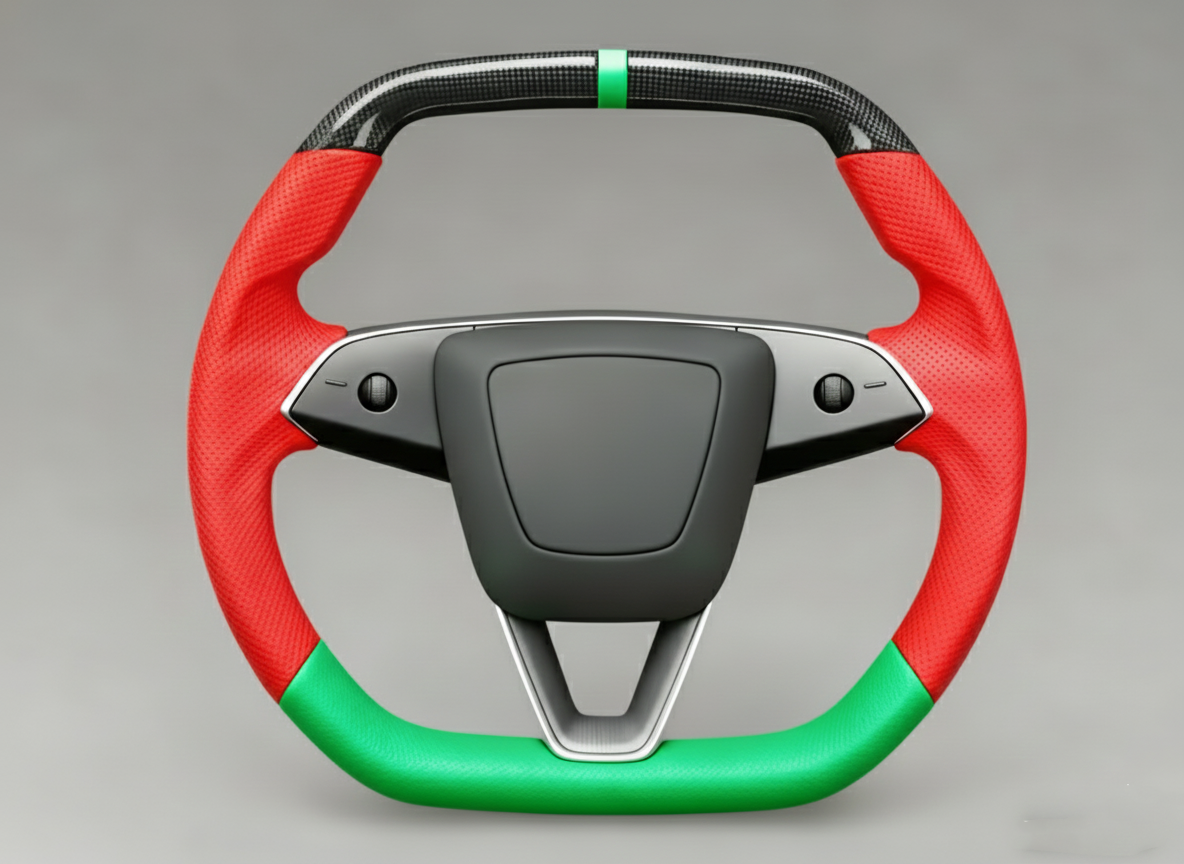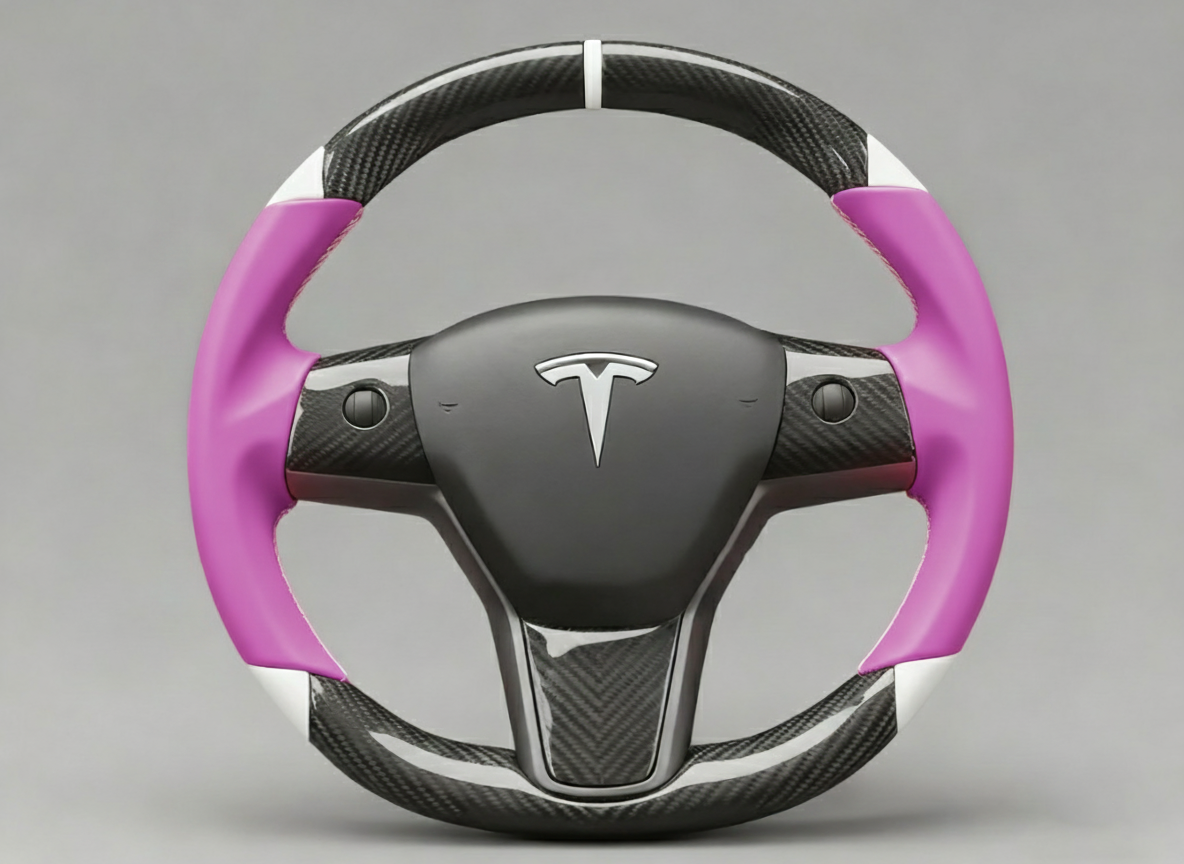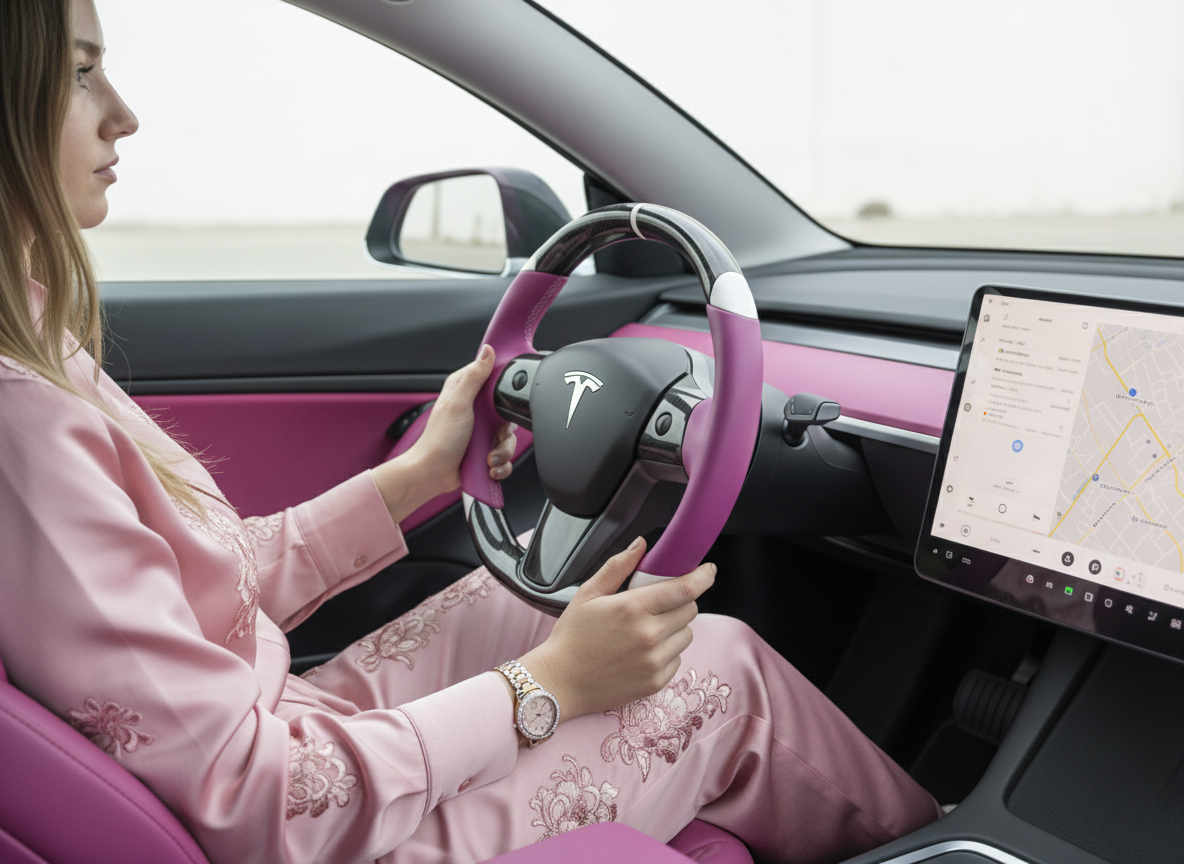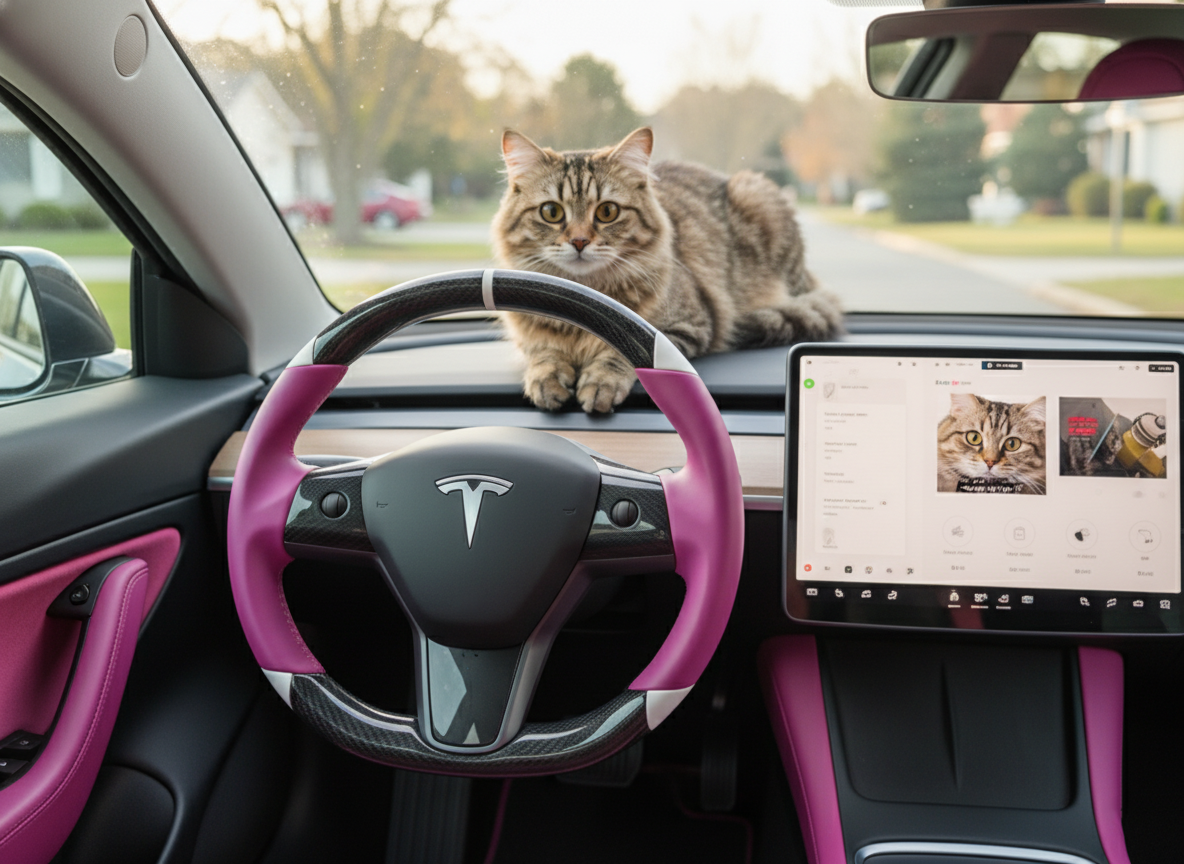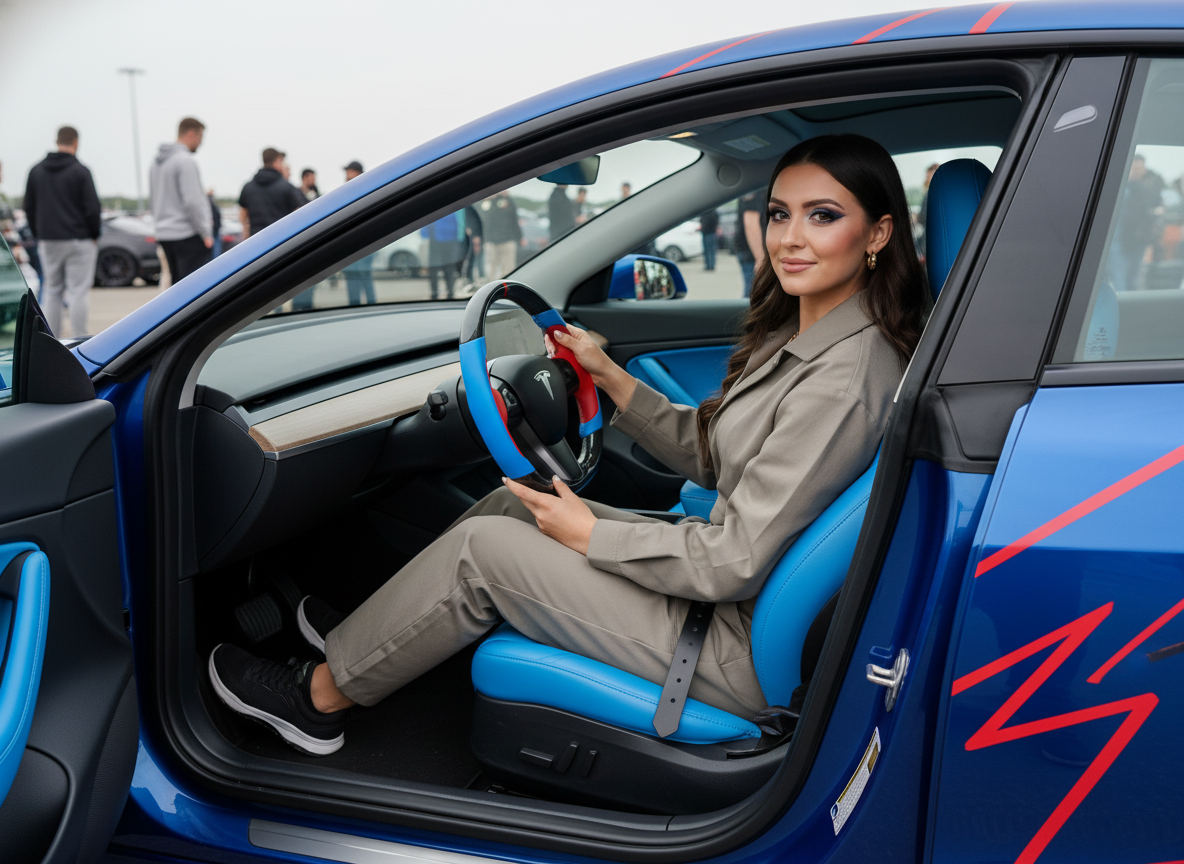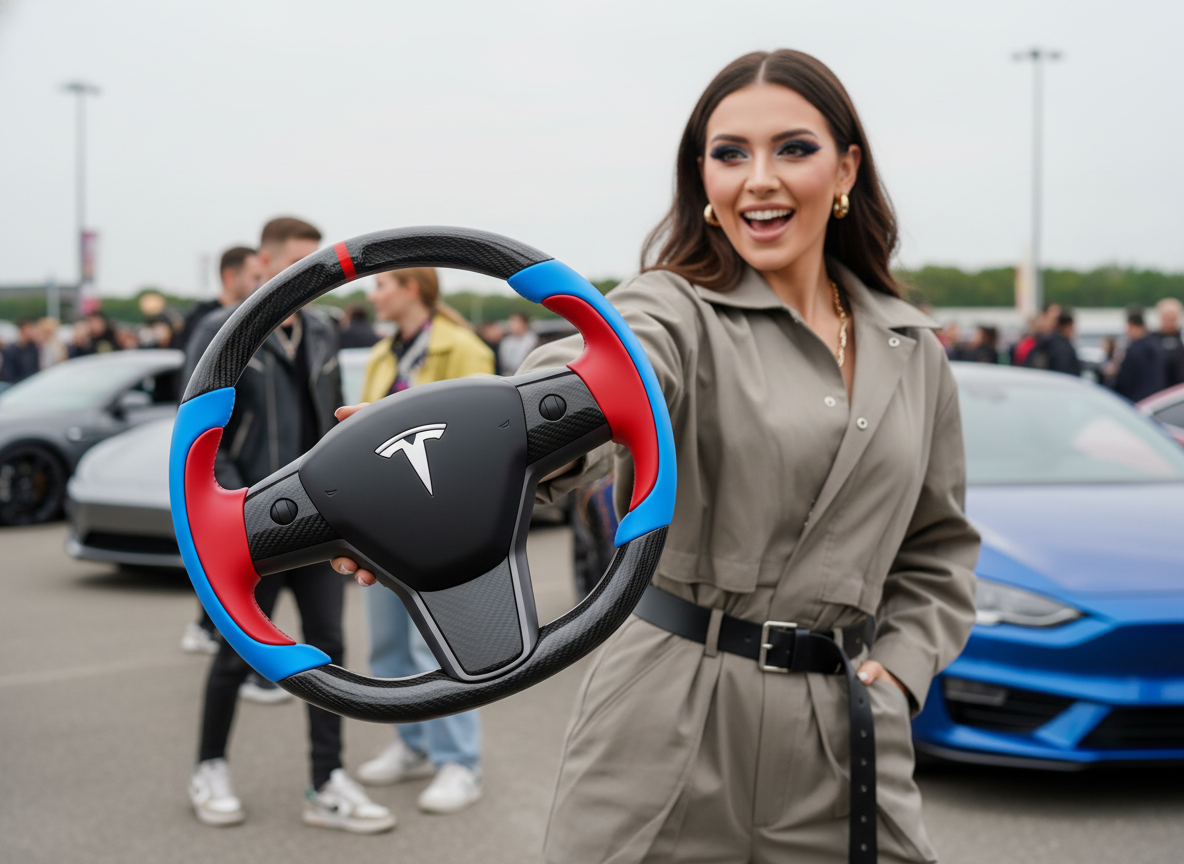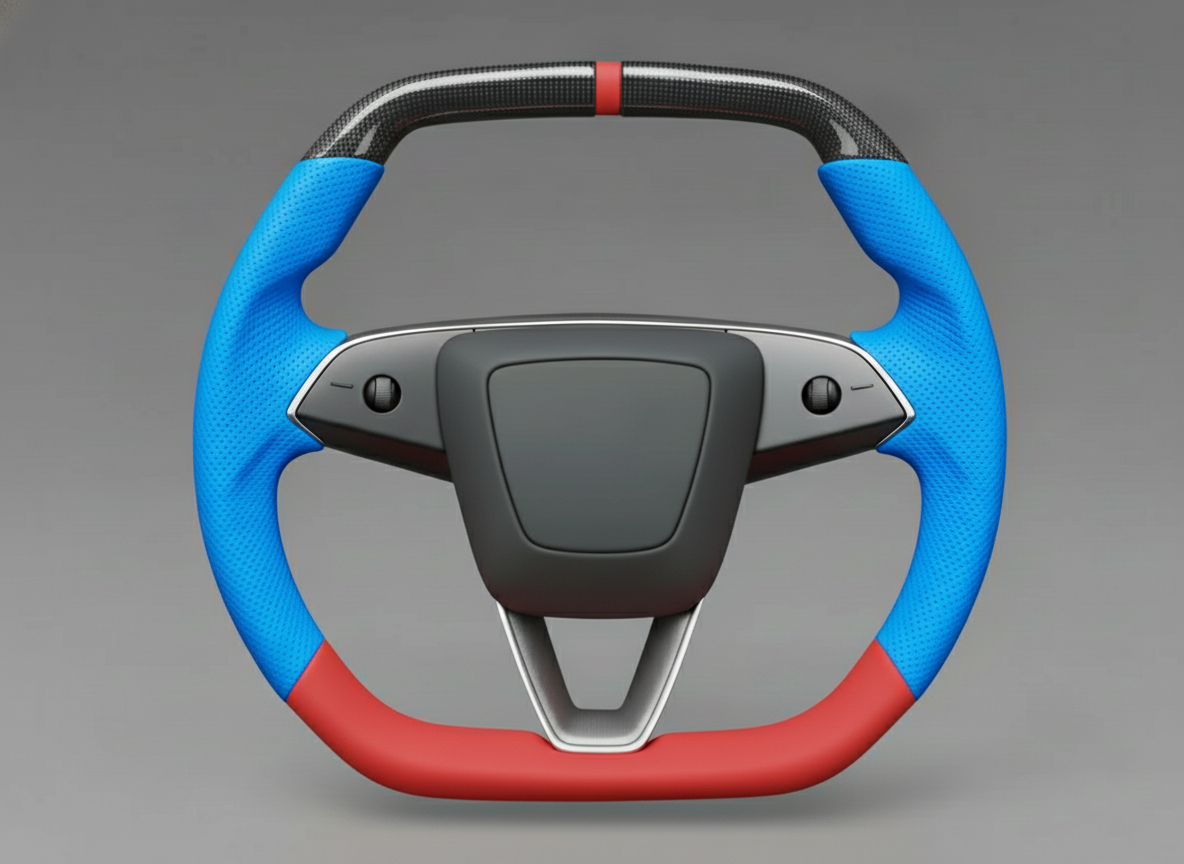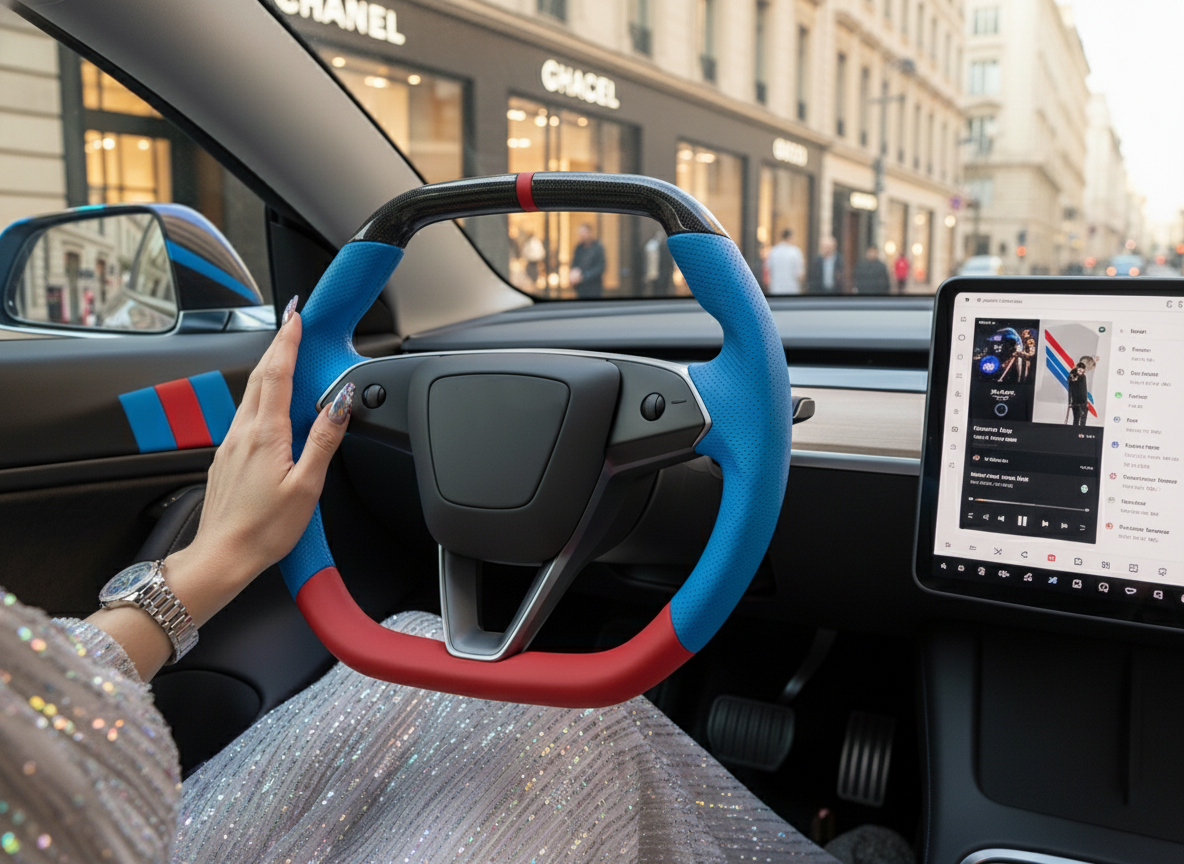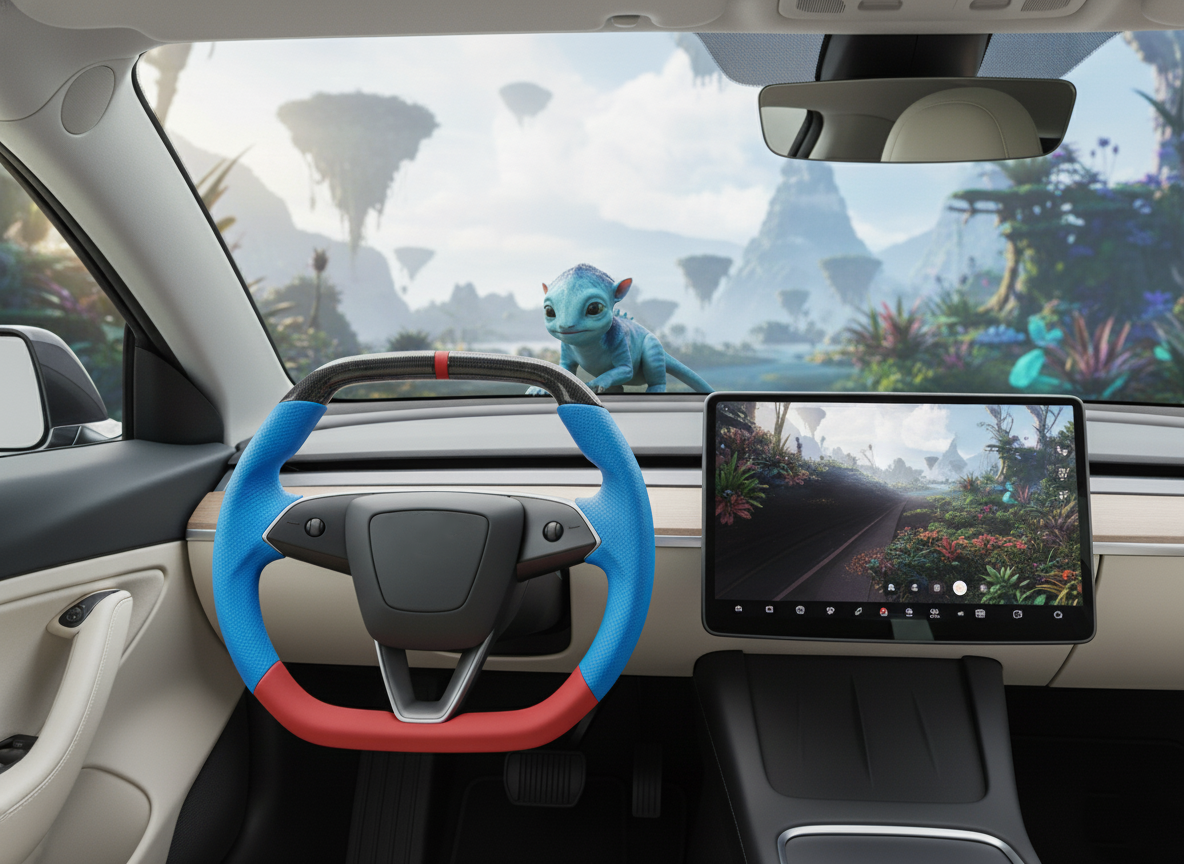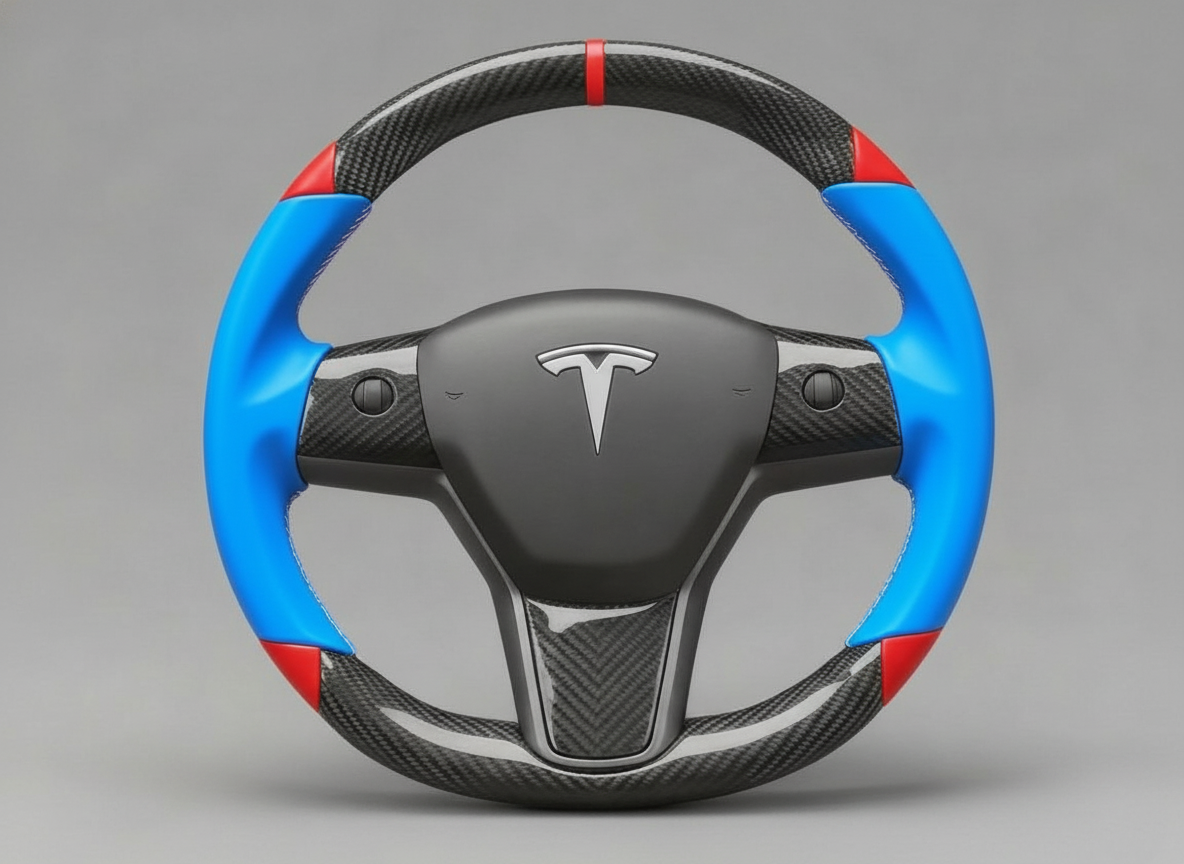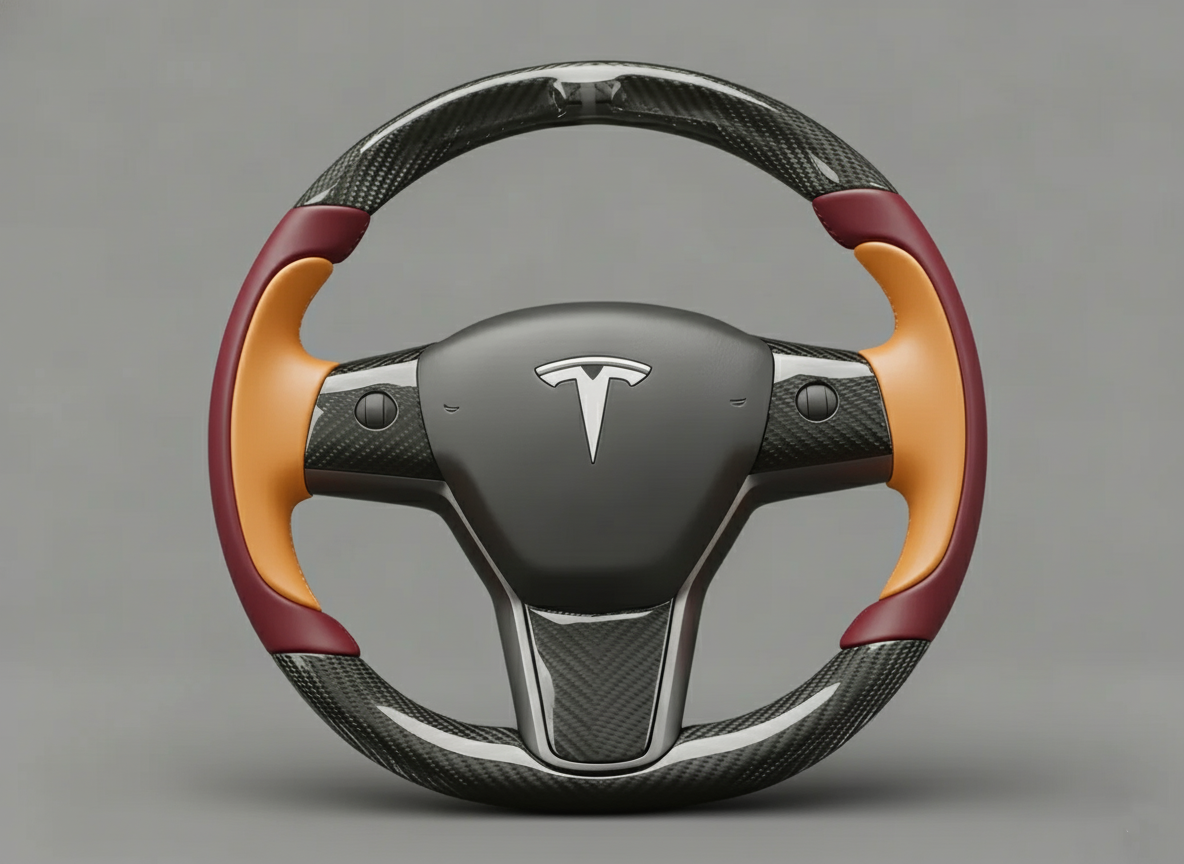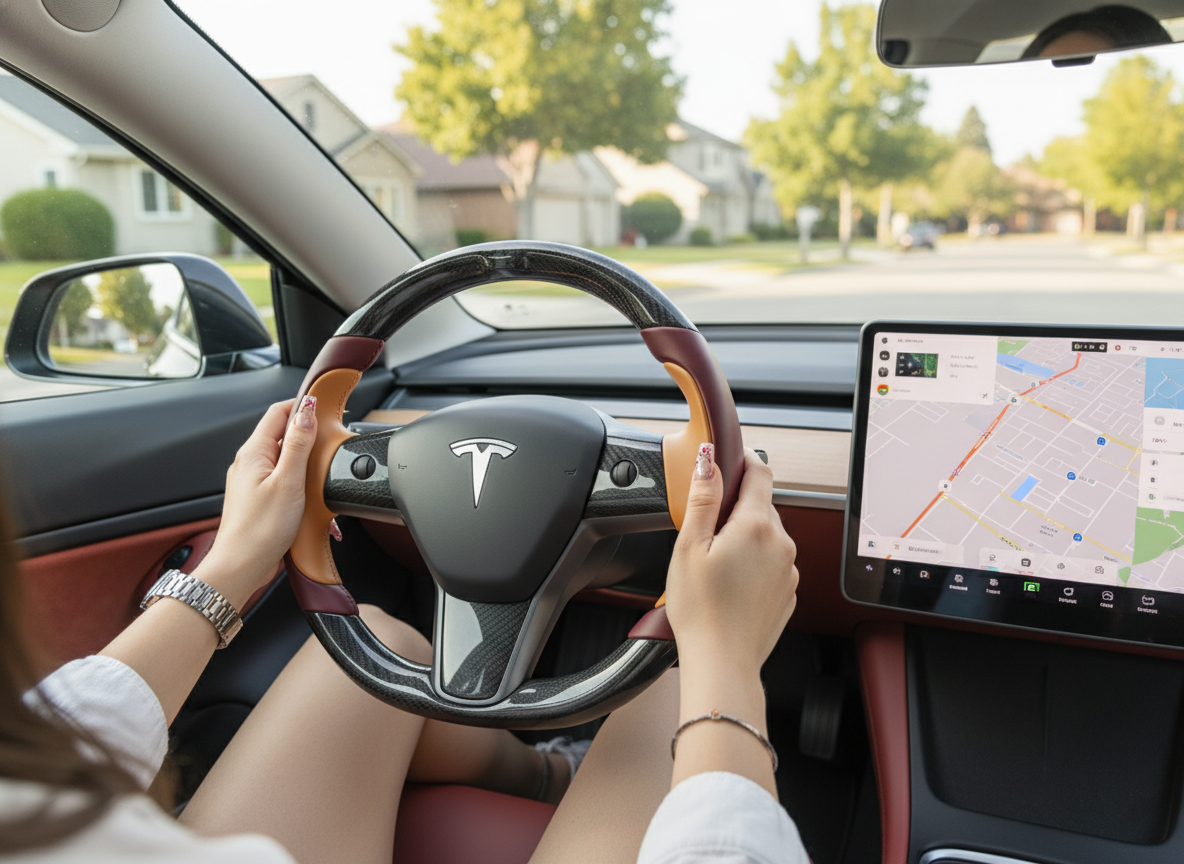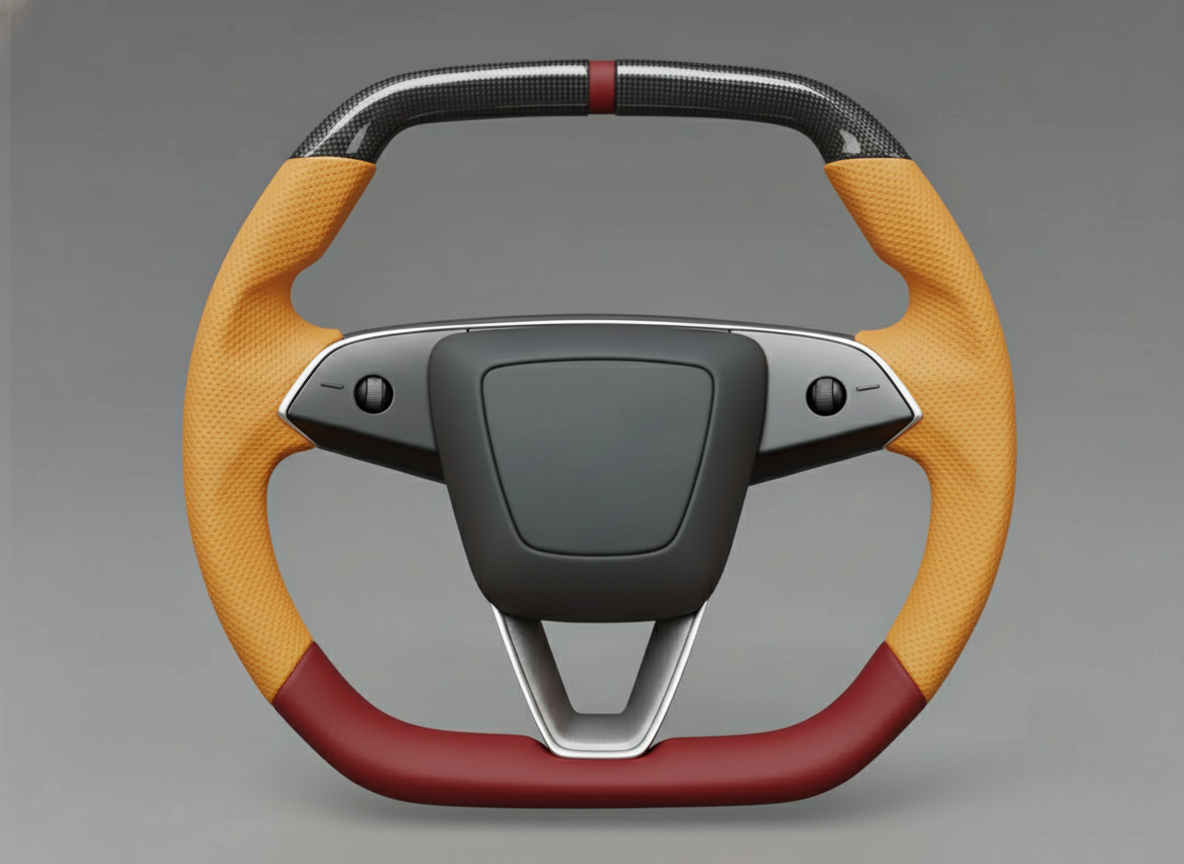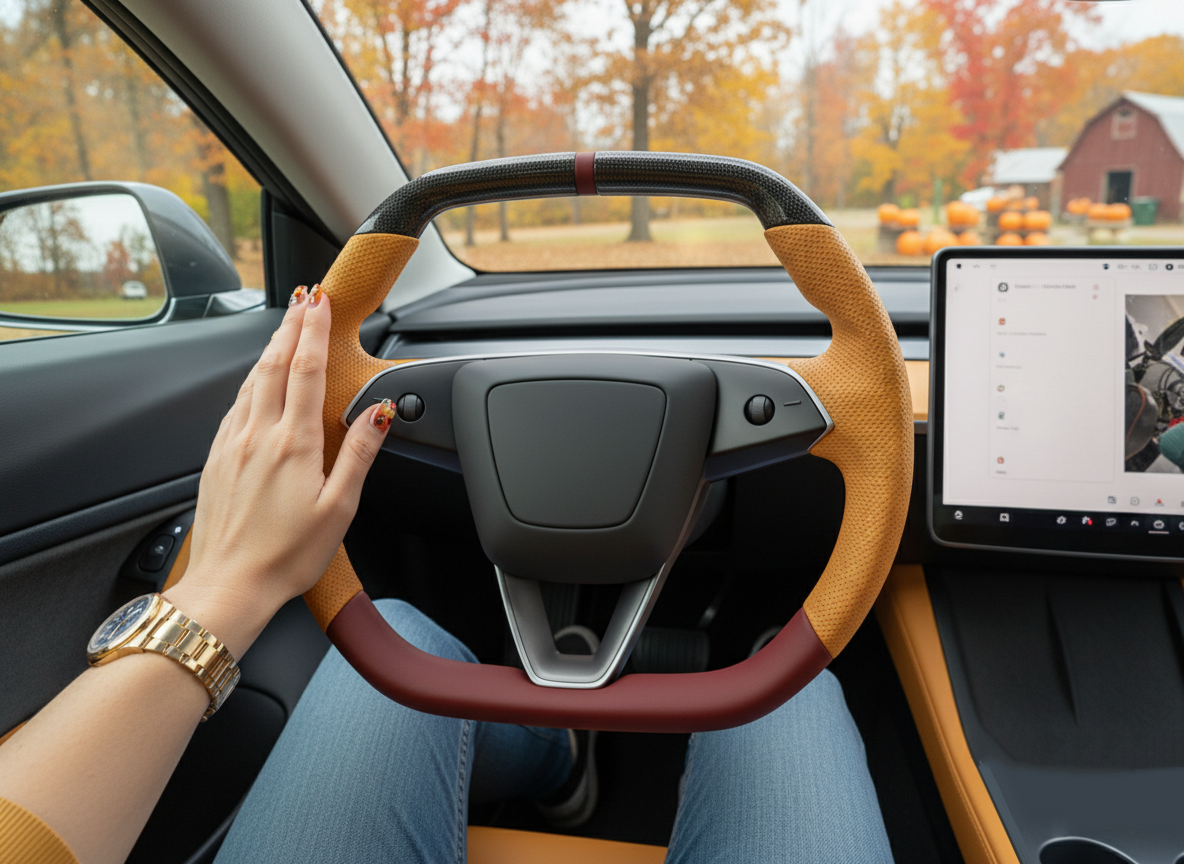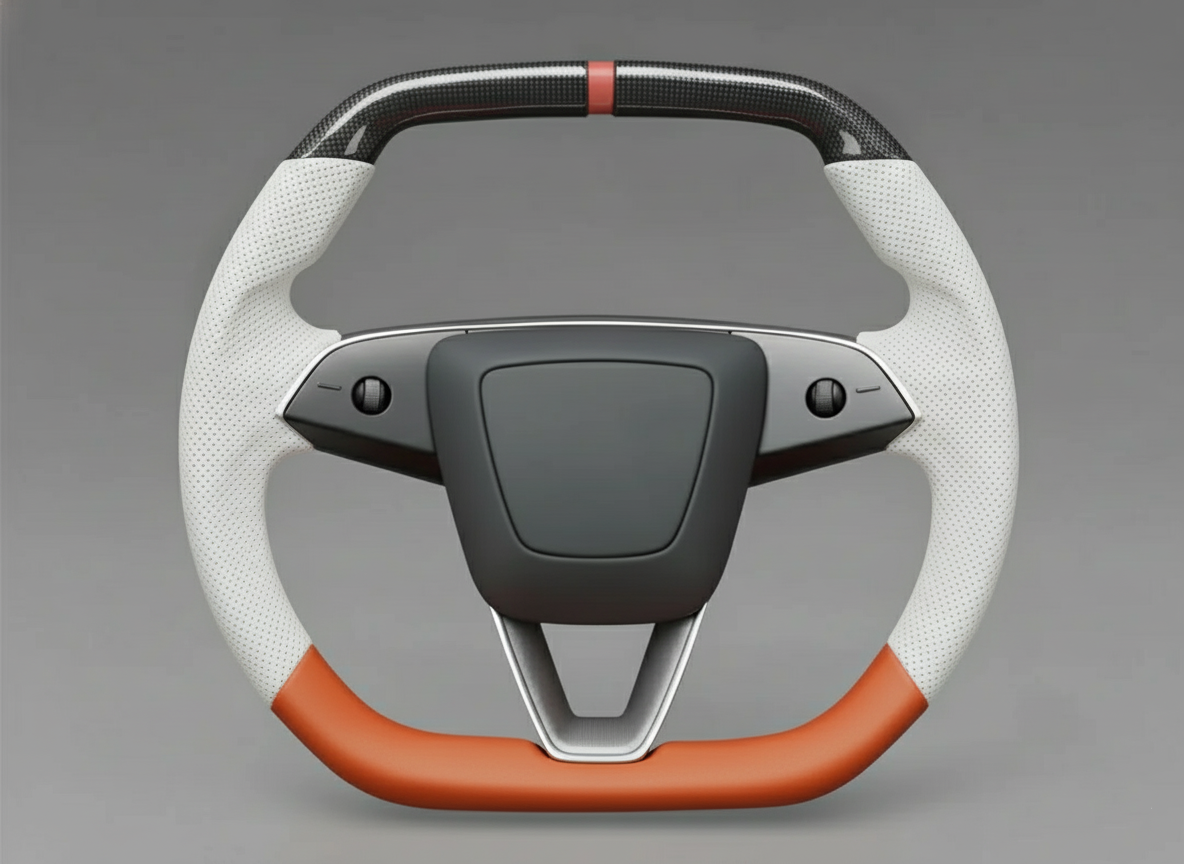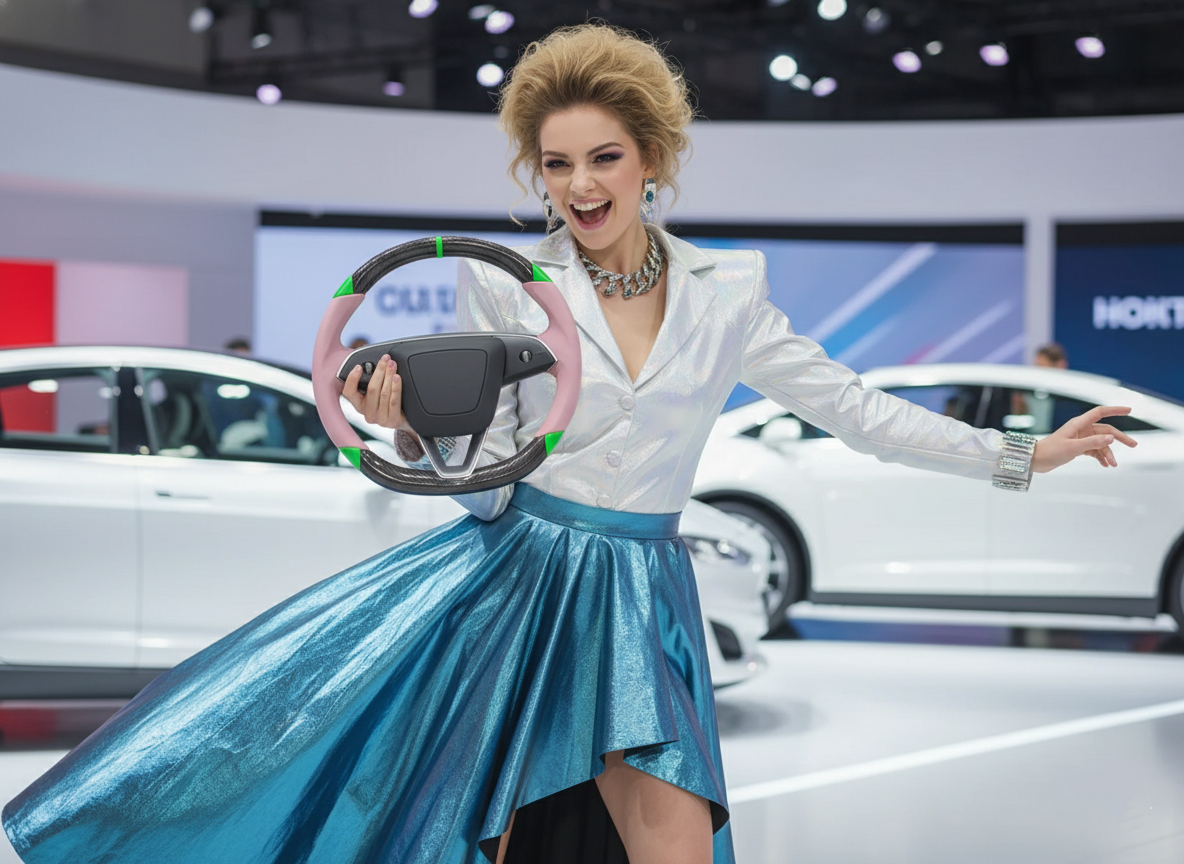
The Model 3 steering wheel features a 365mm diameter and a 33mm grip thickness, complemented by optimized 3/9 o'clock positioning.
Its dual-scroll wheel interaction ensures handling precision and ergonomic long-distance driving comfort within a minimalist aesthetic.
Grip
The Model 3 steering wheel has a diameter of 360mm and a grip circumference of approximately 110mm.
Its quick 10.3:1 steering ratio requires the driver to maintain high control precision within a 2.0-turn lock-to-lock travel.
The vegan leather material possesses a static friction coefficient of approximately 0.6 to 0.8, ensuring no hand slippage during high-speed lane changes.
The 3 and 9 o'clock positions feature 5mm deep thumb grooves, paired with internal polyurethane filling to maintain stable pressure distribution during long drives.
Rim Cross-Section Parameters
At the 12 o'clock position, the cross-section diameter is maintained at 32 mm, presenting a rounder shape to facilitate hand-over-hand maneuvers during U-turns or large-angle rotations.
As the view moves to the primary grip areas at 3 and 9 o'clock, the cross-section evolves into a lateral oval 35 mm wide and 32 mm thick.
This 1.09:1 flatness ratio increases the contact area between the thenar eminence (palm muscle) and the steering wheel, enhancing rotational stability through physical interference without increasing required grip strength.
| Measurement Position | Section Width (mm) | Section Depth (mm) | Geometric Description | Grip Pressure Distribution (N/cm2) |
|---|---|---|---|---|
| Top Center (12 o'clock) | 32.1 | 32.1 | Nearly circular, facilitates sliding | 12 - 15 |
| Side Grip (3/9 o'clock) | 35.4 | 32.2 | Flat oval, matches palm curvature | 8 - 10 |
| Finger Groove (3/9 inner) | 28.5 | 31.0 | Local narrowing, provides anchor point | 18 - 22 |
| Bottom Area (6 o'clock) | 31.8 | 31.8 | Standard size, clears legroom | 10 - 12 |
The innermost layer is a die-cast magnesium alloy frame, which ensures rigidity while reducing rotational inertia.
The frame is wrapped in a layer of expanded polyurethane with a density of 250 to 300 kg/m³.
The thickness of this layer is precisely calculated to generate a linear rebound resistance when compressed by 5 mm, preventing the driver from losing micro-sensitivity to steering angles due to over-gripping.
An array of electric heating wires, approximately 0.5 mm thick, is embedded between the foam layer and the outermost Vegan Leather.
This multi-layer composite structure keeps the final rim circumference between 110 mm and 115 mm, the "golden range" for adult hand gripping.
On the back of the 3 and 9 o'clock positions, the cross-section parameters include 3mm high finger ridges.
These ridges are spaced at approximately 25 mm, matching the average width of the index, middle, and ring fingers.
When the driver places their hands here, the rear ridges and the 5mm deep front thumb grooves form a closed-loop physical locking mechanism.
Even without actively tightening the fingers, the natural downward pressure of the palm allows the steering wheel to maintain its position without shifting during the 2.0-turn lock-to-lock travel.
This cross-sectional design reduces reliance on muscle strength, shifting steering precision from muscular effort to the physical fit of the skeletal structure.
| Material Layer | Thickness Data (mm) | Shore Hardness (Shore A) | Physical Function |
|---|---|---|---|
| Vegan Leather Skin | 0.8 - 1.2 | 55 - 60 | Provides static friction coefficient ~0.7 |
| Buffer Foam Layer | 3.0 - 5.0 | 30 - 35 | Absorbs high-freq vibration & provides support |
| Heating Element | 0.5 | N/A | Maintains constant tactile feel (~35°C) |
| Mg-Al Alloy Frame | 15 - 20 (dia) | N/A | Provides overall torsional rigidity |
Since the Model 3 steering wheel diameter is only 360 mm—about 20 mm smaller than most sedans—the impact of the rim's thickness on handling feel is amplified.
The thicker 35mm side section compensates for the "floaty" feel associated with small diameters, allowing drivers to perform precise lane changes at speeds over 110 km/h with minimal forearm movement.
The combination of the vegan leather's surface tension and the internal polyurethane's density allows for approximately 2mm of sinkage when gripped.
Physical Properties of Vegan Leather
Since Tesla transitioned from genuine leather to 100% Vegan Leather in 2019, the component's physical performance has been calibrated with a static friction coefficient of 0.75 and a thermal conductivity of 0.12 W/m·K.
This synthetic skin is 1.1 mm thick; when 50 Newtons of grip force is applied, surface sinkage is controlled within 0.3 mm.
The R&D goal was to provide superior oil resistance and UV stability compared to traditional leather while meeting a lightweight requirement of 800 grams per square meter.
The polymer polyurethane material used by Tesla features cross-linked reinforcement in its molecular structure, maintaining a Shore hardness between 55A and 60A at a room temperature of 23°C.
This hardness setting provides a "skin-like" touch ergonomically—neither as rigid as plastic nor as unsupportive as certain fabrics.
The surface tension is finely tuned to maintain sliding resistance for a dry palm within a constant range.
According to laboratory Taber abrasion tests, the vegan leather loses less than 5% of its surface texture after 1,000 cycles.
This physical durability ensures the steering wheel surface does not deform or thin out due to localized pressure during frequent urban steering maneuvers.
The internal polyester fiber base cloth provides a tear strength of over 400 Newtons, ensuring the skin remains firmly attached to the frame during accidents or aggressive driving.
| Physical Parameter | Measured Value | Industry Standard | Driving Experience Impact |
|---|---|---|---|
| Static Friction (Dry) | 0.72 - 0.78 | ISO 15113 | Enhances high-speed lane change stability |
| Coating Thickness | 1.05 mm | ASTM D1777 | Provides moderate fingertip engagement |
| Elongation at Break | 120% - 150% | ISO 1421 | Ensures tight, wrinkle-free fit |
| Thermal Conductivity | 0.12 W/m·K | Internal Protocol | Reduces "ice-cold" feel in winter |
| VOCs | < 10 μg/m3 | VDA 278 | Maintains cabin air cleanliness |
The micron-level texture of the vegan leather is not random; it mimics natural porous structures via laser etching.
These micro-pores, distributed at a density of approximately 150 to 200 per cm², play a vital role in moisture management.
When a driver's palm sweats, these pores temporarily accommodate micro-amounts of moisture via capillary action, preventing a lubrication film from forming between the palm and the rim, thus avoiding slippage.
Tests show that in a 85% humidity environment, the friction coefficient only drops from 0.75 to 0.68, far outperforming coated genuine leather in wet conditions.
- UV Resistance: After 1,000 hours of intense UV exposure, the color deviation (Delta E) is less than 1.5, preventing embrittlement.
- Scratch Resistance: No visible marks under a 5 Newton steel needle scratch test, resisting damage from nails or rings.
- Compression Recovery: After prolonged gripping, the recovery rate reaches 98% within 2 seconds.
- Hydrolysis Resistance: No peeling or delamination after 10 weeks in a chamber at 80°C and 95% humidity.
Due to low thermal inertia, the internal 40-watt heating wire can raise the surface temperature from 0°C to 35°C within 90 seconds.
The thickness uniformity of the vegan leather is controlled within 0.05 mm, resulting in extremely even heat distribution without hot spots.
Blind Tactile Guidance
Due to the 10.3:1 high-sensitivity steering ratio, the driver must perceive the steering angle with a precision within 5 degrees during high-speed driving.
To achieve this, the rim features 5mm deep asymmetrical thumb grooves at 3 and 9 o'clock.
When thumbs are embedded, contact pressure shifts from uniform distribution to localized pressure in the thenar region, creating a clear "homing signal" for the nervous system.
The groove width is set at 35 mm, matching human physiology to ensure hands can instantly locate the most efficient operating zone without visual confirmation.
This tactile logic extends beyond the front grooves. The 3mm high finger ridges on the back are spaced at 25 mm, perfectly accommodating the finger joints from the index to the pinky.
The rim cross-section transitions smoothly from a 32mm perfect circle at 12 o'clock to a 35mm lateral oval at 3 o'clock. This dynamic change creates a circumference difference of about 5 mm.
As the driver rotates the wheel, the perceived grip diameter increases linearly, allowing the brain to calculate the steering deflection based on the palm's opening angle.
The polyurethane foam layer beneath the skin has a density of 280 kg/m³, producing an outward expansion force that feels more solid at the oval sections.
At 120 km/h, this tactile feedback helps the driver sense if the vehicle is centered without looking at the instrument cluster.
The scroll wheels provide another layer of data interaction. The metal scroll wheels feature 24 physical detents. Each detent generates approx. 1.5 Newtons of instantaneous resistance and a clear mechanical vibration.
During Autopilot operation, the tactile system works with a 0.15 Nm torque monitoring logic.
By resting hands naturally in the grooves and ridges, the driver can use the arm's natural gravity to generate the required torque without active gripping, reducing muscle fatigue.
The vegan leather's 0.75 friction coefficient ensures that during a requested takeover, the hand is firmly coupled with the rim without perception lag caused by relative displacement.
Thickness
The Model 3 steering wheel grip diameter is set between 32mm and 35mm, significantly thicker than the 28mm average for traditional sedans.
This specification, paired with the 10.3:1 steering ratio, provides more stable leverage during the 2.0-turn travel.
The internal high-density foam and outer Vegan Leather are thickened at 3 and 9 o'clock to match the thenar muscles, effectively dispersing pressure during high-speed cornering.
Design Specifications
The Model 3 steering wheel follows a compact path with a 360mm outer diameter—approx. 5% smaller than the 375-380mm standard in North America.
This reduces the arm's range of motion, which, combined with the 10.3:1 ratio, significantly reduces steering effort travel.
Mechanically, it connects via a 17mm fine-tooth spline shaft to ensure zero-backlash feedback.
The magnesium alloy casting minimizes rotational inertia, improving the response speed of the EPS (Electronic Power Steering) system.
| Physical Parameters | Specification Value | Industry Standard |
|---|---|---|
| Outer Circumference | 1130 mm | 1178 mm |
| Grip Cross-Section | Oval | Circular / Irregular |
| Inner Frame Material | AZ91D Magnesium Alloy | Aluminum / Steel |
| Steering Column Spline | 54 Teeth | 40 - 48 Teeth |
| Total Weight (w/ Airbag) | 1.45 kg | 1.8 kg - 2.2 kg |
The Vegan Leather has a tensile strength of over 15 MPa and a thickness of 1.1 mm.
Beneath it lies a 55 kg/m³ density polyurethane foam, which deforms by 1.5 mm under 5 Newtons of pressure to absorb shock and increase friction.
For thermal management, 0.2mm diameter Ni-Cr alloy wires provide 25 to 45 watts of power, raising the surface to 38°C within 3 minutes with a thermal error within ±2°C.
| Cover & Fill Specs | Technical Index | Performance Description |
|---|---|---|
| Skin Durability | 100,000 cycles | Simulates 10-year lifespan |
| Foam Hardness | Shore A 45-50 | Balances support and softness |
| Adhesive Strength | 3.5 N/mm | Ensures no peeling under heat |
| Heating Wire Pitch | 8 mm | Dead-zone-free heat transfer |
| Surface Friction | 0.65 (Dry) | Ensures no slip without gloves |
Electronic interaction components are located at the 3 and 9 o'clock spokes.
Two Hall-effect sensor based metal scroll wheels provide 256-level displacement resolution. Each rotation provides 24 physical clicks, transmitted via a 19.2 kbps LIN Bus to the vehicle's computer.
For the Highland version (no stalks), pressure-sensitive touch buttons are used with a threshold of 2 to 5 Newtons, providing haptic feedback via Linear Resonant Actuators (LRA) at 150Hz to 200Hz.
| Electronic Components | Technical Standard | Communication Path |
|---|---|---|
| Scroll Resolution | 15 Degrees / Detent | LIN Bus -> SCM |
| Pressure Range | 0N - 10N | Analog to Digital conversion |
| Haptic Latency | < 20 ms | Real-time tactile response |
| ESD Protection | 8kV Contact | Industrial grade ESD standard |
| Standby Power | < 1 mA | Lowers static energy consumption |
The center houses a 60 to 65-liter single or dual-stage airbag made of 420 Denier high-strength Nylon 66.
Deployment occurs within 30 to 50 ms, with 25mm diameter vents to absorb kinetic energy.
The tear line is laser-weakened to ensure reliable opening from -35°C to 85°C.
| Safety Constraints | Measured Data | Test Condition |
|---|---|---|
| Airbag Inflation Pressure | 250 kPa | Ambient (23°C) |
| Cover Opening Force | 80N - 120N | Laser-weakened slot test |
| Fabric Flammability | < 100 mm/min | FMVSS 302 Compliant |
| Sensor Trigger Threshold | 2.5G Acceleration | RCM Trigger determination |
| Clock Spring Wiring | 12 - 14 Core | Supports signals & heating |
When turning at 360 degrees per second, the magnesium frame suppresses micro-vibrations, ensuring clean torque signals.
At high loads, the 35mm grip spreads contact pressure to approx. 1.5 N/cm², improving hand endurance during aggressive driving.
Muscle Load & HMI
The 35mm grip diameter forms a specific physical support relationship with the 14 joints of the hand and the thenar/hypothenar muscles.
This increases contact area by 22% over traditional 28mm wheels, dispersing torque pressure and reducing single-point stress.
Anatomically, this relieves the isometric contraction intensity of deep muscles like the interossei and lumbricals, preventing high fascial tension ("soreness") from "pinching" the wheel.
The 1.5mm compression travel allows for stable friction without over-reliance on fingertip force.
| Hand Muscle Groups | Load Status at 35mm | Fatigue Threshold Change |
|---|---|---|
| Flexor Digitorum Superficialis | Neutral extension, 15% lower pressure | 4h driving without stiffness |
| Adductor Pollicis | Gains lateral support, less clamping force | Reduces hand tremor incidence |
| Flexor Carpi Radialis | Uniform torque distribution | Improved steering precision feedback |
| Palmaris Longus | Low-tension state | Reduced long-term driving aches |
The Hall-effect scroll wheels offer 0.1-degree angular resolution, capturing tiny finger movements.
The 24 physical detents provide tactile counting feedback, allowing speed or volume adjustments without taking eyes off the road.
In Highland, the 2N-7N pressure threshold and 180Hz resonance from the LRA simulate physical button clicks, closing the signal loop within 20 ms.
| Interaction Element | Parameter | Neural Feedback |
|---|---|---|
| Scroll Damping | 0.5 N·m | Clear physical detent |
| Pressure Range | 0 - 10 Newtons | Supports multi-level pressure |
| LRA Acceleration | 1.2G | Strong tactile confirmation |
| Comm. Latency | < 15 ms | Eliminates operational lag |
| Detent Frequency | 24 clicks per rev | Physicalization of digital control |
The steering wheel's thickness acts as a "torque lever." It increases the damping perception of fine steering column vibrations, while the foam absorbs road noise between 50Hz and 150Hz.
At high speeds, the elbow can remain at the "golden" 90-120 degree ergonomic angle, reducing deltoid load by 10% compared to large traditional sedans.
To ensure consistent feel, the wheel runs at a constant 38°C. The Capacitive Sensing Layer (HOD) scans at 10Hz to detect hand contact via minute changes in capacitance (< 5pF).
| Environmental Condition | Technical Spec | User Experience |
|---|---|---|
| Constant Temp Precision | ±2.0°C | No heat-induced discomfort |
| HOD Sensitivity | < 5pF Detection | Senses extremely light touch |
| Surface Friction Torque | 1.2 N·m (Dry) | No slip during aggressive turns |
| Shape Recovery | < 0.2 seconds | Instant rebound after pressure |
| Vibration Alert | 3-Level Adjustable | Tactile warning without interference |
Physical Damping
The 1.3 kg to 1.5 kg AZ91D Magnesium frame is highly stable against 50-200Hz vibrations from the steering rack.
Since EVs lack internal combustion low-frequency vibes, road impacts feel sharper; the damping system must filter these within 20ms.
The 54-tooth spline ensures zero play, meaning all resistance felt comes from tire-road interaction.
In the 10.3:1 ratio, damping suppresses unintended vehicle trajectory shifts caused by involuntary muscle jitters.
Data shows the foam layer has a dynamic damping coefficient of ~0.45. At 0.5 rad/s, it provides 1.2 Nm to 1.8 Nm of physical centering resistance.
The 1.1mm skin and 55 kg/m³ foam act as a physical low-pass filter, absorbing electromagnetic vibrations from the EPS motor.
This allows the driver to pre-judge understeer or oversteer via hand pressure changes without relying on visual cues.
Control
Model 3 control logic is built on the 10.3:1 steering ratio (2.1 turns lock-to-lock).
Two 5-way scroll wheels handle over 90% of high-frequency adjustments.
Torque sensors monitor hand input with a 1.2 to 1.5 Nm variance.
Minimalist Steering Logic
While German sport sedans range from 14.5:1 to 15.5:1, the Model 3's 10.3:1 setting results in only 2.1 turns lock-to-lock.
The torque sensor samples at 1000Hz, sending data 1,000 times per second to the EPS controller.
| Performance Metric | Model 3 Data | Traditional Reference | Differential Result |
|---|---|---|---|
| Steering Ratio | 10.3:1 | 15.1:1 | Response travel shortened >30% |
| Lock-to-Lock Turns | 2.1 Turns | 2.8 Turns | Reduces hand-over-hand frequency |
| Rack Displacement | ~145 mm | ~160 mm | Faster hardware execution |
| Min Turning Radius | 5.8 meters | 5.5 to 6.2 meters | Standard agility with compact ratio |
| Sampling Frequency | 1000 Hz | 500 Hz | Lower input latency |
The 360mm diameter minimizes inertia. The EPS, powered by a brushless DC motor, can generate over 1000 Newtons of thrust to overcome tire friction.
Steering modes include Comfort, Standard, and Sport.
| Feedback Mode | Center Torque (Nm) | Damping Intensity | Environment |
|---|---|---|---|
| Comfort Mode | 1.2 - 1.5 | Extremely Low | Low-speed parking, long trips |
| Standard Mode | 2.0 - 2.8 | Moderate Centering | Urban expressways, commuting |
| Sport Mode | 3.5 - 4.5 | High Resistance | Mountain roads, track, high speed |
At speeds over 100 km/h, software increases center stability.
In Highland, pressure sensors replace stalks, allowing turn signals and wipers to be triggered within a 15mm thumb radius via 2N-5N of force.
The steering column provides 40mm of telescope and 3 degrees of tilt via precision stepper motors (0.5mm accuracy).
Scroll Wheel Multi-dimensional Interaction
The wheels are 25mm in diameter with non-slip rubber coatings.
Trigger pressure is set at 1.5N to 3.0N to prevent accidental activation during turns. Latency from physical click to screen update is under 100 ms.
Left Scroll: Volume (2% per click); Left/Right toggle for tracks; Press for Play/Pause.
When in "Mirror" or "Steering Wheel" adjustment menus, the left wheel is repurposed to control tilt and span. This eliminates mechanical stalks on the door panel.
With Autopilot active, vertical scrolling modifies cruise speed (1 unit for slow scroll, 5 units for fast).
Left/Right toggle adjusts follow distance (1-7 stages). A short press activates Voice Assistant.
Long-press (1.5s+) can be customized for acceleration modes, glovebox, Dashcam, or fan speed.
Right Scroll Data: Speed micro-adjust (1 unit); Fast adjust (5 units); 7 stages for distance; 1.5s threshold for long-press.
The wheels are positioned 12-15 mm from the thumb's natural resting spot, ensuring 90% of adjustments occur without leaving the rim. Mechanical life is rated for 500,000 cycles.
Electronic Resistance Modes
Torque sensors sample at 1000Hz. Assistance is linearly adjusted based on speed.
At low speeds, the motor compensates for 1500N-2500N of static friction. At high speeds, assistance is reduced to maintain the trajectory.
- Comfort: 1.2-1.5 Nm torque. 80% of road feedback is filtered. Ideal for parking.
- Standard: 2.0-2.8 Nm. Retains mechanical road feel for drainage ditch covers or road changes.
- Sport: 3.5-4.5 Nm. Simulates heavy mechanical connection with minimal play.
The system automatically compensates for crosswinds or road crown.
If sensors detect a persistent yaw force from road tilt, the motor applies a counter-torque (0.1-0.3 Nm) to keep the car straight.
- Latency: < 50ms from input to motor assistance.
- Max Thrust: > 100 Nm torque during emergency evasion.
- Thermal Protection: Adjusts curve if motor exceeds 100°C.
- Road Filtering: Distinguishes high-frequency asphalt noise from low-frequency input.
In power failure scenarios, backup power takes over within 10ms.
During Autopilot, if counter-torque falls below 0.12 Nm, the system prompts for hand contact. In collision risks, the motor generates a 30Hz pulse vibration as a tactile warning.