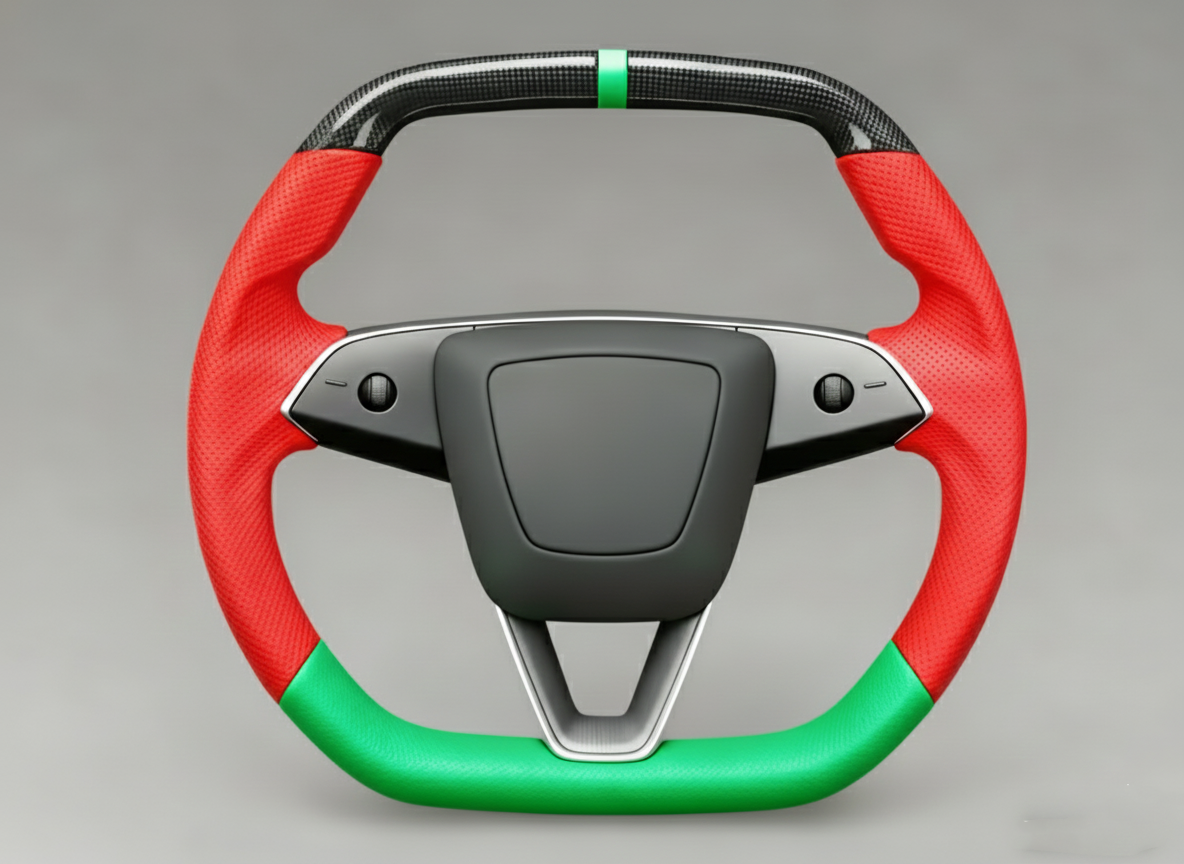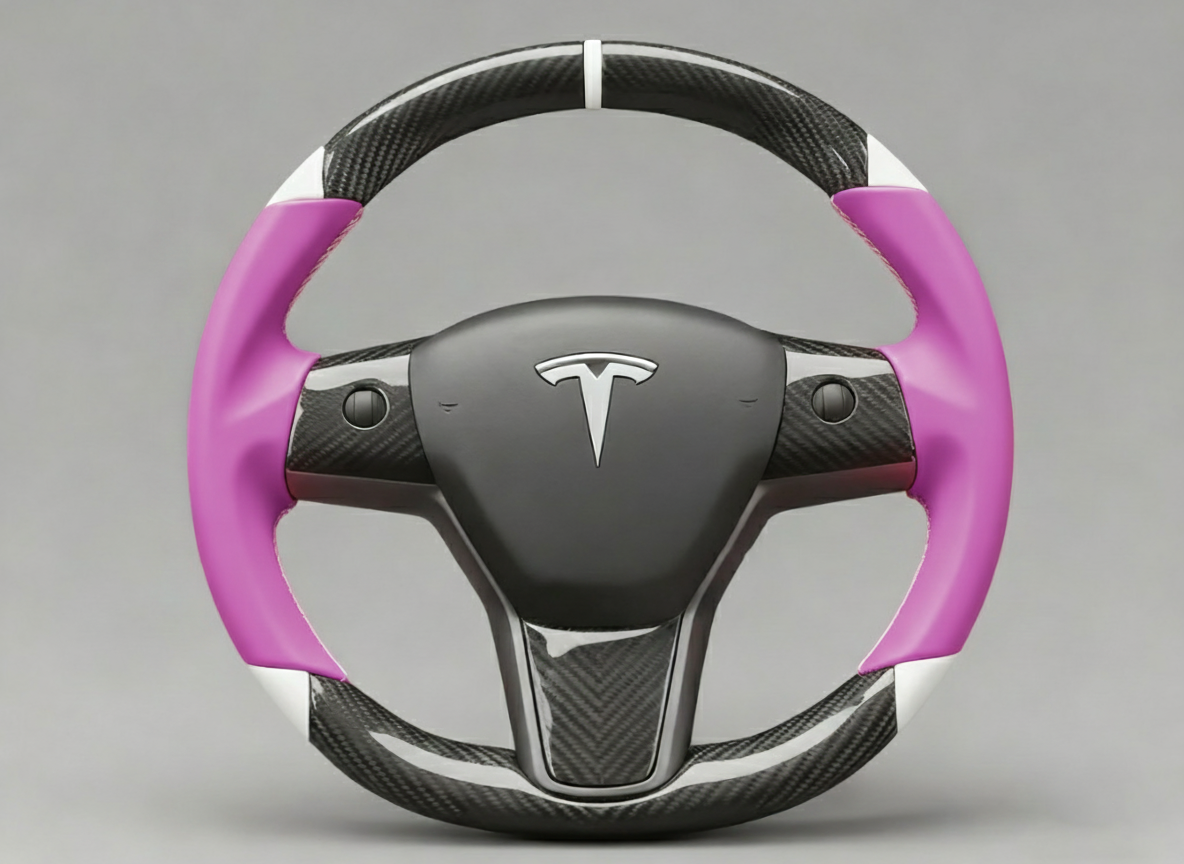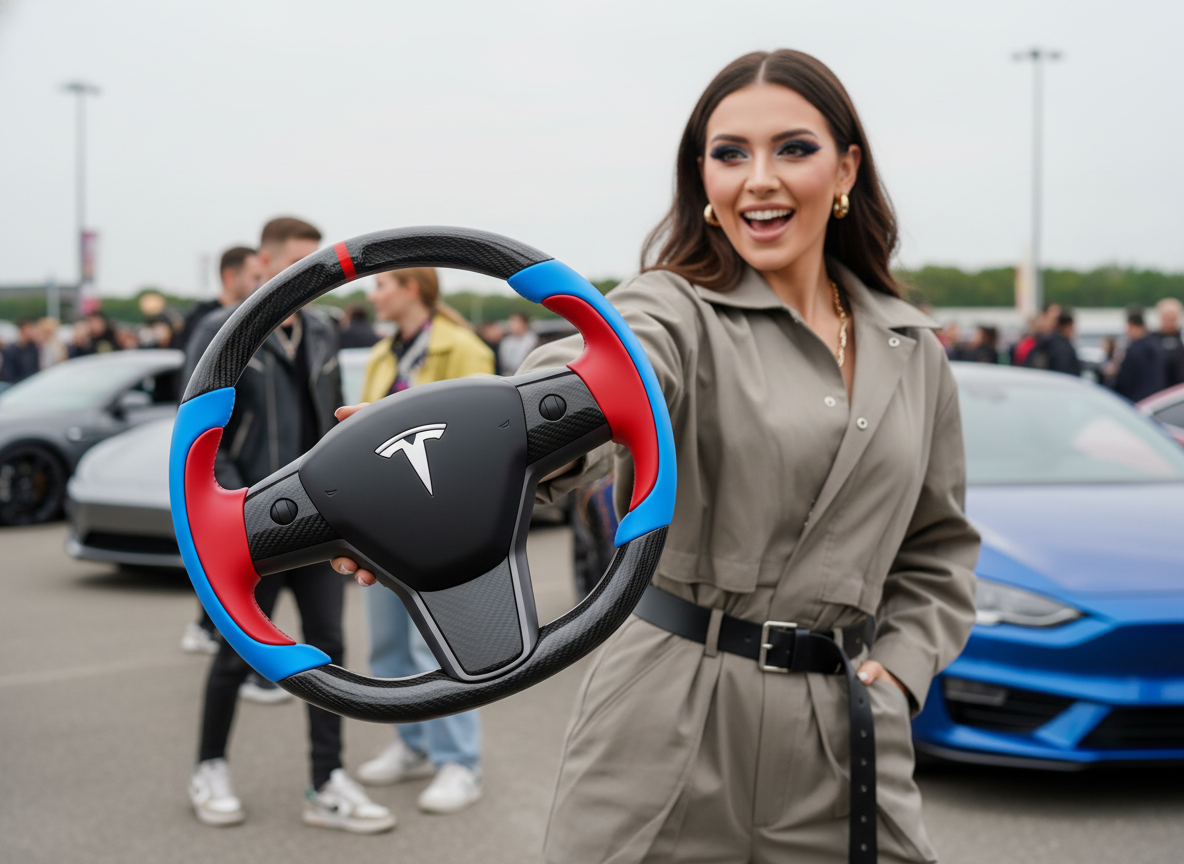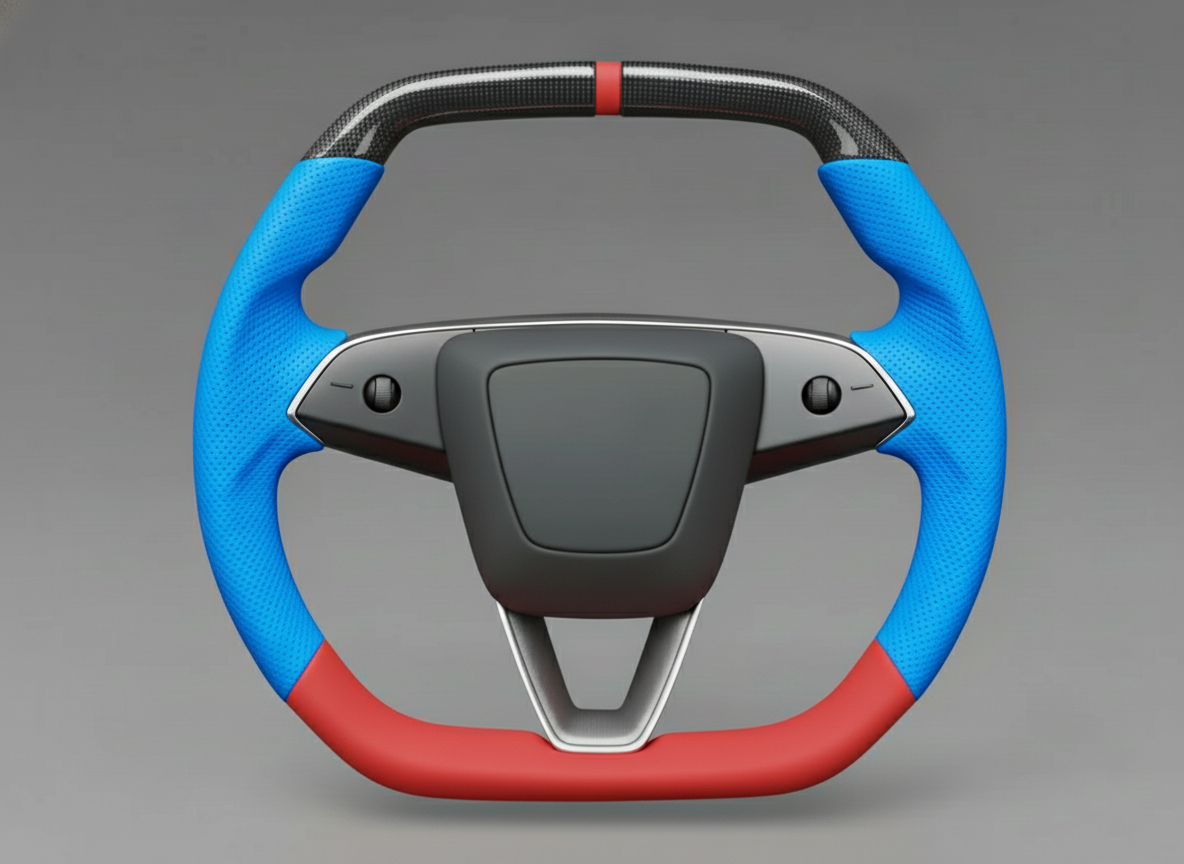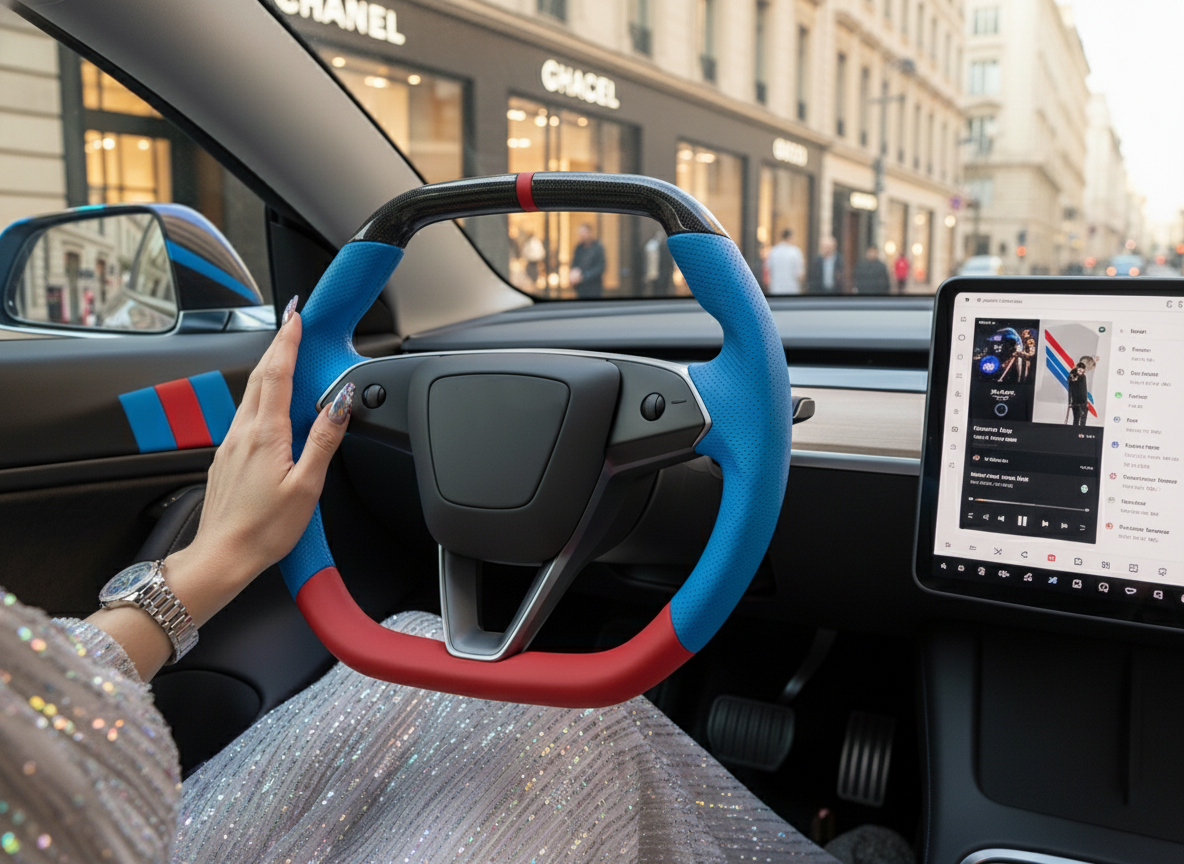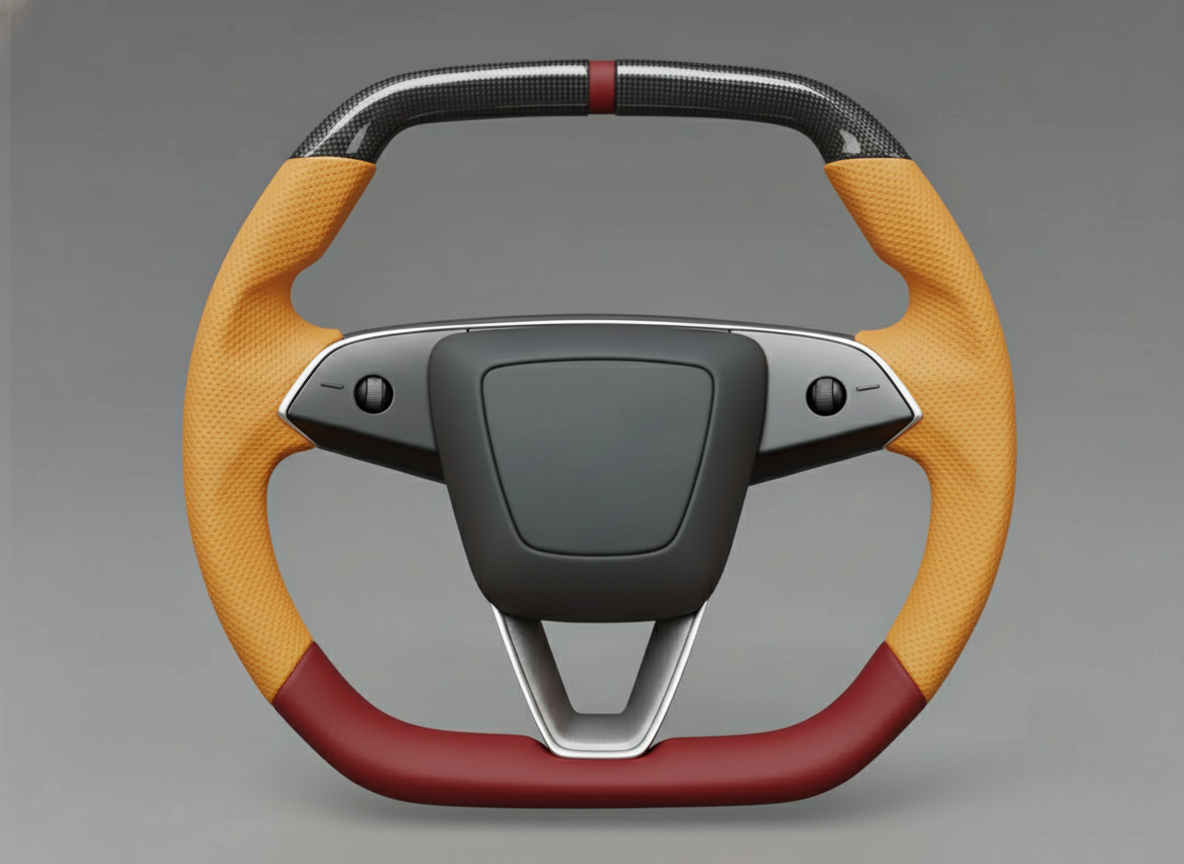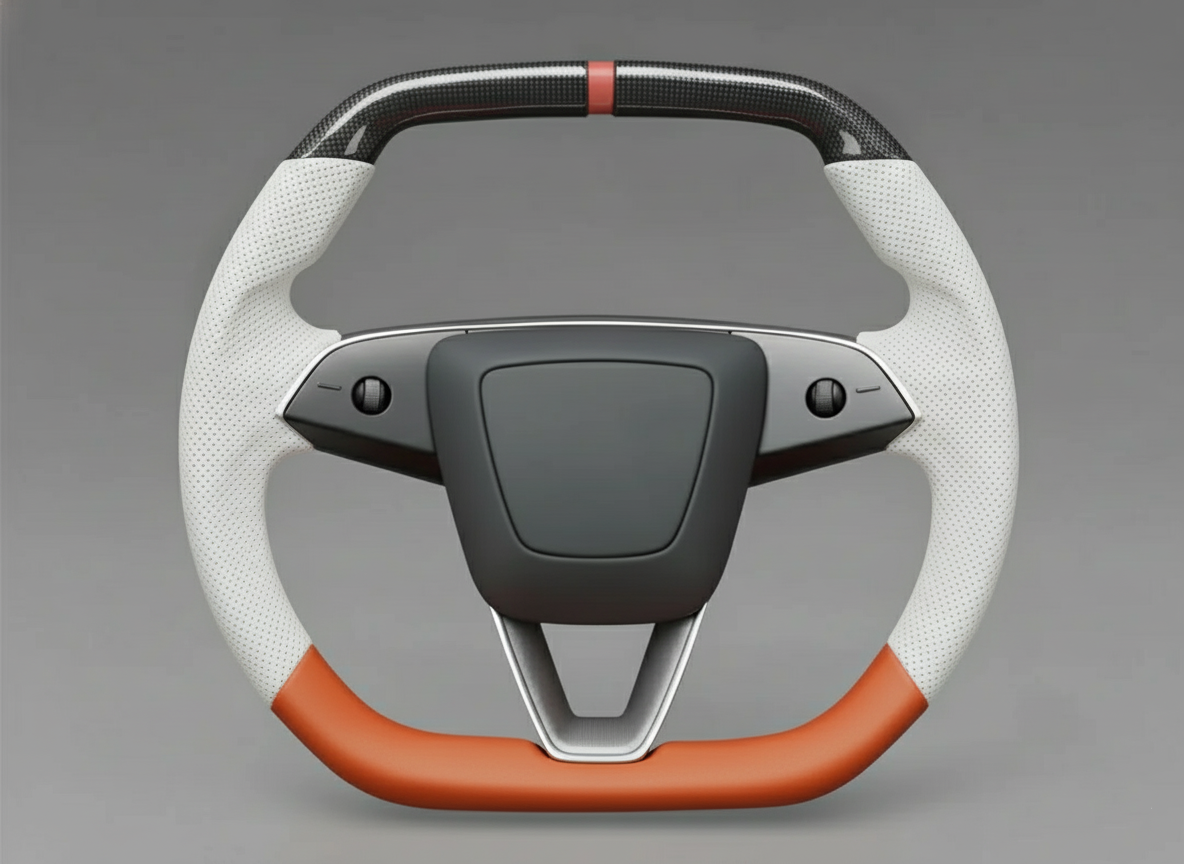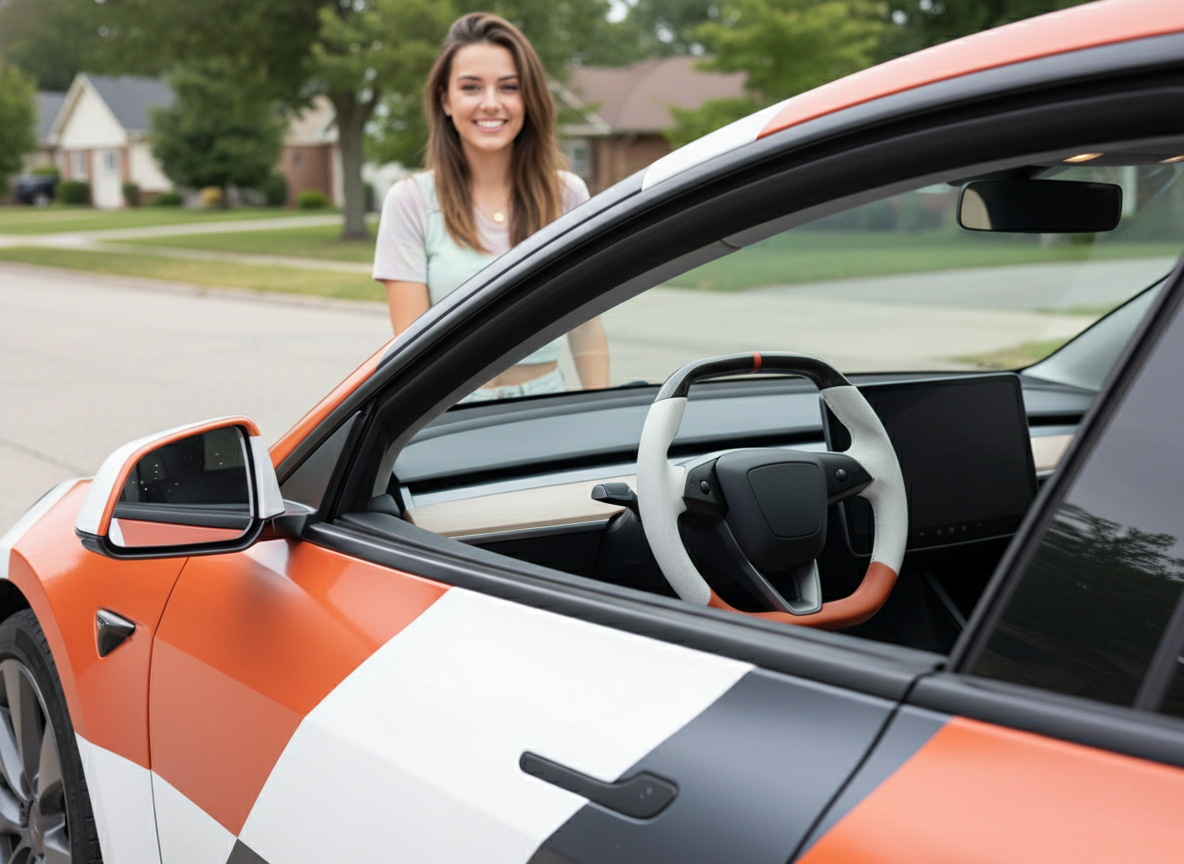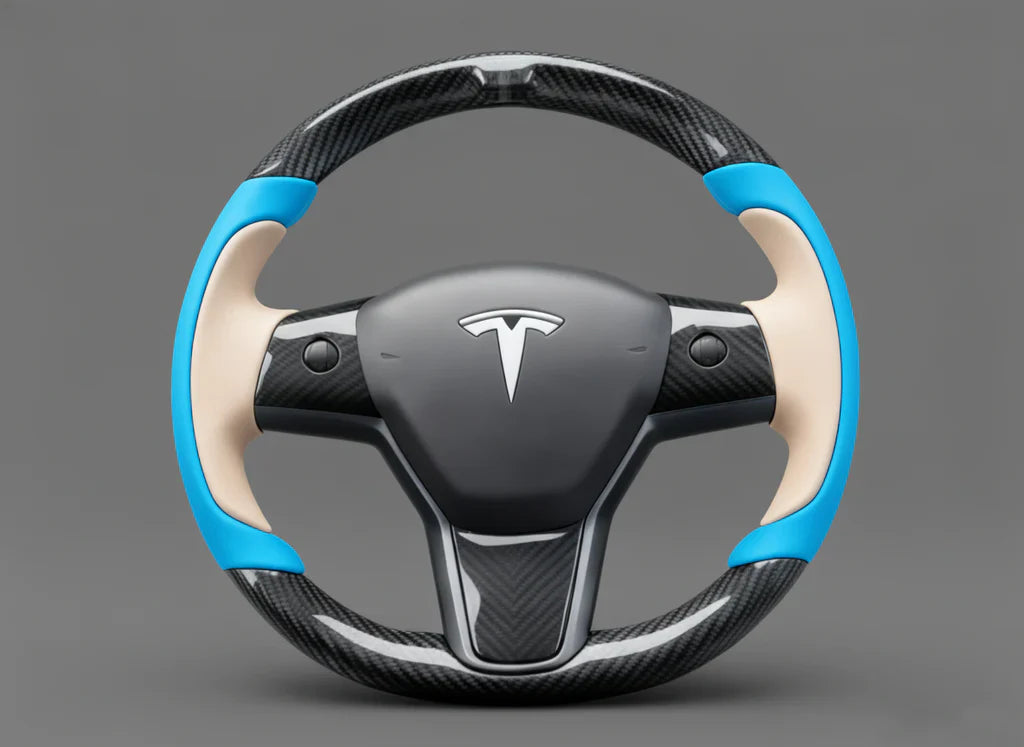
For track use, it is recommended to replace the steering wheel with a 350mm Alcantara wheel.
When modifying to a quick-release system, a 2-ohm resistor must be wired in series to prevent the airbag warning light from illuminating.
The center bolt should be coated with threadlocker and tightened to 50 Nm to prevent loosening due to high-frequency vibrations.
Track Use
The factory Model 3 350mm synthetic leather steering wheel often suffers from unstable grip when dealing with lateral accelerations exceeding 1.0G, which is common on the track.
The primary requirement for a track steering wheel is to maintain a high coefficient of friction (μ > 0.8), especially when palms are sweaty or when wearing Nomex racing gloves.
Competitive selection focuses on the directness of RMS torque transmission, usually by reducing the diameter to 320mm-330mm to physically reduce steering input travel, combined with Alcantara or perforated leather materials to lock in the 3 o'clock/9 o'clock grip posture, preventing slippage during rapid counter-steering.
Material Friction Performance
Construction of Alcantara
Alcantara is the mainstream choice for track modifications currently, but it must be clarified that Alcantara is a registered trademark of Alcantara S.p.A. in Italy, not a generic material name.
It is a high-grade synthetic material composed of 68% Polyester and 32% Polyurethane.
From a microscopic view, Alcantara uses a "needle-punching process" to entangle microfibers together, forming a surface texture similar to natural suede.
This surface possesses countless tiny columnar fibers. When grasped by the palm, these fibers undergo minute deformation, increasing the contact area.
- Dry Grip: In dry conditions, the friction coefficient of Alcantara is usually between 0.9 and 1.0.
- Wet Grip: Even if the surface absorbs moisture, its porous structure allows water to penetrate into the inner layers, maintaining a surface friction coefficient of about 0.7 to 0.8.
The thickness of this material is usually between 0.8mm and 1.2mm, wrapped directly around the steering wheel skeleton or foam layer.
For Model 3 owners, when purchasing, you should confirm that "Automotive grade" Alcantara is used, usually code 9002 (Dark Grey) or 9040 (Black).
These models have undergone anti-UV treatment and will not fade or turn purple under sun exposure like low-end knockoffs.
Differences with Real Suede
Suede is the product of sanding and napping the inner layer (flesh side) of leather.
- Initial Performance: Brand new Suede offers mechanical grip slightly higher than Alcantara because natural leather fibers are coarser and have a stronger "bite."
- Water Absorption Issue: Natural leather absorbs water like a sponge. After a few continuous laps on a track day, Suede will absorb a large amount of hand sweat, becoming heavy and damp.
- Hardening Phenomenon: Salts in sweat remain in the leather fibers after drying, causing fibers to stick together and harden. After 6 to 12 months of high-frequency use, the grip area of Suede will become shiny and smooth (Matted down), with the friction coefficient plummeting below 0.5, and it is irreversibly damaged.
Principle of Perforated Leather
The Model 3 factory wheel uses smooth Vegan Leather (PU synthetic leather), which is completely non-breathable, causing sweat to float on the surface forming a "hydroplaning layer."
Modified perforated leather improves this through physical means:
- Drainage Channels: The surface is densely covered with micro-holes of 1.0mm - 1.2mm diameter, providing physical space to accommodate sweat and drainage channels, preventing sweat from forming a continuous water film between the palm and the leather surface.
- Mechanical Texture: The edges of the holes form height differences at the microscopic level, increasing surface roughness.
- Data Comparison: The friction coefficient of ordinary smooth leather may drop to 0.4 when wet, while perforated leather can maintain around 0.6. Although not as good as Alcantara, it is a significant improvement over the factory state.
Shortcomings of Carbon Fiber
Many Model 3 modified wheels like to use large areas of Glossy Carbon Fiber. From a performance perspective, this is the worst choice for track driving.
- Low Surface Energy: Glossy carbon fiber is covered with a Clear Coat, usually epoxy resin or polyurethane. This surface is very smooth with almost no pores.
- Loss of Friction: Once palms sweat, there is almost no friction between the palm and the clear coat. If your palm slides onto the carbon fiber area during a turn, it is extremely easy to lose your grip.
- Heat Capacity: Although carbon fiber composites conduct heat slowly, dark surfaces absorb heat extremely fast under direct sunlight. On a summer track day, the surface temperature of sun-exposed carbon fiber can reach over 70°C, requiring gloves to touch.
Glove Matching
For advanced players, the choice of steering wheel material must match the Racing Gloves. This is an interaction between two contact surfaces.
| Glove Palm Material | Recommended Wheel Material | Physical Performance Analysis |
|---|---|---|
| Suede / Nomex Fabric | Alcantara | Best Combination. Fabric fibers "interlock" with each other, similar to the microscopic principle of Velcro. Requires the least grip force, keeping arm muscles most relaxed. |
| Silicone Print | Leather / Vinyl | The high tackiness of silicone can compensate for the lack of friction in smooth leather. However, if used on Alcantara, silicone may wear down the pile on the surface, leading to pilling. |
| Smooth Leather | Perforated Leather | Traditional combination, direct feedback, but requires greater grip force than fabric combinations to prevent sliding. |
Maintenance and Lifespan
- Cleaning Alcantara: Many people think Alcantara becomes slippery over time due to wear. In fact, most cases are due to oils and dead skin filling the gaps between the pile. Using warm water with a tiny amount of neutral detergent, combined with a soft brush to gently scrub, can usually restore 80% of the grip.
- Wear Cycle: Under high-frequency use without gloves, the 3/9 o'clock positions of an Alcantara steering wheel usually show obvious smoothing (Balding) after driving 30,000 to 40,000 km.
- Irreversible Damage: Avoid using interior detailing sprays containing oils or silicones on track steering wheels.
Wheel Shape Analysis
Physical Advantages of Round Wheels
For most Track Day enthusiasts, a Full Round steering wheel remains the best choice according to the laws of physics.
- Continuous Operation: In Autocross or small tracks with many sharp turns, the driver needs to turn the steering wheel significantly and frequently. A round design ensures that whenever you reach out to grab the wheel, there is a solid rim at that position.
- Recovery and Counter-Steering: Model 3 Performance allows rear sliding in Track Mode. When the vehicle experiences Oversteer and requires rapid counter-steering to save the car, a round wheel allows the palm to slide freely on the rim (Sliding).
- Error Tolerance: Suppose you hit a curb bump while exiting a corner, causing your hand to lose grip; a round wheel allows you to re-establish grip at any angle. If the wheel is an irregular shape, the palm might grab air, which can lead to an irretrievable loss of control at speeds over 100km/h.
Track Limitations of Yoke Steering Wheels
The Yoke (rectangular/half-width) steering wheel promoted by Tesla offers a wide field of view during highway cruising, but has obvious engineering flaws in track applications.
- Missing Upper Half: When the steering angle exceeds 180 degrees (i.e., the wheel is upside down), the driver's "top hand" should ideally grip the 12 o'clock position to assist with force, but on a Yoke, this position is air. The driver is forced to change hand habits to grip the side edges or bottom edge. This unnatural posture severely disrupts the mechanical leverage of the arms, leading to insufficient steering force.
- Nightmare in Low-Speed Corners: When navigating hairpins like the Corkscrew at Laguna Seca or the Hairpin at Suzuka, the Yoke requires the driver to cross hands in a very awkward posture. If fine adjustments are needed at this moment, wrists easily interfere with knees.
- Even More Dangerous Scenarios: If the vehicle spins out, the front wheels will automatically center due to physical inertia, and the steering wheel will spin wildly. With a round steering wheel, you can let go and let it center before gripping it again; an irregularly shaped Yoke spinning rapidly acts like a rotating blunt blade, where the missing areas and protruding corners can easily injure fingers or wrists.
Practical Utility of Flat-Bottom D-Shape
The Flat-Bottom steering wheel is a compromise solution in the current aftermarket, retaining 90% of the round contour with only the bottom flattened.
- Space Optimization: Interior space in a Model 3 modified with fixed racing Bucket Seats becomes limited. Bucket seats usually have high thigh bolsters, making entering and exiting the cockpit difficult. The flat-bottom design increases the vertical distance between the thighs and the bottom of the steering wheel, facilitating entry and exit for drivers wearing helmets and heavy racing suits.
- Blind Operation Reference: In intense driving, due to centrifugal force pulling the body, the vestibular nerve may temporarily lose the sense of "center position." When your palm touches the flat section, the tactile sensation immediately tells the brain the current rotation angle of the steering wheel without taking eyes off the track.
- Blind Spots in Operation: The only downside is during extremely rare large-angle continuous counter-steering (like drifting transitions), where the straight section at the bottom might interrupt the fluidity of palm sliding. However, in Grip Racing, such extreme situations rarely occur.
Grip Cross-Section and Ergonomics
Besides the overall shape, the cross-section profile of the grip itself directly affects finger force efficiency.
- Oval vs. Perfect Circle: The factory Model 3 steering wheel cross-section is close to a flattened oval with a thick circumference. Competition steering wheels tend to use an oval that is longer vertically (about 32mm x 28mm).
- Finger Groove Design (Pistol Grip): Excellent track wheels feature deep finger grooves on the back of the 3 and 9 o'clock positions. When fingers hook into these grooves, the wheel will not easily slip out of hand even without applying immense grip force.
- Thumb Rest Area: Observe if there are protruding thumb support blocks at the 10 and 2 o'clock positions on the front of the wheel. In high-speed corners, pressing the thumb here can serve as an additional fulcrum, helping the wrist control minute corrections in steering input more delicately.
Impact of Wheel Depth (Dish)
Aftermarket wheels come not only in flat types but also in Deep Dish types.
- Position Compensation: The adjustment range of the Model 3 factory steering column is limited. If you are tall and push the seat back, you may feel the steering wheel is too far away. Choosing a steering wheel with a 50mm or 90mm Dish can physically bring the wheel closer to the driver.
- Leverage Operation: Once the wheel is closer to the body, elbows can maintain a bend of about 90 degrees, which is the optimal angle for arm muscles to control fine movements.
-
Stalk Interference: Increasing depth moves the steering wheel away from the turn signal and gear stalks. You may need to extend your fingers or even let go to flick the turn signal. Although signals are rarely used on track, if the car needs to be driven home, consider whether finger length can reach the stalks or if stalk extenders are needed.

Diameter Settings
Mechanical Changes from Smaller Size
The torque formula in physics (Torque = Force × Distance) determines the role of steering wheel diameter. The steering wheel radius is the lever arm.
- Shortened Lever Arm: Reducing diameter from 350mm to 320mm means the lever arm is reduced by about 8.5%.
- Increased Input Force: To generate the same steering torque, the driver's hand muscles need to apply about 10% to 15% more force.
- Actual Feel: The Model 3's EPAS (Electronic Power Assisted Steering) has heavy damping in "Sport" mode. Switching to a 320mm small wheel will make low-speed maneuvering noticeably heavier, but on the track, this heaviness is a positive characteristic.
Steering Travel and Response Rate
The Model 3 possesses an extremely fast steering ratio of 10.3:1 among production cars, taking only about 2 turns from Lock-to-Lock.
We can quantify this difference using the circumference formula (C = πd):
- 350mm Factory Wheel: Rotating one full circle, hand movement distance is about 1099mm.
- 320mm Competition Wheel: Rotating one full circle, hand movement distance is about 1005mm.
When navigating the same corner, your hands physically move nearly 100mm less.
In continuous Chicanes or emergency avoidance lane changes, this 10% reduction in travel allows the driver to complete steering with fewer arm crossing movements.
How to Choose: 320mm or 330mm
In the aftermarket, these two sizes are mainstream. The choice depends on your body size and specific use.
| Size Spec | Target Audience & Scenario | Detailed Analysis |
|---|---|---|
| 320mm | Medium/Small Build, Kart/Formula Style Preference | Ultimate Sensitivity. This is the standard size range for most GT3 race cars. Feel is extremely tight, road feedback is strongest because the lever arm is short, minimizing attenuation of every vibration from front wheels. The downside is if the car is also for daily commuting, heavy steering may accelerate fatigue. Visibility is easily blocked by the upper rim. |
| 330mm | Universal, Endurance Style | Balanced Choice. A compromise between torque and sensitivity. If you feel the factory wheel is too big but fear 320mm is too aggressive, 330mm has the highest margin for error. It retains enough leverage arm so that in long Track Day sessions (e.g., 20 mins per session), arm soreness will be less than with 320mm. |
| 300mm & Below | Not Recommended (Unless Formula Seating Position) | Overly Sensitive. This size is usually for Sim Racing or extremely light Formula cars. Used on a Model 3 weighing 1.8 tons, it makes steering extremely heavy and neurotic; tiny hand movements cause body roll, making it extremely hard to hold a smooth line in high-speed corners. |
Eccentric Design and Legroom
Many high-end track steering wheels (e.g., certain models from Momo, Sparco, OMP) adopt an Eccentric / Offset design.
- Physical Structure: The rim is not a concentric circle; the mounting holes are slightly biased towards the bottom of the ring, or the rim is shifted upwards by 10mm to 15mm relative to the mount.
- Solving Pain Points: The Model 3 floor is high due to the battery pack. If the driver is tall (180cm+), thighs easily rub against the bottom of the steering wheel.
- Actual Benefit: Using a 320mm eccentric wheel, although the diameter is smaller, because the wheel body is shifted up, legroom might actually be greater than the factory 350mm wheel.
Line of Sight Obstruction
- Factory No-Cluster Advantage: The Model 3 factory setup has no traditional instrument cluster, only the center screen. Therefore, reducing steering wheel diameter usually doesn't block the speedometer or tachometer like in a BMW or Porsche.
- Caution with Added Gauges: Many track players add MoTeC LCD screens or phone mounts on the steering column to monitor battery temp, G-force, and lap times. Switching from 350mm to 320mm drops the upper rim by about 15mm. This 15mm drop is very likely to block the line of sight to your added small gauges. Before buying, it is recommended to cut a 320mm ring model out of cardboard and sit in the car to simulate the line of sight height.
Grip Thickness
Besides overall diameter, the thickness of the rim (Grip Thickness) is also part of the sizing.
- Factory Data: The Model 3 factory grip circumference is about 105mm, with a flatter cross-section.
- Competition Setting: Track steering wheels usually thicken the grip to 110mm - 120mm, with a cross-section closer to an oval.
- Grip Logic: A thicker grip increases the contact area between the palm and the wheel, dispersing local pressure on the palm. When the body rushes forward under heavy braking, a thick wheel provides a fuller sense of support. If you have small hands (wear size S gloves), choosing a wheel that is too thick (e.g., 35mm x 32mm section) will prevent a tight grip, causing soreness in the tiger mouth area during long drives.
Materials
For the Model 3, Alcantara (Synthetic Suede) is the top choice for competition. Composed of 68% polyester and 32% polyurethane, when paired with FIA-certified Nomex racing gloves, it provides physical friction close to "adhesion," effectively countering lateral G-forces over 1.0g on the track.
Carbon Fiber is mainly used for the skeleton and the upper/lower wheel body. Dry Carbon process (Pre-preg) can reduce weight by about 30%-40% compared to the factory metal wheel, lowering rotational inertia and transmitting subtle vibrations from tire-road contact more clearly.
Perforated Leather, while durable and easy to clean, sees a significant drop in friction coefficient after palms sweat, making it more suitable for mixed scenarios of 90% street use and 10% track.
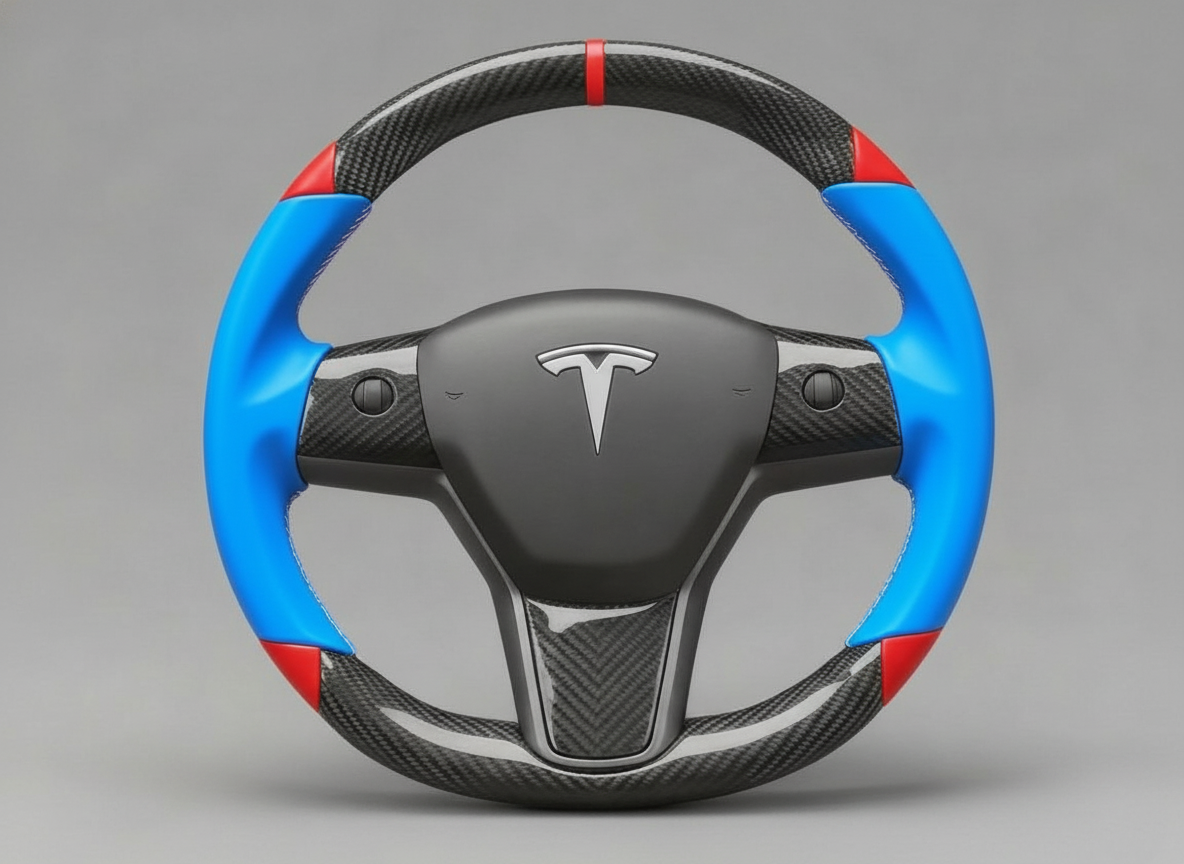
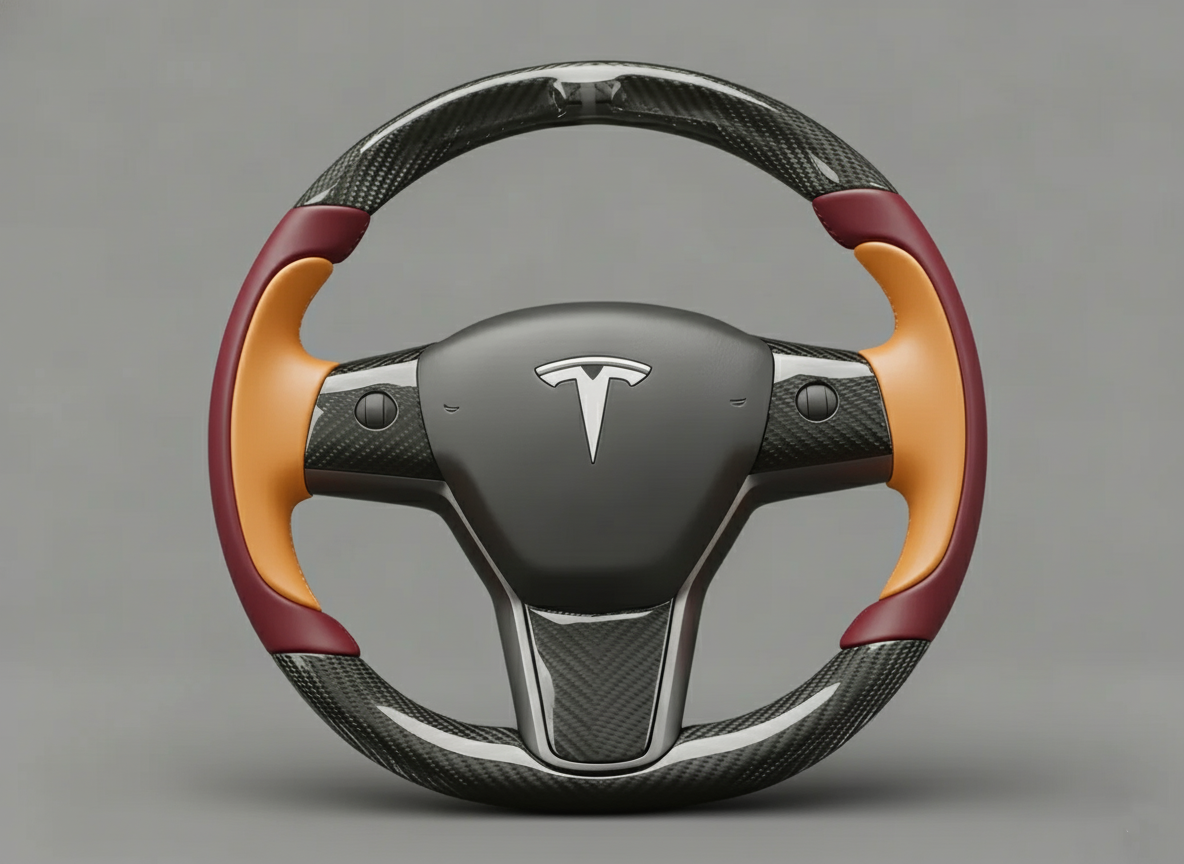
The optimal competition configuration is usually: Carbon fiber skeleton providing rigidity and road feel, with Alcantara wrapping at the 3 and 9 o'clock grip positions to ensure precise input.
Alcantara
Composition and Manufacturing Process
Produced by Alcantara S.p.A. in Italy, the composition ratio of this material is very fixed: approximately 68% Polyester and 32% Polyurethane.
This specific formula undergoes complex industrial processes including spinning, needle punching, impregnation, extraction, buffing, and dyeing.
In this process, the microfibers are extremely fine, with a single fiber diameter usually less than 1/10000 mm.
It is this ultra-fine fiber structure that macroscopically forms a suede-like touch.
-
Structural Advantage: Unlike genuine leather, Alcantara has no natural grain directionality. No matter from which angle you grip, its physical properties (such as tensile strength, thickness uniformity) are consistent.
-
Weight Difference: At the same thickness (usually 0.8mm to 1.0mm), Alcantara is about 30% to 50% lighter than genuine leather. Although this only saves a few dozen grams on steering wheel wrapping, in racing engineering where extreme lightweighting is pursued, every component's weight reduction counts.
Friction and Glove Pairing
In track conditions, due to the lack of excessive intervention from electronic assist systems or to obtain direct road feedback, the driver needs to apply precise steering torque.
- Dry Environment: In dry conditions, Alcantara's surface fibers provide static friction about 20%-30% higher than smooth leather.
- Wet/Sweaty Environment: When palms sweat or the environment is humid, the friction coefficient of genuine leather drops drastically, becoming slippery. Alcantara's porous microfiber structure can accommodate trace amounts of moisture, maintaining high friction.
- Nomex Glove Effect: When paired with FIA-certified Nomex (Aramid) racing gloves, a mechanical interlock similar to "Velcro" occurs at the microscopic level between the contact surfaces. This extremely high grip allows the driver to relax finger muscles during cornering, controlling direction solely through friction between the palm and the wheel, significantly delaying the onset of Arm Pump.
Thermal Management and Light Reflection
Optical and thermal properties of materials directly affect driving safety.
- Light Absorption: Alcantara is a completely diffuse reflective material (Matte Finish). Under strong noon sunlight, it will not form reflections on the inside of the windshield like Nappa leather or high-gloss carbon fiber. For drivers who need to constantly focus on Braking Points and Apexes, this is a functional advantage that eliminates visual interference.
- Specific Heat Capacity and Conductivity: The thermal conductivity of this synthetic material is significantly lower than genuine leather. After summer sun exposure, the surface temperature of a leather steering wheel may reach 60°C - 70°C, making it impossible to hold immediately. Alcantara, due to the large air layer between fibers, insulates better, with surface temperatures usually 10°C - 15°C lower, and the touch does not produce a "burning sensation." The same principle applies in winter; it will not feel as icy as leather.
Wear Mechanism and Maintenance Truth
Alcantara's physical abrasion resistance (Martindale Test) is very high.
The "wear," "shining," or "hardening" users see is, in 95% of cases, not material damage, but fiber Matting.
- Oil Contamination: If driving with bare hands, oils secreted by palms, dead skin cells, and hand lotion residues penetrate fiber gaps.
-
Restoration Method: To restore grip, you don't need to replace the leather, but follow a specific cleaning process.
- Use a dedicated Alcantara cleaner (like Sonax or various fabric cleaners).
- Use a soft brush (toothbrush hardness is fine) to gently scrub in circles to brush oils out of fibers.
- Absorb dirt with a damp microfiber towel.
- Very Important Step: During drying, use a clean brush to comb against the lay of the fibers to make them stand up again.
If driving the Model 3 for weekly commuting, it is recommended to perform this deep cleaning every 2-3 months.
Distinguishing Genuine from Fake and Substitutes
Common substitutes include Dinamica (often used in Mercedes AMG) or generic Ultrasuede.
- Dinamica: Main component is recycled polyester, stronger environmental attributes, touch is slightly rougher, excellent abrasion resistance, often used for seat contact surfaces, but tactile delicacy on steering wheels is inferior to Alcantara.
- Low-end Knockoffs: Usually made of ordinary flocked cloth. This material sheds (Shedding) after heating or friction, and color easily bleeds onto racing gloves (Color Transfer).
-
Identification:
- Press Test: Real Alcantara leaves obvious matting marks (Writing Effect) when pressed with a finger, and color shade changes with pile direction.
- Thickness Feel: Alcantara Panel series used for steering wheel wrapping usually has no sponge backing (Unbacked), is extremely thin, and fits tightly to the wheel body.
Carbon Fiber
Dry Carbon vs. Wet Carbon
When browsing aftermarket accessories catalogs, you will find that steering wheels marked as "Carbon Fiber" can vary in price by two to three times. The physical reason lies in the manufacturing process: Wet Carbon vs. Dry Carbon (Pre-preg).
- Wet Carbon Process: This is the low-cost option. Usually, a layer of carbon fiber cloth is laid on the surface of a fiberglass or plastic mold, then manually brushed with Resin, air-dried, or baked at low temperature. Products made this way have high resin content, uneven thickness, and are prone to invisible internal air bubbles.
- Dry Carbon (Pre-preg) Process: The standard for high-end competition steering wheels. Factories use carbon fiber cloth pre-impregnated with resin (Pre-preg), place it in a mold, and cure it in an Autoclave under high temperature (usually over 120°C) and high pressure.
- Data Difference: The resin-to-fiber ratio of dry carbon products is usually controlled around 30:70, while wet carbon is often 50:50 or even higher. With equal strength, dry carbon parts are 40% to 60% lighter than wet carbon. For a Model 3 steering wheel, using dry carbon for the upper and lower body assembly usually weighs 150g to 300g less than the version with factory magnesium-aluminum alloy skeleton wrapped in foam.
Rotational Inertia and Electronic Power Steering Trade-off
The Model 3 is equipped with Electronic Power Assisted Steering (EPAS). This system is essentially a filter that filters out most "noise" (vibration) from the road, but for track drivers, this "noise" is precisely the intelligence on tire grip.
The High Modulus characteristic of carbon fiber plays a role here.
- Lowering Rotational Inertia: The steering wheel is the mass load at the end of the steering column. Reducing the weight of the Rim means the initial torque required to turn the steering wheel is smaller. In frequent left-right weight transfers (Chicane) on the track, a lighter wheel body allows for sharper steering input.
- Vibration Transmissibility: Foam materials and thick leather have damping properties that absorb vibration. Cured carbon fiber is extremely hard and rigid. When the vehicle runs over Kerbs or the front wheels begin to skip slightly due to Understeer, the carbon fiber skeleton can transmit these high-frequency vibrations to the palm with higher fidelity.
Gloss vs. Matte Coating Practical Choice
Carbon fiber itself is a black-gray fiber fabric; the smooth surface we touch is actually Epoxy Resin Clear Coat. When purchasing, the surface finish not only affects looks but also driving safety.
- Glossy: 80% of products on the market are glossy. It enhances the 3D effect of carbon fiber through refraction. But in a track environment, glossy coating has two fatal flaws. First, when sunlight hits from the side or rear, the top of the steering wheel becomes a reflector, projecting glare directly into the driver's eyes or onto the inside of the windshield. Second, the smooth clear coat surface is a low surface energy material; once palms sweat, friction drops off a cliff, becoming extremely slippery.
- Matte: This is the rational competitive choice. Factories add matting agents to the clear coat to make the surface diffuse, completely eliminating glare risks. Although the matte surface touch is still not as grippy as Alcantara, it provides slightly better friction in slightly wet conditions compared to glossy coatings.
Weave Patterns
You will see different carbon fiber texture names representing different weaving logics and physical properties.
- 3K Twill (2x2): The most classic and common choice. "3K" means each bundle contains 3000 carbon filaments. 2x2 twill weave has a signature diagonal look aesthetically. Physically, this weave gives the material extremely high tensile strength in two directions, and due to the relatively loose weave structure, it conforms easier to complex curved shapes of steering wheels, reducing wrinkles and faults.
- Forged Carbon: Material popularized by Lamborghini. It is not woven cloth but chopped short carbon fibers mixed with resin and compression molded. It looks like marble. In terms of strength, Forged Carbon is Isotropic (strength is consistent in all directions), while woven carbon is anisotropic.
- Honeycomb / Camo: These are usually special weave patterns mainly for personalization. Note that overly complex weave patterns can easily cause texture Distortion on small-curvature grips. If quality control standards are not high, you may see pattern breaks, affecting visual integrity.
Resin Heat Capacity and Temperature Sensitivity
Epoxy resin has a relatively high specific heat capacity, meaning it can store heat.
- Summer Exposure: If you park your Model 3 in the open paddock, under direct noon sunlight, the surface temperature of carbon fiber parts rises extremely fast and dissipates heat slowly. Since resin is a poor conductor, heat accumulates on the surface, causing a distinct burning sensation when gripped.
- Winter Touch: Although not as bone-chilling as aluminum alloy, carbon fiber parts will retain coolness for a long time in low-temperature environments.
- Layout Advice: Based on thermal and friction characteristics, absolutely do not buy a steering wheel with a "Full Carbon Fiber" grip. Ensure the 3 and 9 o'clock hand rest areas are leather or Alcantara; carbon fiber should be limited to 12 and 6 o'clock for structural support or lightweighting.
Skeleton Transplant and Airbag Matching
-
Remanufactured OEM Core: Currently the safest and most mainstream solution. Manufacturers recycle used factory Model 3 steering wheels (usually magnesium-aluminum alloy casting), strip original foam and skin, retaining the central metal skeleton and Hub.
- Advantage: This scheme 100% guarantees the engagement precision of the Spline with the steering column, and mounting points for the airbag module, horn contacts, and multi-function scroll wheel harness slots are all factory spec, with no tolerance issues.
- Aftermarket Molded Skeleton: Some low-price products use reverse-engineered aluminum alloy skeletons. Since the Model 3 steering wheel integrates complex scroll wheel control modules and harnesses, if the aftermarket skeleton casting precision is insufficient, it leads to sticking buttons, excessive airbag gaps, or even skeleton fracture under severe impact.
Quick Release System
Mainstream specs mostly adopt 6x70mm PCD bolt spacing, compatible with Sparco or MOMO wheels.
When purchasing, you need to precisely calculate the total hub thickness of 60mm-65mm to offset the space difference after removing the factory wheel.
Distinct from traditional mechanical structures, Model 3 specific quick releases must solve physical connection problems for SRS Airbag resistance matching (usually 2.0-2.2 ohm) and Dual Scroll Wheel signal transplantation, otherwise it will cause Autopilot failure or system errors.
Specs and Bolt Spacing
6x70mm:
When shopping for Model 3 quick release kits, you will most frequently encounter the 6x70mm figure.
This represents 6 bolt holes distributed on a 70mm diameter circle (Pitch Circle Diameter, PCD).
This is currently the most universal physical connection standard in the Aftermarket.
If you buy steering wheels or quick release hubs from the following brands, they default to this spec:
- MOMO
- Sparco
- OMP
- Vertex
- NRG (Most models)
Under this standard, fixing screws usually use M5 specs.
To ensure the Horn Button can be installed smoothly, the Center Bore diameter is usually around 55mm.
As long as both your quick release hub and steering wheel are marked 6x70mm PCD, there are no obstacles to physical installation, and holes will align precisely.
6x74mm:
Another common spacing standard is 6x74mm.
Although there is only a 4mm diameter difference, it is hard to distinguish with the naked eye. Forcing installation will lead to stripped threads or broken screws.
This spec mainly appears on brands focusing on classic Italian design:
- Nardi
- Personal
- Raid (Some models)
If your steering wheel is Nardi and the quick release hub is NRG (usually 6x70mm), you cannot tighten the screws directly.
There are two physical solutions to this problem:
- Buy Dual-Pattern Quick Release: Many modern quick releases (like NRG Gen 2.5 or Works Bell Rapfix) have 12 holes drilled on the flange. This means it is compatible with both 70mm and 74mm specs.
- Install Conversion Spacer: Buy an aluminum alloy ring about 10mm thick with two sets of different threaded holes to serve as an intermediate piece connecting the hub and the steering wheel.
12 O'clock and Vertical Alignment Issue
This is particularly troublesome on cars like the Model 3 where steering gear misalignment affects Steering Angle Sensor (SAS) data.
- MOMO Mode (6x70mm): Directly above (12 o'clock direction) is a screw hole.
- Nardi Mode (6x74mm): Directly above (12 o'clock direction) is the center position between two screw holes, meaning there is no hole at 12 o'clock.
If you buy a 6x70mm steering wheel but pair it with a hub that only supports Nardi mode alignment, the steering wheel will be skewed by 30 degrees after installation.
Screw Specs and Material Strength
The Model 3 Performance exerts large instantaneous steering torque on the track, so the shear strength of screws must be up to standard.
Standard Specs:
- Diameter and Pitch: M5 x 0.8mm
- Length: Usually 10mm to 15mm. If a Trim Ring or button panel is added, it needs to be extended to 15mm-20mm.
Head Shape:
- Countersunk/Flat Head: Screw head is conical. This requires corresponding Chamfers on the steering wheel or quick release holes. Advantage is a flush surface after installation, preventing hand cuts.
- Button Head/Pan Head: Screw head protrudes. Used for flat holes without chamfers. Some Sparco steering wheels must use this type of screw because their metal dish is thin and has no chamfer.
Material Selection:
Most kits come with black oxide steel screws (Grade 8.8 or 10.9). Some owners switch to titanium or aluminum screws for aesthetics.
- Recommended: High-strength steel or Titanium Alloy (Grade 5 Titanium).
- Prohibited: Anodized aluminum alloy screws. The tensile and shear strength of aluminum screws are far lower than steel. They easily break inside the hub during repeated disassembly or sharp steering, making extraction extremely difficult.
Installation Torque Data
Since the Model 3 chassis is stiff and road vibration transmission is direct, correct torque setting is the first line of defense against loosening.
Here are general torque reference values (please refer to product manuals first):
| Connection Point | Screw Spec | Recommended Torque Range | Remarks |
|---|---|---|---|
| Steering Wheel - Quick Release | M5 Countersunk | 4 - 6 Nm | Recommend using a small amount of thread locker (Loctite Blue 242) |
| Quick Release - Hub | M5 Countersunk | 5 - 7 Nm | Stress here is greater than at the steering wheel end |
| Center Main Nut | M14/M16 (Depends on hub) | 35 - 45 Nm | Connects to Model 3 steering column, do NOT use Impact Gun |
Spacer and Thickness Adjustment
If your Model 3 has Paddle Shifter Extensions or button panels installed, a quick release system that is too thin will cause fingers to clash during operation.
- Standard Quick Release Thickness: About 60mm - 65mm.
- Short/Thin Quick Release: Thickness about 25mm - 30mm.
If you purchased an NRG Short Hub (SRK-170H), it is designed very short mainly to accommodate a 60mm standard quick release.
If you use a thin quick release on this short hub, the steering wheel will be too close to the turn signal stalk (distance may be less than 3cm), causing knuckles to constantly hit the stalk when turning.
In this case, you need to buy a 10mm to 20mm Spacer to increase physical spacing.
Spacer hole spacing follows the 6x70mm standard; ensure extended M5 screws are included when purchasing.
Electronic Signal Wiring
Understanding Factory Signal Transmission Protocol
Before touching any wiring, you must understand that the Model 3 steering wheel is not a simple analog switch like in the past.
The factory steering wheel integrates a PCB circuit board internally, communicating with the vehicle computer via LIN Bus (Local Interconnect Network).
You cannot simply connect two wires together to achieve "Next Track" or "Engage Autopilot."
All scroll wheel operations, mirror adjustments, and even horn signals are encoded digital signals.
When you remove the factory steering wheel, you essentially disconnect this communication node.
To retain these functions, you must transplant that black Control Module from the factory steering wheel completely and repower it.
Eliminating Airbag Fault Light
After unplugging the yellow airbag plug, the system cannot detect loop resistance, the red SRS warning light on the dashboard will illuminate, and the vehicle will limit power output.
You need a 2.0 Ohm to 2.2 Ohm resistor to simulate the presence of an airbag.
- Resistor Specs: Recommend choosing 0.25 Watt (1/4 Watt) or 0.5 Watt (1/2 Watt) metal film resistors. Too low power risks burning out; too high power makes it too bulky to fit in the hub.
- Installation Method: Do not just insert resistor legs into the yellow plug and call it a day. Track vibrations will cause it to loosen instantly. The correct method is to bend resistor legs into a U-shape, insert into the female plug, and use Heat Shrink Tubing or even electrical tape to secure it firmly to the plug.
- Fuse-style Resistor: There are Airbag Delete Resistor Kits packaged in fuse shapes on the market. These have plastic casings, plug in more securely, and are much safer than exposed resistor wires.
How to Make the Horn Work
The Model 3 horn trigger mechanism requires a grounded closed loop. However, when modifying with a quick release, the grounding path is often blocked.
Most Hubs and Quick Release bodies are made of aluminum alloy and have undergone Anodized treatment.
The anodized layer is insulating. If you touch the negative wire of the horn to the hub, often nothing happens.
- Physical Sanding: You may need to use sandpaper to sand off the black oxide layer around a screw hole inside the hub to expose the silver aluminum alloy substrate, establishing a conductive contact.
- Dedicated Grounding Ring: Many hub kits (like NRG) include a thin metal Shoehorn plate between the steering column and the hub, responsible for contacting the metal contact point on the back of the steering column. Ensure this metal ring is coated with a small amount of Dielectric Grease during installation to prevent friction noise or poor contact.
Signal Passthrough:
If you decide to retain the factory scroll wheel buttons (via a relocated panel), the biggest challenge is passing this complex ribbon cable through the detachable quick release structure.
Option 1: Ordinary 2-Pin Quick Release + External Curly Cord
- Quick Release Body: Use ordinary NRG Gen 2.0 or Sparco quick releases, which have only 2 copper contacts in the center (only enough for the horn).
- Routing: Scroll wheel module data cables cannot go through the quick release interior; you must use a coiled cable similar to a telephone cord, with one end connected behind the steering column and one end to the steering wheel panel.
- Disadvantage: The cable turns with the wheel, easily tangling; during spirited driving, the flailing cable may interfere with vision or entangle fingers.
Option 2: Multi-Pin Electronic Quick Release (Pass-Through)
- Representative Products: Works Bell Rapfix II (with dedicated terminals) or Krontec racing connectors.
- Technical Details: This quick release center integrates 12 to 22 gold-plated Pogo Pins.
- Advantage: When the steering wheel is removed, there are no trailing cables. The moment it is attached, all buttons and scroll wheels are instantly powered and usable.
- Note: This rewiring work is immense, requiring purchase of 20-24 AWG fine wires and specialized JST or Molex crimping pliers.
Internal Space Management
The internal space of a Model 3 short hub is a cylindrical space about 80mm in diameter and only 30mm deep. You need to stuff in:
- The huge factory yellow airbag plug (containing resistor).
- The factory horn plug.
- If using a multi-pin quick release, a bunch of adapter harnesses.
Wiring Warning:
- Do Not Kink: Strictly forbid folding harnesses into 90-degree dead angles, which leads to internal copper wire fatigue breakage.
- Clock Spring Protection: When installing the hub, ensure the alignment hole on the back aligns with the protruding pin on the clock spring box. If forced tight without alignment, you will directly crush the clock spring box. Once damaged, not only does the airbag fail, but the Steering Angle Sensor (SAS) is also scrapped, requiring expensive replacement of the entire steering column assembly.
- Noise Cancellation: If stuffed harnesses and plugs are not secured, they will rattle inside the hub like a bell when turning. Be sure to use Tesa Tape to wrap all hard plastic plugs to prevent rattles.
Wireless Bluetooth Module Alternative
To avoid complex physical wiring, a Bluetooth-based analog solution (like Taptes control box) has appeared on the market.
- Principle: Series connect a Bluetooth receiver in the original harness position, tucked under the dashboard. Stick a Bluetooth transmitter button on the steering wheel.
- Latency Issue: This solution has a signal latency of 50ms - 200ms. Irrelevant for volume adjustment, but if you want to quickly adjust cruise speed via scroll wheel on track, or honk to warn a car ahead, this delay is perceptible.
- Power Supply: The transmitter on the steering wheel usually needs button cell batteries. On cold winter track days, voltage drop may lead to signal loss.
Axial Distance Adjustment
Calculate Total Length of These Three Items
You need to focus on the sum of axial lengths of three components: Hub + Quick Release (QR) + Steering Wheel Dish.
The distance from the mounting face of the Model 3 steering column to the hand grip is fixed on the factory wheel.
When you switch to a competition steering wheel, this distance changes significantly.
- Short Hub: Hubs designed specifically for Model 3 (like NRG SRK-170H) are usually compressed to between 42mm - 45mm in height. This is to leave room for the quick release. If you mistakenly buy a "Standard Hub," length will reach 90mm - 100mm; adding a quick release will make the steering wheel hit your chest.
- Standard QR: Taking NRG Gen 2.0 or 2.5 as examples, body thickness is 60mm - 62mm.
- Thin QR: Only 25mm thick. Usually used for tall drivers or situations requiring extreme space compression.
- Works Bell Rapfix II: The thickness of this high-end quick release is about 61mm.
Don't Put Stalks Out of Reach
The Model 3 turn signal and gear stalks are fixed to the steering column, length and angle are non-adjustable. This is the easiest point to screw up when modifying quick releases.
- Comfort Zone: The distance from the back of the steering wheel rim to the stalks should be controlled between 60mm - 80mm for best ergonomics.
- Extreme Distance: Once this distance exceeds 100mm, you must take your hand off the steering wheel to signal. In street driving, this is very dangerous and tiring.
- Interference if Too Close: If distance is less than 40mm (e.g., using short hub + thin QR + flat wheel), your knuckles will frequently hit the stalks during sharp turns or when wearing racing gloves, potentially causing accidental high beam activation.
If your calculated total length results in stalks being too far (e.g., over 120mm), you must purchase Turn Signal Extenders.
These are usually aluminum alloy clamps that physically extend the stalks and curve them towards the steering wheel, typically costing $30 to $50 a pair.
Real Difference Between Flat and Deep Dish
When choosing a wheel body, you will see the parameter "Dish."
- Flat (0mm Dish): Spokes and grip are on the same plane. Combined with standard QR and short hub, this usually positions the Model 3 steering wheel close to the factory fore-aft distance. Suitable for drivers 175cm - 180cm tall who don't want to change seat rail position.
- Semi-Dish (30-50mm): Grip extends towards the driver.
-
Deep Dish (70-90mm): This steering wheel brings the grip extremely close to the driver.
- Applicable Scenario: If you are over 185cm and need to push the seat all the way back for legroom, but can't reach the wheel, a Deep Dish is the only solution.
- Side Effect: A 90mm Deep Dish with a 60mm QR and 45mm Hub gives a total extension nearing 20cm.
Spacers are the Final Adjustment Tool
If you bought all accessories and installed them, only to find the steering wheel is just a bit off from your body, or too close to the stalks, you don't need to buy a new quick release, just buy a Spacer.
Spacers are precision-machined aluminum alloy rings installed between the quick release and the steering wheel.
- Specs: Common thicknesses are 10mm, 20mm, 30mm, and even 50mm or longer.
- Function: It is a magic tool for fine-tuning seating posture.
-
Screw Matching: Adding spacers requires changing to longer screws.
- Spacer 10mm -> Screw length needs to reach 25mm - 30mm.
- Spacer 20mm -> Screw length needs to reach 35mm - 40mm.
- Never force use of original short screws with only two threads engaged; this will pull the screws out directly when the body pulls on the wheel during heavy braking.
Elbow Angle Determines Everything
The Model 3 factory seating posture is usually too relaxed (laying down) for track driving.
You need to adjust seat fore-aft position and steering wheel axial distance to meet the following standards:
- Wrist Test: When your back is fully against the bucket seat backrest, extend your arm straight; the wrist joint should rest exactly on top of the steering wheel.
-
Elbow Angle: When hands grip 3 and 9 o'clock positions, the elbow bend angle should be between 90 degrees and 110 degrees.
- Too Straight (>120 degrees): Shoulders need to engage during turning, losing fine road feel feedback, and lacking sufficient arm travel for rapid counter-steering when saving a loss of control.
- Too Bent (<80 degrees): Steering wheel is too close to the chest, restricting operation, and in a collision, there is insufficient space for airbag deployment (if not removed) or body forward movement, easily causing sternum fractures.