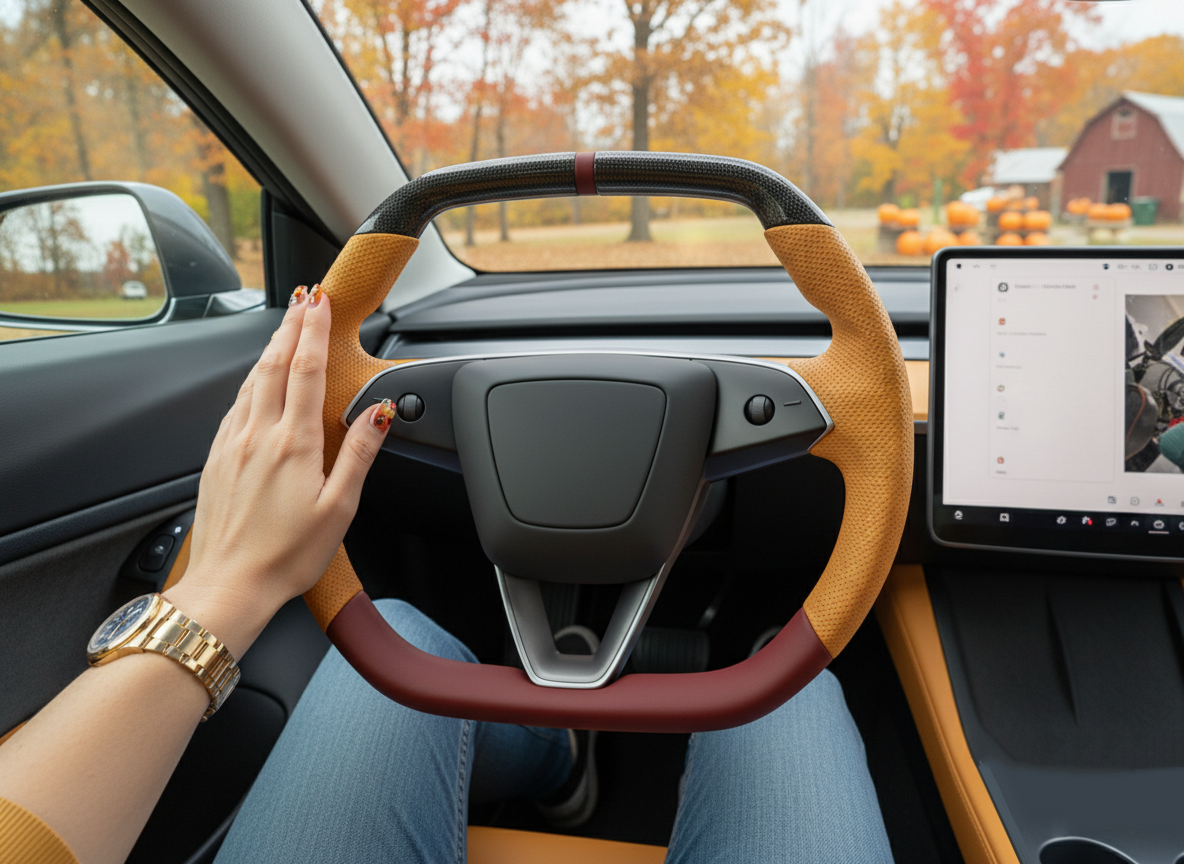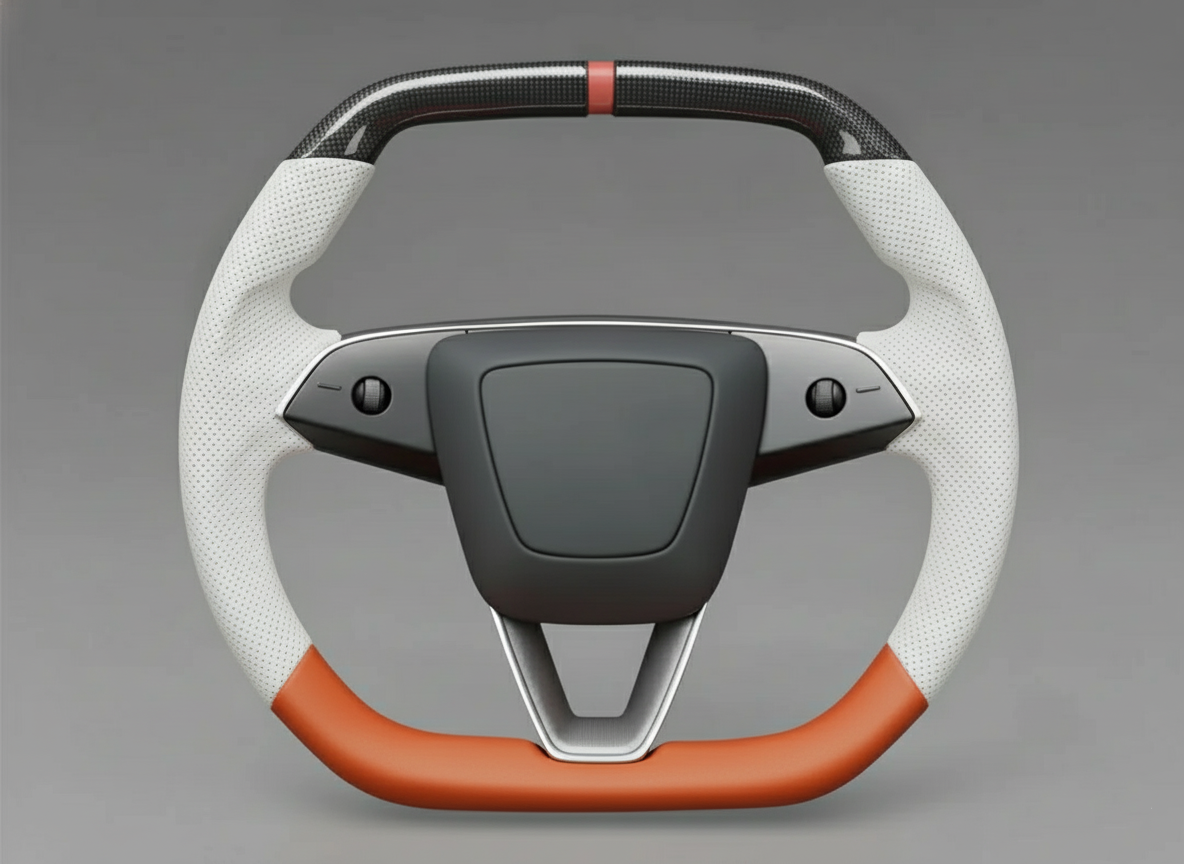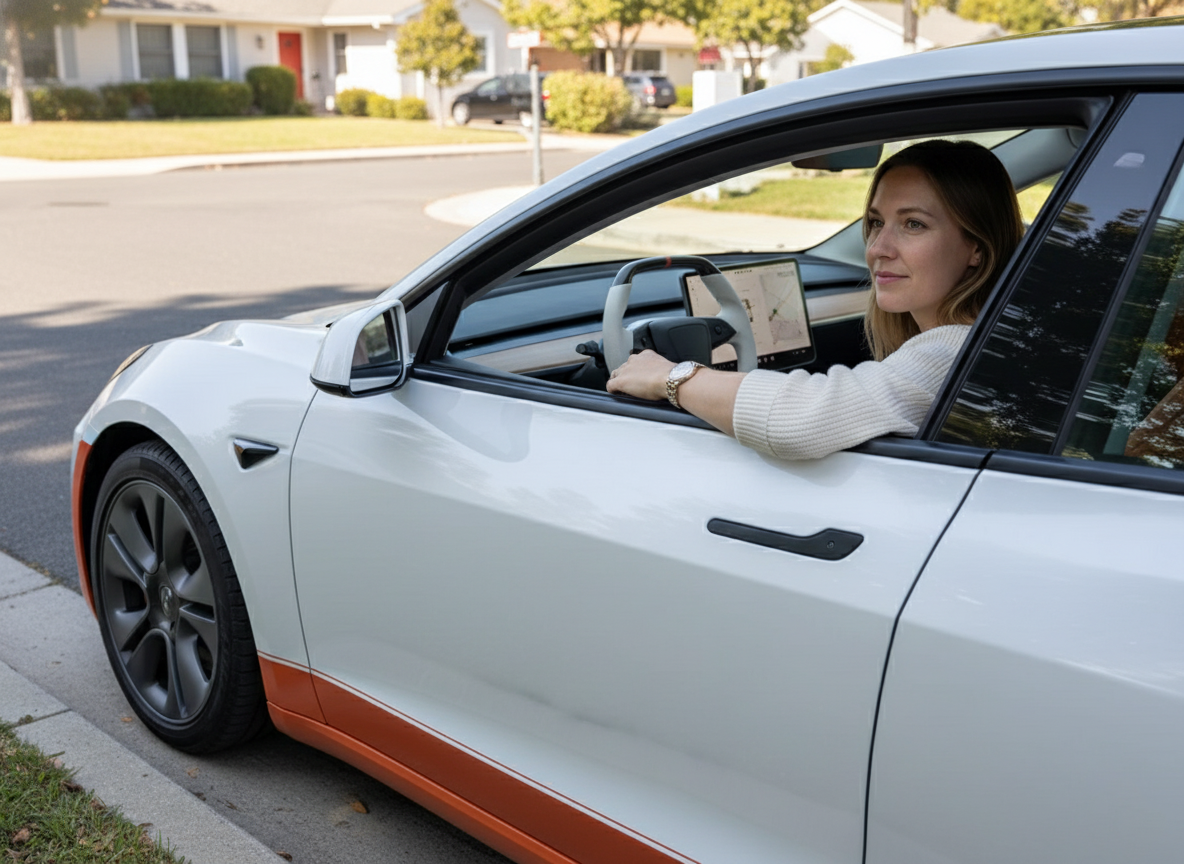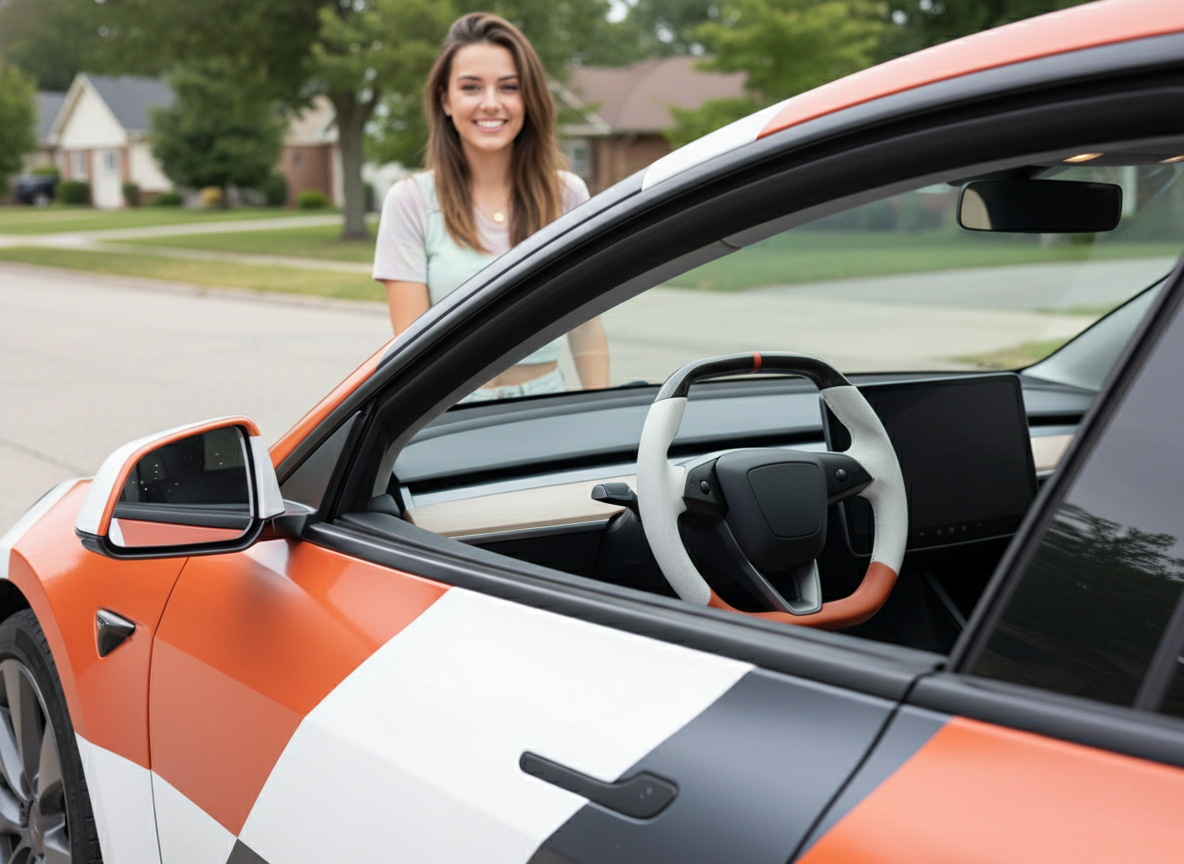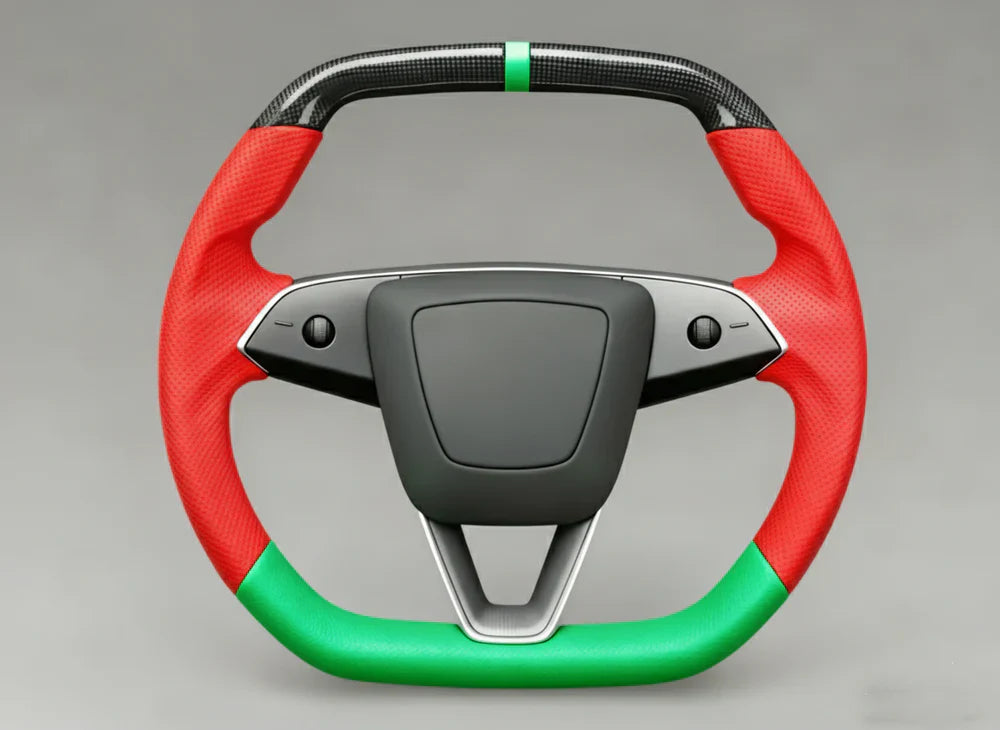
For Model 3/Y, matte carbon fiber is recommended as the primary choice.
Data shows it matches the original interior by over 90% and effectively resists fingerprints and glare.
Choose the glossy version only if you have already modified the interior with glossy kits.
Before installation, be sure to disconnect the 12V power supply and use a T25 tool to remove the airbag.
Interior Match
For the 2021+ refreshed Model 3 and Model Y, matte carbon fiber is the optimal solution.
Its low-reflection coating has minimal visual discrepancy with the factory open-pore wood and the center console's matte black trim, effectively preventing reflections on the windshield under strong sunlight.
Glossy carbon fiber utilizes a multi-layer clear coat stacking process with high glossiness.
It is better suited for the carbon fiber interiors of the Model S/X Plaid or for creating a high-contrast visual center in Model 3/Y white interiors, though it requires cleaning fingerprints every 2-3 days.
Factory Black Interior
Tesla's design team intentionally removed the criticized "Piano Black" elements in the interior evolution of the Model 3 and Model Y, switching to large areas of matte black plastic and fabric.
The goal was to reduce visual distractions while driving and improve durability.
Therefore, when selecting a carbon fiber steering wheel for this interior environment, one must deeply understand how light refracts and reflects on different surfaces.
Matte carbon fiber is considered the standard answer for black interiors because its surface coating technology strictly controls glossiness (Gloss Units, GU) between 5-15 GU.
This is almost identical to the low glossiness of factory wood trim, which is approximately 5-10 GU.
When light enters the cabin, the matte coating produces diffuse reflection.
Light is scattered evenly in all directions rather than reflecting in a concentrated manner like a mirror.
This optical characteristic allows the matte steering wheel to present a soft charcoal gray visually, clearly showcasing the 2x2 Twill Weave structure of the Toray T700 carbon fiber fabric itself without being obscured by surface reflections.
In contrast, to pursue a sense of deep three-dimensionality, glossy carbon fiber usually stacks high-transparency epoxy resin clear coats exceeding 1.5mm in thickness, reaching a surface glossiness of over 90 GU through polishing.
Beyond visual continuity, the 2021+ refreshed interior completely abandoned high-gloss piano black in the center console area, switching to satin black materials for the wireless charging pad and cup holder edges.
The surface touch of matte carbon fiber steering wheels is typically treated with Teflon or similar nano-coatings.
This not only matches the satin black visually but also provides a similar dry damping sensation to the touch.
Consistency in feel is crucial for building an "OEM+" upgrade style.
Conversely, the clear coat on glossy carbon fiber feels like glass or hard plastic.
While it has high friction when dry, once palms sweat, a thin film of sweat quickly forms on the smooth surface, causing the friction coefficient to plunge and resulting in slippage.
It also easily attracts fingerprints and skin dander.
Against a full black interior background, fingerprint smudges on a glossy steering wheel become exceptionally obvious due to the dark backdrop.
For perfectionist owners, this requires keeping a microfiber cloth handy for daily cleaning.
The massive panoramic sunroof and slanted windshield of the Model 3/Y mean the steering wheel is constantly exposed to direct sunlight.
According to optical testing, the specular reflectance of glossy carbon fiber surfaces is extremely high.
At noon or when sunlight hits from the side, the upper portion of a glossy steering wheel (10 to 2 o'clock position) acts like a mirror, reflecting intense light spots directly into the driver's retina or forming a clear ghosting effect on the inside of the windshield, seriously interfering with the reading of Autopilot information and road observation.
The microscopic uneven structure of the matte carbon fiber surface can effectively absorb and scatter over 95% of direct light.
Even under intense sunlight, the steering wheel surface only appears as a uniform light gray, completely eliminating "light pollution" risks.
For the Model 3/Y, which lacks a traditional instrument cluster, visual purity in the steering wheel area directly affects driving focus.
The low signal-to-noise ratio of the matte surface is particularly practical here.
Premium White Interior
The most iconic element of the factory white interior is the pure white aluminum/ceramic-textured trim that runs across the dashboard and extends to the door panels.
This trim replaces the open-pore wood of the black version; its surface is smooth, cool, and has a high reflectance, building a high-brightness visual base alongside the vegan leather seats.
In this high-key environment, a carbon fiber steering wheel is no longer just a component that blends in; it becomes a visual anchor that breaks the tonal monotony.
For white interiors, glossy carbon fiber demonstrates an overwhelming aesthetic advantage.
This stems from basic principles of optical contrast: the white interior itself is an environment filled with reflected light.
The factory white trim surface has a smoothness similar to piano black; though the color is white, its physical texture is "glossy."
When a glossy carbon fiber steering wheel is installed, the glass-like texture presented by its thick clear coat forms a perfect harmony with the smooth texture of the factory white trim in both touch and vision.
The deep black of glossy carbon fiber and the surrounding brilliant white form an ultimate black-and-white dual-tone.
Under light refraction, the 3K carbon fiber texture beneath the glossy coating produces a visual effect called "Holographic Depth," making the steering wheel look like a black gemstone suspended in a white space cabin.
This high-contrast style strongly reinforces the "Stormtrooper" color scheme often associated with Model 3/Y interiors.
If matte carbon fiber is forced into a white interior, while not looking out of place, it often appears dull due to the lack of luster.
It fails to stand out in this high-light environment and may even be swallowed by the bright surroundings, losing the intended display effect of a modified steering wheel.
However, choosing glossy carbon fiber is not without cost, particularly regarding glare management.
The white interior already has high light reflectance, with white seats and trim reflecting sunlight throughout the cabin.
Introducing a high-reflectance glossy steering wheel may cause the driver to experience "light overload" under specific angles of direct sunlight.
While glossy carbon fiber is extremely beautiful in a white interior, it also acts like a black mirror, faithfully reflecting the glass roof or side window scenery.
To mitigate this, many owners with this configuration choose to wear polarized sunglasses, using polarization principles to filter out stray light generated by the glossy coating.
Additionally, fingerprint issues persist on glossy steering wheels in white interiors.
Interestingly, because the surroundings are so bright, the human pupil naturally constricts, reducing sensitivity to dark details.
Consequently, tiny dust and fingerprints are actually less noticeable against the white background than in a black interior—a form of visual compensatory effect.
Of course, matte carbon fiber still has a loyal following for white interiors, with their logic usually based on "function first" or "color temperature neutralization."
While the factory white trim is smooth, the white seats themselves have a matte leather texture.
Choosing a matte carbon fiber steering wheel can be seen as an echo of the seat material.
A deeper consideration lies in reducing "visual noise" within the cabin.
The white interior is already very bright and piercing; if the steering wheel also glitters, it may cause visual fatigue.
Matte carbon fiber acts like a black hole, absorbing surrounding diffused light and providing a steady grip center.
Especially for owners living in regions with extremely intense sunlight like California or Texas, the matte coating effectively prevents the steering wheel from becoming a focal point of glare.
Furthermore, if the owner plans to replace the white dashboard trim with Alcantara or matte carbon fiber trim, the steering wheel must be matte to maintain material interface unity.
But in an unmodified factory white interior, a matte steering wheel is often considered too low-profile, wasting the natural stage provided by the white interior.
Practical Usage Comparison
Regarding the practical comparison between matte and glossy carbon fiber steering wheels, the core difference lies not just in aesthetics but in tactile feedback, optical interference, and maintenance costs over thousands of miles of daily driving.
These two distinct surface finishing processes determine how they interact differently with palm sweat, ambient light, and physical wear.
Matte coatings usually use polyurethane or Teflon-based clear coats to simulate a dry, natural touch.
Glossy coatings rely on multi-layer high-hardness epoxy resin and high-gloss clear coats, pursuing glass-like smoothness and hardness.
Tactile experience is the first bridge of communication between driver and vehicle.
A glossy carbon fiber steering wheel feels like freshly waxed car paint or high-end piano keys—extremely smooth with a slight tackiness.
When hands are dry, this tackiness provides an excellent friction coefficient, helping the driver lock onto the wheel during spirited driving.
However, this advantage turns into a disadvantage when palms sweat.
Sweat and oils from the human palm form a micron-level liquid film on the glossy coating, causing the static friction coefficient to drop sharply, creating a greasy sensation.
In contrast, the matte carbon fiber surface is covered with a fine granular structure.
This microscopic texture effectively channels sweat and prevents the formation of a continuous liquid film, maintaining a constant and dry grip even during long drives or when hands are sweaty.
Additionally, there is a subtle difference in thermal conductivity; the thick resin layer of the glossy version absorbs heat faster after exposure to sun, feeling hotter in summer, while the diffuse reflection of the matte surface keeps its temperature about 3-5 degrees Celsius lower.
The unique cabin design of the Tesla Model 3 and Model Y—removing the dashboard and using low hood lines with a panoramic glass roof—places the steering wheel in a literal "light well."
In actual testing, when the sun is at a high angle (such as 11:00 to 14:00), the upper arc of a glossy carbon fiber steering wheel (10 to 2 o'clock) converges light like a concave mirror.
This high-intensity specular reflection not only stings the driver's eyes but also creates clear reflections on the inside of the windshield, which can obstruct the view or interfere with the driver's observation.
The diffuse reflection rate of a matte steering wheel is typically below 5%.
No matter the angle of the sunlight, it only presents a soft glow, completely eliminating glare risks—a significant passive safety advantage for owners in low-latitude, high-sunlight areas.
Durability and maintenance frequency directly determine long-term satisfaction.
Although glossy carbon fiber is hard, its mirror-like surface is an amplifier for scratches.
Even wiping with a rough paper towel or a light scratch from a ring can leave permanent swirl marks.
Matte carbon fiber is much more forgiving; its inherently frosted texture perfectly hides fine scratches and fingerprints.
Even touching it with hands covered in chip crumbs won't leave obvious oily marks.
Generally, a matte steering wheel only needs a quick wipe during a car wash, with a maintenance frequency 1/10th that of the glossy version.
However, matte coatings are not perfect.
While glossy coatings can be repaired by polishing if struck by a hard object, a damaged matte coating usually cannot be restored through polishing because polishing would destroy its matte texture.
Here is a detailed data comparison of the two materials in actual usage scenarios:
| Dimension | Matte Carbon Fiber | Glossy Carbon Fiber | Practical Impact & Advice |
|---|---|---|---|
| Anti-Glare Rating | A+ (Excellent) | C- (Poor) | Glossy creates reflections on the windshield at noon, obstructing vision. |
| Fingerprint Visibility | < 5% | > 90% | Glossy shows oils easily; Matte is almost maintenance-free. |
| Sweaty Hand Grip | Stable (Dry) | Unstable (Slippery) | Those with sweaty hands should avoid glossy; friction drops when wet. |
| Micro-Scratch Tolerance | High (Well-hidden) | Low (Easy swirl marks) | Rings and nails easily leave scratches on glossy coats, visible in light. |
| Surface Temperature | Relatively Low | Extremely High | Glossy feels hotter after sun exposure and takes longer to cool. |
| Repair Difficulty | Extreme (No polishing) | Moderate (Polishable) | Glossy scratches can be polished; Matte damage is usually irreversible. |
| Cleaning Frequency | 1x / 2 weeks | 1x / 2 days | Matte for low maintenance; Glossy for perfectionists. |
| Visual Lifespan | 3-5 years (looks new) | 1-2 years (oxidation) | Glossy coats are more prone to yellowing or cracking under UV without high-quality layers. |
"Your lifestyle determines your choice: if you pursue a 'set it and forget it' experience, matte is the only answer; if you are willing to perform extra cleaning for ultimate visual brilliance, glossy is worth considering."
Beyond this, UV aging must be considered.
Although high-quality carbon fiber steering wheels use UV-resistant clear coats, physical properties dictate that glossy coatings show signs of aging more easily.
Long-term UV exposure can cause the epoxy resin layer to yellow slightly, a change that is very obvious against the black carbon fiber beneath a high-transparency glossy coat.
The semi-transparent frosted nature of the matte coating effectively hides this slight discoloration, making its visual "freshness" typically 30% to 50% longer than glossy products.
For owners planning to keep their vehicle for more than 5 years, matte material is clearly superior in durability.
Style Guide
The difference between glossy and matte depends primarily on the surface clear coat process.
Glossy is typically covered with a 1-2mm thick epoxy resin layer, forming a lens-like refractive effect that strongly amplifies the 3D depth of the carbon fiber weave, echoing the glass touchscreens in the car.
Matte uses a satin treatment, controlling glossiness below 20% through diffuse reflection, visually closer to the frosted black interior parts and Alcantara materials standard in 2021+ Tesla refreshes, effectively reducing glare interference while driving.
Optical Reflection Performance
The iconic 3D holographic depth of glossy carbon fiber is entirely due to the epoxy resin and polyurethane clear coat layers covering the carbon cloth.
This transparent medium is usually 1.5mm to 2mm thick, acting like an irregular optical lens.
When external light enters this resin layer (with a refractive index of about 1.5), the light path bends and then hits the individual carbon fiber filaments below, which are only 5 to 7 microns in diameter.
Because standard Tesla carbon fiber typically uses 3K 2x2 Twill Weave, each bundle contains thousands of cylindrical monofilaments arranged at different angles.
Light undergoes anisotropic reflection on these cylindrical surfaces, then refracts back through the resin to the human eye.
This complex light path results in the "cat-eye effect" (chatoyancy), where light and dark areas of the carbon texture shift dynamically as the viewing angle changes.
Glossy treatment maximizes this phenomenon, making the black carbon fiber look like a 3D structure with actual depth rather than just a layer of cloth.
However, glossy treatment faces optical challenges in Tesla's unique all-glass roof environment, mainly regarding specular reflection:
- Highlight Overflow: At noon or in intense sunlight, the resin layer on top of a glossy steering wheel reflects sunlight like a mirror. This reflection typically exceeds 90 GU, which can momentarily interfere with the driver's vision and produce brief afterimages on the retina.
- Windshield Projection: At certain light angles, the silhouette of the upper steering wheel is clearly reflected on the inside of the windshield. For the Model 3 and Model Y, which lack a dashboard, this reflection often sits exactly where the driver looks at the road or HUD, creating visual noise.
- Point Source Interference: During night driving, streetlights or headlights from following vehicles sweep across the cabin, forming moving highlights on a glossy steering wheel.
In contrast, the optical performance of matte carbon fiber follows the principle of diffuse reflection.
During manufacturing, craftsmen add micron-sized matting agents (usually silica particles) to the outermost clear coat.
These particles form invisible uneven textures on the surface during curing.
When parallel light hits this surface, light waves no longer reflect in the same direction but scatter randomly in all directions.
This physical treatment suppresses surface glossiness to between 10 GU and 20 GU.
In actual driving, the optical stability of the matte surface is extremely high, stripping away all interfering reflections and leaving only the carbon fiber texture information:
- Texture Fidelity: While the matte layer reduces the "cat-eye" flow, it provides high texture readability. Regardless of the light angle, the carbon fiber weave is clear and consistent, without "overexposure" or invisible areas caused by excessive reflection.
- Color Constancy: The matte coating eliminates environmental color reflections. A glossy steering wheel might look bluish under a blue sky or orange at sunset, while a matte wheel stays a stable deep charcoal gray in any light.
- Visual Fatigue: By eliminating high-frequency light and shadow changes, the matte surface is friendlier to the eyes during long-distance driving. Pupils don't need to frequently adjust to sudden brightness changes reflected from the steering wheel.
Tesla's center screen, while treated for anti-glare, is still physically smooth glass.
From a refractive index matching perspective, glossy carbon fiber has a similar index and surface tension to the screen glass, leading the brain to categorize both as "precision-machined surfaces" of the same level.
Existing Interior Match
Tesla's interior design language has undergone significant iterations, transitioning from early minimalist glossy materials to current satin and fabric textures.
For Model 3 and Model Y produced between 2017 and 2020, the center console used high-gloss Piano Black trim.
This material has extremely high reflectance and a deep black base color, with a glossiness typically above 90 GU in its original state.
In this environment, a glossy carbon fiber steering wheel creates visual continuity with the center console.
Matching the mirror-like finish maintains the "tech-luxury" vibe of older models.
The 2021+ refreshed models, including the latest Highland version, completely abandoned piano black in favor of Satin Black and gunmetal metallic accents.
The current center console glossiness is strictly controlled below 20 GU, with a fine frosted touch that absorbs most diffused light.
In this generation of interior architecture, matte carbon fiber is the only choice that fits the design logic.
Regarding the dashboard trim:
- Open-Pore Wood: Black interiors come standard with open-pore wood, a natural material without thick sealing paint, retaining a matte texture. Matte carbon fiber is a harmonious partner here, as neither produces mirror reflections.
- White Interior: White trim strips are smooth and have high albedo. In this high-light, high-contrast environment, glossy carbon fiber often performs better, reinforcing the minimalist sci-fi "spaceship" style.
For owners who have already modified their interior, the existing modification attributes have the highest priority:
| Dashboard Modification Status | Required Steering Wheel Match | Matching Logic |
|---|---|---|
| Glossy Carbon Fiber Trim | Glossy | Must maintain 100% consistency. A mismatch in glossiness looks cheaper than different materials. |
| Matte Carbon Fiber Trim | Matte | Matte trim must be paired with a matte wheel for a Porsche GT or BMW M Performance-like factory feel. |
| Alcantara/Suede | Matte | Alcantara is light-absorbing. Glossy carbon fiber looks too greasy and flashy next to it. |
| Forged Carbon Fiber | Same Finish | Match glossy forged with glossy forged, or matte with matte. Do not mix twill and forged patterns. |
Tactile & Maintenance
At the contact dynamics level, glossy and matte finishes provide different physical feedback.
Glossy carbon fiber has a surface roughness (Ra) typically below 0.05 microns, meaning nearly 100% contact area with the palm.
Initially, it feels cool and smooth like an iPad screen.
However, it is highly sensitive to humidity; once palms sweat, it can become "tacky" or "sticky," leading to unpredictable friction during intense steering.
Matte carbon fiber's surface roughness is controlled between 0.5 and 1.5 microns.
This structure prevents skin from fully adhering, leaving a microscopic air layer for "dry contact."
This ensures consistent grip regardless of hand moisture, feeling more like anodized aluminum and matching the touch of Tesla's synthetic leather seats.
Glossy carbon fiber is a typical oleophilic surface. Any trace of oil creates visible rainbow patterns or high-contrast smudges on a mirror surface.
Maintaining a glossy wheel requires a high degree of self-discipline—you essentially need a microfiber cloth in the glove box for daily wipes.
Matte carbon fiber is far more tolerant, hiding fingerprints and skin dander due to its light-diffusing properties.
However, matte finishes have a weakness called "local polishing" (shining).
After tens of thousands of miles, friction from the palms may gradually smooth the matte coating in high-frequency contact areas, making them look shiny.
Never use polishing agents, wax, or abrasive cleaners on matte carbon fiber. Doing so will permanently flatten the microscopic texture and create irreversible glossy patches.
Overall Atmosphere
In interior design psychology, glossy carbon fiber constructs a high-frequency visual environment.
It stems from the supercar traditions of the 90s and 2000s, using reflections to showcase complexity and expense.
It acts as a high-contrast anchor, reminding the driver that they are holding a customized, premium industrial product.
Matte carbon fiber aims for a low-noise visual environment.
This aligns with modern GT3 race cars where any reflection is a distraction.
It makes the carbon fiber look like a structural, native material rather than a decorative overlay, imbuing the Tesla interior with a serious, tool-like "combat" atmosphere.
To pin down your style, consider these two personas:
-
The Showroom Spec:
If you value static beauty while parked or enjoy city neon lights flowing through the cabin at night, glossy is irreplaceable. It suits those who view Tesla as a high-tech toy and want to use material contrast to upgrade the luxury level. -
The Track Spec:
If you view the car as a precision tool and loathe fingerprints or reflections, matte is the only answer. It conveys rational, restrained engineering aesthetics. This style perfectly matches black interiors, Alcantara headliners, and satin black "chrome delete" kits.