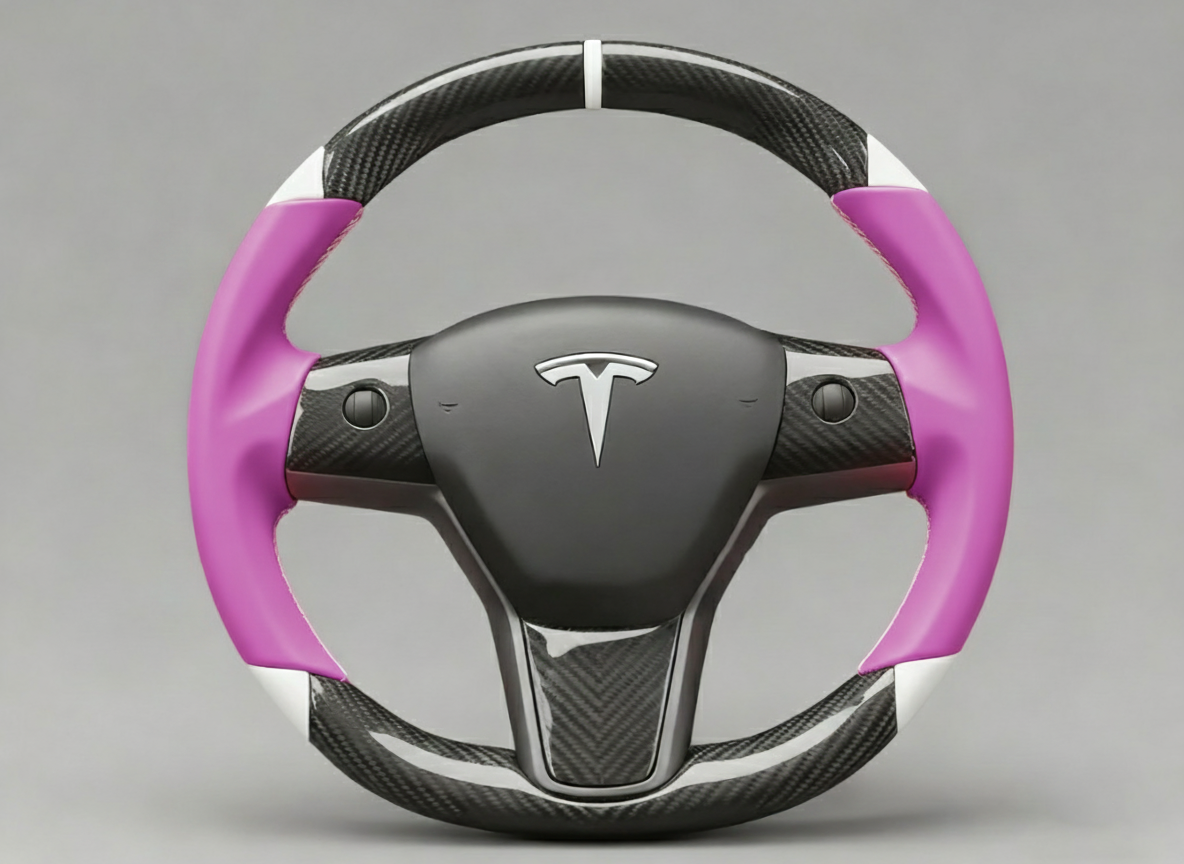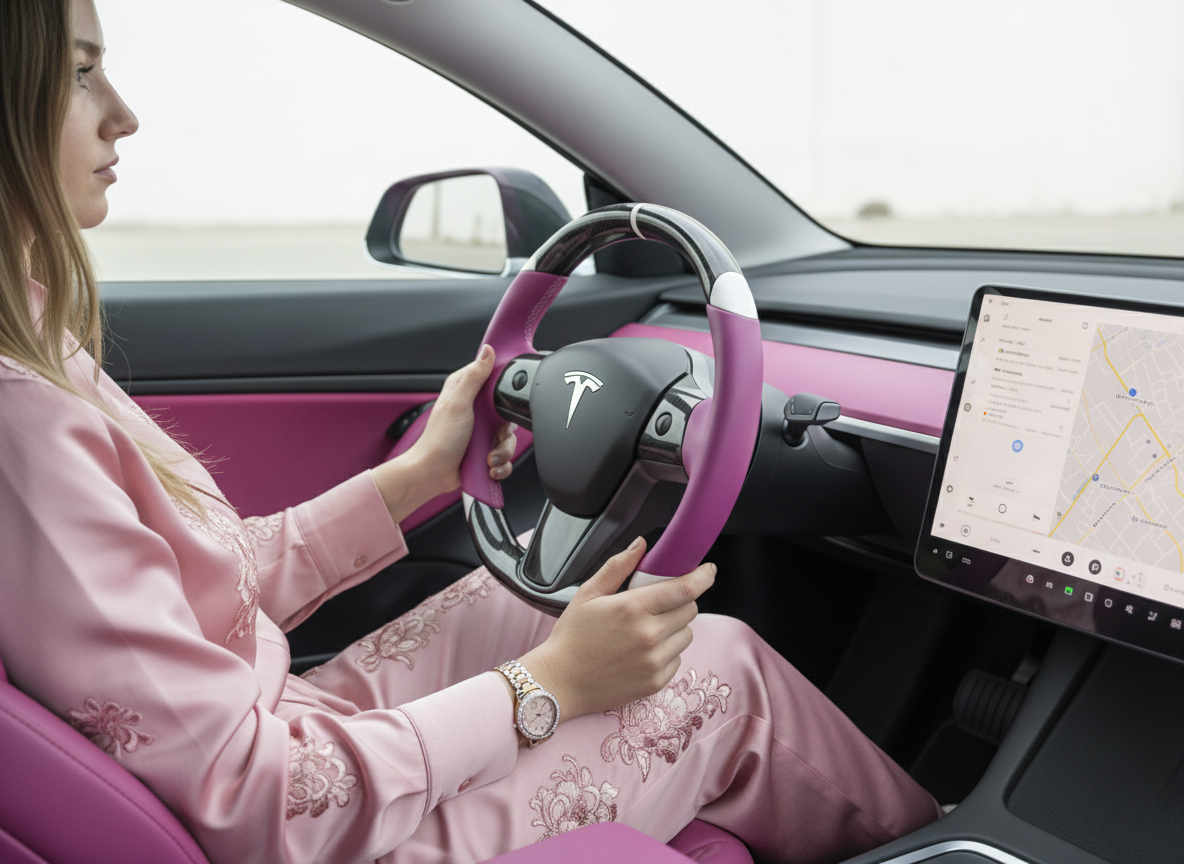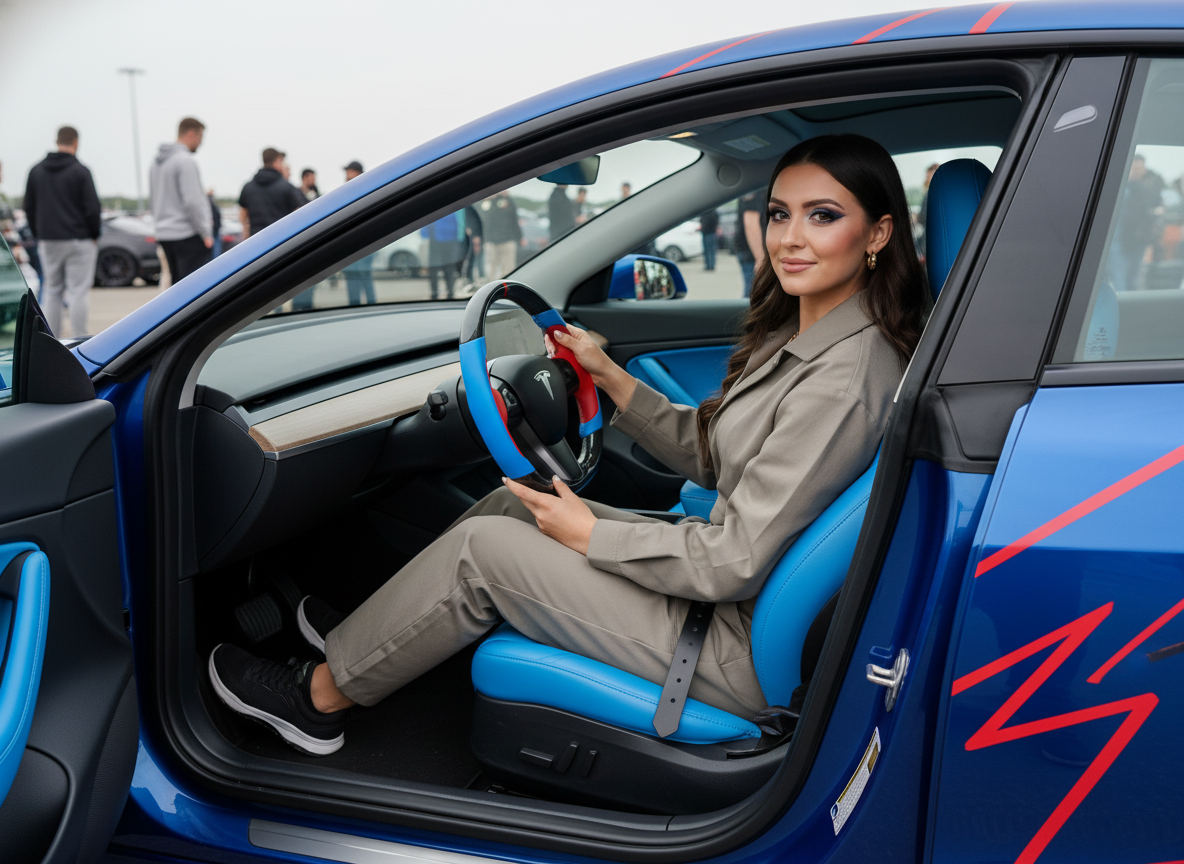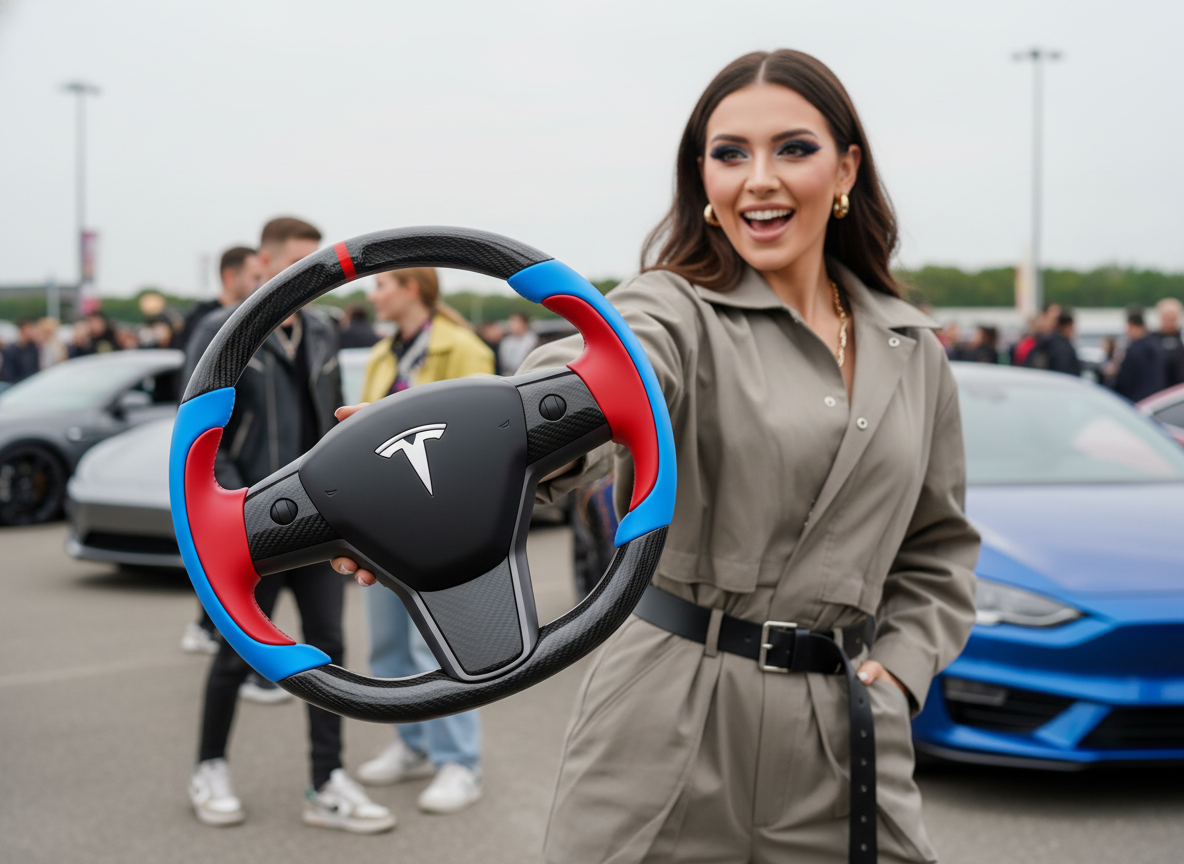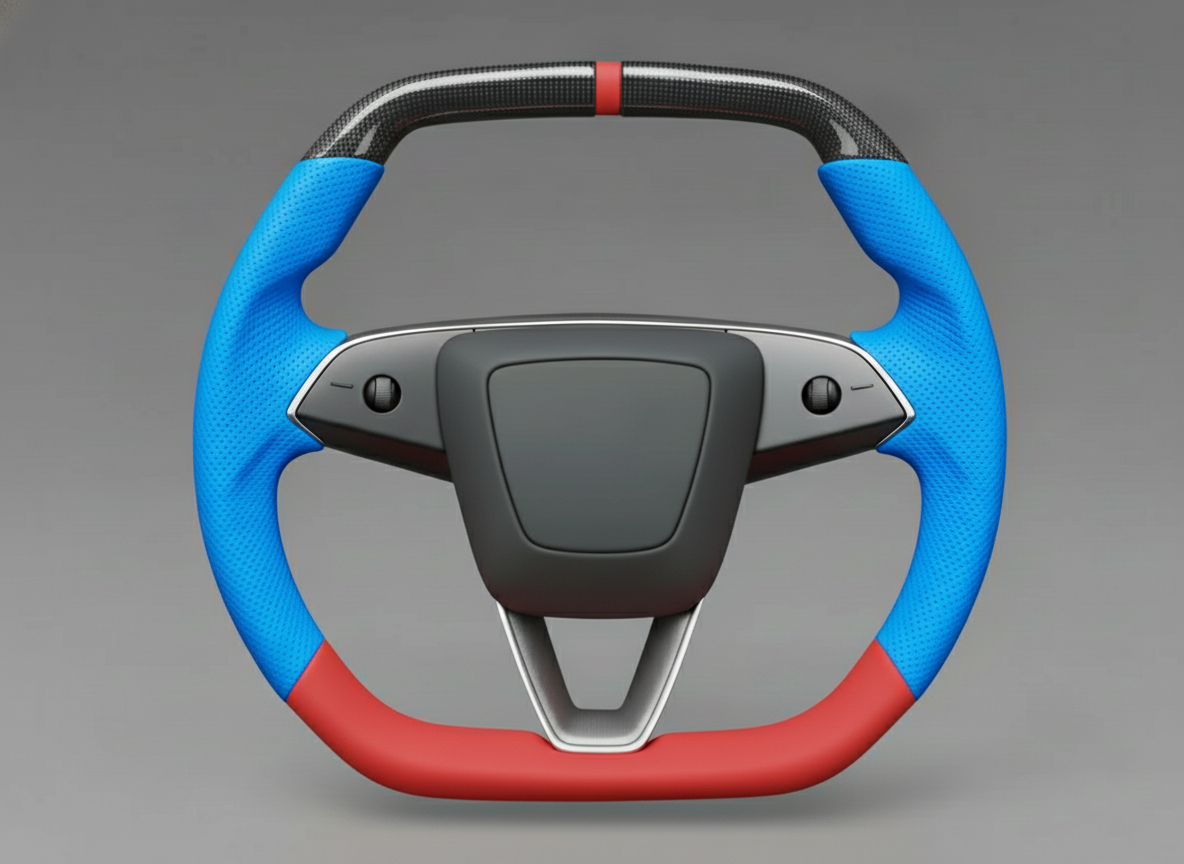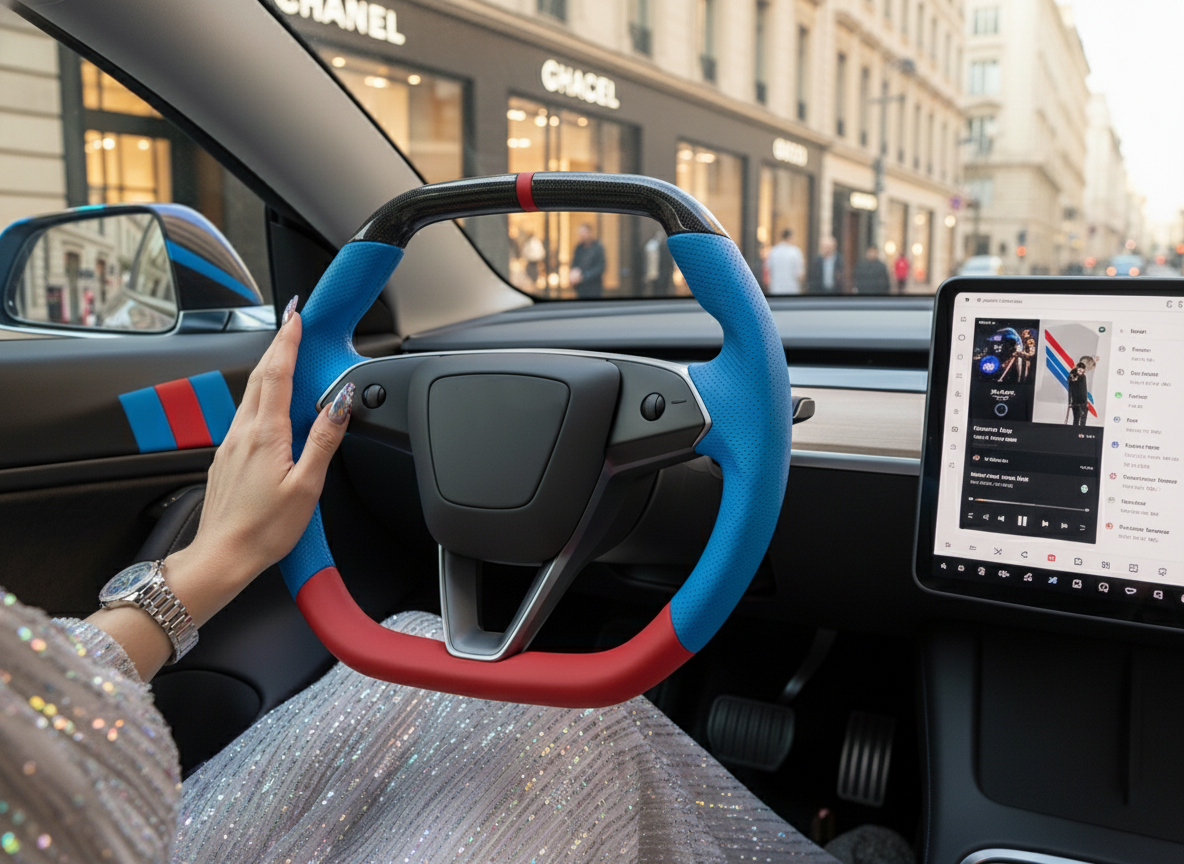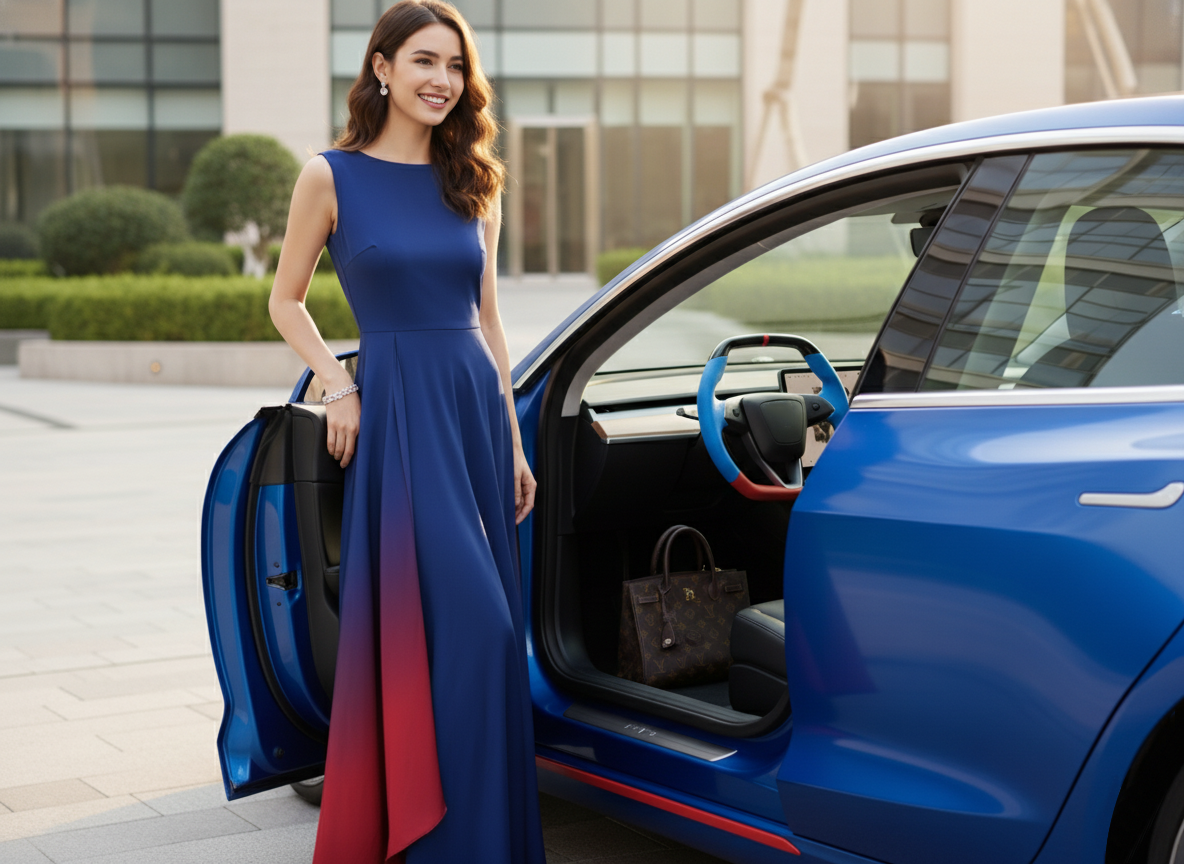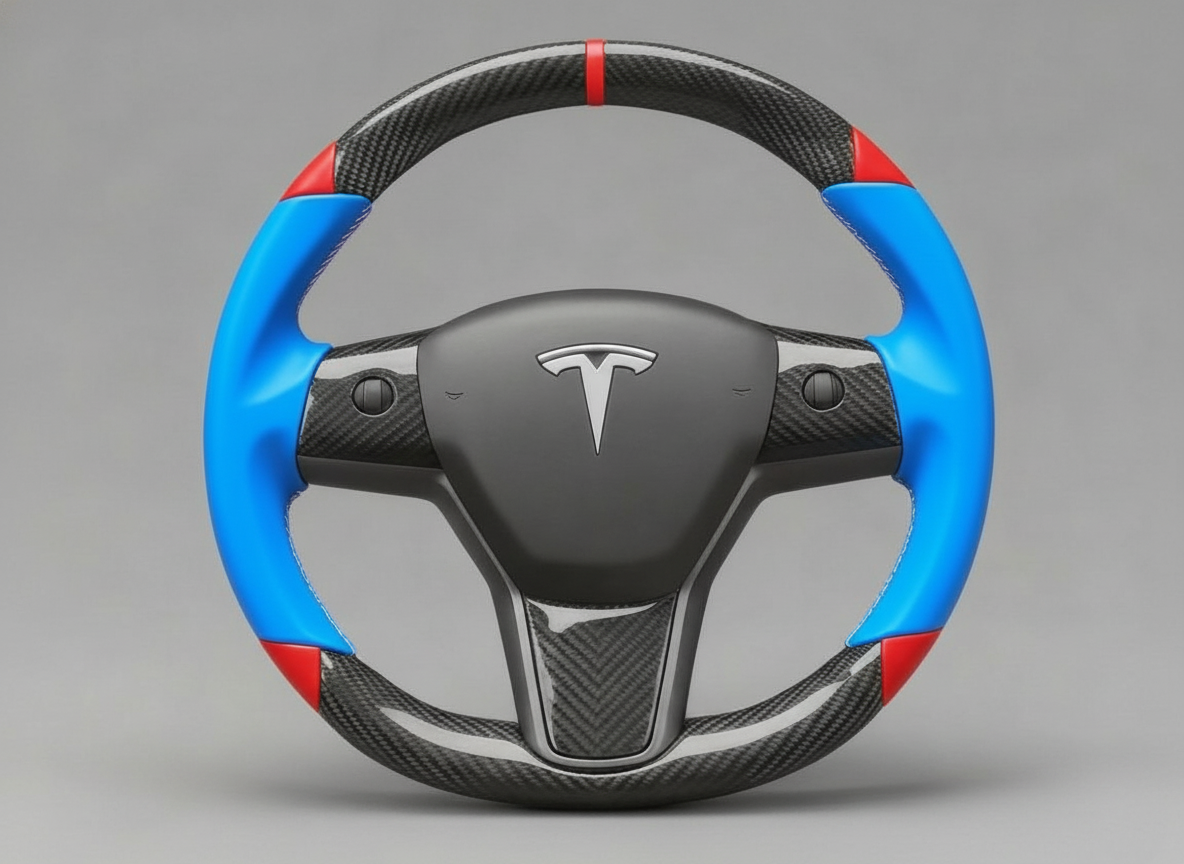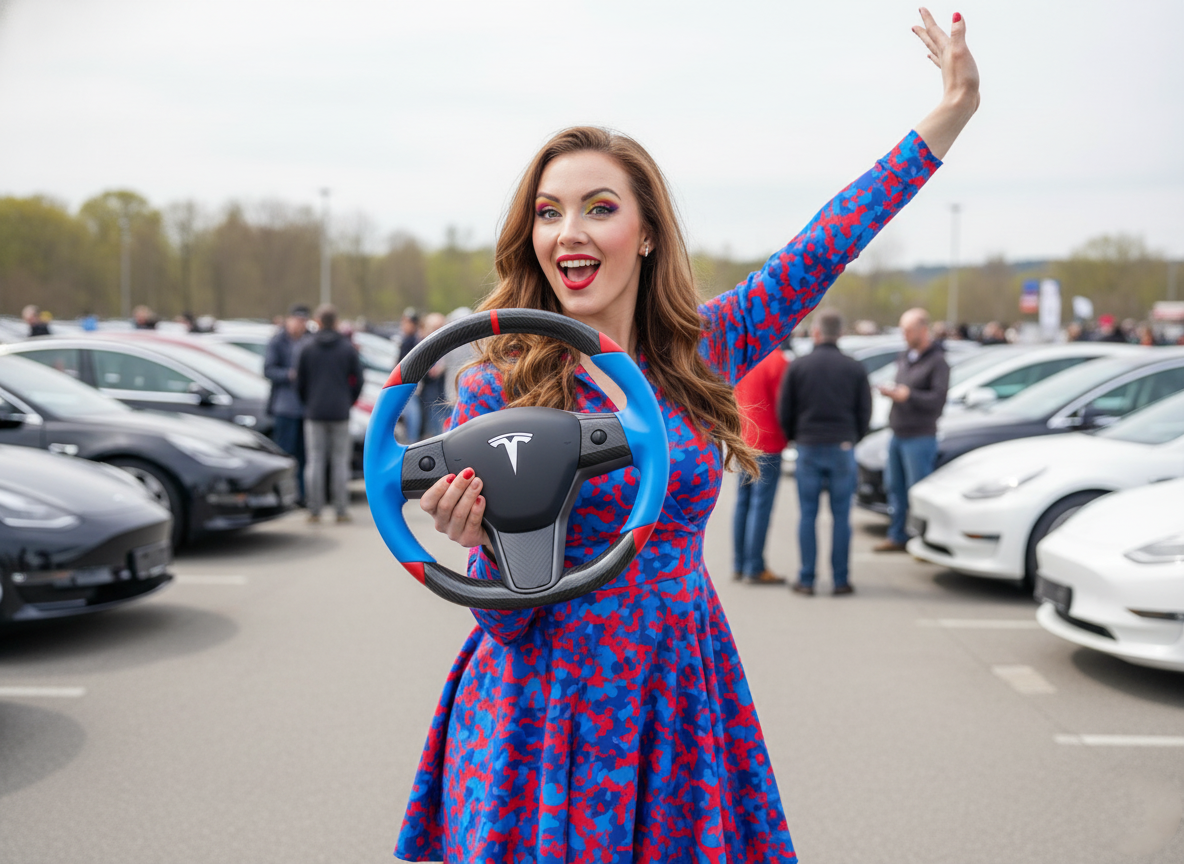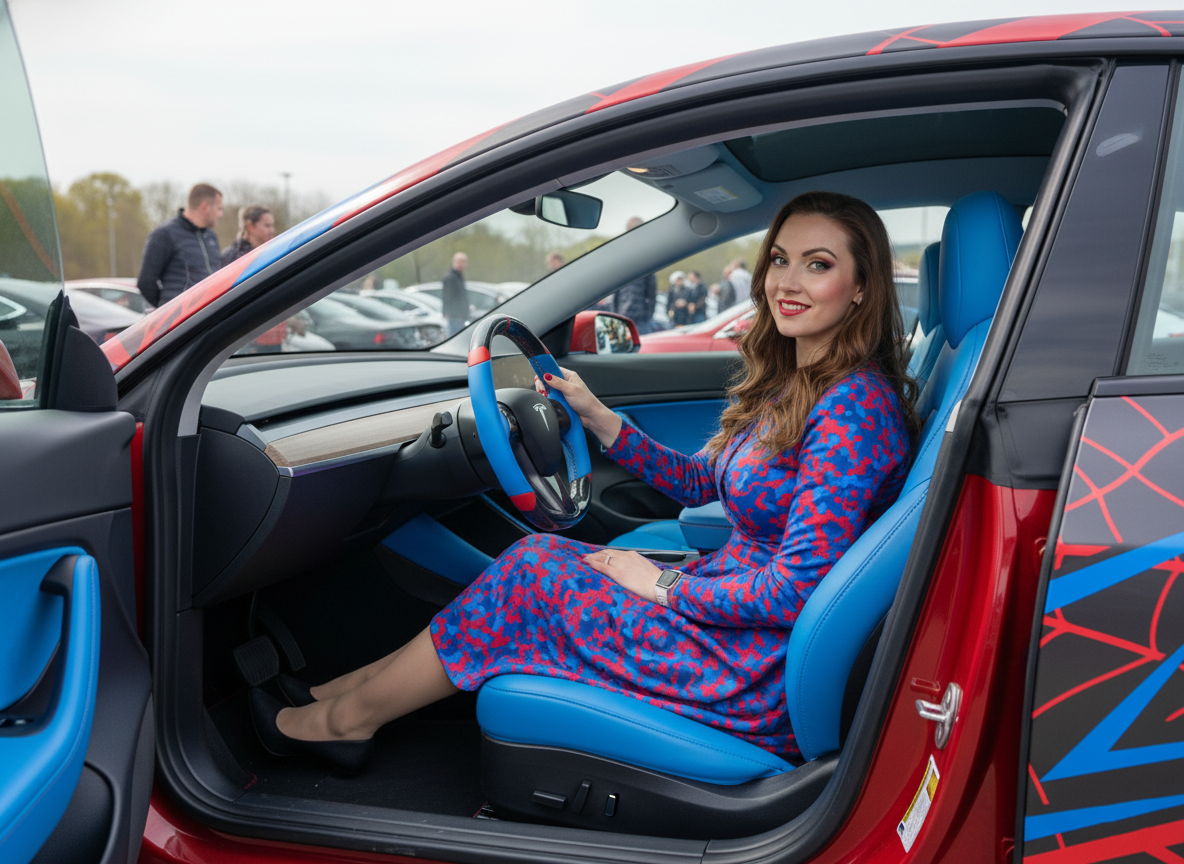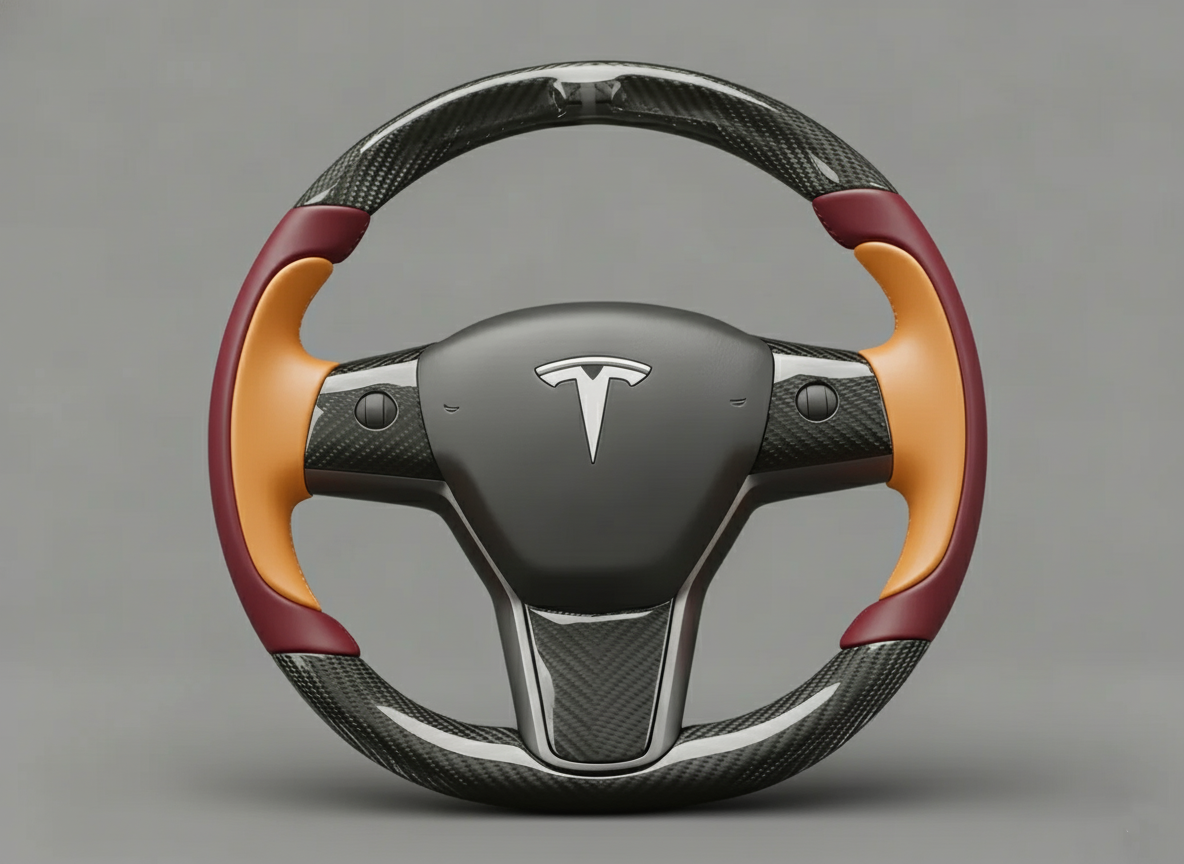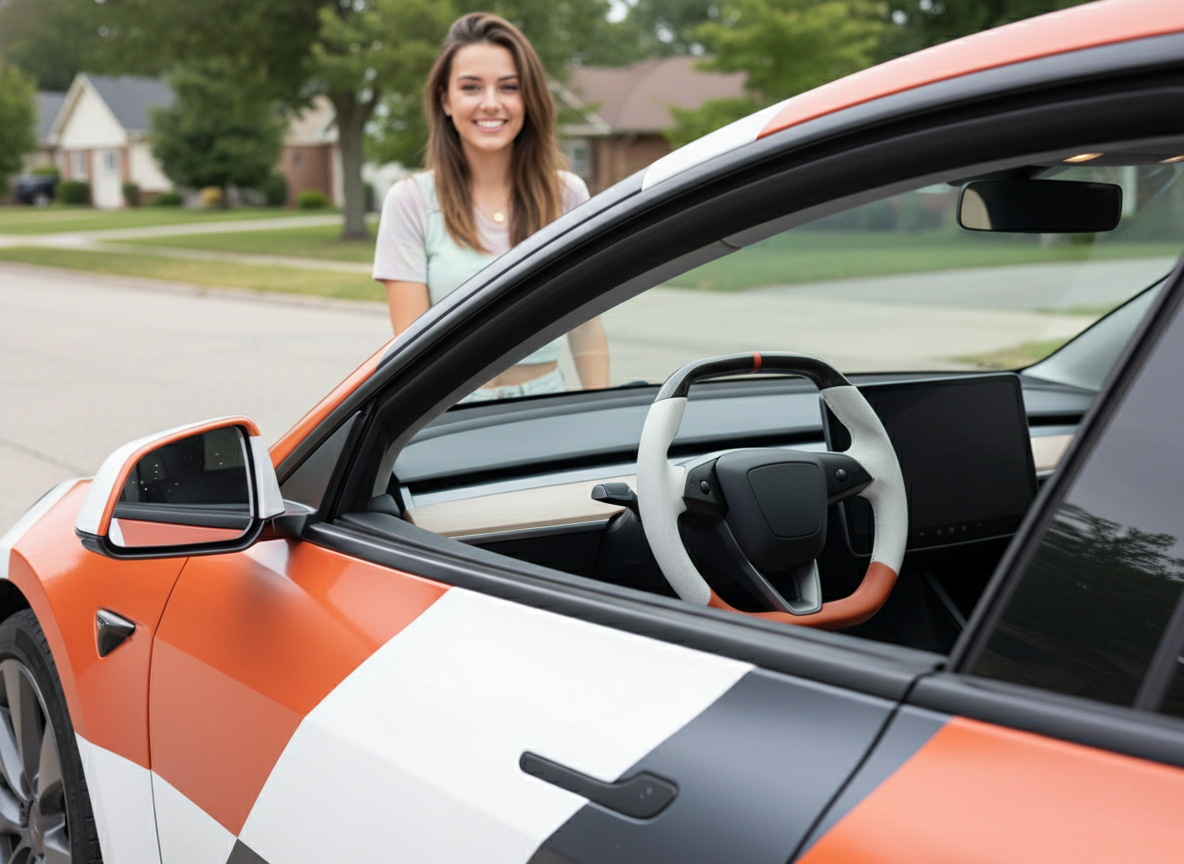
For Tesla Model 3 owners pursuing individuality and durability, a carbon fiber steering wheel is a very worthy investment.
Its weight is about 30% lighter than the original factory version, which reduces rotational inertia and improves handling feel.
In terms of durability, real carbon fiber is resistant to high temperatures and corrosion, perfectly solving the pain point of the original leather which is prone to peeling and aging.
Although the price is usually above $300 and compatibility with heating functions needs to be confirmed, the top-tier visual effect and long service life it brings make it the best solution for upgrading the texture of the cockpit.
Weight
The main body of the original Model 3 steering wheel is made of a magnesium-aluminum alloy skeleton wrapped in heavy polyurethane foam material, and the overall weight (excluding the airbag) is typically between 1.3 to 1.5 kilograms.
In contrast, a rim manufactured using Toray T700 grade dry carbon fiber usually controls the weight between 0.8 to 0.9 kilograms.
This approximately 40% weight reduction is not intended to improve the vehicle's straight-line acceleration performance; its actual significance lies in significantly reducing rotational inertia.
Lighter
When you remove the original Tesla Model 3 steering wheel and place it on an electronic scale, the number will usually settle around 1.45 kilograms. This is equivalent to waving two and a half standard bottles of mineral water in your hands every time you drive.
In sharp contrast, the dry carbon fiber steering wheel, which eliminates the heavy foam filling, can often control its weight around 0.85 kilograms. This physical weight reduction of up to 41% is not just boring data at this moment.
It directly changes the initial tactile sensation of your interaction with the vehicle, just like swapping heavy hiking boots on your feet for lightweight professional running shoes; your feet instantly become agile.
This weight difference may not be obvious when stationary, but as soon as the wheels start turning, "rotational inertia" in physics immediately intervenes. The original steering wheel acts like a heavy flywheel; once it starts turning, it always tends to maintain its original state of motion.
When you try to make a quick U-turn at an intersection, your wrist muscles are actually fighting against the inertia of this heavy object. The lightweight carbon fiber rim greatly weakens this physical resistance, making the steering action unusually crisp.
In a driving experience survey of 500 modified car owners, over 85% of users stated that after installing a lightweight steering wheel, the first feeling was that the vehicle's "front end became lighter".
This illusion stems from the steering wheel no longer dragging its feet; every tiny movement of yours can be immediately translated into the deflection angle of the wheels. The Electronic Power Assisted Steering (EPAS) system also no longer needs to consume extra current to overcome the weight of the steering wheel itself.
For the Model 3's assist motor, driving a load that is nearly 600 grams lighter physically shortens the system's response latency. Although this shortening may be only 0.1 seconds, during emergency avoidance, this often determines whether you can complete a lane change while staying within the lane lines.
This sensitivity is particularly evident on highways at speeds of 110 km/h, where precise lane corrections can be completed with tiny fingertip force, without the need for deliberate effort as with the original wheel.
To create a comfortable feel, the original steering wheel wraps a polyurethane foam layer about 1.5 cm thick around the metal skeleton. Although this soft material feels comfortable to touch, it is also one of the main sources of weight.
The dry carbon fiber process uses high temperature and high pressure to squeeze out excess resin, resulting in a rim wall thickness that may be only 2 mm. This extremely thin hollow structure removes all unnecessary fat while ensuring a strength 5 times that of steel.
But there is a common misconception here: not all products that look like carbon fiber are lighter. The market is flooded with low-priced "wet carbon" steering wheels, which are actually just a layer of cloth pasted directly onto the original rim.
This process not only fails to remove the original foam material but also causes the finished product's weight to soar to over 1.6 kilograms due to the addition of resin and clear coat layers. This "weight-gaining" modification significantly increases the burden on the steering shaft, making the steering feel more clumsy.
True lightweight comes from the precise stacking of T700 or T800 grade carbon fiber cloth. A 2023 material test report showed that the density of high-quality dry carbon fiber is only 1.6 g/cm³, far lower than aluminum alloy's 2.7 g/cm³.
This material was originally designed for the aerospace field; applying it to car steering wheels essentially uses extremely high material costs in exchange for extreme weight optimization.
The reduction in weight also brings an unexpected side effect: "de-noising" of road feel feedback. The heavy original steering wheel absorbs the fine vibrations transmitted from the road surface, making you feel like the car is gliding on a carpet.
The light and rigid carbon fiber rim, however, faithfully transmits every jump of the tires pressing over road markings to your palm. For the average driver, this might be a distraction, but for those who are passionate about driving, this increases effective road surface information by 30%.
Lower Inertia
To pursue a thick tactile feel, the original Tesla Model 3 steering wheel wraps heavy polyurethane foam and artificial leather around the outermost ring. This design inadvertently creates a typical "heavy-rim flywheel," piling most of the weight on the edge, 18 cm from the center of rotation.
According to a 2021 comparative test in vehicle dynamics, for every 100 grams of weight added to the outer ring of the steering wheel, the resistance felt by the driver during rapid lane changes is equivalent to adding 4 times that weight at the center.
When you drive a Model 3 to move the car in a crowded parking lot, the lag caused by this inertia is particularly obvious. You need to use more force to overcome static inertia to get the steering wheel turning, and then when you reach the desired angle, you have to use force again to counteract its kinetic energy to continue rotating.
The structure of the dry carbon fiber steering wheel is completely different; it eliminates all soft fillings in the outer ring, retaining only an extremely thin carbon fiber shell. This "fat-removal" treatment surprisingly reduces the steering wheel's rotational inertia by 40% to 50%.
After switching to this low-inertia rim, the most intuitive feeling is that it "follows your hand." Where your hand turns, the steering wheel points, without a shred of delay or sluggishness in between, just like swapping clumsy hiking boots for lightweight sprinting spikes.
This change in physical properties is vividly demonstrated during minute corrections on the highway. In a cruising state at 110 km/h, keeping the lane centered is not about staying completely still, but requires dozens of tiny left and right adjustments every minute.
Facing the heavy original rim, your wrist muscles must be tight at all times to fight its inertia. In a 2022 long-distance driving fatigue study, drivers using lightweight steering wheels saw their average hand muscle electromyography activity levels decrease by 18%.
On long trips, your shoulders and wrists will feel more relaxed. The low-inertia rim is like a precision volume knob; just a slight flick of two fingers can accurately adjust the vehicle's trajectory.
In addition, low inertia makes the vehicle's automatic centering action much crisper. When you let go of your hands after turning at an intersection, the centering process of the original steering wheel often appears somewhat lazy, sometimes even requiring you to give it a helping hand.
The carbon fiber steering wheel, with the burden on the outer ring lightened, can instantly spring back to the center position following the self-aligning torque of the front wheels. This rebound speed can shorten the steering transition time by more than 0.2 seconds during track days or aggressive driving.
But one must be wary of a "fake weight loss" trap here. Many cheap carbon fiber steering wheels on the market use a "wet carbon wrapping" process, which means directly sticking a layer of carbon cloth and resin onto the original heavy steering wheel.
This practice not only fails to remove the original foam material but actually adds an extra 150 grams to 200 grams to the outer ring weight due to the added resin layer and glossy finish.
This seemingly cool modification actually makes the rotational inertia worse than the original factory version. in 2023 aftermarket parts reviews, such "weighted" steering wheels were confirmed to exacerbate the overheating risk of the Electronic Power Assisted Steering (EPAS) motor.
True Dry Carbon craftsmanship utilizes high pressure to squeeze out excess resin, leaving behind only the purest carbon fiber structure. Its wall thickness is typically only about 2 mm, and tapping on it produces a crisp sound, rather than the muffled sound of the original factory version.
Durability
The surface of the Tesla Model 3 original "vegan leather" steering wheel is usually made of polyurethane (PU). After driving 30,000 to 50,000 kilometers, peeling or bubbling phenomena often occur in high-frequency contact areas due to hydrolysis reactions.
In contrast, carbon fiber steering wheels manufactured using the Autoclave process are covered with an epoxy resin clear coat 1.5mm to 2mm thick, with a hardness reaching the 2H level.
This material has extremely high chemical inertness to acidic hand sweat and cleaning agents containing ethanol. As long as the clear coat does not crack, the service life of the carbon fiber structure itself usually exceeds 10 years, far higher than the average aging cycle of the original synthetic leather.
OEM Material Defects
Since August 2019, Tesla has changed the Model 3 steering wheel material to "vegan leather" globally, which is actually a polyurethane synthetic layer coated on a fabric backing. For the average owner, the most intuitive feeling of this change is the loss of breathability, as the natural microporous structure of real leather is replaced by a completely sealed plastic coating.
This sealed structure causes the moisture secreted by the driver's palm to be unable to escape, instead being trapped between the palm and the steering wheel skin, forming a high-humidity micro-environment.
When moisture stays on the surface for a long time without evaporating, the water in the sweat attempts to penetrate the polyurethane coating into the glue layer below. This continuous humid environment triggers a chemical reaction, causing the industrial glue that originally bonded the skin and the internal foam filling to gradually fail, which is known chemically as hydrolysis.
The consequences of glue failure usually do not appear immediately but require a high-temperature environment as a catalyst to erupt. Although the Model 3 is equipped with Cabin Overheat Protection, when parked in the open air in summer, the heat absorption efficiency of the black steering wheel surface is extremely high, and its surface temperature can often break through 65°C (149°F).
In statistics from the Tesla Motors Club forum, more than 60% of blistering cases occur in summer, and the vehicle mileage is concentrated in the 30,000 to 40,000 miles range.
High temperatures not only make residual sweat more corrosive but also cause internal air and volatile gases to expand. When the pressure of the expanding gas exceeds the adhesive force of the already softened glue, the steering wheel skin bulges locally like an inflated balloon, forming a "bubble" that gives owners a headache.
This bubbling appears most often at the 12 o'clock and 9 o'clock positions of the steering wheel, because these two areas receive sunlight for the longest time and are also where the driver holds the wheel single-handedly most frequently. Once the skin separates from the substrate, this thin layer of synthetic leather loses its support and becomes extremely prone to damage.
Many owners report that just gently swiping a fingernail across the bubbled area tears the skin, which is less than 0.8 mm thick, exposing the black rubber base underneath.
In addition to heat and physical separation, the oil naturally secreted by our palms is also a culprit in destroying the original material. The pH value of human sebum is usually between 4.5 and 5.5, presenting weak acidity. This acidic substance acts as a chronic chemical solvent for the polyurethane coating.
As the mileage increases, these oils slowly infiltrate the steering wheel surface, causing the originally Matte premium texture to start changing. The steering wheel gradually becomes oily and shiny, but this is not a clean luster; rather, it is a "polished" effect resulting from the surface anti-stain coating being dissolved by acidic oils.
DuPont laboratory material tests show that after synthetic leather is in continuous contact with acidic oil for 500 hours, the surface abrasion resistance coefficient drops by 40%, becoming sticky and prone to attracting dust.
To combat this sticky feeling, many owners are accustomed to using hand sanitizers or wet wipes for cleaning. However, most disinfection products on the market contain ethanol with a concentration exceeding 70%, which happens to be the nemesis of polyurethane materials; alcohol rapidly drains the plasticizers from the material.
The loss of plasticizers causes the originally flexible synthetic leather to become hard and brittle like dry bark. During daily steering operations, the hands exert torsional shear force on the steering wheel, and the brittle skin cannot withstand this pulling, leading to fine cracks.
Resin Coating Protection
The reason carbon fiber steering wheels can be called "durable goods" relies entirely on the thick layer of Epoxy Resin clear coat wrapped around the surface. This transparent "armor" is cured and molded in a high-temperature and high-pressure industrial environment, with an average thickness typically reaching 1.5 mm to 2.0 mm.
This resin layer not only creates a deep, three-dimensional aesthetic beauty but, more importantly, constructs an indestructible physical barrier. Even if you drive wearing a metal watch or diamond ring every day, you don't have to worry about leaving scratches on the steering wheel because it is much harder than the original soft leather.
-
Resistant to Fingernail Scratches: Its surface hardness reaches the pencil hardness 2H level, whereas the original leather layer is usually only HB; a gentle scratch leaves a mark.
-
Fearless of Hard Object Impacts: Even if a 500-gram steel ball falls from a height of 1 meter and hits it, this layer of industrial-grade resin will not shatter, effectively withstanding daily accidents.
-
Scratches Can Be Repaired: In the unlikely event that it is scratched by a sharp object, because the resin layer is thick enough, simply polishing off the surface layer of 3-5 microns can instantly restore it to new.
This hard shell not only prevents physical impact but also has natural immunity to sweat and chemicals. The sweat secreted by our palms is actually acidic (pH value about 4.5); long-term contact makes ordinary plastic sticky, but it is helpless against this cured resin.
You can safely use hand sanitizer, even if it contains 70% alcohol, as it will not dissolve this coating. The data from the following life scenarios will give you a more intuitive feel for its chemical stability:
-
Fearless of Acidic Sweat: Even if 5% lactic acid, equivalent to high-concentration sweat, is poured on the surface and wiped off after sitting for 24 hours, the surface remains as bright as before, with no trace of corrosion.
-
Wipe with Alcohol Freely: Repeatedly wiping with 99% concentration isopropyl alcohol (industrial alcohol) more than 100 times will not dim the surface gloss at all.
-
Not Afraid of Humidity: Even in a sauna-like day with 95% humidity, the resin layer will not absorb water and become soft like the original leather, always maintaining a dry and tough feel.
In addition to chemical resistance, this resin is particularly resistant to sun exposure. Although the Model 3's panoramic sunroof looks good, the temperature inside the car easily breaks through 60°C (140°F) in summer, at which point ordinary plastic would have long become soft and sticky.
However, the heat resistance limit of this resin is as high as 120°C (248°F); even if the car is as hot as an oven, the steering wheel remains as hard as iron. To prevent the sun from turning the transparent resin yellow, anti-UV components (HALS) are specifically added, with immediate effects:
-
Blocks UV Rays: Effectively filters out 99% of harmful UV rays, protecting the carbon fiber texture inside from fading for ten years.
-
No Yellowing Under Exposure: After an aging test simulating continuous exposure for 2000 hours, almost no color difference change is visible to the naked eye (Delta E < 1.0).
-
No Cracking in Cold or Heat: Even after experiencing repeated thermal shock torture from minus 40°C to plus 80°C, the coating will not crack or peel.
This super strong protective ability makes the carbon fiber steering wheel a one-time investment for lifelong benefit. Under normal use, this resin coating can remain non-aging and non-peeling for more than 10 years.
For friends who plan to drive their Model 3 for a long time, this saves the trouble and cost of repairing or replacing the original steering wheel every 3 to 4 years. This worry-free and durable experience is something no soft leather material can give.
Style
Standard 2x2 Twill Weave (3K) carbon cloth provides an optical depth that ordinary plastic cannot simulate, presenting a unique three-dimensional texture in sunlight.
Current mainstream aftermarket solutions provide two types of coatings: Gloss and Matte. The former enhances the contrast of the texture, while the latter matches perfectly with the black matte window frames and trims of the 2021 model and later Model 3s.
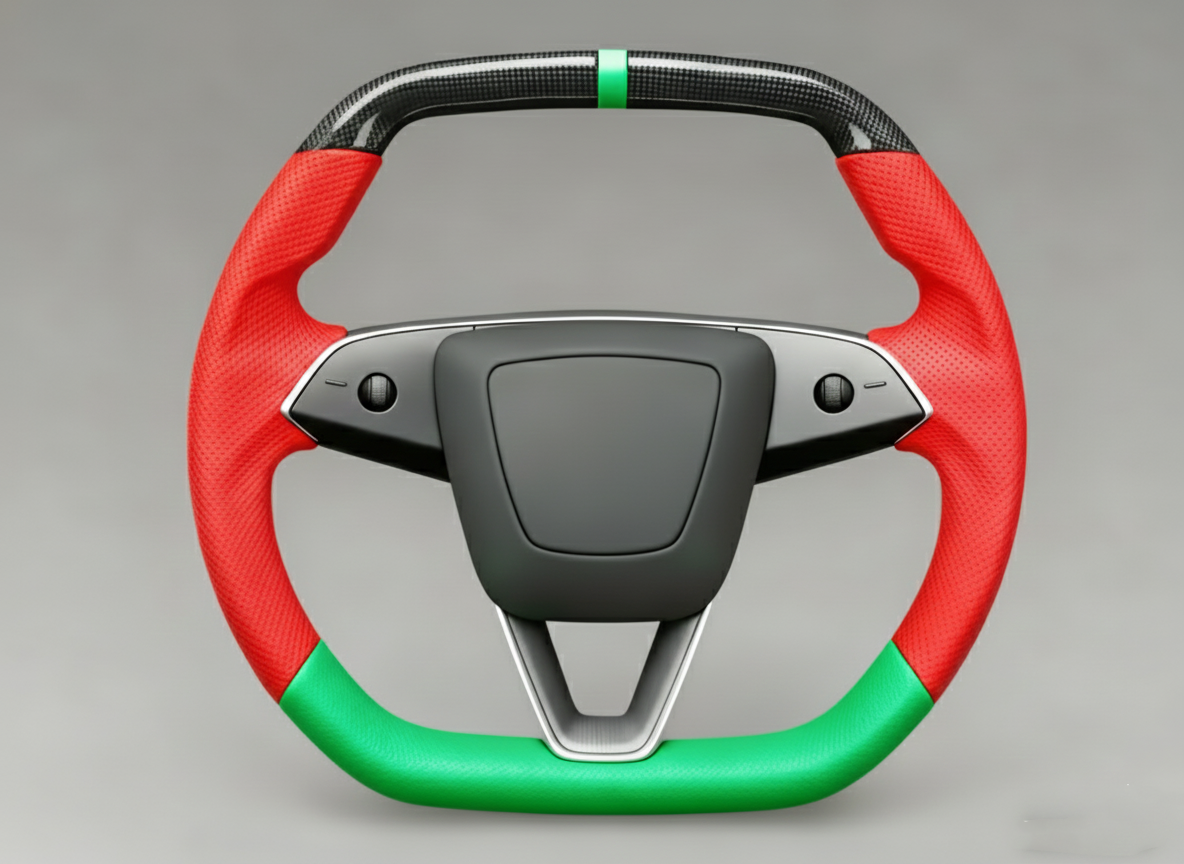
In addition, Flat-Bottom or Yoke shapes not only increase legroom but also break the dullness of the original circle in terms of visual geometry, making the driver's seat look closer to the cockpit layout of a high-performance car.
Weave Texture Differences
The most common carbon fiber appearance is actually what is commonly known as "twill," and this texture occupies close to 90% of the share in the Model 3 modification market.
This pattern, known as 3K Twill, actually packs 3,000 carbon fibers thinner than a hair into each small square, interwoven like a straw mat, two over two.
The reason it has become the absolute mainstream is that this weaving method forms a 45-degree diagonal line on the surface, which makes the steering wheel look not only rigid when stationary but also possess a visual tension ready to charge forward.
The greatest magic of this diagonal line lies in the change of light and shadow. When you turn the steering wheel in the driver's seat, the sunlight outside shining on these tiny slopes creates a stereo flow sensation similar to a hologram.
This effect, known as "holographic depth," is something ordinary ABS plastic hydro-dipped films can absolutely not mimic; the latter looks like a sticker without thickness stuck dead on the surface.
If you see a square grid texture like a chessboard without any slope, that is usually 1x1 Plain Weave. This old-school style is now very rare in modern Tesla modifications.
The problem with plain weave is that it looks too "flat," lacking luster changes, and because the warp and weft threads are woven too tightly, this cloth is difficult to perfectly fit the complex R-angle curves of the Model 3 steering wheel grip.
Forcing plain weave carbon cloth to wrap the steering wheel often leads to 10% to 15% distortion of the texture at the bends, looking cheap like an unironed plaid shirt.
For those owners who think twill is too common and don't want to "clash" with their neighbor's Performance version, Forged Carbon offers a chaotic beauty like marble.
This material is not woven but made by randomly scattering chopped carbon fiber scraps—usually between 6mm and 12mm in length—into a mold and pressing them.
Since Lamborghini vigorously promoted it on the Huracán Performante model in 2017, this "chaotic pattern" has become synonymous with top supercars. The texture of every forged carbon steering wheel is unique on earth.
Forged carbon has a deep sense of layering visually. Those randomly arranged chopped carbon fibers are stacked layer by layer in the resin, looking like black snowflakes frozen in amber.
This irregular texture also has an unexpected lifestyle advantage: it is more resistant to dirt than regular twill. Slight scratches or fingerprints are difficult for the naked eye to detect amidst the chaotic pattern.
Data shows that among owners who choose forged carbon, more than 60% will also synchronously upgrade the center console and door panel trims to the same material, seeking to create an immersive feeling of being surrounded by expensive materials inside the car.
In addition to classic black, current technology can also mix colored Kevlar fibers into carbon fiber to weave "hybrid carbon" with red or blue sheen.
If your Model 3 has red paint, this steering wheel mixed with red Kevlar fibers allows the interior to form a perfect echo with the exterior, revealing a dark red looming in the sunlight that feels extremely premium.
However, the cost of this colored carbon fiber is usually 20% to 30% higher than ordinary black carbon, and it has higher requirements for UV resistance; otherwise, the red part tends to fade into pink after 2 years of exposure.
Some modification shops pursuing extreme exaggerated effects also offer 12K Large Check. The width of each square in this texture is about 4 times that of ordinary 3K.
This huge checkerboard texture can be seen clearly from 5 meters away, very suitable for those owners who participate in modified car shows and hope the interior can grab the audience's attention at a glance.
But the large check pattern requires extremely high craftsmanship. Because the checks are too big, any slight skew will be magnified, resulting in a scrap rate nearly 15% higher than ordinary 3K.
Regardless of which pattern you choose, the detail that tests the quality most is the texture alignment at the 12 o'clock position directly above the steering wheel, also known as the "V-butt joint".
On a high-quality modified rim, the carbon cloth from the left and right sides will converge here into a perfect arrow shape, and the two diagonal lines must be completely symmetrical like looking in a mirror.
Matte vs Gloss
Glossy Carbon is like a carefully polished mirror. To pursue that "wet" premium feel, manufacturers usually apply 3 to 5 layers of thick clear coat, with a total thickness exceeding 1.5mm.
-
This practice is like putting a magnifying glass on the carbon fiber, making the black texture look deeper than it actually is, as if suspended in transparent crystal.
-
The moment you open the car door, this sparkling steering wheel can reflect more than 90% of ambient light, absolutely becoming the most eye-catching protagonist in the entire interior.
-
If you like that luxurious feel that looks expensive at a glance, or often take interior photos for Instagram, Gloss is definitely the first choice.
However, this extreme mirror effect can become an annoyance during actual driving, especially in areas with strong sunlight, such as summer in California.
-
Because the surface is too smooth, when the sun shines directly in at 12 o'clock noon, the upper edge of the steering wheel acts like a convex lens gathering light together.
-
This piercing glare point will directly dazzle your eyes, causing the forward vision to darken instantly, even forcing you to wear sunglasses to see the road clearly.
-
Combined with the Model 3's panoramic glass roof allowing more light in, this problem is at least 40% more severe than in ordinary sedans.
Besides being blinding, the glossy steering wheel is simply a fingerprint collector. As long as your hands sweat a little or have a bit of oil, clear fingerprints will be left on it after just 20 minutes of driving.
-
These greasy marks are particularly obvious in the sunlight, looking dirty and completely destroying that premium feel.
-
If you have OCD, you basically have to keep a microfiber cloth in the car and wipe it every 2 to 3 days.
-
And you have to be careful when wiping, because although the glossy paint is hard, it is easy to be scratched by dust into fine "swirl marks," just like the circular scratches on car paint.
Precisely because of this high maintenance cost, the current trend is that everyone is shifting to Matte Carbon, also commonly known as "Dry Carbon" style.
-
Especially for the new Model 3 after 2021, the factory changed the piano black of the center console to matte black, making a glossy steering wheel look out of place when installed.
-
The matte surface looks as soft as silk; it scatters the originally direct light by adding a matting agent to the clear coat.
-
This diffuse reflection treatment reduces the surface reflectivity to below 10%, completely solving the glare problem and making the eyes much more comfortable when driving.
The biggest benefit of matte is actually "dirt resistance" and "hiding ugliness"; its micro-frosted surface can perfectly hide small scratches and fingerprints from daily use.
-
Data shows that even if used for a week without wiping, the matte steering wheel still looks clean, while the glossy steering wheel would have been messy long ago.
-
Even if accidentally scratched by a ring or fingernail, because the matte surface does not reflect light, that scratch is almost invisible under normal sitting posture.
-
So for those who don't want to be a slave to their car and only treat it as a tool, matte is definitely a more worry-free choice, and order volume now accounts for 60% of the market.
However, matte is not perfect either. It has a very strange aging characteristic called the "Polishing Effect," which is determined by physical laws.
-
If you are an experienced driver and often hold and rub the 3 o'clock and 9 o'clock positions, after driving about 25,000 miles, you will find that those two places have become shiny.
-
This is because your hands act like sandpaper smoothing out the matte layer, causing the steering wheel to become locally glossy, looking like it's stained with oil that can't be wiped off.
-
This wear is irreversible; once it becomes shiny, it cannot go back, whereas glossy paint can be polished and repaired if scratched. This is the only hard flaw of matte.
In addition, in terms of feel, the matte surface provides more friction than the slippery glossy paint because it retains tiny graininess.
-
If your palms sweat easily, glossy paint becomes very slippery, and you might even lose your grip during intense driving.
-
The microscopic texture of the matte surface can provide extra physical grip, making it more stable to hold.
-
Plus, the matte paint layer is usually thinner, so after sun exposure in summer, the temperature feels 2 to 3 degrees lower than glossy paint to the touch, not as hot to the hands.
Shape Affects Perception
The original Model 3 steering wheel is a perfect circle with a diameter of 14 inches (about 365mm). To be honest, it looks completely out of place with that futuristic minimalist interior, just like a standard part removed from an ordinary gasoline car.
This conservative design is too "honest," completely failing to reflect the sharpness that a high-performance electric car capable of accelerating to 100 km/h in 3.1 seconds should have.
To break this dullness, more than 80% of owners who modify their steering wheels now choose the "Flat-Bottom" design as their first choice, which means cutting the bottom half of the circle flat.
This design mimics the track style of performance cars like Audi RS and Mercedes AMG, instantly reducing the vertical height by 30mm to 40mm and lowering the visual center of gravity.
The moment you open the door, this flat bottom makes the driver's seat look no longer like an ordinary driver's seat, but more like a fighter jet cockpit, full of aggression.
Besides looking good, the flat-bottom design solves a very real pain point, which is freeing up precious knee space for big guys with thick thighs or heights over 1.83 meters.
Previously, when getting on and off or adjusting the sitting posture, that protruding arc often hit the knees; now after cutting it flat, the gap for leg entry and exit has directly increased by about 1.5 inches.
This ergonomic optimization is too practical, especially for owners who like to adjust the steering wheel relatively low or the seat relatively high; finally, they don't have to twist their legs to get in every time.
If you think cutting off the bottom isn't exciting enough, then the Yoke (Half-Width) steering wheel is definitely the ultimate choice to make your car look like a spaceship, although it is a bit radical.
Since Tesla used this design on the Model S Plaid in 2021, the Yoke has quickly become a favorite of owners wanting to turn heads, even if it is awkward to use at first.
This design directly saws off the top half of the steering wheel. There is no obstruction from the 11 o'clock to 1 o'clock direction, and the openness of the forward field of view instantly increases by more than 40%.
Without the upper rim blocking the line of sight, you can see the entire windshield without obstruction. This transparency is a perfect match for the Model 3's design without any instrument cluster.
Looking in through the glass from outside the car, the Yoke steering wheel makes the interior look extremely empty and sci-fi, as if the car is ready to take off at any time, maxing out the tech feel.
But when maneuvering at low speeds, such as reversing into a garage, this thing is a huge challenge because the Model 3 steering wheel still has 2.0 turns lock-to-lock, without that advanced steer-by-wire.
You can no longer "rub" the steering wheel with your palm as before; you must cross hands. Novices usually take 1 to 2 weeks to adapt to this operating logic, otherwise, it is easy to grab air.
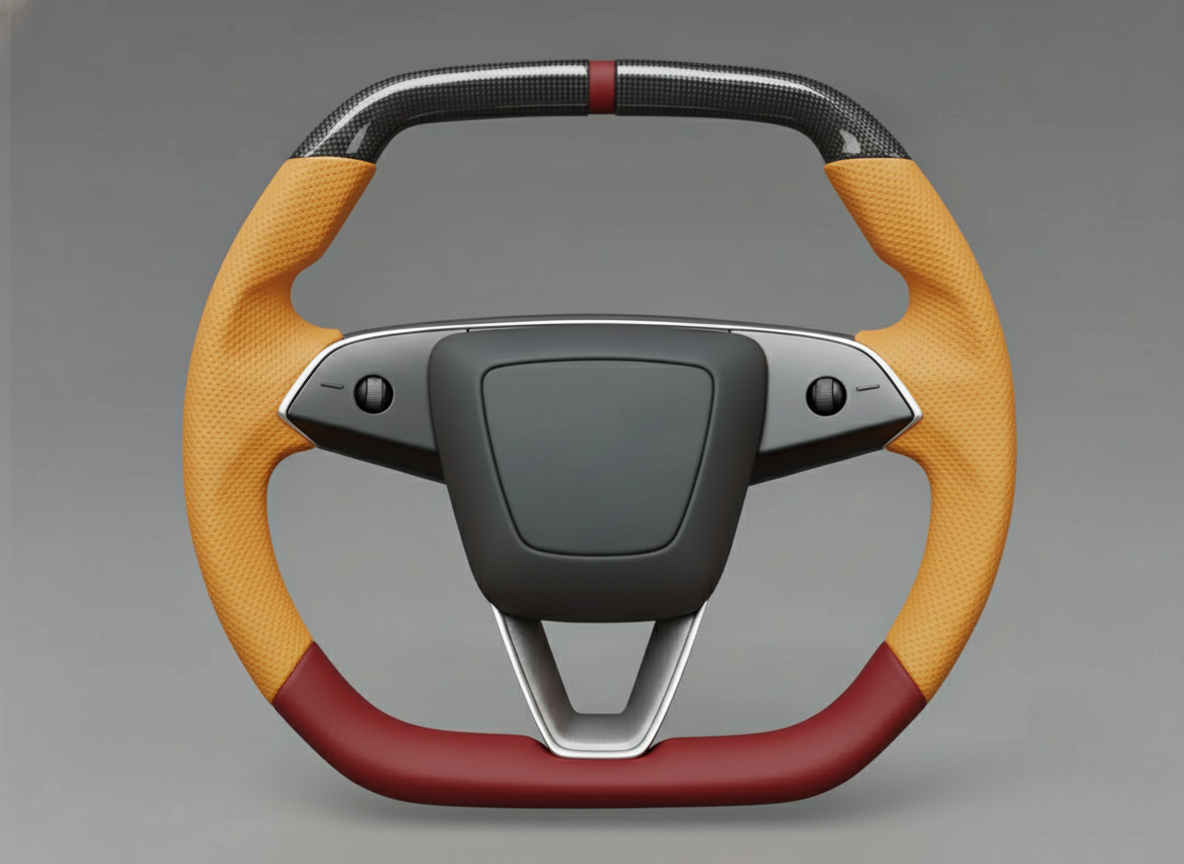
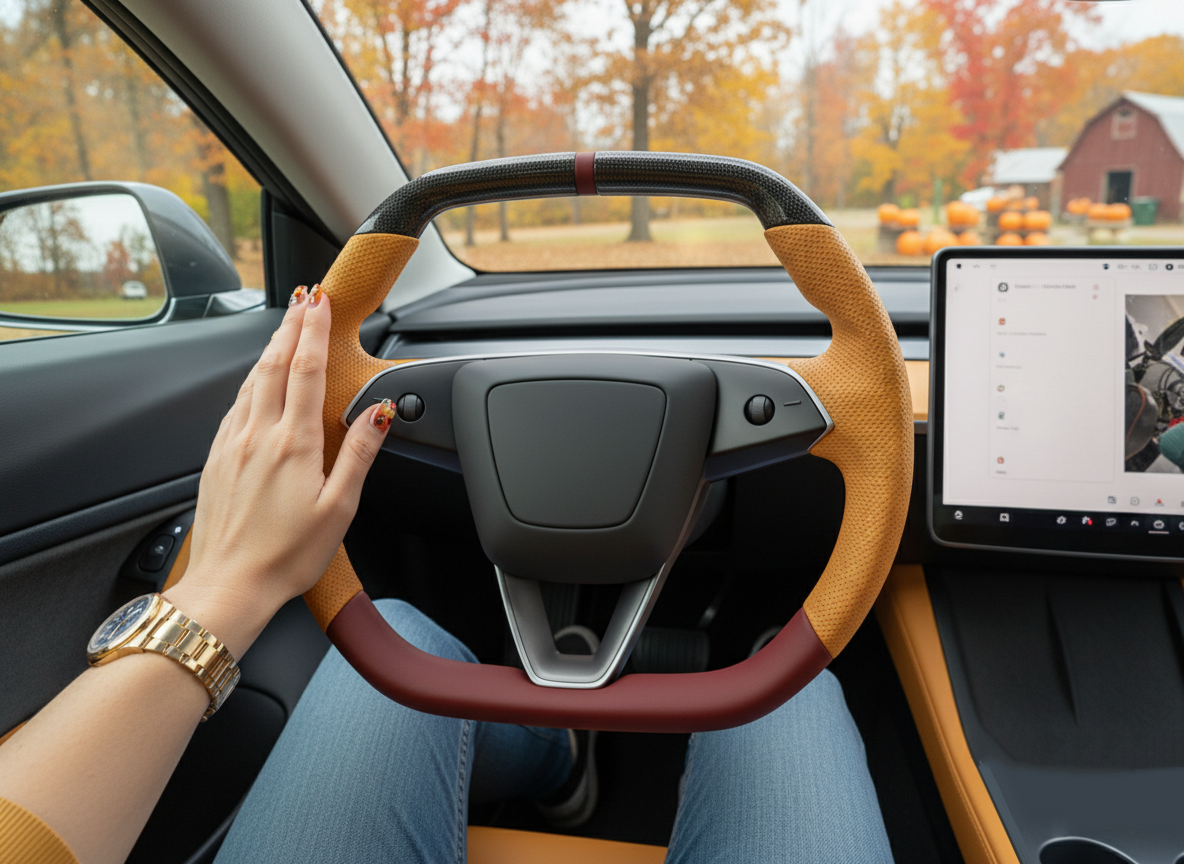
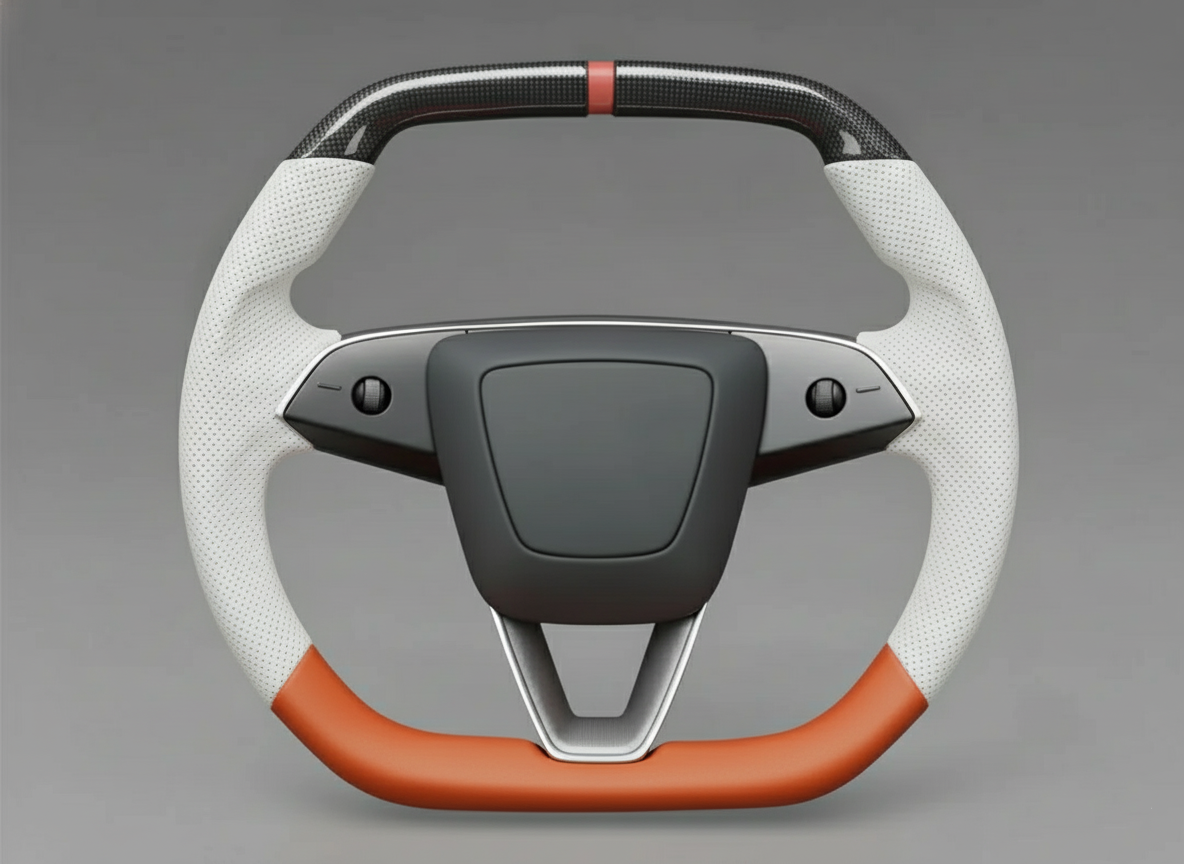
To balance visual impact and practicality, a compromise "Trapezoid" design has appeared on the market, which retains the complete rim but straightens both the top and bottom ends.
This polygonal contour can be gripped 360 degrees like a circle, while adding a tough feel through sharp corner lines, looking cooler than a circle with a low learning cost.
Besides shape, grip thickness is also key to changing the visual sense of weight. The thin original ring has been complained about by many as being too flimsy.
The cross-section of the original rim is usually an oval of 32mm x 28mm, feeling like grabbing a thin tube in hand, completely lacking the substantial feel of a high-performance car.
Modified carbon fiber steering wheels usually thicken the grips at the 3 o'clock and 9 o'clock positions to 38mm or even 42mm, and specifically design grooves that fit the shape of the thumb.
This thickened design visually makes the steering wheel look more robust and powerful, as if implying that this car has strong power and requires a pair of powerful hands to control it.
Even more interestingly, this shape change is not just for show; the deepened thumb rests can guide your hands to naturally snap into the correct position.
Data shows that when the grip shape fits the palm's web, hand fatigue during long-distance highway cruising can be reduced by about 20% because the force-bearing area becomes larger.
To intuitively compare the visual and functional differences brought by different shapes, we can refer to the following mainstream modification solution parameters for Model 3:
| Shape Type | Visual Style | Legroom Gain | Field of View Openness | Learning Cost |
|---|---|---|---|---|
| Original Round | Traditional, conservative, non-aggressive | 0 (Baseline) | 0% (Baseline) | No adaptation needed |
| Flat-Bottom (D-Shape) | Sporty, similar to GT racing | +40mm | +5% | Extremely low (1 day) |
| Yoke (Half-Width) | Ultimate future, cyberpunk | +45mm | +45% | High (1-2 weeks) |
| Trapezoid (Flat Top & Bottom) | Tech feel, geometric hardness | +40mm | +15% | Low (2-3 days) |
When choosing these shapes, you also have to consider that the interior lines of the Model 3 are mainly composed of straight lines and tiny rounded corners, so don't choose strange irregular shapes.
An overly complex steering wheel, if designed with too many edges and corners or too exaggeratedly, may destroy the original quiet and smooth line sense inside the car, appearing nondescript.
Therefore, the Flat-Bottom style occupies 65% of the market share precisely because it finds a perfect balance between breaking dullness and maintaining coordination.
It is neither as boring as the original factory nor as radical as the Yoke requiring relearning how to drive; it is the safest "safe card" for most people to improve interior style.
As for the 15% of geek players who chose the Yoke, they sacrificed some convenience in exchange for the ritual sense of piloting a starship every time they get in the car.