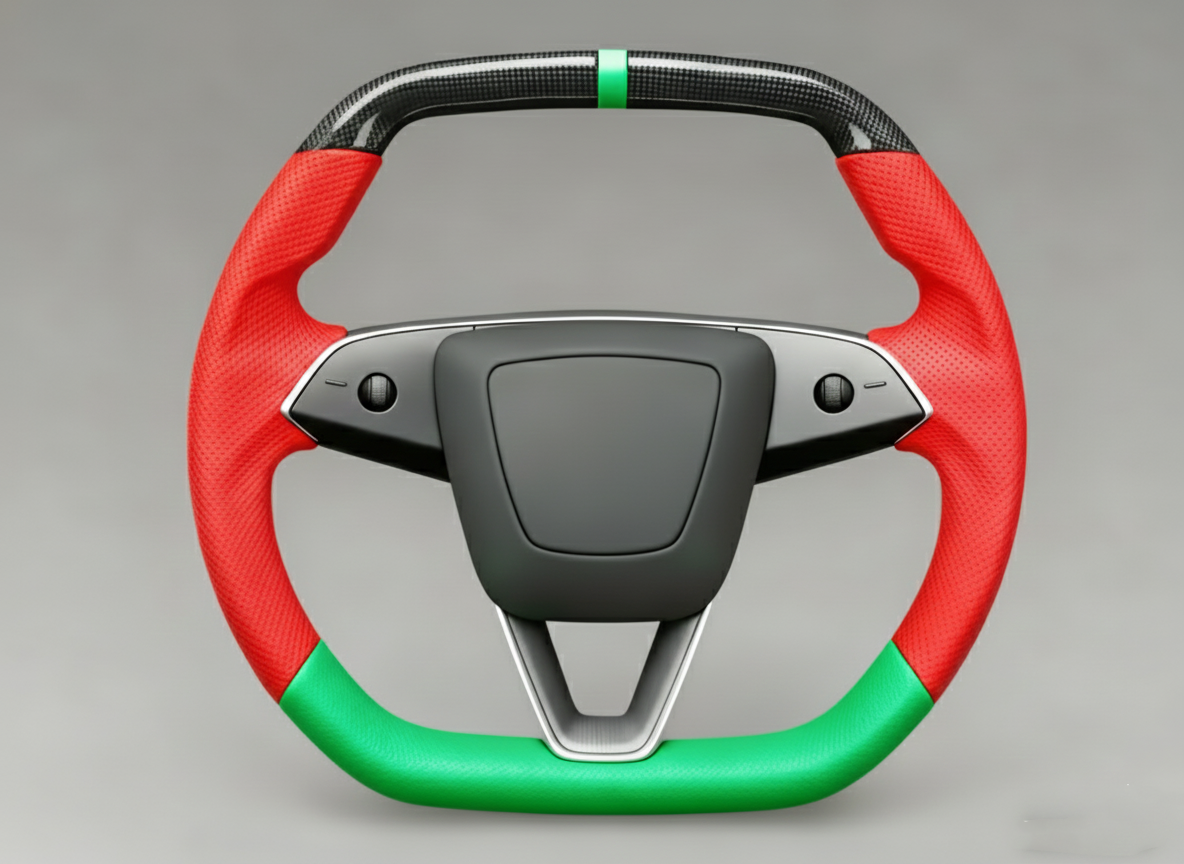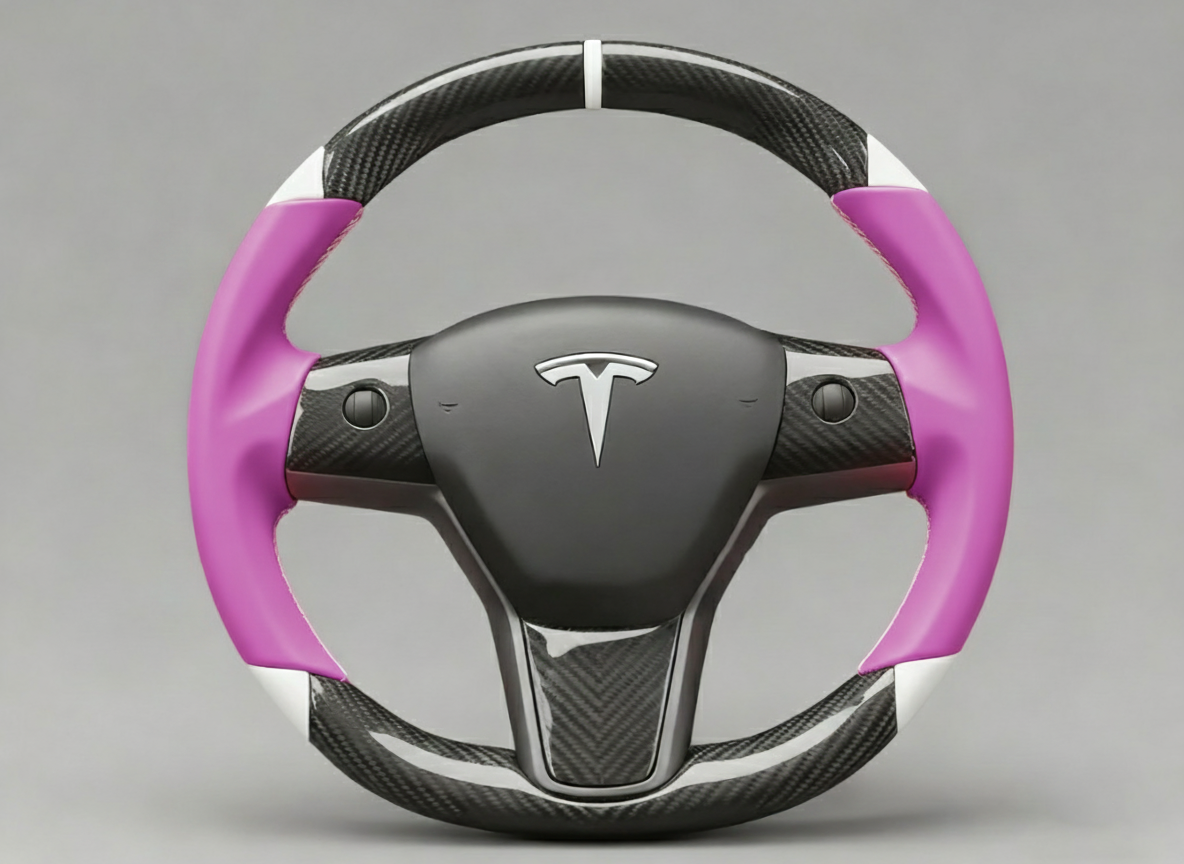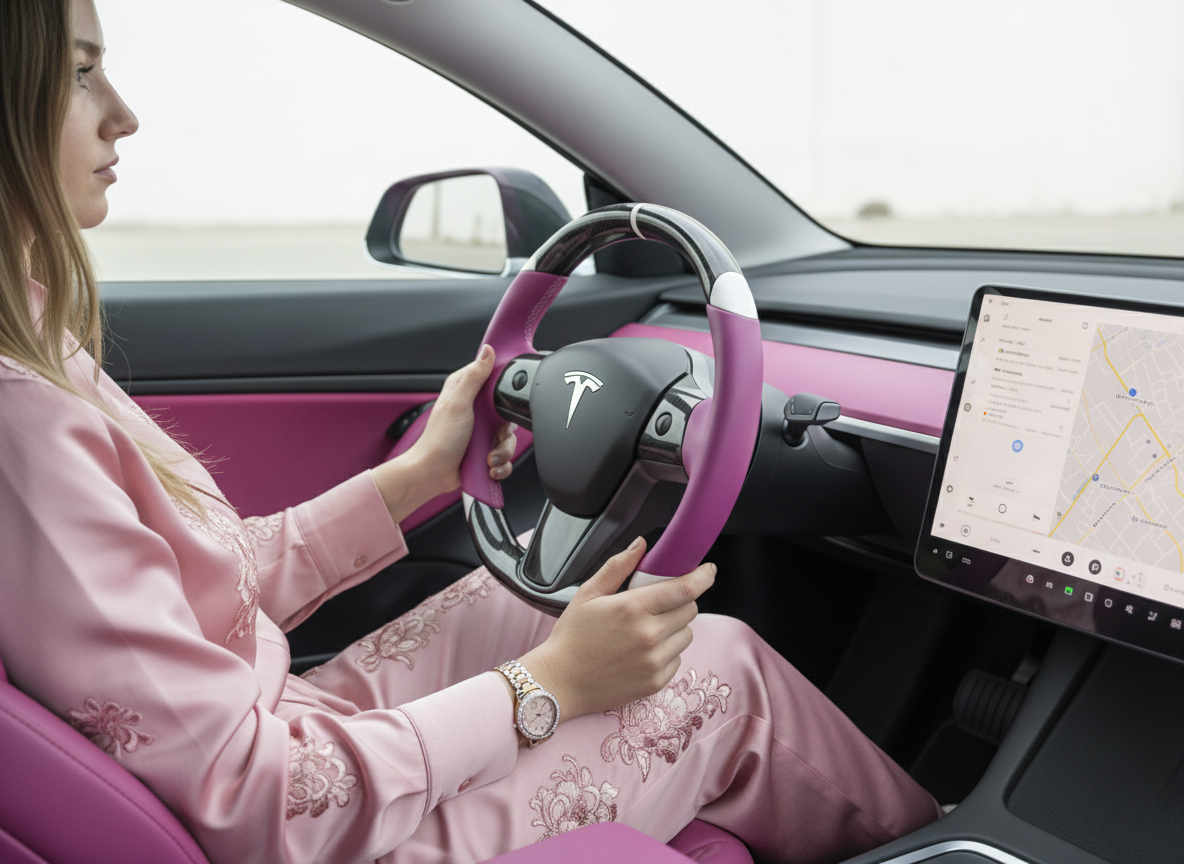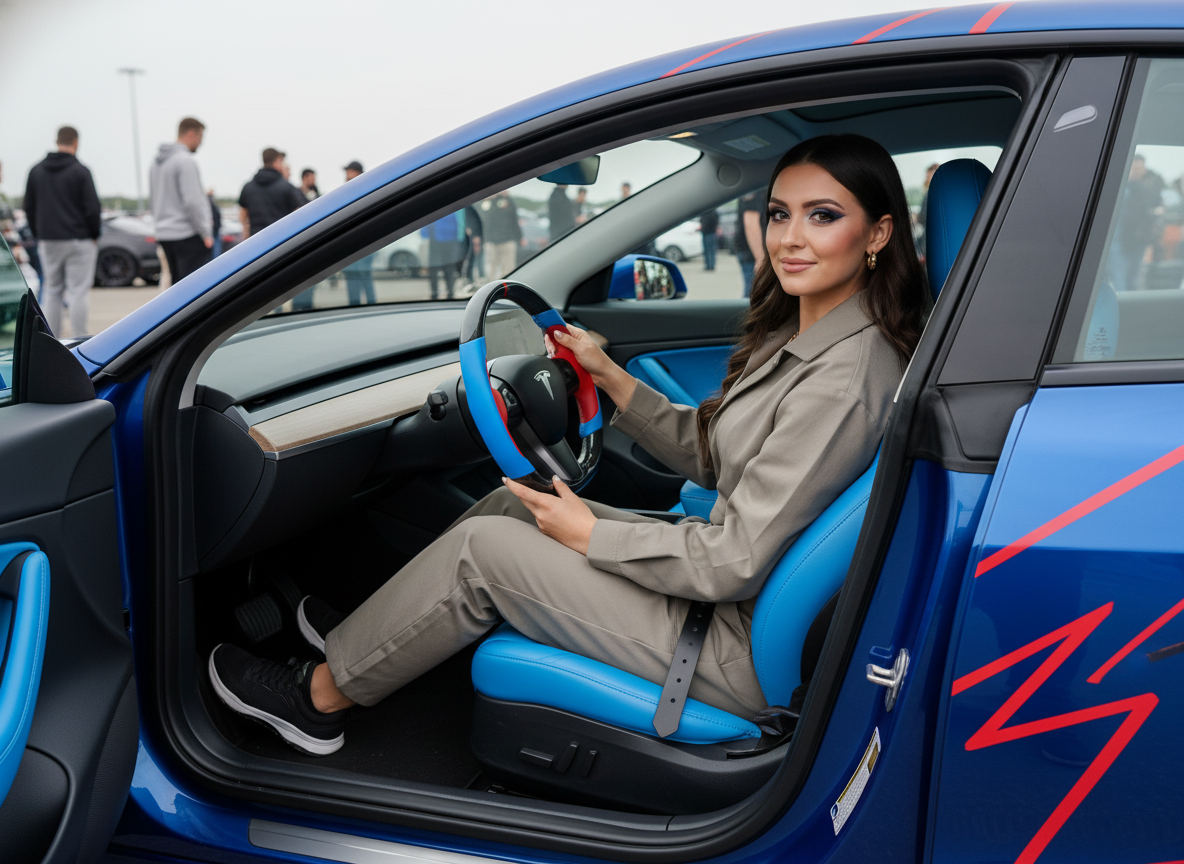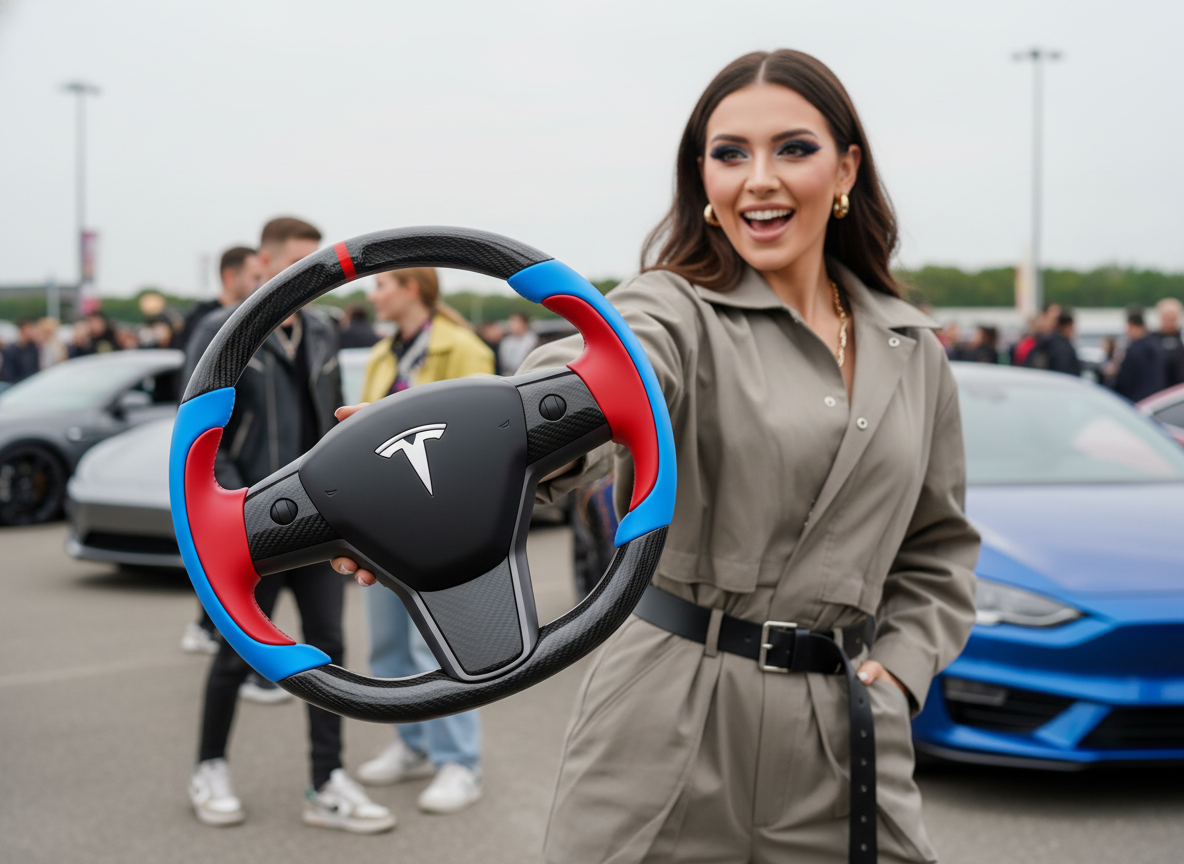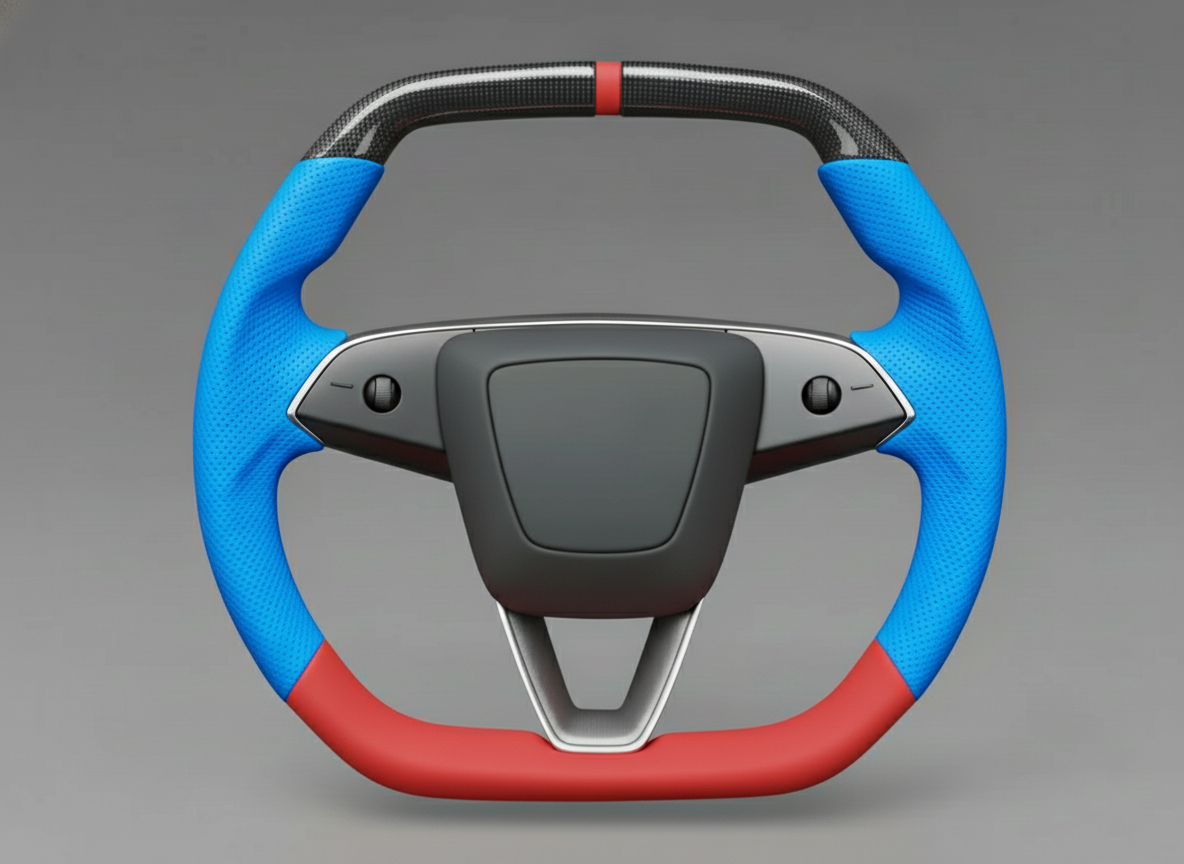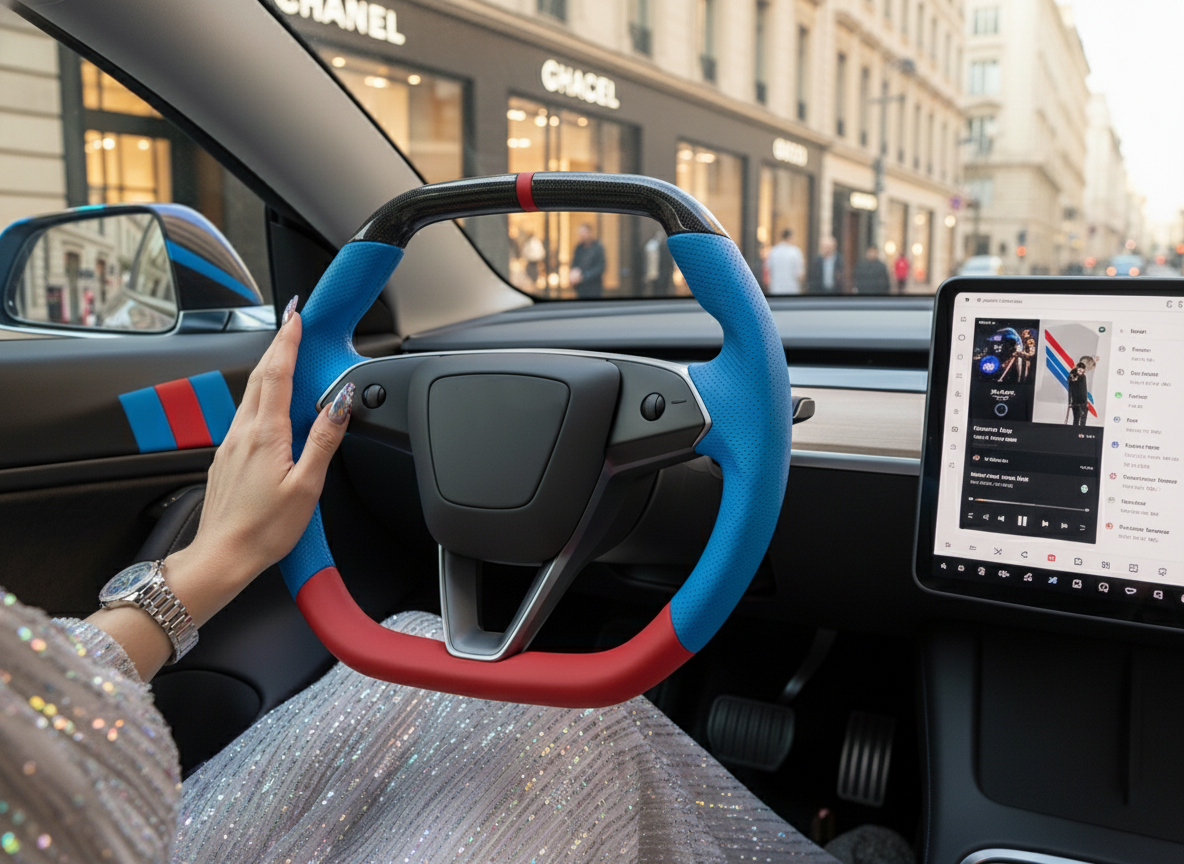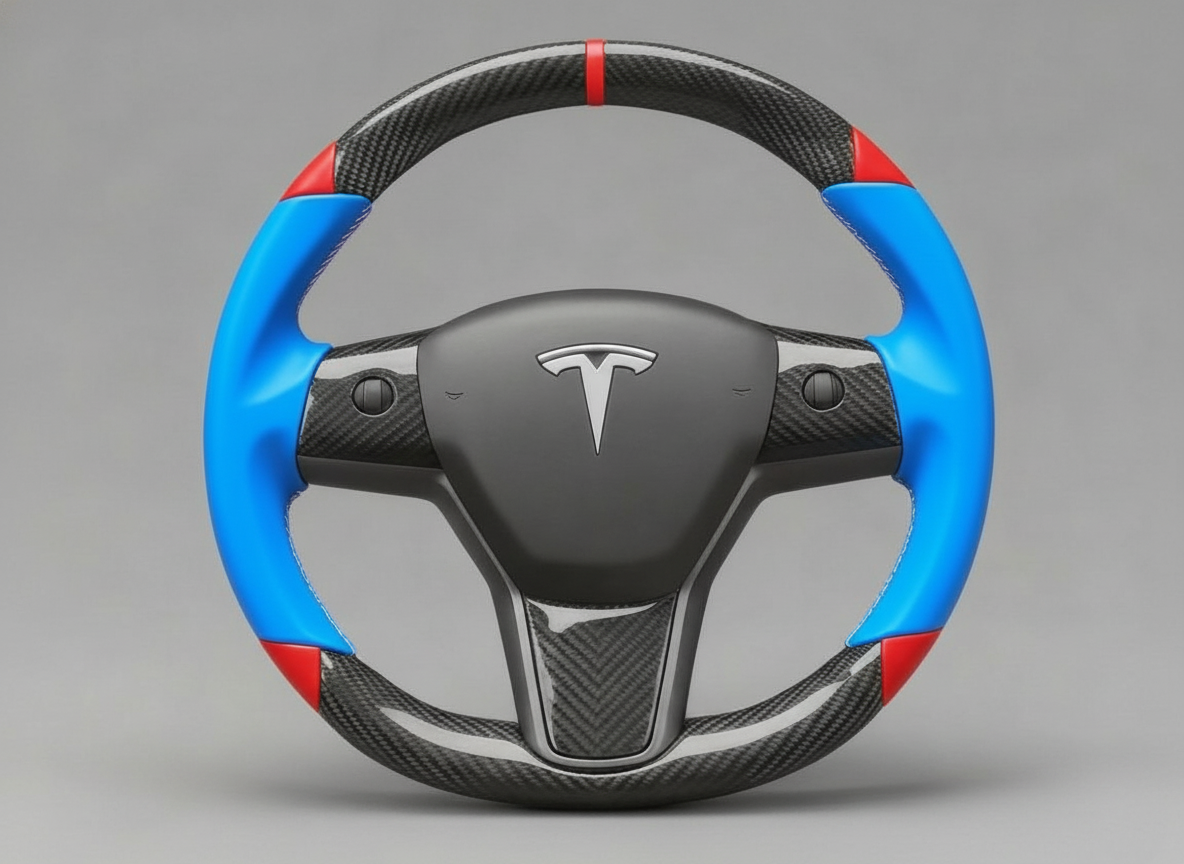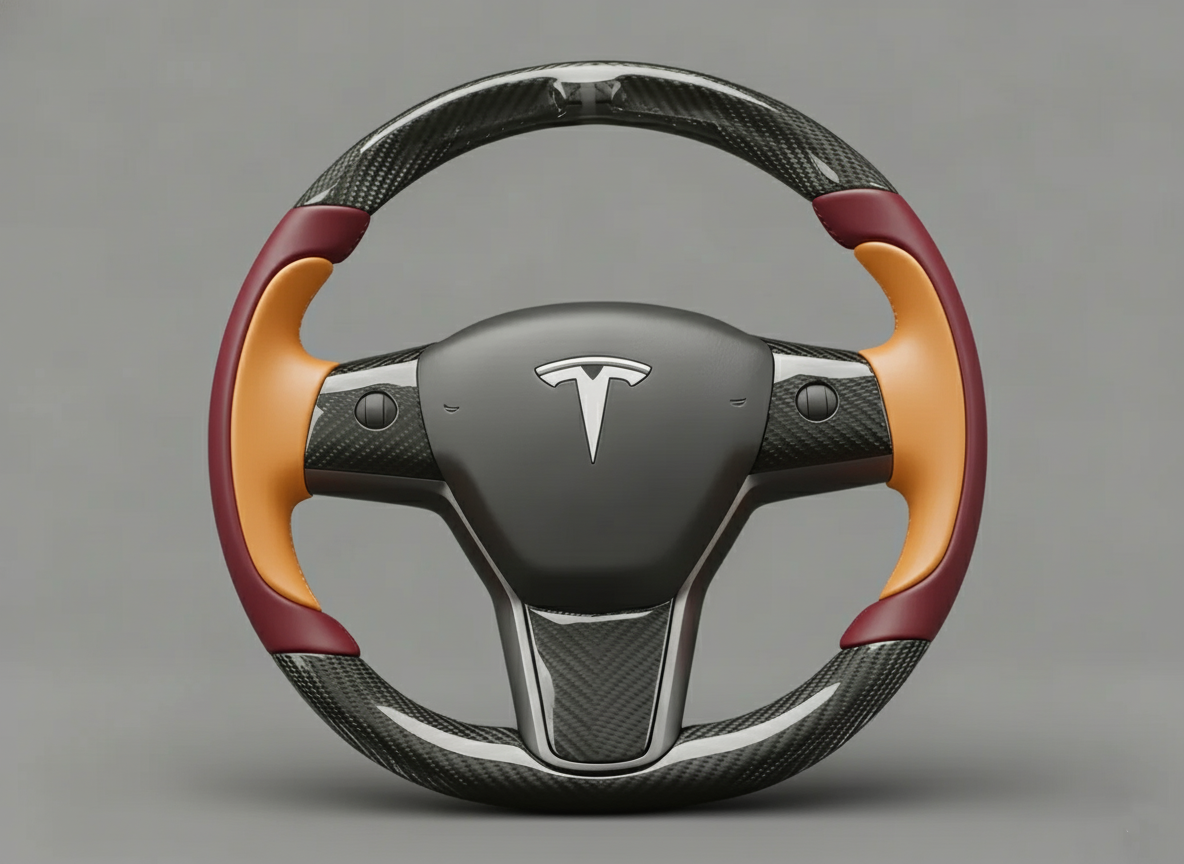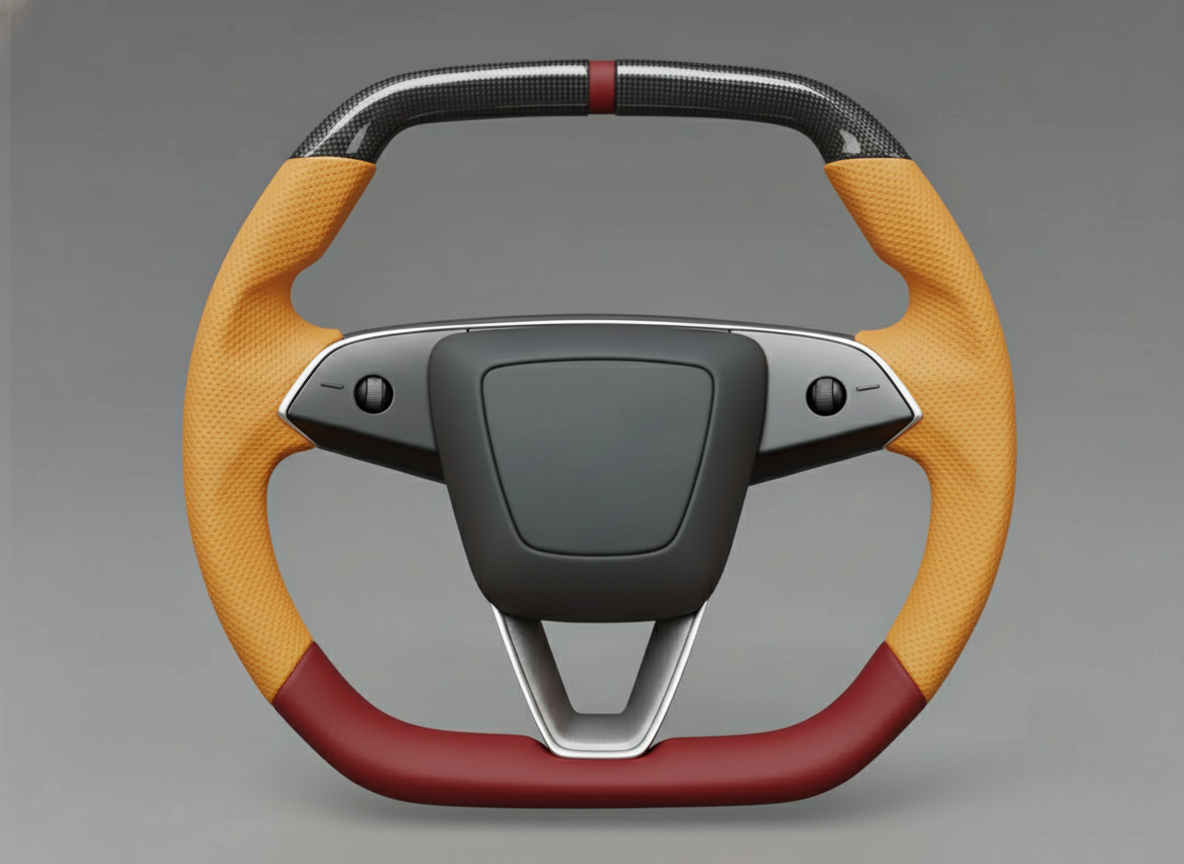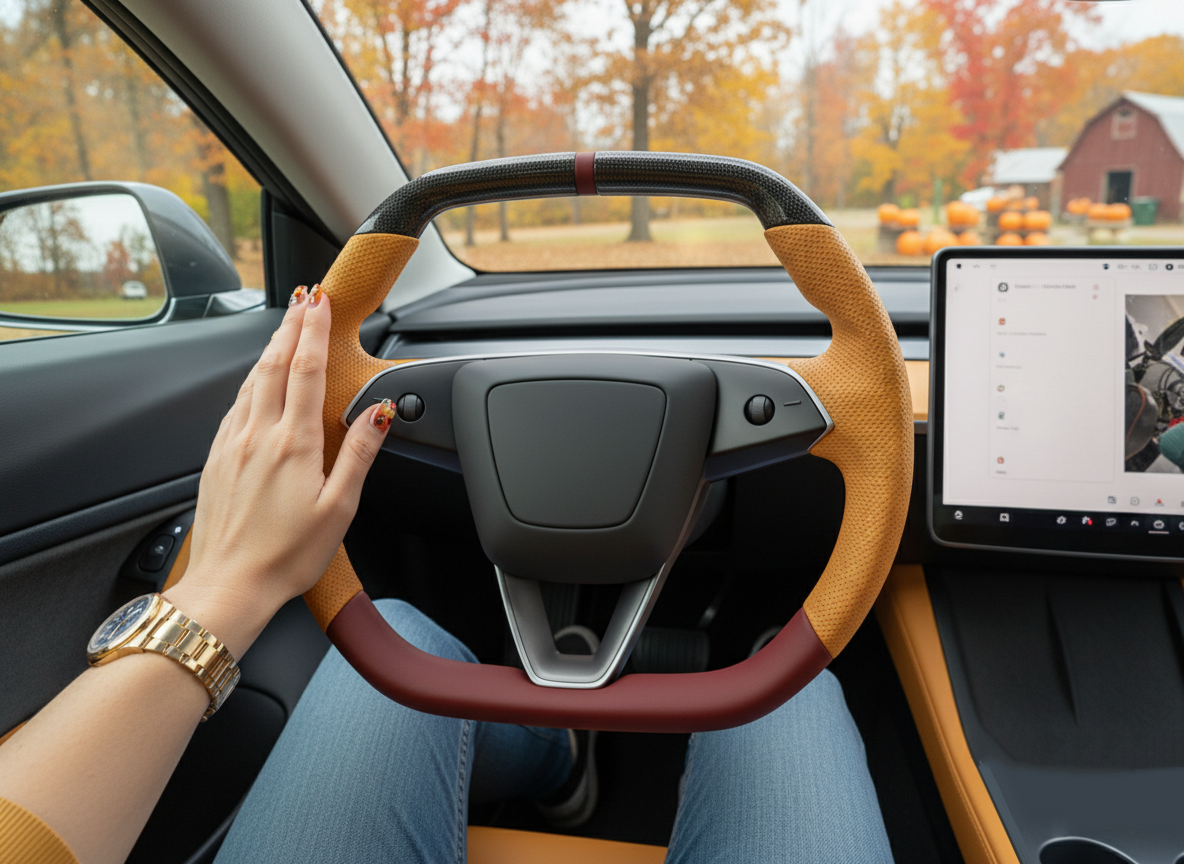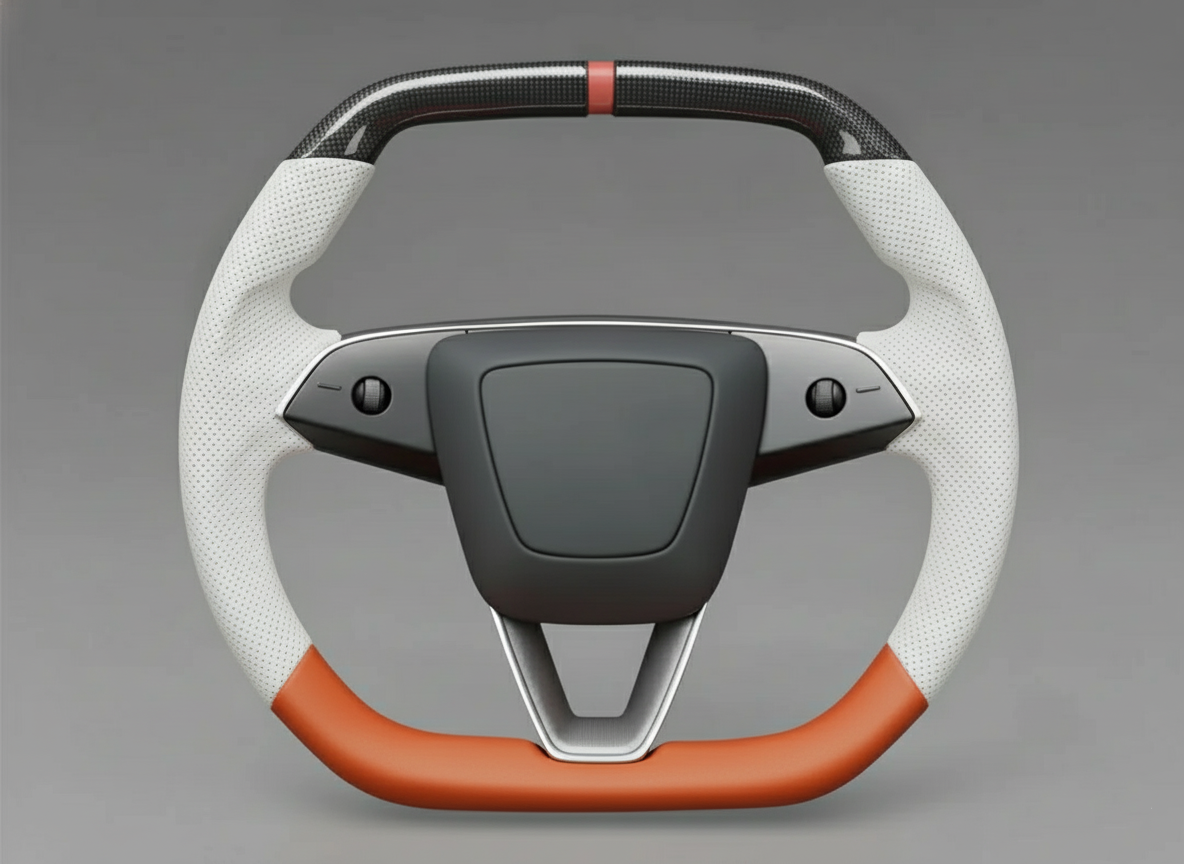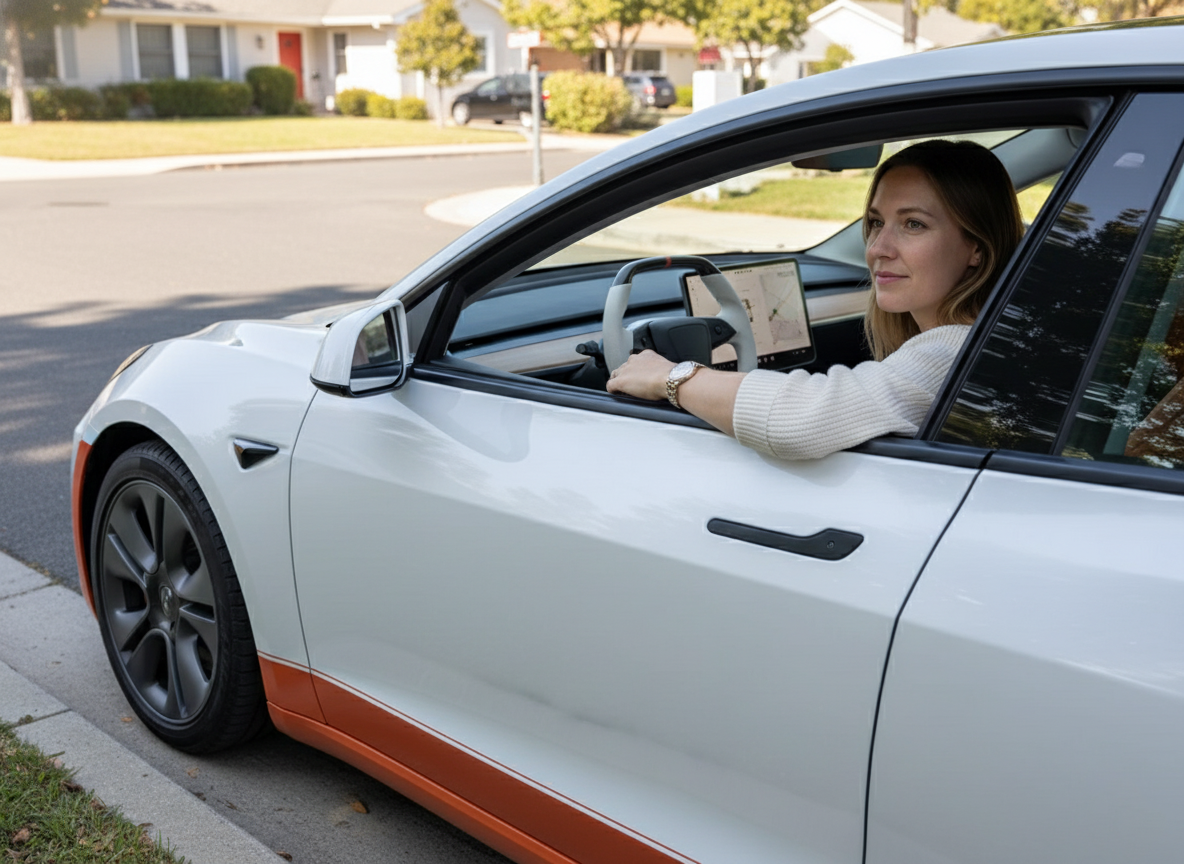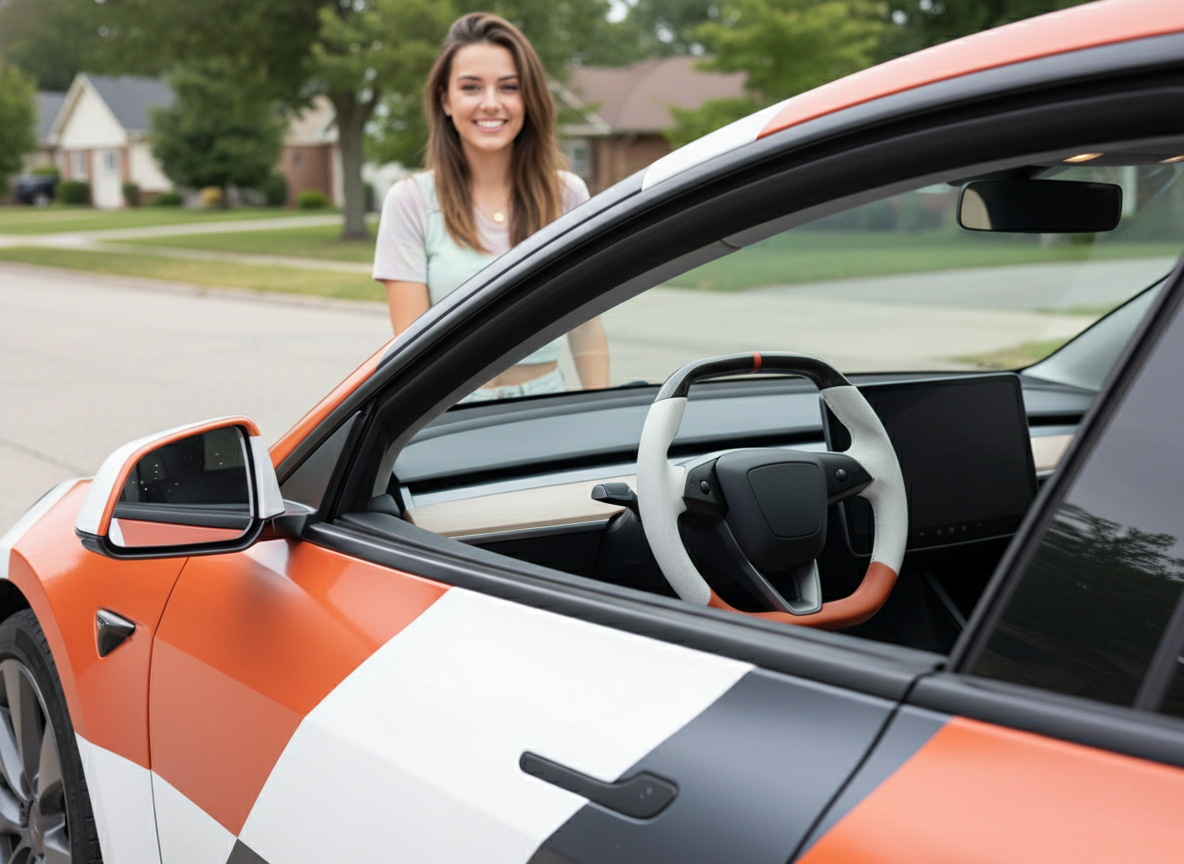
Select T300 Dry Carbon Fiber, which offers a 40% weight reduction and heat resistance up to 120°C. Pair this with perforated Nappa leather in the grip areas to enhance breathability.
Opt for a Matte coating process. This effectively eliminates glare caused by sunlight refraction while balancing extreme lightweight performance with a secure grip.
Carbon Fiber
Selecting Japanese Toray T300 or T700 grade precursor filaments to manufacture Dry Carbon is the mainstream standard for modifications. This typically utilizes a 3K Twill Weave (2x2) structure.
Compared to the original factory plastic skeleton, its tensile modulus is as high as 230GPa or more, yet the weight is reduced by approximately 40%.
High-quality carbon fiber Yoke steering wheel components must undergo Autoclave curing and be covered with 3 or more layers of UV-resistant Clear Coat.
The paint thickness is controlled at around 0.5mm to prevent the epoxy resin from Yellowing under long-term ultraviolet irradiation, while providing a Mohs hardness of level 3-4 for surface scratch resistance.
Weave Patterns
Industry Standard:
This is the specification used by over 90% of the carbon fiber steering wheels on the current Tesla modification market.
If you want the steering wheel to perfectly match the original carbon fiber trim option of the Model S/X Plaid, this is the only choice.
- Technical Definition: "3K" represents that each bundle of carbon fiber contains 3,000 filaments. "2x2" refers to the weaving logic: one weft yarn crosses over two warp yarns, then passes under two warp yarns.
- Visual Characteristics: This weave produces a distinct diagonal texture (usually at a 45-degree angle). Because light refracts on the curved fiber bundles, it possesses a strong holographic 3D Depth.
- Process Advantage: Compared to plain weave, the structure of twill fabric is looser and has better Drapability. The Tesla Yoke handle connection has complex curved geometries; 3K twill can fit these sharp bends more smoothly without obvious fiber breakage or texture distortion at the edges.
Retro Racing Style:
This texture is less common in modern Tesla modifications but is often seen in early Ferrari (such as F40) or certain Porsche GT series interiors.
- Technical Definition: Uses finer bundles of 1,000 filaments, with a weaving logic of a "one over, one under" Checkerboard pattern.
- Visual Characteristics: The texture is very tight and small, presenting a flat effect similar to a grid. Because there are many weaving points and the fibers are highly curved, the gloss is usually not as high as 3K twill, looking more like a dark gray matte fabric.
- Adaptability Warning: Plain weave fabric is very tight and lacks extensibility. When wrapping the thumb operation area (around the scroll wheels) of the Yoke steering wheel, it is difficult to handle curved surfaces without cutting the fibers.
Lamborghini Style:
Since Lamborghini applied this on a large scale on the Huracán Performante, this texture has quickly become the first choice for Tesla owners seeking differentiation.
- Technical Definition: It does not use continuous long fibers but chops carbon fiber filaments into short segments ranging from 6mm to 12mm, mixes them with resin, and molds them under high pressure.
- Visual Characteristics: The surface presents a random chaotic pattern similar to marble, camouflage, or granite. Since the fibers are also arranged randomly, there are reflection points at different angles when light hits it, sparkling like crushed diamonds.
- Daily Use Consideration: Since Forged Carbon lacks a woven structure, its surface resin layer (Gel Coat) is usually slightly thicker than woven carbon fiber to cover irregular fiber faults.
Large Checkerboard Texture:
If you feel the standard 3K texture is too ordinary but dislike the chaotic feel of forged carbon, Spread Tow is a very modern choice, common in Hypercars like Pagani or Koenigsegg.
- Technical Definition: Manufacturers physically "flatten" and widen standard carbon fiber bundles, making the woven squares very large. Common widths can reach 8mm to 20mm.
- Visual Characteristics: This texture presents a huge checkerboard effect. Because the fiber bundles are laid flat, the curvature of the fibers themselves is extremely low (Low Crimp), making light reflection straighter and sharper, looking more industrially precise.
- Weight Advantage: Although the weight difference (a few grams) on a steering wheel cover is negligible, from a physics perspective, the straighter fiber arrangement of Spread Tow offers a higher stiffness-to-weight ratio than standard 3K.
Texture Direction and Alignment Process
Besides selecting the texture type, the "direction" of the texture is the most intuitive standard for judging a processing factory's craftsmanship.
- Standard Layup: All textures slant in one direction. Visually, this may make the steering wheel look somewhat "crooked" because the left side texture goes up and the right side texture also goes up, lacking symmetry.
-
V-Weave (Symmetrical): This is the standard for high-end customization. Craftsmen will splice two pieces of carbon cloth at the exact center of the Yoke (12 o'clock and 6 o'clock positions), making the texture spread out to both sides in a V-shape or Inverted V-shape, forming a perfect mirror symmetry.
- Inspection Point: Observe the center seam. A perfect V-Weave requires the two textures to align precisely like a fishbone at the seam. If the misalignment exceeds 1mm, the asymmetry is visible to the naked eye, which classifies it as a defective product.
Surface Craftsmanship
Gloss Finish
This is the most traditional carbon fiber treatment and the default option for 70% of the aftermarket. Gloss process attempts to create a "lens effect" through multi-layer spraying and polishing.
-
Optical Principle and Visual Depth: The refractive index of the gloss coating is usually around 1.50. When light passes through the transparent layer and hits the black carbon fiber bundles, the thick clear coat magnifies the woven texture, creating a strong Depth of Image (DOI).
- In sunlight, gloss carbon fiber looks "wet," as if the carbon cloth is soaked in water.
- This process reflects light to the maximum extent; Gloss Units (GU) usually exceed 90 GU (measured at a 60° angle).
- Fingerprint Magnet Effect: Natural oils from palms and hand cream residues will quickly form clear fingerprints on the surface.
- Glare Risk: The windshield angle of the Tesla Model S/X is large. Under direct noon sunlight, the top frame of a Gloss Yoke may form a reflective reflection on the inside of the windshield, interfering with the line of sight.
Matte Finish
Matte surfaces are achieved by adding Flattening Agents—usually micron-sized silica particles—to the clear coat formula.

These tiny particles make the coating surface rough at a microscopic level, thereby diffusing incident light in all directions rather than reflecting it specularly.
-
Gloss Grading:
- Dead Matte: Gloss below 10 GU. This treatment makes the carbon fiber look close to its original dry carbon state, with almost no reflection and a grayish color.
- Satin: Gloss between 15-25 GU. This is currently the more popular "OEM style" choice. It retains a slight silky luster, being neither dull nor glare-producing.
- Tactile Difference: The surface friction coefficient of a matte coating is usually lower than that of a gloss one. When holding it, you will feel it is drier and smoother.
- Stain Resistance: Due to the diffuse reflection principle, fingerprints and slight oil stains are almost invisible on matte surfaces.
Coating Hardness and Scratch Resistance
Whether choosing gloss or matte, the outermost layer is essentially plastic (resin or polyurethane). Its physical hardness is usually between Mohs Hardness 2-3, similar to the hardness of a fingernail.
-
Swirl Marks: Gloss steering wheels are the hardest hit area for swirl marks. Long-term wiping with rough paper towels or scratching by metal rings worn on hands will leave tiny circular scratches on the surface. Under strong flashlight illumination, these scratches form spiderweb-like patterns, causing the black carbon fiber to look gray and foggy.
- Repair Solution: The advantage of gloss coating lies in its repairability. Using automotive paint polishing compound and a polisher to cut off a few microns of the surface layer can restore the mirror luster.
-
Irreversible Damage to Matte: Once a matte coating is scratched, it is usually permanent.
- Taboo: Absolutely do not polish matte surfaces. Polishing will smooth out the microscopic particles on the surface, causing the area to become shiny (Shiny Spot) and making the steering wheel look mottled and uneven.
- Wear Characteristics: In areas where the Yoke is frequently grabbed (such as the back of the 3 and 9 o'clock positions), long-term hand friction may gradually wear the matte layer into a semi-gloss layer.
UV Resistance and Yellowing Metrics
All epoxy resins will undergo photodegradation reactions when exposed to UV-A (315-400nm) ultraviolet light for a long time, causing polymer chain scission, macroscopically manifesting as resin yellowing.
- Technical Specification Requirements: Qualified Tesla Yoke modifications must use Automotive Grade UV-Resistant Clear Coat.
- Identifying Inferior Craftsmanship: Cheap carbon fiber steering wheels (usually priced under $400) often omit the independent anti-UV spray layer and use mold resin directly as the final surface. Such products usually begin to yellow after 6-12 months in sunny regions like California or Florida, and this chemical change is an irreversible internal deterioration.
Environmental Adaptability
Thermal Conductivity and "Heat Absorption" Effect
The reason carbon fiber looks cool is that it physically transfers heat more easily.
To understand why carbon fiber steering wheels (like Tesla's Yoke) are hotter to the touch in summer, the core lies in Thermal Conductivity.
Intuitive Comparison of Thermal Performance:
We can look at the speed of heat transfer of different materials through the following numbers (the higher the value, the faster it heats up):
-
Leather / Polyurethane (Standard Steering Wheel): Approx. 0.03 - 0.15 W/(m·K)
- Conclusion: It is a good insulator and feels mild to the touch.
-
Carbon Fiber Composite: Approx. 5 - 7 W/(m·K)
- Conclusion: Thermal conductivity is dozens of times faster than leather.
-
Aluminum Alloy (Steering Wheel Skeleton): Approx. 200 W/(m·K)
- Conclusion: Conducts heat extremely fast, which is one of the root causes of burning hands.
What actually happens in summer?
- Absorbs Heat Quickly: When parked outdoors in summer, the temperature inside the car can easily reach over 60°C.
- "Instant" Burn: When you touch leather, because leather conducts heat slowly, the heat transferred to the skin is slow; but when you touch carbon fiber, heat rushes to your palm at a speed 50 times faster than leather.
- Cools Down Slowly: Even if you turn on the air conditioner, the cold wind usually blows towards the body and is difficult to blow directly to the back of the steering wheel.
Winter Driving and Lack of Heating Function
For owners in cold regions, this is the biggest functional compromise of modifying a carbon fiber Yoke: The vast majority of carbon fiber areas do not have heating functions.
-
Engineering Limitations: The factory Tesla steering wheel heating element is an extremely thin resistance wire mesh laid directly on top of the foam layer and under the leather layer. In the modification process, carbon fiber is a hard solid shell that must be bonded to the skeleton with epoxy resin.
- Conduction Barrier: If covered with 2mm thick carbon fiber and resin over the heating wire, it is difficult for heat to penetrate this hard shell to the surface.
- Structural Risk: The thermal expansion and contraction cycles generated by the heating wire will cause the adhesive between the carbon fiber and the underlying skeleton to fail, easily leading to Delamination or bubbles over time.
- Actual Experience: If you buy a modified Yoke with heating functionality, the heat is usually limited to the leather/Alcantara grip areas at 3 and 9 o'clock. The top and bottom carbon fiber frames will feel like holding a cold steel pipe in freezing temperatures. It is recommended that owners living in the north keep a pair of driving gloves or develop the habit of turning on the preheating function via the App 15 minutes before departure.
UV Aging and Resin Yellowing
Although carbon fiber itself is chemically inert, the Epoxy Resin wrapping it is not. Environmental Ultraviolet (UV) light is the resin's biggest enemy.
- Chemical Reaction: UV-A (320-400nm) in sunlight destroys the polymer chains in the cured resin. The by-product of this photodegradation reaction not only reduces the mechanical strength of the structure, but the most intuitive manifestation is Yellowing.
- Glass Protection Limits: Although Tesla's panoramic roof and windshield usually have good Infrared (IR) and Ultraviolet (UV) blocking rates, side window glass (especially if the owner has not applied high-quality ceramic film) may have lower UV blocking rates.
- Protection Advice: If your parking environment is mainly outdoors, be sure to confirm that the Yoke you purchased uses a clear coat containing HALS (Hindered Amine Light Stabilizers).
Humidity and Hand Sweat Friction Changes
Environmental humidity and palm sweating significantly alter the Coefficient of Friction on the carbon fiber surface, which is directly related to handling safety.
| Surface State | Glossy Carbon Fiber | Matte Carbon Fiber |
|---|---|---|
| Dry Hands | Extremely high friction, tacky feel, solid grip. | Medium friction, dry and silky feel. |
| Slight Sweat/Damp | Friction drops sharply. Surface becomes very slippery, like wet glass. | Friction remains relatively stable; microscopic roughness provides some grip. |
Safety Alert:
In high humidity regions like Florida or Southeast Asia, or if you tend to have sweaty palms while driving, a Full Carbon Yoke may pose a slipping risk.
In such climates, it is strongly recommended to choose a Spliced Style, using carbon fiber only on the top/bottom, while retaining perforated leather or Alcantara in the main stress zones at 3/9 o'clock to ensure hands do not slip during emergency lane changes.
Genuine Leather
Unlike the polyurethane (PU) synthetic material used by the Tesla factory, high-end Yoke steering wheel modifications typically select Austrian or German Nappa Top Grain Leather, with a standard thickness controlled at 1.2mm ± 0.1mm to ensure the grip does not feel bloated.
The natural collagen fiber network structure of genuine leather gives it a breathability rate 30% to 40% higher than synthetic materials, effectively reducing sweat accumulation on palms during long-distance driving of over 2 hours.
This is a deep consumer decision guide regarding "Nappa Craftsmanship," approximately 900 words. Content focuses on leather grades, physical processing, coating parameters, and specific technical details adapted for Yoke steering wheels.
Nappa Craftsmanship
Where is this leather actually cut from?
True automotive-grade Nappa must use Top Grain leather, typically sourced from bull hides in Southern Germany or Austrian ranches.
- Scar-free Rate: The cattle in these regions are raised in environments without barbed wire and with few insects, so the skin itself has very few scars. Of a standard 45 square foot raw hide, only 10% to 15% of the area can be selected as top-tier Nappa raw material.
- Full Grain Retention: Factories only dare to retain the natural pores and grain (Full Grain) on hides with very few surface defects. If the merchant uses leather covered with thick embossed patterns (to cover scars), it is usually Corrected Grain; the feel will be harder than full grain, and breathability drops by 40%.
Why does it feel softer than ordinary leather?
Nappa's softness comes from special Retanning and Fatliquoring stages.
- Drumming Time: Ordinary automotive leather may only be tumbled in a Milling Drum for 12 hours, whereas Nappa usually requires 24 to 48 hours.
- Softness Data: In the leather industry's BLC softness test, the reading for ordinary steering wheel leather is usually 3.0 - 3.5 mm, while qualified Nappa leather readings should be controlled at 4.0 - 4.5 mm.
How is leather thickness controlled to avoid bloating?
The Tesla Yoke handle itself is thick. If the leather is too thick, the grip will feel swollen at the thumb web; if too thin, it loses the fullness of genuine leather.
- Standard Skiving: Raw cowhide thickness usually exceeds 4mm. The standard finished thickness for automotive Nappa must be precisely controlled at 1.1mm - 1.2mm.
- Edge Treatment: At the splicing seams, precise skiving machines must be used to thin the edges to 0.5mm - 0.6mm.
- Checkpoint: When you receive the custom steering wheel, press the seam lightly with your fingernail. If you can feel a distinct step or protrusion, the edge skiving process is substandard. A good Nappa wrap should have smooth transitions at the seams.
How thick is the protective layer?
The automotive environment has extreme temperature differences (-30°C to 80°C) and strong ultraviolet rays.
- Coating Microns: High-quality Nappa uses water-based polyurethane coatings, strictly controlled at 30 to 50 microns thick. This thickness passes the Taber Abrasion Test (CS-10 wheel, 1000g load, 500 cycles without breakage) without blocking the leather pores, retaining breathability.
- Matte Degree: To match the minimalist style of Tesla interiors, the coating gloss (Gloss Unit) is usually set at 1.5 - 2.5 GU (Matte).
Stitching and Stretching Details
The rectangular design of the Yoke makes wrapping much more difficult than circular steering wheels, especially at the indentations at 3 and 9 o'clock.
- Pre-stretching: Nappa leather needs to be pre-stretched and shaped on a mold before wrapping. Leather without pre-stretching is prone to loose bulges on the inside of the handle within 3 months of installation.
- Thread Specifications: It is recommended to use Bonded Nylon 6.6 thread, usually specification Tex 70 or Tex 90. This thread is resin-bonded, won't unravel, and has extremely high abrasion resistance. You can observe the stitch length; high-standard Nappa stitching pitch should be stable between 3.5mm - 4.0mm.
Thermal Management
Why does factory leather feel like plastic wrap, while genuine leather feels like skin?
Tesla's factory vegan leather is essentially a polyurethane (PU) plastic layer coated on a fabric base. Plastic is a completely closed structure; its water vapor transmission rate is almost zero.
- Greenhouse Effect: When your palm grips the factory Yoke tightly, a closed micro-environment forms between the palm and the contact surface. Heat and trace moisture from the skin cannot penetrate the plastic coating and are "stifled" back onto the skin surface. This is why driving in a 25°C air-conditioned room for a long time still makes hands feel damp and sticky on the factory steering wheel.
- Real Leather Data: High-quality Nappa leather retains the collagen fiber network structure. According to ASTM E96 standard testing, the breathability of quality uncoated or lightly coated automotive leather is usually between 400 to 600 g/m²/24h.
Who cools down faster after summer sun exposure?
If you live in areas with strong sunshine like Arizona or California, the Specific Heat Capacity and Thermal Conductivity of the steering wheel determine whether you get "burned" when getting in the car.
- Surface Temperature Measurement: Parked for 2 hours under 35°C direct sunlight, the surface temperature of black interiors can easily break 70°C (158°F). Although both leather and plastic eventually reach this temperature, the perceived feeling is completely different.
- Conductivity Difference: Plastic typically has a low thermal conductivity (about 0.15 W/m·K); it not only absorbs heat but is extremely good at "locking heat in." When you turn on the AC to cool down, the heat inside the plastic steering wheel releases very slowly.
- Advantage of Genuine Leather: The density and fiber structure of genuine leather make its heat dissipation efficiency about 20% higher than heavy injection-molded PU. Coupled with Tesla's Cabin Overheat Protection, once the AC kicks in, the speed at which genuine leather surface temperature returns to a "touchable range" (below approx. 45°C) is usually 3 to 5 minutes faster than synthetic leather.
Is so-called "Anti-Infrared" leather useful?
High-end customizers (usually using German Hans Reinke or Austrian Wollsdorf leather sources) offer options treated with Cool-Leather technology.
- Principle: This process adds special IR-Reflecting Pigments during tanning. Ordinary black objects absorb the full spectrum of sunlight, while these pigments reflect the infrared band like white objects.
- Data Comparison: Under the same black dye, the surface temperature of Cool-treated leather is 10°C to 15°C lower than ordinary leather.
Will genuine leather heat up slowly in winter?
Actually, this worry is redundant; the heating experience of genuine leather is even more premium.
- Heat Conduction: The Yoke steering wheel heating wire is attached to the skeleton surface. Factory PU leather, being usually over 1.5mm thick and containing a foam layer, has a lag in heat transfer. Custom Nappa leather is skived (thickness approx. 1.2mm), and since the leather's collagen structure is similar to human skin, heat transfer is more direct and gentle.
- Heat Uniformity: Synthetic materials soften unevenly when heated, while genuine leather becomes softer and more conformable after heating.
- Warm-up Test: Turning on heating in a -5°C environment, the time for the genuine leather surface to reach 30°C is usually only 15-20 seconds slower than the bare skeleton, but this trades for a more uniform heat distribution, avoiding the situation where "one spot is burning, another is freezing."
The Hard Impact of Color on Temperature
No matter how premium the material, dark colors always absorb more heat than light colors.
- White: If your Tesla interior is white, choosing white Nappa leather is the optimal solution for thermal management. White has the highest reflectivity for visible and infrared light; even under exposure, the surface temperature is over 20°C lower than black.
- Black: If you choose black Nappa, it is strongly recommended to pair it with Perforation Craftsmanship.
- Function of Perforation: Physically punching holes in the 3 and 9 o'clock grip areas is not just for visual decoration; it directly increases the leather surface area, improving air circulation efficiency by 30%.
Material Comparison
What is it actually made of? Differences at the chemical level
Through a microscope, the nature of these three materials determines their lifespan.
-
Tesla Factory Vegan Leather (OEM Vegan):
It consists of a multi-layer structure: the bottom is a woven or non-woven fabric base, the middle is a foam layer, and the top is a polyurethane (PU) coating.- Physical Weakness: The thing this laminated structure fears most is Hydrolysis. When oils and moisture from hand sweat penetrate tiny cracks, the PU coating chemically reacts with the underlying glue, causing the coating to separate from the base. This is why many Model 3/Y owners see the steering wheel bubbling or peeling like a snake shedding skin around 25,000 km (15,000 miles).
-
Genuine Leather (Genuine/Nappa):
This is a chemically stabilized biological tissue. It is made of countless collagen fiber bundles tightly interwoven without a layered structure.- Physical Strength: Its fibers are vertically interlaced, providing extremely high tear strength. Even if the surface wears, it remains a complete piece of skin and will not delaminate. Unless you cut it with a knife, it is almost impossible for it to suffer physical structural collapse.
-
Alcantara / Suede (Synthetic Suede):
Do not think this is the opposite of genuine leather; it is actually a highly complex synthetic material, usually composed of 68% Polyester and 32% Polyurethane.- Physical Characteristics: It uses needle-punching technology to tangle ultra-fine fibers together, creating a suede-like touch. Each of its fibers has a diameter only 1/20th of a human hair.
Slippery or Grippy? Friction Coefficient Real Test
Because the Yoke steering wheel lacks the upper half, if your hand slips while turning, the risk is greater than with a round steering wheel. The metric here is the Coefficient of Friction (COF).
-
Dry Grip State:
- Alcantara: Champion. COF exceeds 1.0. This is why race cars use it. Without gloves, its friction is so high it might even feel "abrasive."
- Nappa Leather: COF approx. 0.6 - 0.8. It offers a "controlled slide." When you need to let the steering wheel return quickly by sliding through your hands, genuine leather is the smoothest and won't get stuck.
- Factory PU: Moderate friction in the initial state, but the surface is too smooth and lacks texture bite.
-
Wet Grip State (After Sweating):
- Factory PU: Disastrous performance. Moisture cannot be absorbed and forms a micron-level water film (Hydroplaning effect) on the surface, causing the friction coefficient to plummet, becoming an "ice rink."
- Alcantara: If hands sweat excessively, the fibers absorb water and become sticky and cold; the grip feels very disgusting, like holding a wet rag.
- Nappa Leather: Most stable performance. Although friction drops slightly, the pores wick away some moisture, maintaining over 80% grip.
What does it look like after long use? Aging Test
All materials age, but the way they "get old" determines if your car looks "characterful" or "trashy."
-
Alcantara's "Balding" Problem:
This is the most fragile material. If not cleaned regularly, oils from hands (Sebum) will glue the upright fluff together, forming shiny, hard patches, known as "matting" or "caking." Once the fibers wear and break, irreparable "bald spots" appear. Appearance degradation is very obvious after 2 years of high-frequency use. -
Factory PU's "Terminal Illness":
As mentioned, once hydrolysis peeling occurs, it is permanent damage. You cannot repair it; you can only tear it off and re-wrap or replace the entire wheel. This aging is sudden and may start peeling unexpectedly one summer. -
Nappa Leather's "Patina":
Genuine leather is the only material that might "look better with use." After 5,000 friction cycles, the matte coating will be polished shiny, and the leather surface becomes glossier and softer. As long as there is no breakage, these traces of time are seen as a sense of premium quality (Patina) by vintage car enthusiasts.
Suede
In the automotive modification market, Tesla Yoke steering wheels labeled as "Suede" typically use Alcantara (68% Polyester + 32% Polyurethane) or Dinamica and similar synthetic ultra-fine fiber materials, rather than natural animal suede (which rots easily).
This material offers a dry friction coefficient of about 0.9-1.0, far higher than the 0.4-0.6 of ordinary leather, ensuring stability when gripping the Yoke at the 3 and 9 o'clock positions.
Its downside lies in maintenance costs: due to the lack of anti-stain coating, the fiber pores easily adsorb hand oils (pH 4-6).
If cleaning and grooming are not performed every 2-4 weeks, the fluff will show Matting and caking phenomena within 6-12 months.
Durability
Why does the factory leather rot easily?
Many Model S/X owners find the factory Yoke steering wheel surface peeling after driving 10,000 to 15,000 miles (approx. 1.6k to 2.4k km). This is mainly blamed on Tesla's use of "Vegan Leather."
- Hydrolysis: The factory material is essentially a polyurethane (PU) coating. When this material is in long-term contact with moisture and salts in hand sweat, combined with high in-car temperatures, chemical bonds break.
- Insufficient Physical Thickness: The factory covering thickness is usually only 0.6mm - 0.7mm. In contrast, the standard thickness for traditional automotive-grade Nappa leather is usually 1.1mm - 1.2mm.
How many years of sun can Carbon Fiber withstand?
Carbon fiber itself (carbon filaments) is extremely stable; the durability shortfall lies in the Resin and outermost Clear Coat wrapping it.
-
Yellowing:
If you live in a region with strong UV rays (e.g., California, Texas), ordinary epoxy resin will yellow after 1-2 years of exposure due to UV degradation.- Selection Standard: You must confirm the supplier uses UV-resistant epoxy resin.
-
Cracks from Thermal Expansion/Contraction:
Carbon fiber has an extremely low coefficient of thermal expansion, while the resin wrapping it and the internal metal skeleton have higher expansion coefficients.- Risk Scenario: Under extreme temperature differences (e.g., -10°C inside the car in winter, rapidly rising to 25°C after turning on high heat), the inconsistent expansion speeds of different materials can cause hairline cracks in the clear coat on the carbon fiber surface.
- Process Difference: Carbon fiber formed using Pre-preg autoclave processes has a resin content controlled at 30%-35% and a dense structure. Compared to simple wet lay-up processes (resin content >50%), crack resistance is over 3 times higher.
-
Surface Hardness:
High-quality carbon fiber steering wheels are sprayed with high-hardness clear coat (similar to car paint). Its pencil hardness is usually between 2H-3H.
Will Genuine Leather actually get worn bald?
We are discussing Full Grain Nappa or high-quality Top Grain leather here, not factory synthetic leather. Leather durability depends on the Top Coat.
-
Abrasion Resistance Cycle (Taber Test):
In the industrial standard Taber abrasion test, automotive-grade Nappa leather can usually withstand 500-1000 rotation friction cycles without coating breakage. For normal home use, this is equivalent to 5-8 years of normal service life. -
Oil Absorption and Shine:
Genuine leather is a porous structure. Although coated, long-term accumulation of hand oils will slowly penetrate.- Phenomenon: After 1-2 years of use, the 3 and 9 o'clock grip positions will become oily and shiny (Shine). This does not mean the leather is broken, but that oils have filled the grain.
- Repairability: Using professional Leather Cleaner and a horsehair brush can remove oils and restore the original matte texture. Synthetic leather cannot do this.
-
Fingernail Scratches:
Compared to carbon fiber, genuine leather has elastic recovery capabilities. Slight fingernail indentations will rebound and disappear on their own after a few hours or upon heating.
Is Suede hard to maintain?
The durability logic of Suede (Alcantara/Dinamica) is completely different from the above two. It almost never "breaks," but easily gets "ugly."
-
Main Failure Mode: Matting
Suede consists of millions of upright ultra-fine fibers. The durability issue isn't fibers breaking, but fibers being stuck together by sweat and oil, lying flat on the base.- Timeline: If you have "sweaty hands" and never clean it, after 3-6 months, the grip area will turn into a hard block similar to old plastic, and friction drops from 1.0 to below 0.5.
- Physical Wear: In the Martindale abrasion test, Alcantara can withstand over 20,000 cycles, actually more wear-resistant than ordinary leather.
-
Fading Risk:
Black suede has better color stability under long-term exposure than red or blue. Dyeing processes determine that colored suede may show visible color difference (Fading) around 3 years, turning into a dusty gray color.
Lifespan of Internal Skeleton and Glue
This is a hidden durability metric easily overlooked by consumers.
-
Metal Skeleton:
All modified Yokes are built on metal skeletons (magnesium-aluminum alloy). Durability depends on whether the metal is recycled from accident cars. New cast skeletons have no metal fatigue issues, while recycled skeletons may have microscopic cracks invisible to the naked eye. -
Glue Delamination:
Bonding leather or carbon fiber to the skeleton requires industrial-grade glue.- Summer Heat: Car interior temperatures can reach 60°C-70°C during summer exposure. Inferior glue softens at 50°C, leading to leather bubbling or carbon fiber plates loosening.
- Judgment Standard: Ask the merchant if they offer a warranty against delamination of over 12 months, implying they used heat-resistant polyurethane adhesives.
Friction
Friction Coefficient Comparison Under Dry/Wet Conditions
Higher values mean a more secure grip. Data based on estimated values from automotive interior material laboratories under ASTM D1894 standards.
| Material Surface Treatment | Dry COF | Wet COF | Change Rate (Performance Decay) |
|---|---|---|---|
| Suede (Alcantara) | 0.95 - 1.05 | 0.85 - 0.90 | -10% (Extremely Stable) |
| Perforated Nappa Leather | 0.65 - 0.75 | 0.45 - 0.55 | -30% (Significant Drop) |
| Smooth Nappa Leather | 0.60 - 0.70 | 0.35 - 0.45 | -40% (Slippage Risk) |
| Matte Carbon Fiber | 0.40 - 0.50 | 0.30 - 0.35 | -25% (Not inherently anti-slip) |
| Glossy Carbon Fiber | 0.35 - 0.45 | 0.15 - 0.20 | -55% (Extremely Dangerous) |
Data Interpretation:
- Dry Hands: Suede provides more than twice the grip of gloss carbon fiber.
- Sweating: When palms produce sweat (moisture + oil), the friction of gloss carbon fiber plummets to a level similar to "wet tiles," causing extremely easy slippage.
Carbon Fiber
Many owners choose carbon fiber for visual impact, but from a tribological perspective, Glossy Carbon Fiber is the worst choice for steering wheel grip areas.
-
Physical Properties of Clear Coat:
The touch of gloss carbon fiber is actually touching the Polyurethane Clear Coat.- When Dry: The smooth surface provides a "Tack" based on Van der Waals forces adhesion.
- Micro-Hydroplaning: Once palms sweat or after washing hands, moisture cannot penetrate the surface (as the clear coat is non-porous), forming an extremely thin fluid film between the skin and the steering wheel.
-
Advantage of Matte Carbon Fiber:
Matte Finish is not just for being low-key. This process leaves microscopic concave-convex textures (Roughness) on the clear coat surface.
Genuine Leather
Leather's grip performance lies between carbon fiber and suede, highly dependent on the leather processing method.
-
Embossing and Contact Area:
Full Grain or Embossed leather surfaces have natural irregular textures.- Nappa's Paradox: Expensive Nappa leather pursues extreme smoothness, which conversely reduces mechanical friction. Although the touch is premium, its anti-slip property in intense driving is inferior to ordinary embossed cowhide.
-
Functionality of Perforation:
Selecting "perforated leather" at the Yoke grips is not just for breathability. The edge of every tiny hole acts as a physical resistance point (Edge Effect). -
Moisture Absorption Buffering:
Genuine leather is a porous material capable of absorbing a certain amount of hand moisture. However, if driving for a long time, the surface will still become greasy and slippery after the leather is saturated with moisture.
Suede
The reason Suede (or Alcantara) is the standard configuration for racing cars and supercars is that it changes the way friction is generated.
-
Fiber Interlocking:
Unlike carbon fiber or leather which rely on surface tackiness, suede is covered with countless micron-level upright fibers. When you grip the steering wheel, these fibers undergo elastic deformation and embed into the ridges of your fingerprints.- Mechanical Mechanism: No matter which direction your hand applies force, the fibers can provide reverse support force.
-
Hydrophobicity and wicking:
Although the suede structure is porous, the synthetic fibers themselves are usually Hydrophobic. Sweat is not absorbed into the fibers to mold but is drained away through the gaps between fibers via capillary action.- Result: Even with sweaty hands or wearing racing gloves, because no continuous water film forms, the friction coefficient can still be maintained above 0.85.
Impact of Shape and Diameter on Grip
When changing to a custom Yoke, you need to pay attention to the "thickness" parameter.
-
Thicker Grip:
Many custom Yokes are 2-4mm thicker than the factory steering wheel.- Biomechanical Advantage: A thicker grip increases the Contact Patch between the palm and the steering wheel. According to Friction = Coefficient of Friction × Normal Force, assuming grip force (N) is constant, a larger contact area disperses hand pressure, allowing you to "lock" the steering wheel with less effort, although it doesn't directly change the friction coefficient.
-
Thumb Rests:
The design of the Yoke relies heavily on the gripping power of the thumb. Custom steering wheels usually deepen the thumb grooves above the 3 and 9 o'clock positions. - Recommendation: If choosing slippery carbon fiber material, you must ensure the merchant has deepened the thumb groove profile depth.