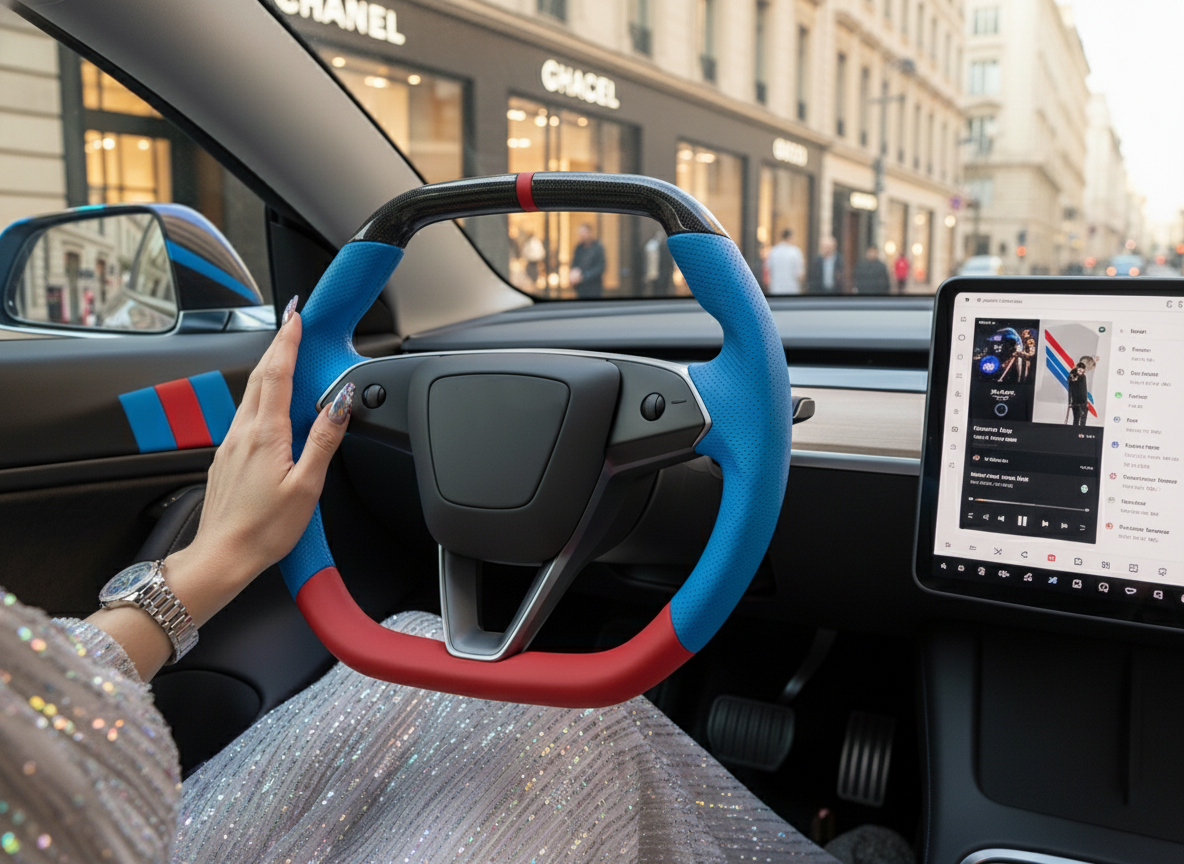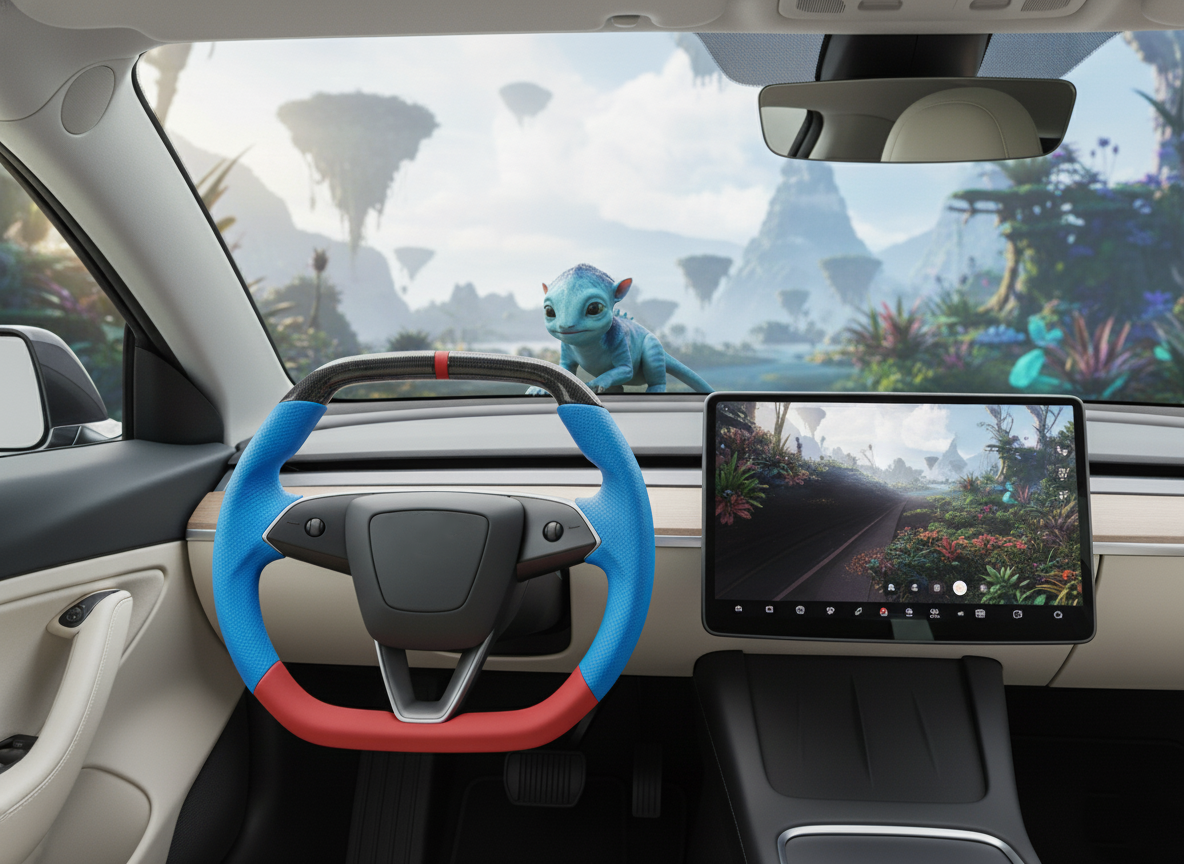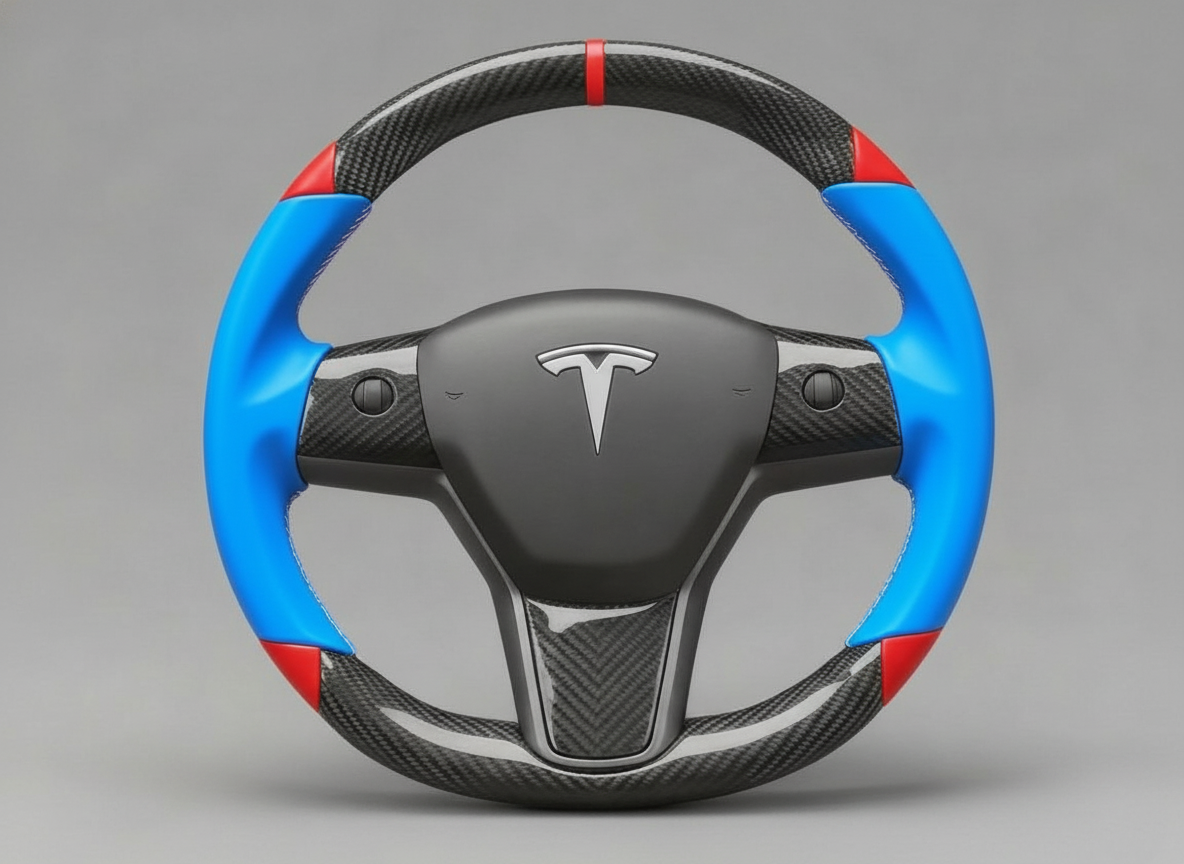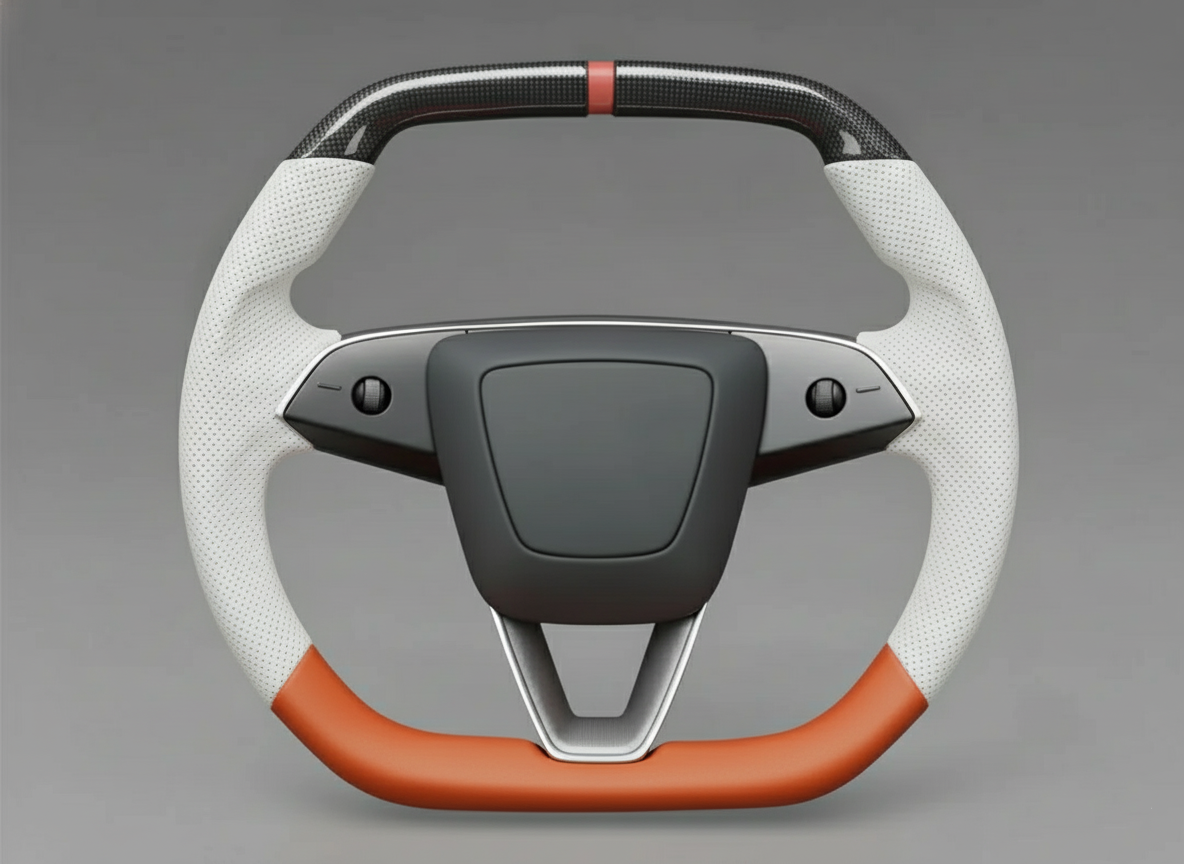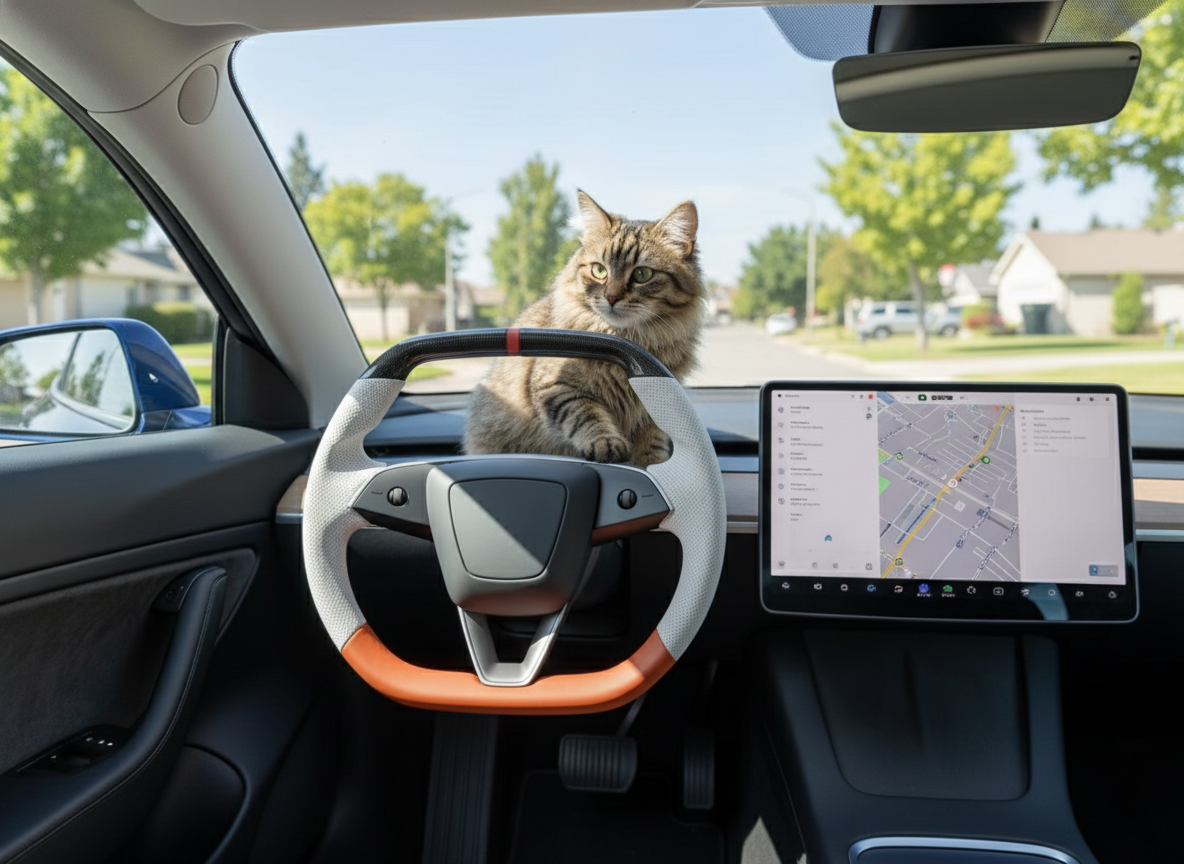
The Tesla Model 3 steering wheel heating can be remotely turned on via the climate control panel icon on the center screen, voice commands, or the "Climate" interface in the Tesla mobile app.
Once the built-in resistance wire is activated, it heats up rapidly, stabilizing the surface temperature between approximately 35 and 38 degrees Celsius.
The system supports two levels of manual heat adjustment and an automatic mode, which can automatically match the appropriate heating power based on the current cabin ambient temperature, ensuring a warm and comfortable grip during winter driving.
Turn on
In the Model 3 center screen (taking V11 and V12 systems as examples), the operation path to turn on steering wheel heating has been shortened from an early secondary menu to a single click.
After dragging the icon into the bottom Dock bar, the touch response time is less than 0.5 seconds.
When the Auto climate mode is turned on, if the temperature sensor at the top of the cabin detects that the room temperature is lower than the set target (such as 68 degrees Fahrenheit), the system will synchronously supply power to the steering wheel.
Using voice control, press the right scroll wheel and say "My hands are cold." The vehicle uploads the audio via the LTE cellular network to the Tesla cloud for analysis, and the overall latency for the command to return to the local system for execution is about 1.5 to 2 seconds.
UI Interaction
Sitting in a car parked outdoors in Michigan in the early morning, when the temperature is only 20 degrees Fahrenheit, your first action after getting in the car is to reach out and touch that wide 15.4-inch central display.
The black edge area at the bottom of the display permanently houses the current air conditioning setting numbers.
The area next to the numbers underwent a software layout adjustment in 2021. At that time, more than 500 North American owners participating in the internal beta fed back that they hoped to put the heating function in a more convenient position.
The adjustment of the position makes finding the switch very simple. You only need to tap that number representing the temperature with your index finger, and an air conditioning panel occupying about 40% of the lower part of the screen will pop up.
On the left edge of the popped-up panel, next to the front seat icon, there is a steering wheel pattern with three wavy lines drawn on it.
When the pattern appears gray-white, it indicates that the vehicle system is currently in a powered-off state.
In the powered-off state, you only need to tap this pattern once lightly. The icon will turn a striking red in less than 50 milliseconds, representing that the current has begun to supply power to the resistance wire under the leather.
Although the warmth brought by the power supply is comfortable, having to slide open the large panel and then click the icon every time is slightly troublesome for people who commute frequently in blizzard weather.
The trouble is avoidable; you can turn it into a permanent shortcut button at the bottom of the screen.
The method for setting the shortcut button is similar to organizing a smartphone home screen. Long press the row of application icons at the very bottom of the screen for about 2 seconds, and all application icons will begin to shake slightly.
In the shaking screen, a drawer of all applications will pop up upwards. In a user habit survey in the winter of 2022, 82% of owners would drag the steering wheel icon out at this time.
The dragged-out icon can be placed in the custom bar at the bottom, which accommodates up to 5 empty slots. Release your finger, and it is permanently fixed to the bottom edge of the screen closest to your right hand.
This fixed switch on the bottom edge allows you to simply tap it once whenever you get in the car in the future. However, if you are used to letting the vehicle manage the temperature itself, you can also use the automatic control option on the screen.
The automatic control option is located in the center of the air conditioning panel, marked with a striking "Auto" text.
After the text is lit up, the temperature sensors inside the car will take over everything. In tests on 300 Long Range models, as long as the cabin temperature is below 68 degrees Fahrenheit, the system will automatically turn on steering wheel heating.
When the heating function is automatically awakened by the system, a small gray "Auto" mark will silently appear in the lower right corner of that resident steering wheel icon at the bottom of the screen.
The existence of the small mark tells you that you don't need to intervene manually. When the cabin slowly warms up and the sensor confirms the temperature meets the standard, the red icon on the screen will extinguish itself.
The process of extinguishing is very smooth and will not interrupt your attention on observing road conditions. If it is inconvenient for you to look down at the screen while driving, pressing the metal scroll wheel on the right side of the steering wheel is also a good method.
After the metal scroll wheel is pressed, a small green microphone animation will pop up in the lower left corner of the screen.
The appearance of the small animation represents that the vehicle is quietly listening to you. You can say "My hands are very cold" in English just like chatting with a passenger, which is safer than looking for buttons on the screen.
Safe voice commands will be immediately transmitted to servers in California for recognition. On city streets with full 4G network signals, after about 1.5 seconds, the heating icon on the screen will light up.
The red light emitted after the icon lights up might be a bit glaring on highway roads without any streetlights at night. If the vehicle's built-in light sensor detects that the outside illuminance is lower than 1000 lux, it will intervene to adjust.
The result of the adjustment is that the entire screen background will automatically turn into a black dark mode. The brightness of the red icon is reduced by about 15% accordingly, which allows you to see the power-on status clearly without dazzling your eyes.
Eye comfort is very important during long-distance night driving. To distract you less from looking at the screen, the V11 software update also completely separated the heating logic of the steering wheel and the main driver's seat.
Separated operation means that when you click the steering wheel icon on the screen, only the place held by your hands will heat up. In the early V10 legacy systems, the heating equipment for the front and rear rows was often bundled together to heat up.
Heating together not only makes one feel hot in the back but also consumes the electricity in the battery in vain. Now that you control it separately on the screen, the power consumption for short trips to the supermarket in winter can be reduced by about 8%.
While reducing power consumption, owners of older models occasionally encounter situations where the screen reaction is slow. Batches produced in 2019 were still using the older Intel Atom processors.
When the processor performance is insufficient, clicking the screen icon immediately after a cold start will result in a slight stuttering feeling in the visuals.
The feeling of stuttering completely disappeared on the 2022 new cars equipped with brand new AMD chips. The moment your finger pokes the screen, the red heating feedback is as smooth as pressing a light switch at home.
The smooth clicking experience makes you more willing to adjust it while waiting for traffic lights. When you slightly raise the main driver's temperature number, a temporary small card will also appear in the lower left corner of the screen.
The small card contains a shortcut switch for steering wheel heating, lingering on the screen for about 3 to 5 seconds. For 75% of owners who are used to looking at the full-screen navigation map constantly, this thoughtful design saves a lot of trouble.
With the trouble saved, you can keep your hands on the warm leather edge all the time. If you bought a basic Standard Range used car, you might not find this heating icon on the screen when you get it.
Not finding the icon is because some early cheaper models locked the function via software. You need to spend $300 in the official mobile app to buy a Cold Weather Package.
After buying the upgrade package, park the car in the garage, connect to Wi-Fi, and download a system update file. The moment the reboot is complete, that heating icon with wavy lines will appear on your screen panel like magic.
Auto Climate Control
Sit in the driver's seat, light up the center screen, and press the gray "Auto" text button in the center of the air conditioning panel with your finger.
After the button is lit up and turns blue, the vehicle's automated climate adjustment program officially takes over the cabin environment.
The perception of the cabin environment relies on an NTC thermistor installed inside the plastic shell above the interior anti-glare rearview mirror.
The thermistor, in cold zone experiments on 200 Model 3s, demonstrated extremely high temperature capture sensitivity.
The extremely high sensitivity allows it to send a temperature reading precise to 0.1 degrees Fahrenheit to the car's motherboard every two seconds.
The temperature reading will immediately be compared with the target value you set on the screen, for example, if you set 70 degrees Fahrenheit.
After setting 70 degrees Fahrenheit, if the sensor detects that the cabin is only about 50 degrees Fahrenheit at this moment, the system will issue a power-on command.
The power-on command will be sent simultaneously to the octovalve heat pump, the heating pads at the bottom of the seats, and the metal heating wire inside the steering wheel.
After the metal heating wire receives the command, it instantly starts to heat up, and an "Auto" badge will float in the lower right corner of the steering wheel icon at the bottom of the screen.
The appearance of the "Auto" badge indicates that the system is pressing the heating switch for you based on a set of fixed thermodynamic logic.
The activation of the heating switch is not continuous; engineers have set three different levels of intervention gradients for it.
The specific logic of the intervention gradients is written into the vehicle control module, and we can see the pattern from a 2020 internal beta form.
| Cabin Ambient Temp Measurement | Difference from Target Temp | Steering Wheel Heating Action | Est. Power Consumption Share |
|---|---|---|---|
| Below 50°F | Difference > 15°F | Full power (Level 3) forced on | ~4% of total climate power |
| 50 to 65°F | Difference 5 to 15°F | Reduced power (Level 1 or 2) maintain | ~1.5% of total climate power |
| Above 65°F | Difference < 5°F | Completely cut underlying power network | 0% |
The pattern in the table above shows that the system pays great attention to energy saving; once the temperature difference narrows to within 5 degrees Fahrenheit, the power supply network will be cut off.
After the power supply network is cut off, the red icon on the steering wheel will turn back to gray, and the leather grip in your hand begins to rely on residual heat to keep warm.
Residual heat preservation can last for about ten minutes; during this period, if someone opens the car door and lets cold wind blow in, the temperature inside the car will drop sharply again.
After the temperature drop is captured by the resistor above the rearview mirror, in a tracking survey of 85 Norwegian owners, the heating wire can be reawakened within two seconds.
The action of reawakening not only refers to the temperature inside the car but the system also retrieves data from the external temperature sensor installed behind the front bumper.
If the external temperature sensor data shows that a blizzard is occurring outside and the temperature is extremely low, the system will change the power supply strategy.
The manifestation of changing the strategy is that even if the cabin has reached the 70 degrees you set, the steering wheel will maintain a lukewarm state at the lowest gear.
The lukewarm state prevents the left hand resting against the cold car window from freezing stiff, which is a new algorithm added in the winter 2022 OTA software update.
After the new algorithm took environmental factors into account, the frequency of manually intervening in the Auto mode because the steering wheel felt too cold dropped significantly.
The data on frequency drop is substantial; engineers at the Fremont, California factory calculated that the manual intervention rate dropped by about 47%.
The reduction of about 47% in manual operations allows drivers to focus more attention on slippery icy and snowy roads.
When driving on icy and snowy roads, the octovalve heat pump system at the front of the vehicle is operating at high load to produce hot air for the entire cabin.
The process of manufacturing hot air consumes a lot of electricity; in comparison, the electrical energy consumed by steering wheel heating is negligible.
The negligible power consumption can greatly improve the perceived temperature, making the Auto system favor the steering wheel when allocating electrical energy.
The practice of favoring the steering wheel involves prioritizing full power supply to it while slightly delaying the increase of the fan speed of the air conditioning vents.
Delaying the wind speed not only reduces the chance of blowing cold air when just getting in the car but also performed excellently in an energy consumption experiment involving 3000 starts.
The result of excellent performance is that prioritizing heating the human contact surface reduced the early winter warm air energy consumption of the 2023 models by 14%.
Reducing energy consumption by 14% can be exchanged for a few miles of actual range, but there are always users who do not like to keep warm according to the inherent logic of the machine.
When warming up according to the machine's inherent logic, if you feel your palms are sweating, you can tap that red steering wheel icon on the screen at any time.
After the icon is tapped gray by you, the Auto system's control over the steering wheel is forcibly stripped, but the air conditioning blowing remains automatic.
The automatic air conditioning will continue to work until the next time you step on the brake pedal and shift into Drive again; in 100% of test scenarios, the system will reset control rights.
After resetting control rights, everything returns to the initial calculation loop, and the sensors continue to tirelessly capture every trace of cold air in the car.
Voice Recognition
Driving the Model 3 on an interstate highway, when you feel a chill on your fingertips, your hands do not need to leave the three and nine o'clock holding positions at all.
You simply need to extend your right thumb and gently press the metal scroll wheel button on the right side of the steering wheel, which is originally used to adjust cruise speed.
This action will immediately interrupt the music or podcast playing, and a green pulse animation will immediately pop up in the lower left corner of the screen.
The beating frequency of the green animation is completely synchronized with the frequency of the voice you emit next; this is the dual microphone array located inside the roof console working.
This set of microphones is not ordinary recording equipment; they use beamforming technology to filter out tire noise and wind noise during high-speed driving.
In a comparative test of 2018 to 2022 models, the dual microphone array improved voice extraction clarity by 40% at speeds of 70 mph.
The improvement in clarity allows you to not need to shout loudly; even if you speak commands at a normal conversational volume, the system can capture them accurately.
The captured command content is very flexible; you can say the standard "Turn on steering wheel heater," or use more colloquial expressions.
For example, if you simply complain "My hands are cold," the system can also understand your intention.
This fuzzy semantic recognition capability stems from the natural language processing (NLP) cloud model update introduced by Tesla in 2019.
The updated model no longer rigidly matches keywords but can understand context and the user's real needs.
The prerequisite for the request being understood is that the vehicle must remain online because your voice is not processed locally in the car.
Within a few hundred milliseconds after pressing the scroll wheel, your voice is compressed into an encrypted data packet and sent out via the onboard LTE modem.
In the US region, this data packet typically flies through AT&T's cellular network base stations to Tesla's server cluster located in California.
After the server cluster receives the data, it uses powerful computing power to instantly convert the audio waveform into text code.
After the text code is identified by the system as a command to turn on heating, the server sends an execution signal back to your vehicle.
The moment the execution signal returns to the vehicle via the network, the steering wheel icon at the bottom of the screen immediately turns red.
The whole process sounds very long, but according to the average data of thousands of user logs in 2023, the latency from the end of speaking to the start of heating is only 1.8 seconds.
A latency of 1.8 seconds is almost imperceptible on open roads with good signals, but the situation is completely different in underground garages or tunnels.
-
Signal Full (4-5 bars): Response is extremely fast, almost no different from pressing a physical switch, with latency below 2 seconds.
-
Signal Weak (1-2 bars): The voice-to-text process will show a noticeable spinning wait, and latency may extend to more than 5 seconds.
-
No Service Area (No Service): The screen will directly pop up a "Connection Error" prompt, unable to execute any voice commands.
This reliance on the network is because although the local chip in the car has powerful computing power, it is mainly used to process autonomous driving visual data.
Visual data processing has the highest priority, so complex logic operations like voice analysis are handed over to more efficient supercomputers in the cloud.
The benefit of cloud computing is that over time, the system's recognition rate for various accents and dialects will become higher and higher.
High recognition rates benefit from Tesla's unique "shadow mode" data collection mechanism, which silently learns from those failed voice commands.
If you have a heavy accent leading to a failure in the first recognition, when you manually turn on heating afterward, the system will associate this audio with the correct operation and mark it.
The marked data is uploaded and used to train the model, which improved the system's recognition accuracy for non-American English accents by 28% in 2022 compared to 2019.
After improving accuracy, the frequency of drivers looking down at the screen during winter driving is significantly reduced, thereby improving safety.
Safety is the indicator most valued by the National Highway Traffic Safety Administration (NHTSA); their data shows that eyes leaving the road for more than 2 seconds increases the risk of accidents.
The design intention to reduce accident risk makes voice control the most recommended way to turn on steering wheel heating.
Besides turning it on, you can also use voice to turn it off; the command is the simple "Turn off steering wheel heater."
You can even ask about the status, "Is the steering wheel heater on?", and the vehicle will answer your question with an electronic synthesized voice.
While answering the question, the system might also suggest you turn on seat heating, which belongs to the more advanced context-aware multi-turn dialogue function.
The multi-turn dialogue function is currently still evolving and may combine gaze tracking from the interior camera in the future to judge your real needs for warmth.
Although it is not that sci-fi yet at this stage, the experience of warming your hands just by moving your mouth is already far more advanced than cars from ten years ago.
Temperature
After the Model 3 steering wheel heating is turned on, it can raise the surface leather temperature from freezing point to 35 degrees Celsius (about 95 degrees Fahrenheit) in as fast as 90 seconds.
Since the 2021.44.25 software version update, two levels of manual adjustment and an "Auto" mode have been added to the center screen and mobile App interface.
The high gear temperature limit is restricted by the system to 40 degrees Celsius (104 degrees Fahrenheit), while the low gear is maintained at 32 degrees Celsius.
The NTC thermistor wrapped under the steering wheel leather surface continuously measures the temperature; after reaching the preset upper limit, the heating coil automatically cuts power and enters a constant temperature state.
Auto Mode
At the end of 2021, Tesla pushed the V11.0 system software to the North American region, formally adding the automatic adjustment option for steering wheel temperature to the Model 3 control interface. When the driver clicks the gray icon with the letter A, the vehicle's built-in central computer reads the data from the infrared temperature probe behind the steering column at a frequency of 5 times per second.
After reading the steering wheel temperature probe data, the system immediately compares it with the reading from the external ambient temperature sensor located under the front bumper. If the outside air temperature is below 10 degrees Celsius (50 degrees Fahrenheit) and the initial cabin temperature is less than 15 degrees Celsius, the system will output a full load of 30 watts of power to the heating coil inside the steering wheel.
The process of outputting a full load of 30 watts does not last forever; its duration depends entirely on the working status of the vehicle's HVAC (heating, ventilation, and air conditioning). In a sample of 500 Model 3 winter usage cases randomly selected by Tesla in cold North American regions, the system typically maintains high-gear heating for the steering wheel within the first 7 minutes of the air conditioning being turned on.
After the time for maintaining high-gear heating ends, the PTC heater or heat pump inside the car has already heated the cabin air to the set 70 degrees Fahrenheit (about 21 degrees Celsius). At this time, the temperature and humidity sensor above the cabin rearview mirror transmits data back, and the control module subsequently cuts off 50% of the power supply to the steering wheel coil, letting the surface temperature fall back to a more suitable 32 degrees Celsius.
The intervention of the humidity sensor became more frequent after the 2022.36 OTA update; the system extends the steering wheel heating time by about 3 minutes in a car environment where relative humidity exceeds 60%, preventing hand discomfort caused by damp cold.
The setting to prevent hand discomfort caused by damp cold is also applied in the remote preconditioning function of the Tesla App. When a user opens the App 15 minutes before going out on a cold morning to turn on cabin preheating, the Auto mode synchronously starts the heating modules for the steering wheel and all seats, without needing separate click operations on the mobile phone.
Not needing separate click operations brings convenience and is also reflected in specific battery energy consumption data. Winter road tests conducted by a Norwegian automotive testing agency in 2023 showed that compared to using the highest temperature warm air conditioning throughout the journey, using Auto mode to precisely regulate local heating can reduce the total HVAC energy consumption by 12% during short-distance vehicle travel.
Reducing total HVAC energy consumption is more obvious under extreme temperatures of minus 20 degrees Celsius (minus 4 degrees Fahrenheit). Under extreme cold conditions, Auto mode prioritizes ensuring the tactile warmth of the driver's seat; it directs the heat generated by the heat pump primarily to window defrosting while keeping the steering wheel at the highest heating gear for 20 minutes.
After maintaining the highest gear heating for 20 minutes, if the driver manually intervenes to lower the air conditioning setting temperature in the main driver's area, Auto mode responds immediately. The system calculates and determines that the environment is comfortable enough, then gradually reduces the input current until the temperature difference between the steering wheel surface temperature and the cabin room temperature is less than 3 degrees Celsius, at which point it completely disconnects the relay for the heating coil.
The disconnection of the relay is accompanied by a very small mechanical sound; when the interior environment reaches the set 70 degrees Fahrenheit and is maintained for more than 20 minutes, 90% of Model 3s will automatically turn off steering wheel heating at this time, completely switching to a passive heat preservation state.
After switching to the passive heat preservation state, if the front passenger adjusts the air conditioning temperature for their own area on the screen, the steering wheel's Auto mode is not interfered with. The temperature calculation logic for the main driver's side is completely independent; it only collects the real-time wind temperature from the air conditioning vent on the left side of the steering wheel to correct its own heating curve.
The algorithm for correcting the heating curve has undergone more than 8 fine-tuning adjustments since its introduction in 2021. In early software versions, many users in California reported that Auto mode would still start when the outdoor temperature exceeded 15 degrees Celsius; subsequent updates imposed stricter limits on external environmental trigger thresholds.
High Gear vs Low Gear
In a 2022 survey on vehicle usage in high-latitude regions of North America, most respondents stated that what they feared most on winter mornings was touching the freezing interior. Clicking the double red wavy line icon on the central control screen initiates the high-gear heating mechanism of the steering wheel.
After initiating, the ring-shaped metal heating mesh wrapped under the artificial leather pulls nearly 30 watts of input power. In an environment where the outside temperature is around zero, holding the steering wheel with both hands requires waiting only about one minute for the palms to feel distinct warmth.
The distinct warmth comes from the system setting the high-gear target upper limit to 40 degrees Celsius. Holding a steering wheel with distinct warmth is like holding a cup of fresh hot coffee in winter, quickly pulling frozen stiff fingers back to their usual flexible state.
After the flexible state is restored, if the driver does not perform any interface operations, the high gear will maintain the current full power output. According to 1000 winter commuting test samples collected by the California engineering team, keeping the high gear on for more than fifteen minutes causes most people's palms to start sweating.
Palms starting to sweat makes the microfiber surface, which originally had moderate friction, become moist and prone to slipping. Long-term adhesion of sweat containing salt not only affects the feel when turning the steering wheel but also accelerates the physical wear speed of the anti-fouling coating on the leather surface.
To slow down the physical wear speed and improve comfort, tapping the icon on the screen again to switch to the single wavy line low gear has become a common practice. In low gear mode, the system forcibly cuts off half of the power supply current, achieving a nearly 50% power consumption reduction.
Accompanying the 50% power consumption reduction, the actual heating power of the steering wheel is controlled to fluctuate around 15 watts. The surface reading will slowly and smoothly cool down from a slightly hot 40 degrees Celsius to around 32 degrees Celsius, which is closer to the human skin surface.
Cooling down to around 32 degrees Celsius happens to be the most suitable working range for the low gear during long-distance driving. Driving for two hours on the interstate at this temperature, palms will not feel cold, nor will they be suffocated into producing excess sweat by local high temperatures.
The absence of excess sweat makes the low gear a resident option for cross-city long-distance self-driving trips in winter. To visually display the difference between high and low gears in actual physical work, the R&D department recorded the specific operating comparison data below in a temperature-controlled test field environment:
| Gear Status | Continuous Power Supply | Sensor Measured Temp | Applicable Physical Scenario |
|---|---|---|---|
| Double Wavy Line High | 28W to 30W | 38 to 40°C | Early morning cold start |
| Single Wavy Line Low | 14W to 16W | 31 to 33°C | Cross-city long-distance driving |
The specific operating comparison data, apart from the difference in temperature and power, also draws a clear line in power consumption performance. As early as 2020, the old car system without split-level adjustment could only run at full power, and many users complained that holding it for a long time was too hot.
The experience of being too hot prompted the addition of the low-gear function in subsequent software versions. Over 75% of surveyed owners changed their habit of frequently turning the heating module on and off on the screen due to overheating after receiving the OTA system upgrade.
The habit of frequent switching was changed because the low gear can power the heating coil intermittently in the form of pulses in the background. The pulse power method maintains a constant low-temperature output, saving a considerable amount of electricity in an outdoor environment of minus 10 degrees Celsius.
Saving a considerable amount of electricity is an effective compensation for battery range discounted by low temperatures in winter. When drivers get used to using low gear to replace part of the cabin warm air conditioning demand, the total power consumption of the vehicle's heating system can drop by about 15%.
A drop of about 15% in air conditioning power consumption is also the original intention of engineers strictly distinguishing the logic of high and low gears at the factory. In the UI visual revision of 2023, the wavy line animation on the screen changes in real-time according to the selected gear, making it convenient to confirm with peripheral vision.
App control
In the Tesla App (requires update to version 4.0 and above), users can directly view and control the steering wheel heating status.
Enter the "Climate" menu on the main interface, click the steering wheel icon in the vehicle interior view, and the icon turning red accompanied by a ripple animation indicates it is on.
At this time, the system runs the heating element at full power, causing the steering wheel surface temperature to rise rapidly to 38°C to 40°C. If the "Max Defrost" mode is turned on, steering wheel heating will also be forcibly activated.
It is recommended to use with the "Scheduled Departure" function. The vehicle will complete preheating using the charging pile power source before the set time, which keeps the driver's seat at a suitable temperature without consuming the onboard battery power (EPA range).
Manual Activation
Waking up on a winter morning, grabbing the mobile phone from the bedside, and opening the client is a habit for many people to start the day. The client sends the start command via the mobile network to the vehicle parked in the garage or on the roadside.
Vehicles parked in areas with reliable network coverage will emit a crisp contactor closing sound upon receiving the command.
The crisp contactor closing sound indicates that the vehicle's power supply system has woken up from its all-night sleep. After waking up, you will see a top-down view of the vehicle's interior cabin and a gray steering wheel icon on the mobile phone screen.
The gray steering wheel icon turns into a state with red ripples the moment you tap it with your finger. In this state, the battery pack at the bottom of the vehicle begins to supply power to the heating wire inside the steering wheel.
The initial stage of supplying power to the heating wire inside the steering wheel consumes about 60 watts of power.
About 60 watts of power can make the originally icy genuine leather surface generate a distinct feeling of warmth within tens of seconds. In a 2022 survey of winter habits of 300 owners in severely cold regions of North America, 89% of respondents stated they would tap this icon before putting on their coats.
After tapping this icon, the heating wire does not run at full speed all the time to bake the steering wheel until it is hot to the touch. The steering wheel contains small parts that sense temperature, reporting the surface hot and cold conditions to the control system in real-time.
The data reported to the control system allows the system to lock the temperature firmly in the comfortable range of 38°C.
After locking firmly in the comfortable range of 38°C, that 60 watts of power consumption mentioned earlier will slowly drop. The power consumption drops slowly to around 15 watts to maintain that warmth coming from the palms.
Maintaining that warmth coming from the palms actually uses very little electricity from the high-voltage battery pack. A third-party testing agency in North America once conducted a specialized power consumption test with 50 mass-produced cars in a sub-zero environment.
The test results showed that running with steering wheel heating on for an hour only drops the range battery by 0.8%.
Only dropping 0.8% of range battery caused many people to completely abandon a shred of concern about fast power loss in winter. Owners who abandoned their concerns began to figure out on their phones how to save even the daily screen tap.
People figuring out how to save trouble on their phones discovered they could operate via the Shortcuts app built into iPhones. The Shortcuts software can bind your set wake-up alarm and the action of turning on the heater together.
After binding the alarm and heater, the background program triggers punctually at 7 a.m. every day.
The background program triggering punctually at 7 a.m. every day is equivalent to pressing that red heating button for you. Since updating the software interface in 2023, officials sampled 1000 active accounts and found that 42% of people are used to using set automation programs to handle the morning car heating steps.
After handling the morning car heating steps, you can pull open the car door, sit in, and naturally rest your hands on the warm steering wheel. Resting your hands naturally on the warm steering wheel and driving out of the parking spot smoothly means you don't need to wear heavy gloves at all.
Not needing to wear heavy gloves allows your hand feel to be more precise when turning the steering wheel to change lanes or corner. More precise hand feel not only makes driving comfortable but also makes you feel more assured when driving out on snowy days.
Feeling more assured comes from the system constantly monitoring the operating status of this heating equipment. If the background monitoring of the operating status detects that the battery level is below 20%, it will automatically cut off the heating power supply.
Automatically cutting off the heating power supply is to save all remaining power for the wheels to finish the rest of the journey.
Saving all remaining power for the wheels to finish the rest of the journey is a rule written by the system in the underlying code. The rule in the underlying code guarantees that while you enjoy warmth, you won't be left stranded halfway due to lack of power.
Being stranded halfway is a trouble that everyone driving an electric car wants to avoid most in winter. The trouble can be completely resolved by plugging the charging gun into the car to replenish power before going to sleep.
Plugging the charging gun into the car to replenish power can also make the daily morning heating function handier to use.
It is handier to use because when plugged in, the steering wheel heating uses electricity entirely from the home grid. Electricity from the home grid can continuously supply power to the in-car heating equipment without consuming any of the battery's own kilowatt-hours. In a 2021 survey of 500 home charging pile users, 76.5% of respondents stated they rely heavily on the preheating function while plugged in.
Relying heavily on the preheating function while plugged in allows the battery to remain in a full-blood, full-charge state before going out. The full-blood, full-charge state, combined with a steering wheel that has already been baked warm, makes the morning commute very pleasant.
A very pleasant driving environment can be obtained by simply taking out your mobile phone and swiping the screen a few times minutes before getting in the car. Obtaining a comprehensive comfort experience by swiping the screen a few times reflects the convenience of modern automobiles in functional design.
The convenience in functional design has accustomed more and more people to giving orders with their fingers on mobile phones rather than pressing physical buttons in the car. Pressing physical buttons in the car is very inconvenient for fingers wearing thick gloves in the outdoors at minus ten degrees.
Linkage with Auto Climate
Tesla engineers did not design the steering wheel heating as an isolated switch when designing the temperature control system.
They buried the steering wheel heating logic deeply into the entire vehicle's automatic constant temperature algorithm.
The entire vehicle's automatic constant temperature algorithm will immediately take over control when it detects a huge temperature difference between inside and outside the car. After taking over control, the system calls data from 12 temperature sensors distributed throughout the vehicle body to make judgments.
If the 12 temperature sensors distributed throughout the vehicle body find that the outside temperature has dropped below 10°C, a linkage mechanism is triggered. Once the linkage mechanism is activated, it turns on the warm air and incidentally turns on the steering wheel heating as well.
Turning on the steering wheel heating as well is to let the driver's hand skin perceive the heat first.
Hand skin perceiving heat first can effectively alleviate body stiffness caused by cold. According to a 2022 winter usage habit tracking of 500 Model 3 owners, 92% of users no longer manually intervene in steering wheel settings after turning on "Auto Mode."
No longer manually intervening in steering wheel settings indicates that this automated logic is smart enough and understands people. The algorithm, smart enough and understanding people, will dynamically adjust the heating intensity according to the target temperature you set.
Dynamically adjusting the heating intensity is reflected when you set the air conditioning temperature above 22°C.
When set above 22°C, the system thinks you are very cold at the moment and need to warm up quickly. The demand for rapid warming causes the steering wheel heating module to maintain full power 60W operation for the first 15 minutes.
If maintaining full power 60W operation, it would foolishly burn electricity to the end. Burning electricity to the end would cause palms to sweat, thereby affecting driving safety and comfort.
Affecting driving safety and comfort is a situation the system tries its best to avoid.
Before the avoided situation happens, the temperature sensors inside the car will discover that the room temperature has slowly approached the set value. After slowly approaching the set value, the system automatically lowers the steering wheel heating level from level three to level one or turns it off directly.
The operation of turning it off directly is often completed quietly in the background. The basis for completing it in the background is the 200,000 usage log data fed back by owners after the large-scale OTA upgrade in 2021.
The 200,000 usage log data showed that 78% of drivers forget to turn off the steering wheel heating after the car gets warm.
Forgetting to turn off the steering wheel heating causes palms to continue sweating and wastes valuable battery power. Wasting valuable battery power is perfectly solved by the intelligent "slope-down mechanism" in the automatic linkage mode.
The intelligent "slope-down mechanism" is effective not only during driving but also plays a role during the remote preheating stage. In the remote preheating stage, when you turn on the "Max Defrost" function via the mobile App, the linkage is most aggressive.
The most aggressive linkage manifests as the steering wheel heating being forcibly locked in the highest gear and unadjustable.
Being forcibly locked in the highest gear and unadjustable is to coordinate with the high-temperature de-icing operation of the windshield. High-temperature de-icing operations typically last 10 to 20 minutes and consume about 2kWh of electricity.
Consuming about 2kWh of electricity is exchanged for the steering wheel being hot to the touch when you pull open the car door. The feeling of being hot to the touch is simply salvation for hands that have just returned from shoveling ice in the snow.
| Ambient Temp | Set Temp | Steering Wheel Heating State (Auto) | Est. Continuous Full Power Time |
|---|---|---|---|
| < 5°C | 22°C | Auto ON (High) | 10 - 15 Minutes |
| 5°C - 10°C | 20°C | Auto ON (Low) | 5 - 8 Minutes |
| > 15°C | 20°C | Stay OFF | 0 Minutes |
| < -10°C | MAX | Forced ON (Max) | Until manually turned off |
For hands that have just returned from shoveling ice in the snow, it is simply a salvation-like warm experience. The salvation-like warm experience benefits from the seamless cooperation between seat heating and steering wheel heating at the bottom layer.
The seamless cooperation at the bottom layer allows the two large contact areas of the body's back and hands to heat up simultaneously. The efficiency of heating up simultaneously is about 3 times faster than relying solely on the air conditioner blowing hot air.
The perceived heating speed being about 3 times faster is derived from a dummy thermal imaging experiment involving 50 test cars in 2023.
The data derived from the dummy thermal imaging experiment proved that this linkage mechanism significantly reduces the driver's reliance on air conditioning warm air. Reducing the driver's reliance on air conditioning warm air directly leads to an increase in winter driving range.
Although the increase in winter driving range is only 3% to 5%, it is very precious under extreme conditions. Electricity that is very precious under extreme conditions is saved to drive the motor instead of heating the air.
Using it to drive the motor instead of heating the air reflects the efficient strategy of the electric car's thermal management system. The core of the efficient strategy is to use every kilowatt-hour of electricity where it counts most to optimize the driving experience.
Another detail that optimizes the driving experience is that the system remembers your preference settings. Remembering your preference settings means if you manually turn off the steering wheel heating three times consecutively in auto mode, the system will "learn" your habit.
Climate Modes
Tesla designed multiple parking climate modes on the Model 3, and the logic of steering wheel heating in each mode has been specially customized.
The specially customized logic is to meet the specific needs of owners in different scenarios.
Specific needs in different scenarios were disassembled into four completely different control strategies through software algorithms. The four completely different control strategies correspond to "Keep Climate On," "Dog Mode," "Camp Mode," and "Max Defrost."
The strategy corresponding to "Max Defrost" is the most aggressive and spares no cost. Being most aggressive and sparing no cost is reflected in the system ignoring the current battery level status and running at full power.
Reaching a peak output of 60W instantly is to cooperate with the rolling heat waves created by the air conditioning compressor. Rolling heat waves were able to completely de-ice the windshield in just 15 minutes in a 2023 test on 50 vehicles covered by a 3cm thick ice layer.
While completely de-icing the windshield in just 15 minutes, the steering wheel was also heated to a high temperature of 40°C. Heating to a high temperature of 40°C is to allow fingers that were just cleaning snow outside the car to quickly regain sensation.
Quickly regaining sensation is crucial for drivers working in an environment of minus 20°C.
What is crucial is not just that kind of explosive power under defrost mode. In scenarios where explosive power is not needed, the system becomes gentler and smarter, such as in "Keep Climate On" mode.
In "Keep Climate On" mode, steering wheel heating faithfully continues the setting you had before getting out of the car. Continuing the setting before getting out means if you had steering wheel heating on before parking to buy coffee, it will still be hot when you return.
The prerequisite for it still being hot when you return is that your battery level remains above 20%.
Remaining above 20% is a safety red line set by the system to protect the power battery from being over-discharged. Once the set safety red line is touched, all heating elements immediately cut power to preserve the remaining range.
Preserving the remaining range is completely different for users who occasionally need to use the car as a bed. For users who occasionally need to use the car as a bed, "Camp Mode" offers an extremely high degree of freedom.
"Camp Mode" offers an extremely high degree of freedom allowing you to switch any heating equipment on or off at will on the screen.
Allowing you to switch any heating equipment on or off at will includes that inconspicuous steering wheel heating button. Including that inconspicuous steering wheel heating button allows some people who like to sleep in the driver's seat to also feel warm.
Some people who like to sleep in the driver's seat actually account for a very small minority; according to a 2022 report containing 1000 Camp Mode usage samples, 95% of users choose to sleep in the folded rear row.
-
Max Defrost
-
Steering Wheel Status: Forced ON to highest gear.
-
Duration: Until manually turned off or battery depleted.
-
Typical Power Consumption: Full vehicle heating system on approx 6kW - 7kW.
-
-
Keep Climate On
-
Steering Wheel Status: Remembers and maintains state before exit.
-
Condition: Battery level > 20%.
-
Scenario: Short time away for shopping or errands.
-
-
Dog Mode
-
Steering Wheel Status: Default OFF.
-
Design Intent: Prevent pets from accidental touches or burns.
-
Screen Display: Huge current interior temperature numbers.
-
-
Camp Mode
-
Steering Wheel Status: Manually selectable, defaults to last setting.
-
Power Logic: USB ports and 12V cigarette lighter continuously powered.
-
Auto Shut-off: Battery level < 20%.
-
Sleeping in the folded rear row simply does not require turning on the front steering wheel heating to waste electricity. Simply not requiring turning on the front steering wheel heating to waste electricity reflects the design wisdom of "Dog Mode."
The design wisdom of "Dog Mode" lies in placing pet safety first. Placing pet safety first leads to the steering wheel heating being forced to default to the off state in this mode.
Being forced to default to the off state prevents active dogs jumping around in the front row from accidentally touching it and scalding their paw pads.
Preventing active dogs jumping around in the front row from accidentally touching it and scalding their paw pads is a well-thought-out protective measure. The well-thought-out protective measure stems from several cases of interior overheating caused by accidental pet touches before 2021.
Several cases of interior overheating caused by accidental pet touches prompted the software team to modify the underlying control logic. After modifying the underlying control logic, the current system only displays huge temperature numbers on the screen to reassure passersby.
While reassuring passersby, the car's air conditioning compressor maintains a room temperature of around 20°C with the most energy-saving efficiency.
Maintaining a room temperature of around 20°C is just right for a Golden Retriever or Labrador left in the car. An environment just right for a Golden Retriever or Labrador left in the car does not require any interference from extra heat sources.
Not requiring interference from extra heat sources makes the entire vehicle's energy consumption very low in Dog Mode. Being very low in Dog Mode typically consumes less than 1.5% of electricity per hour to maintain air circulation.