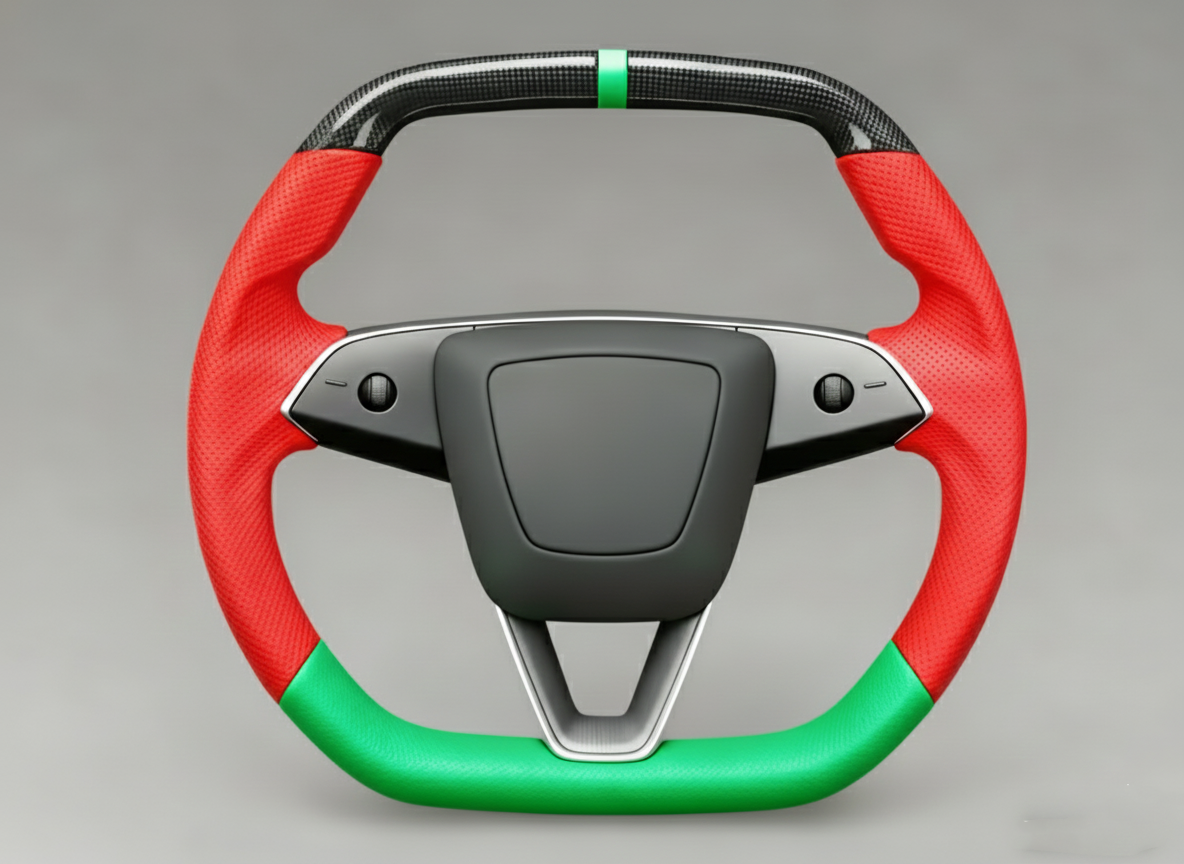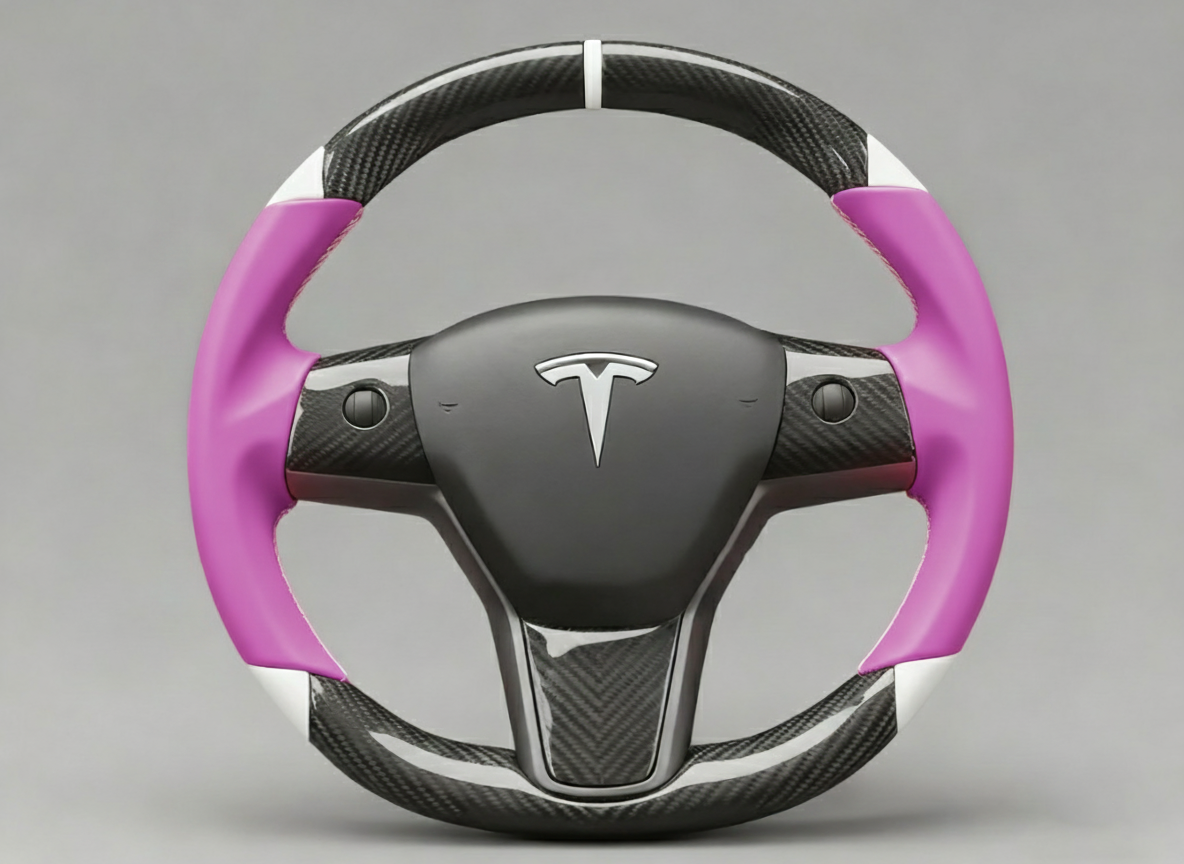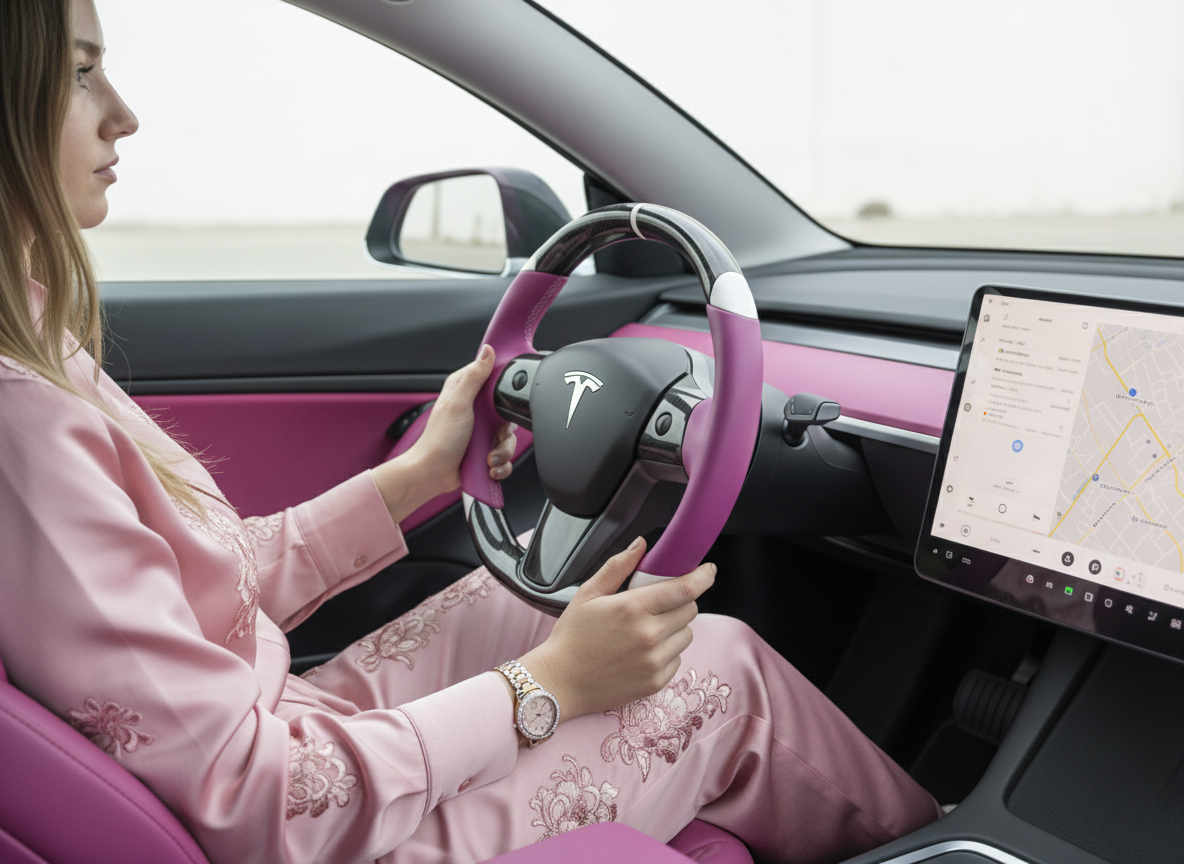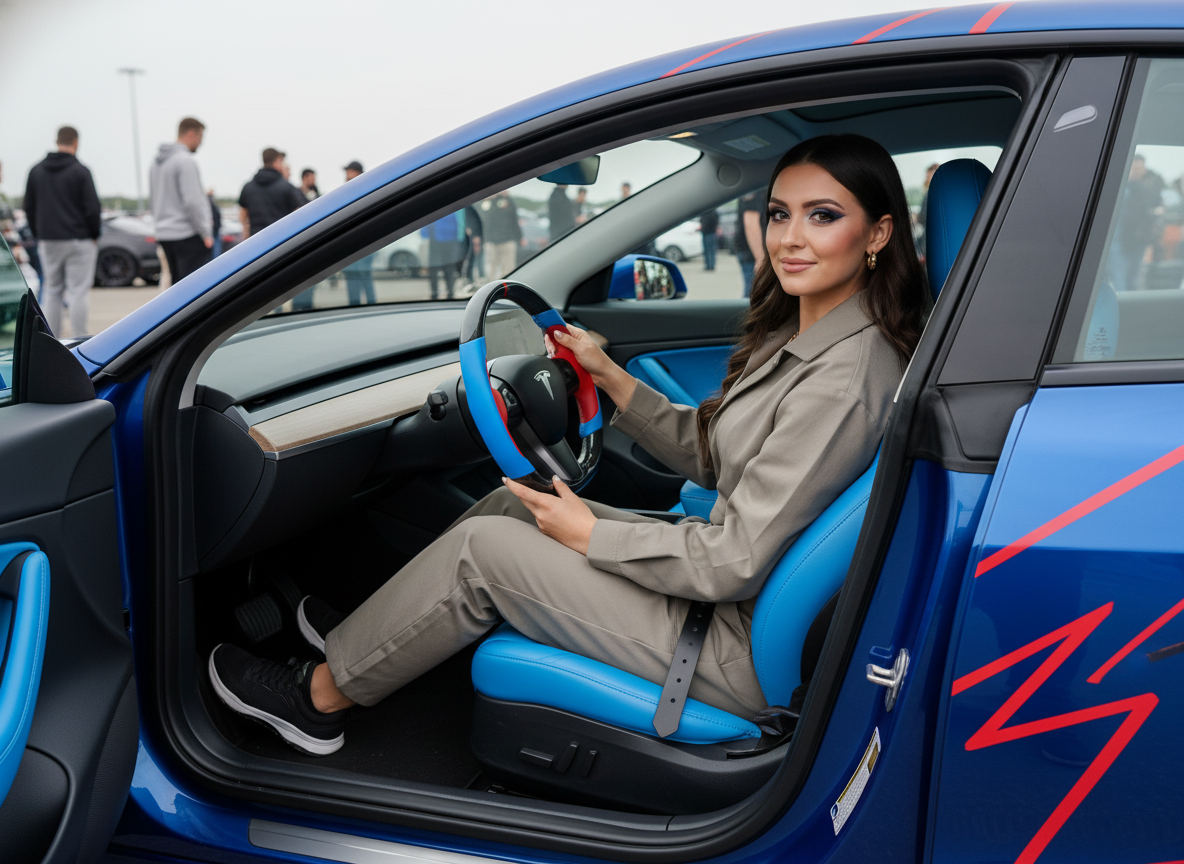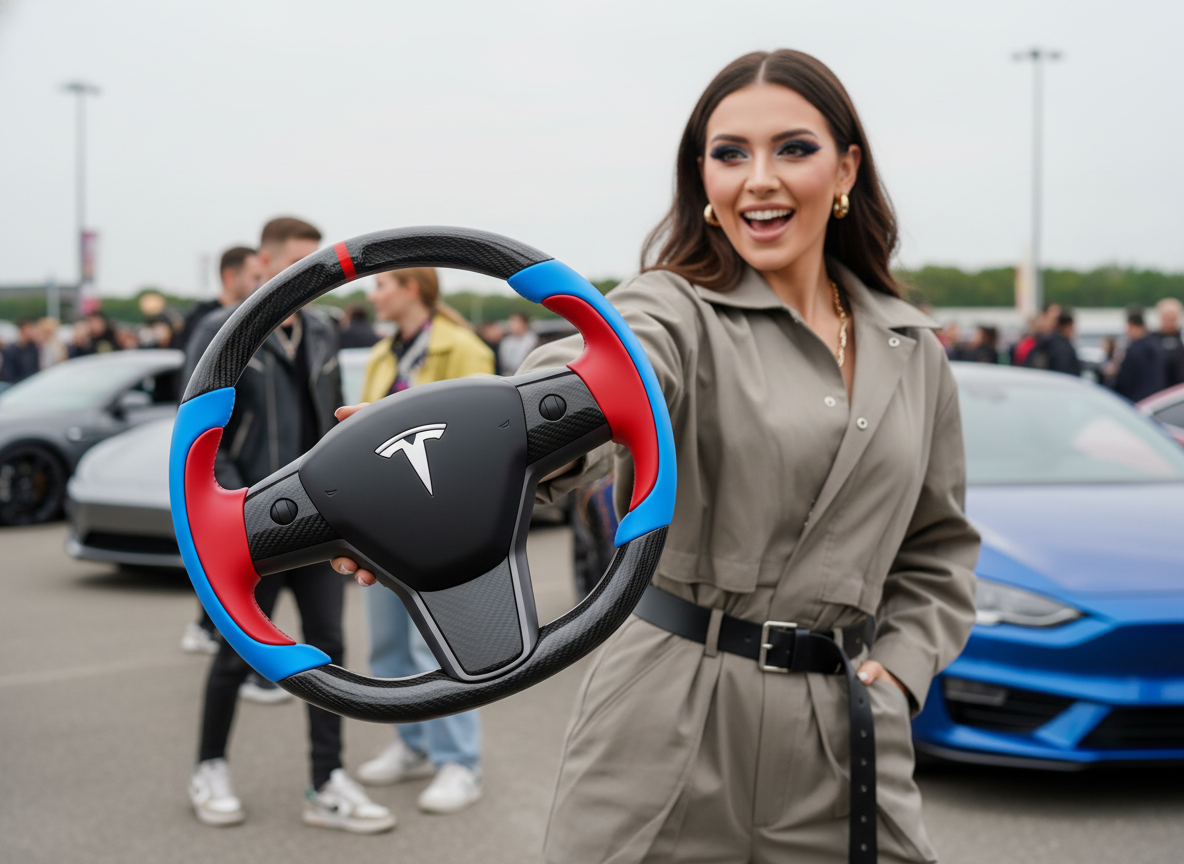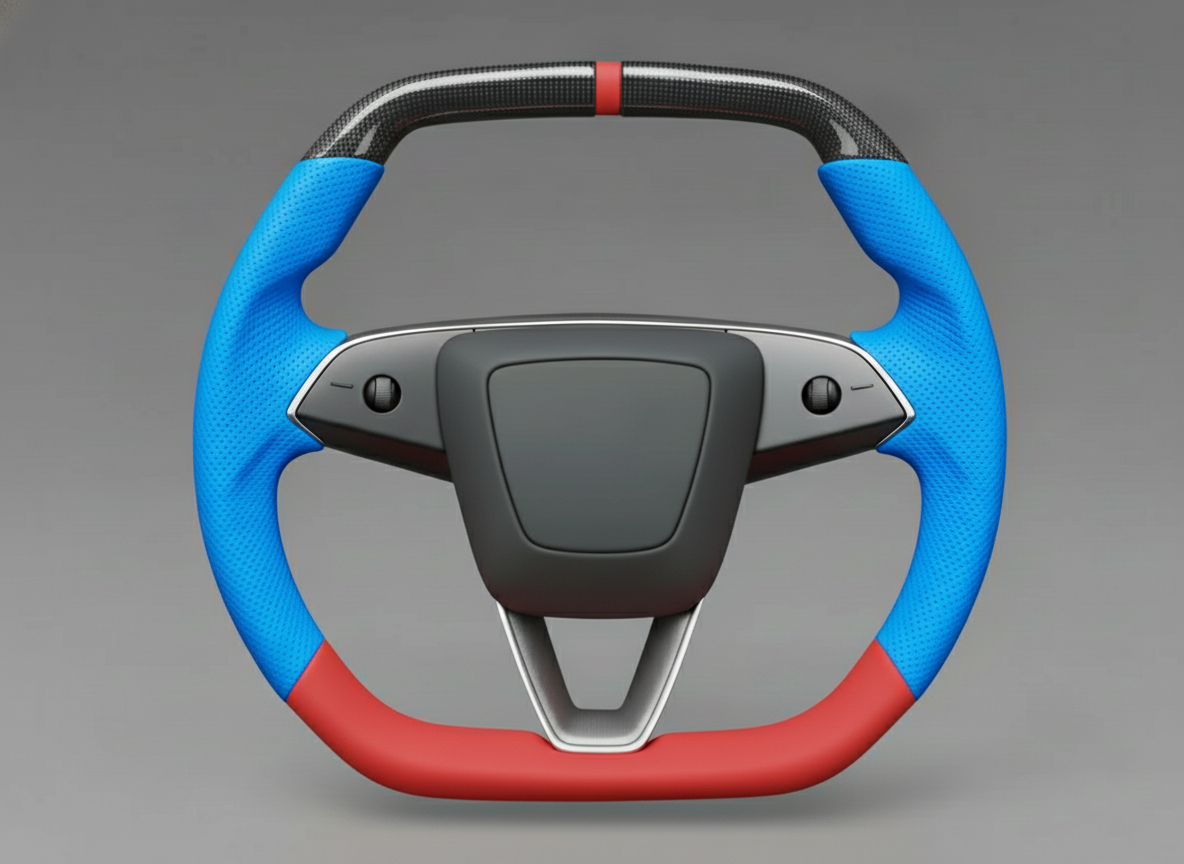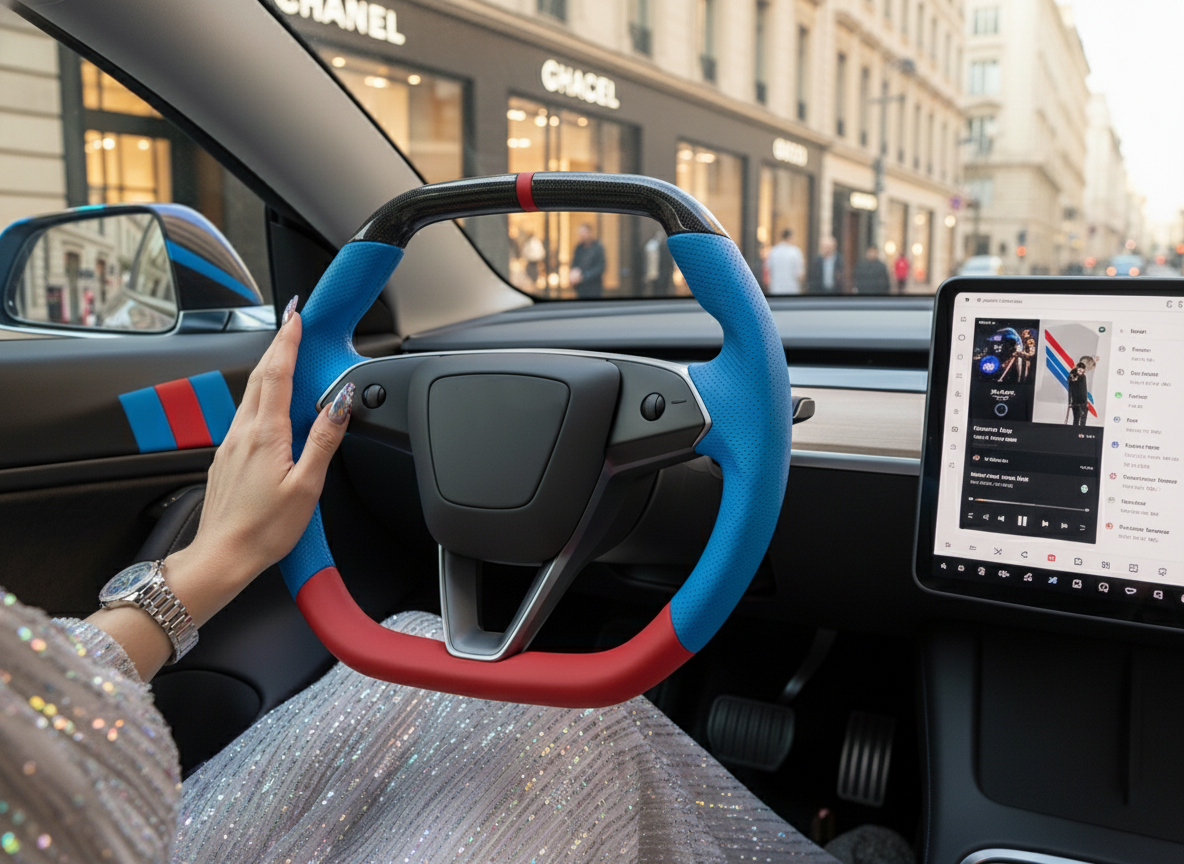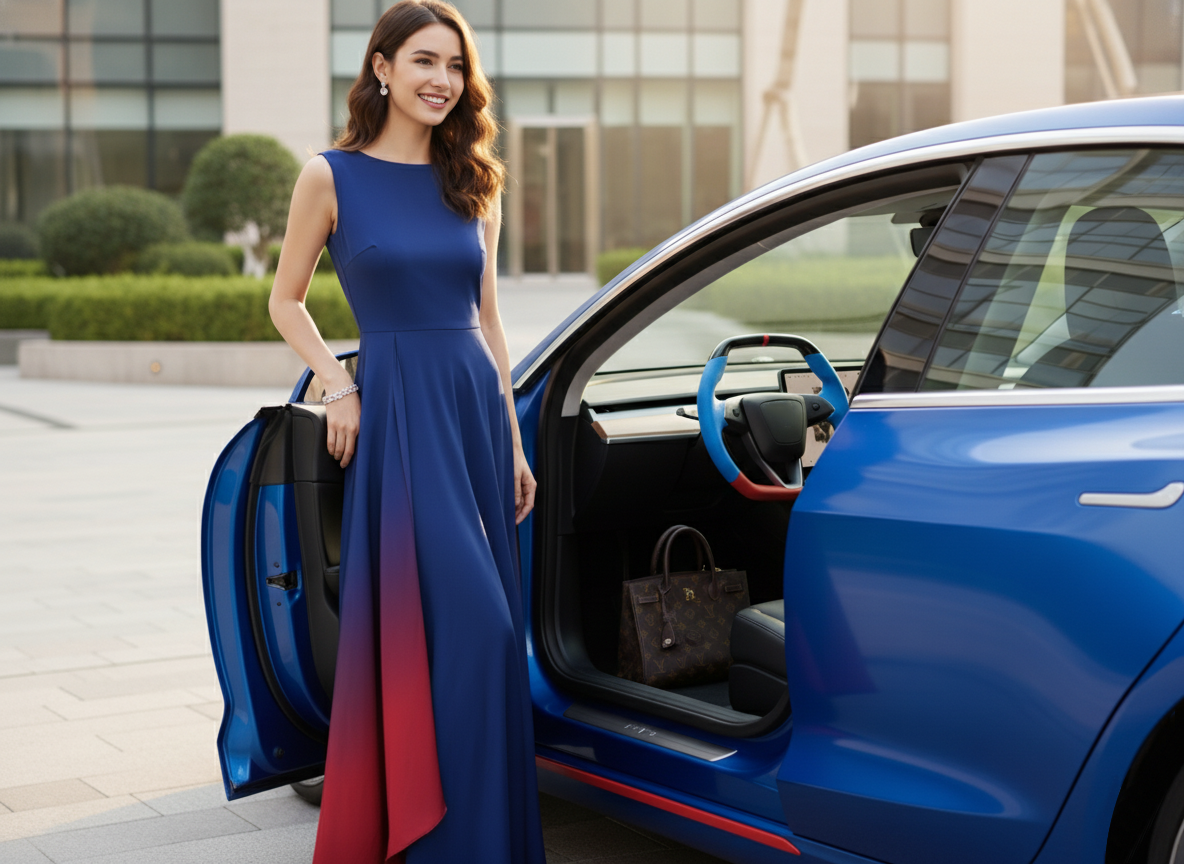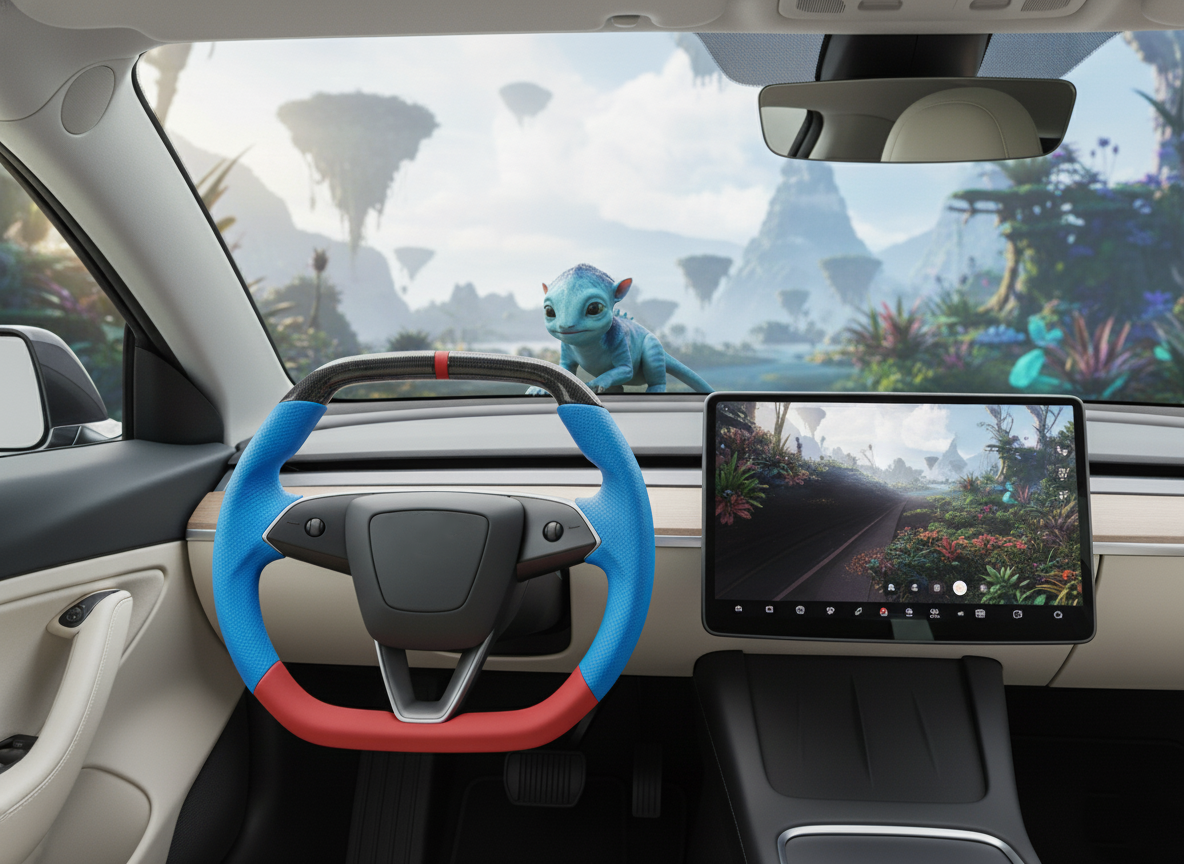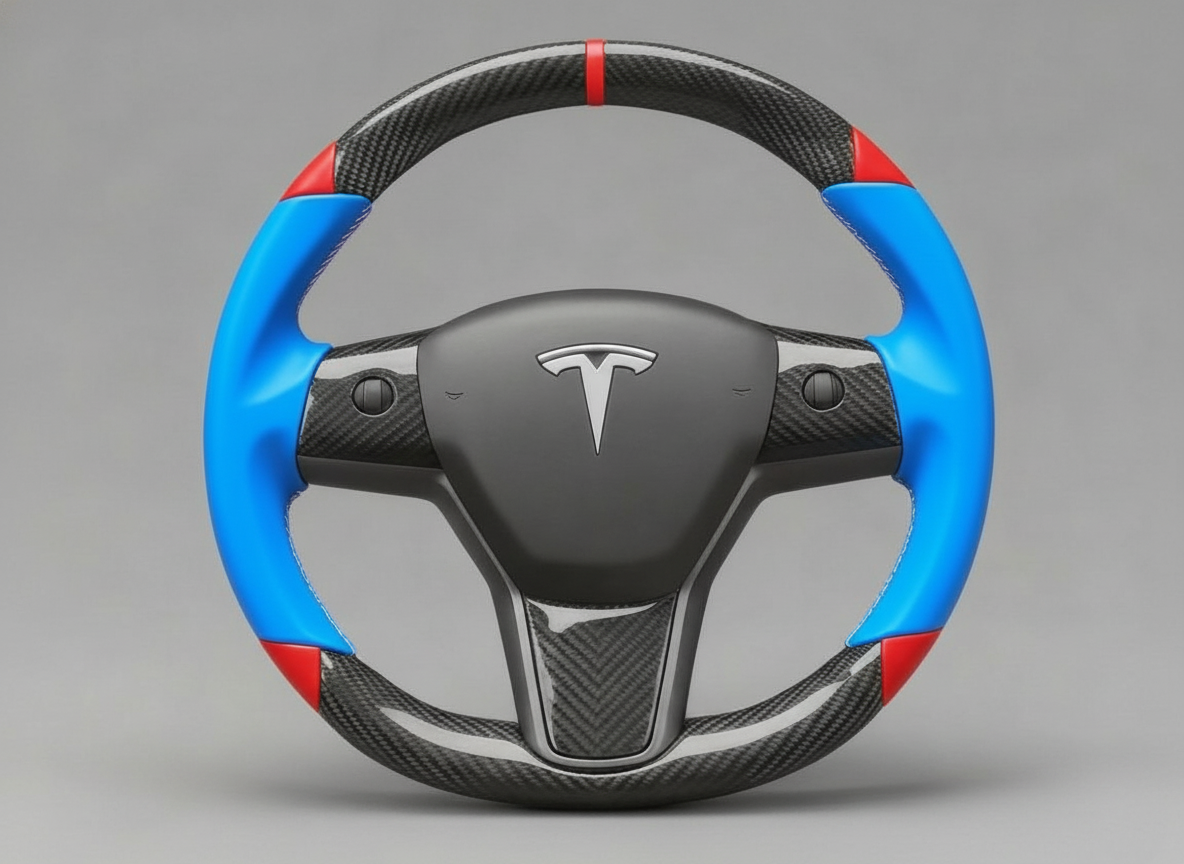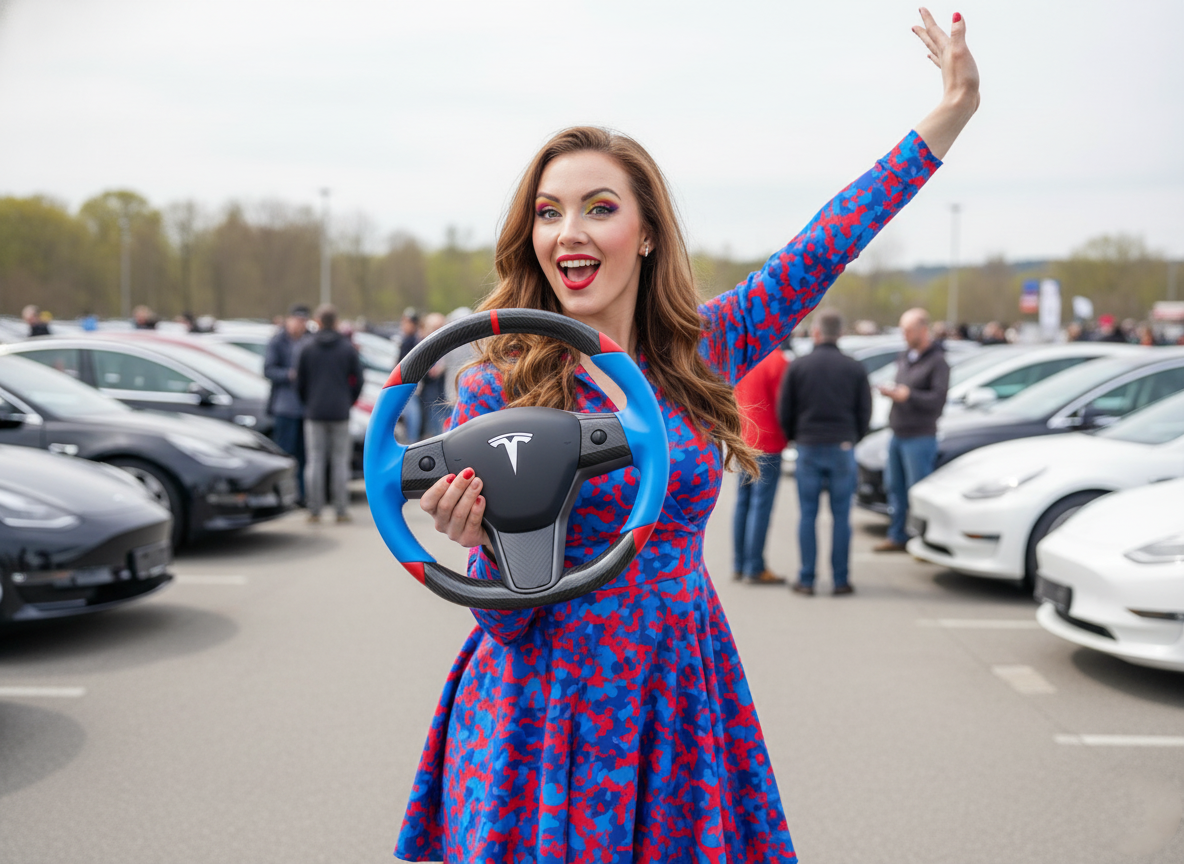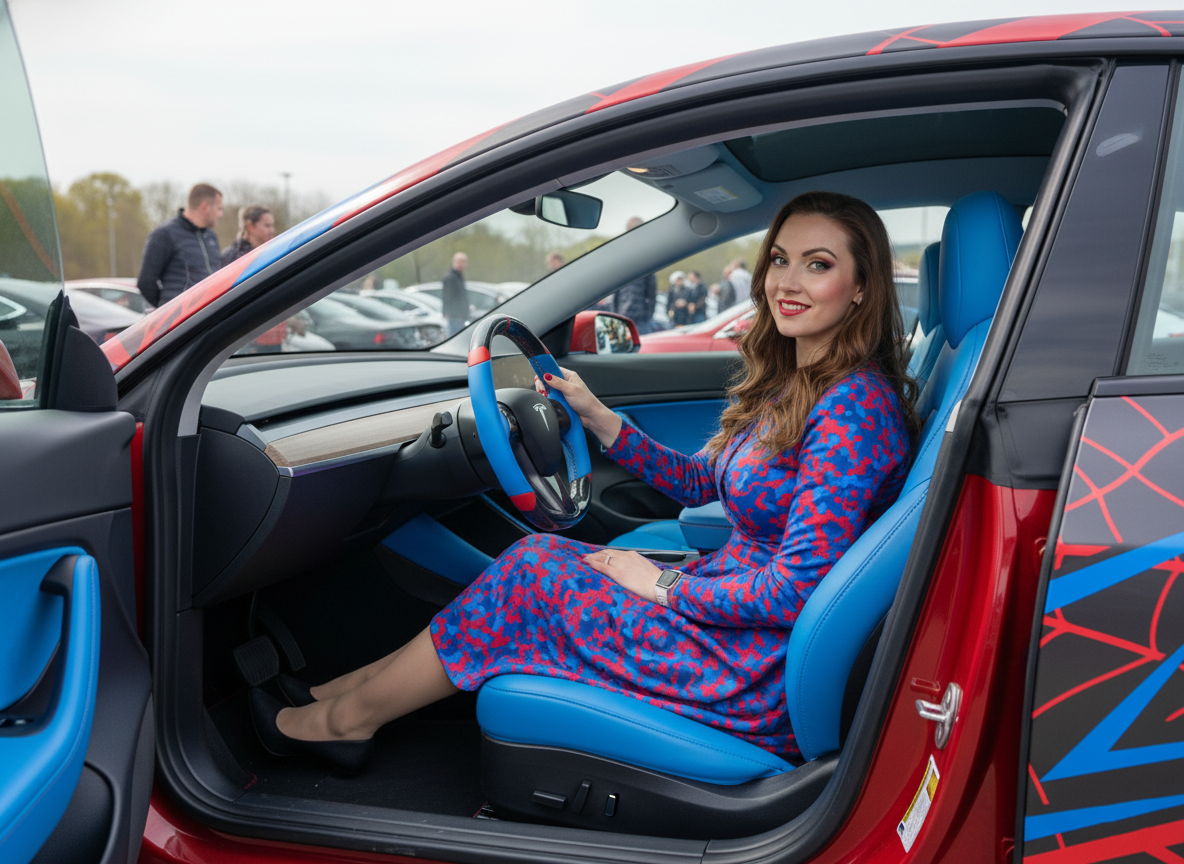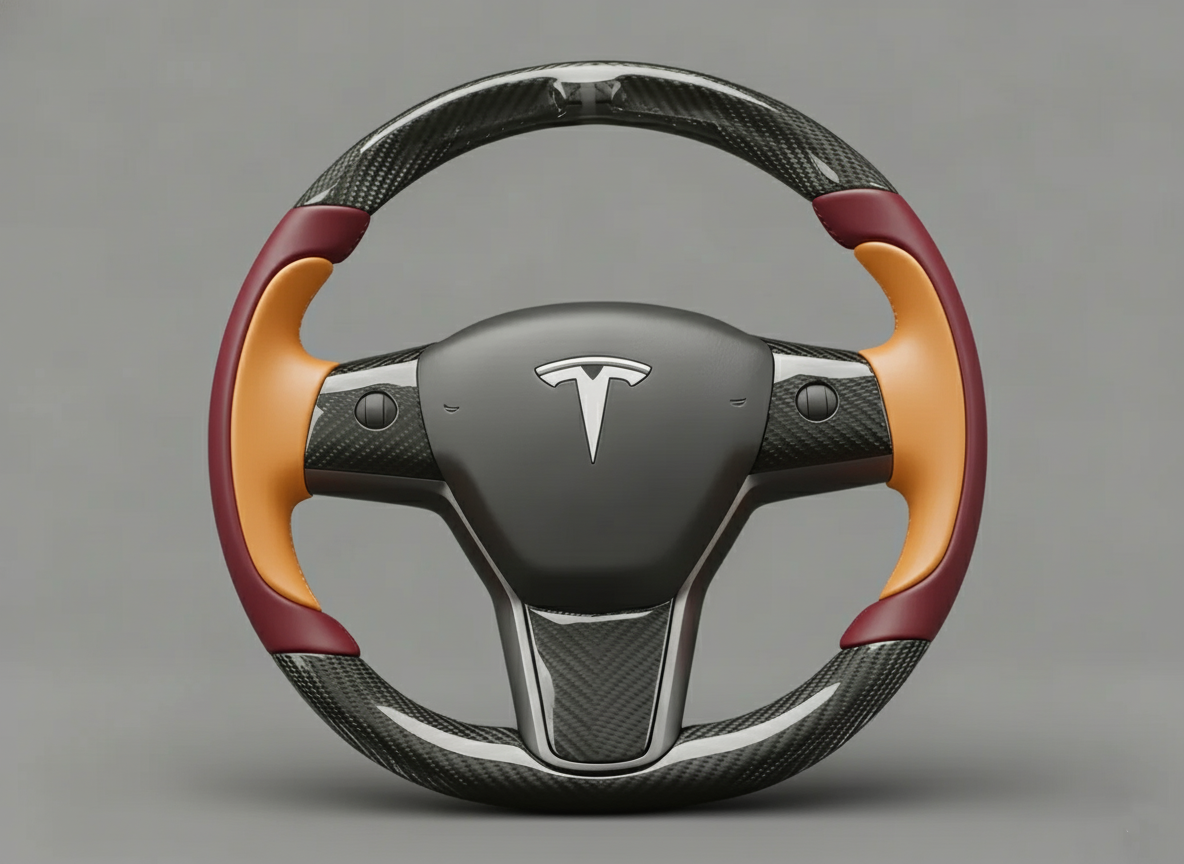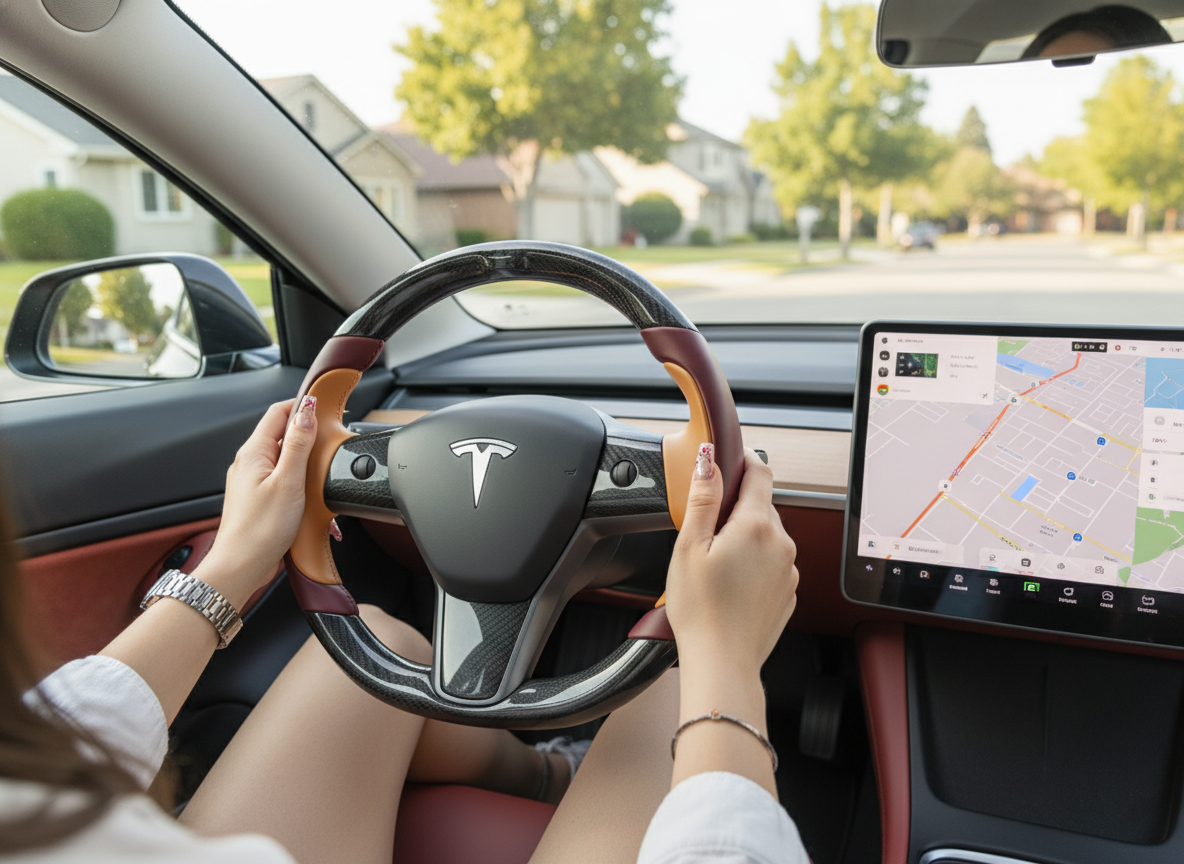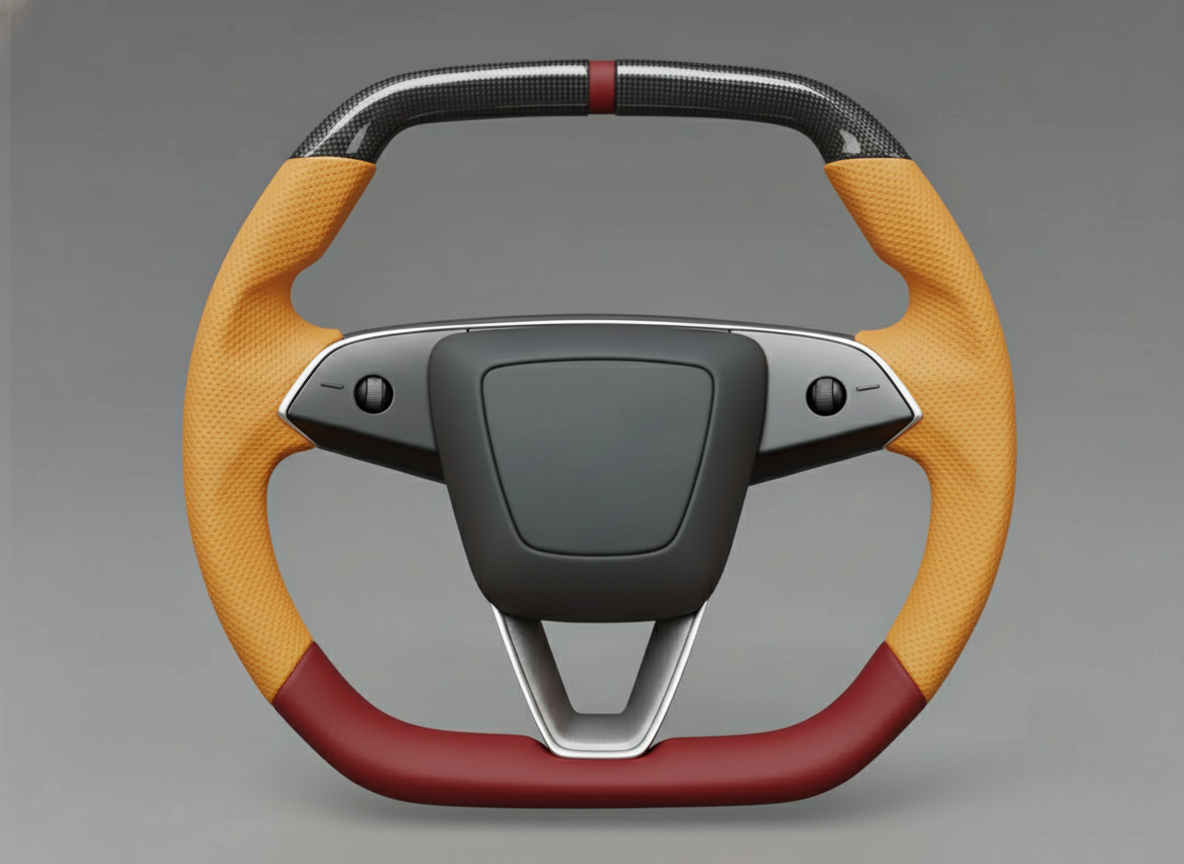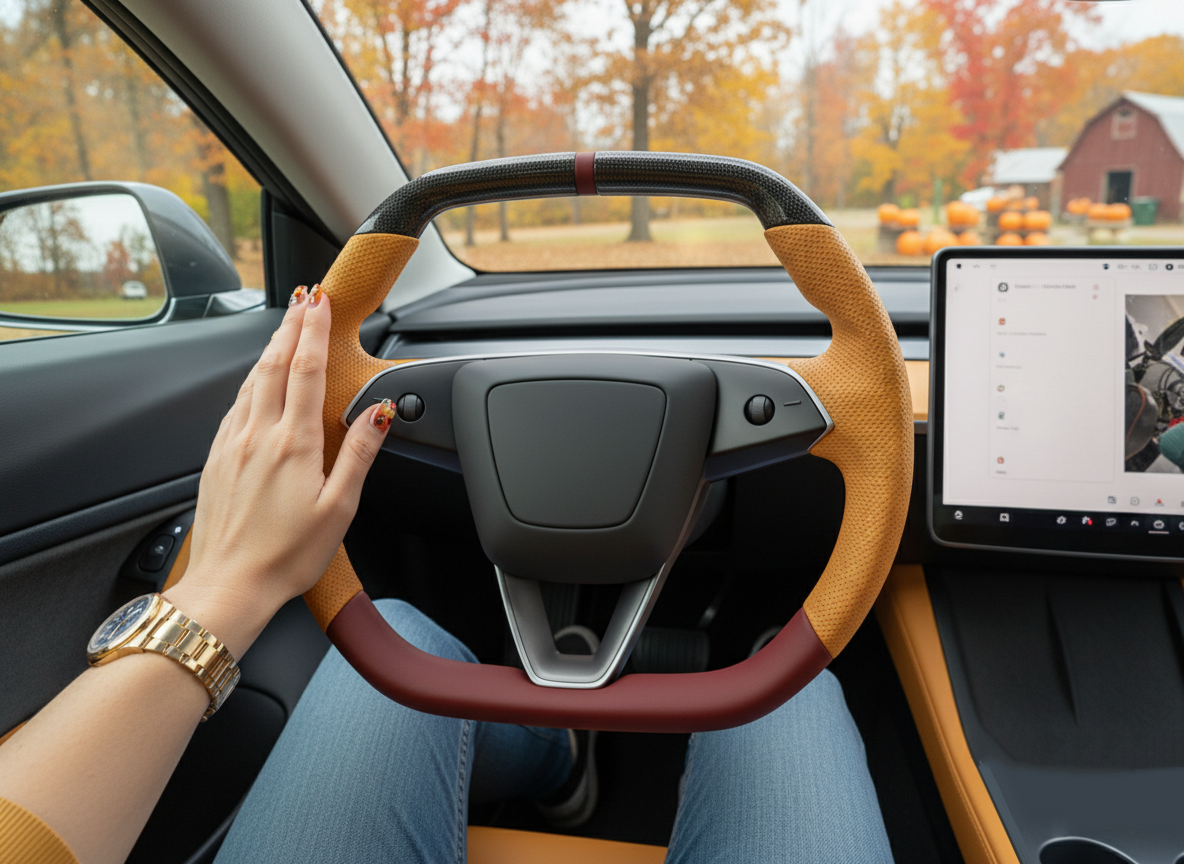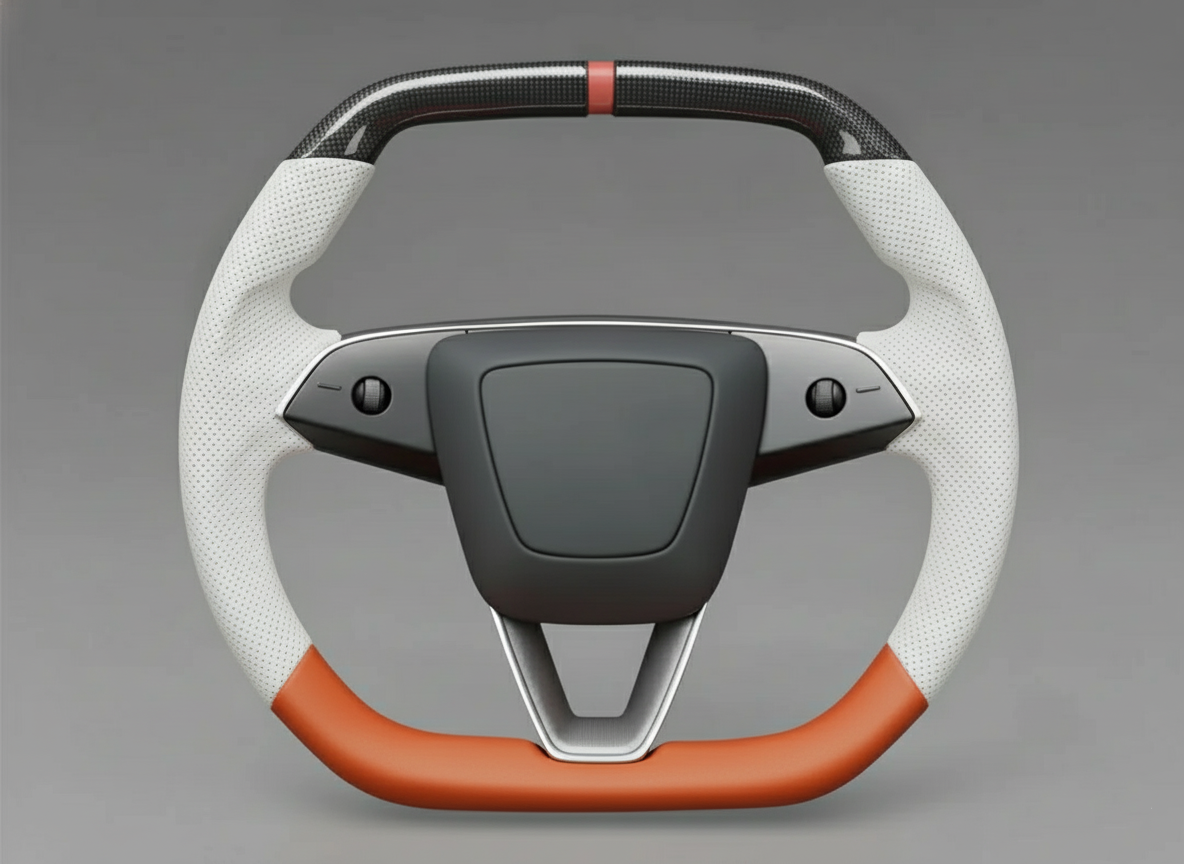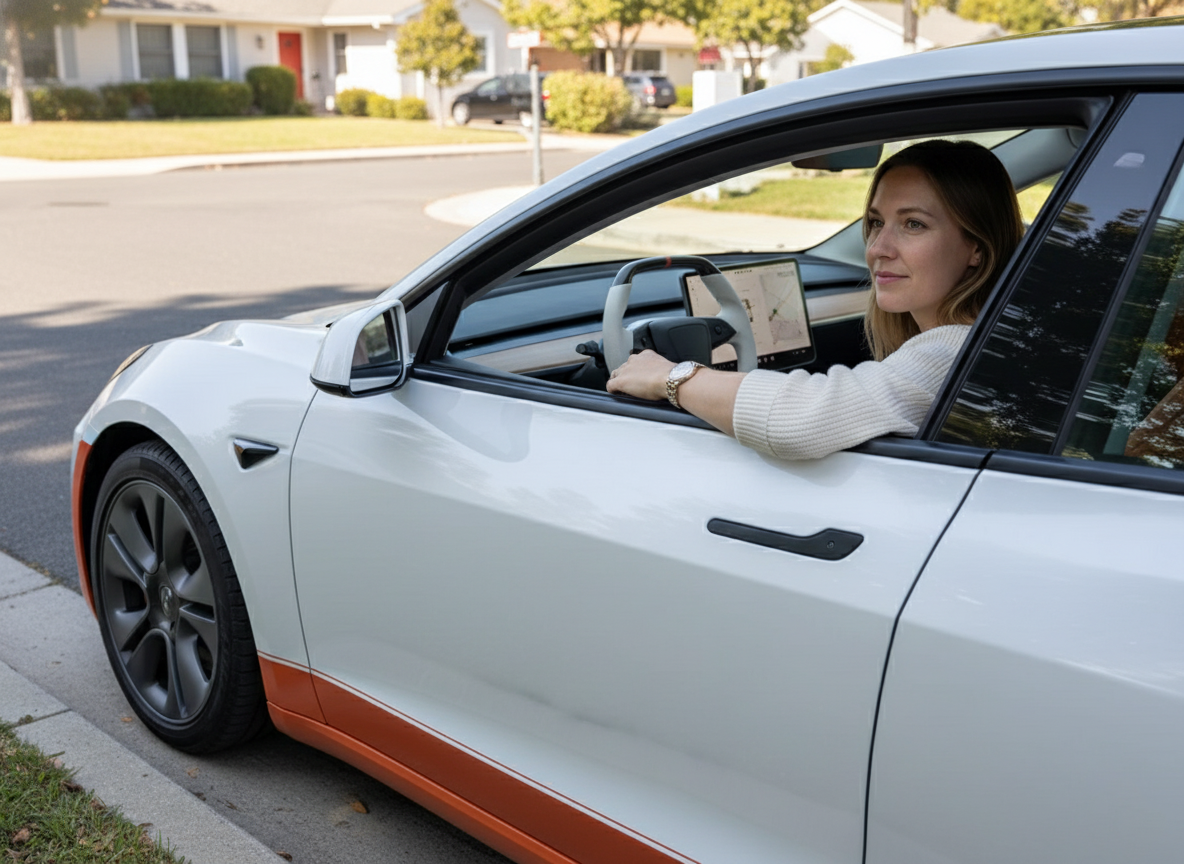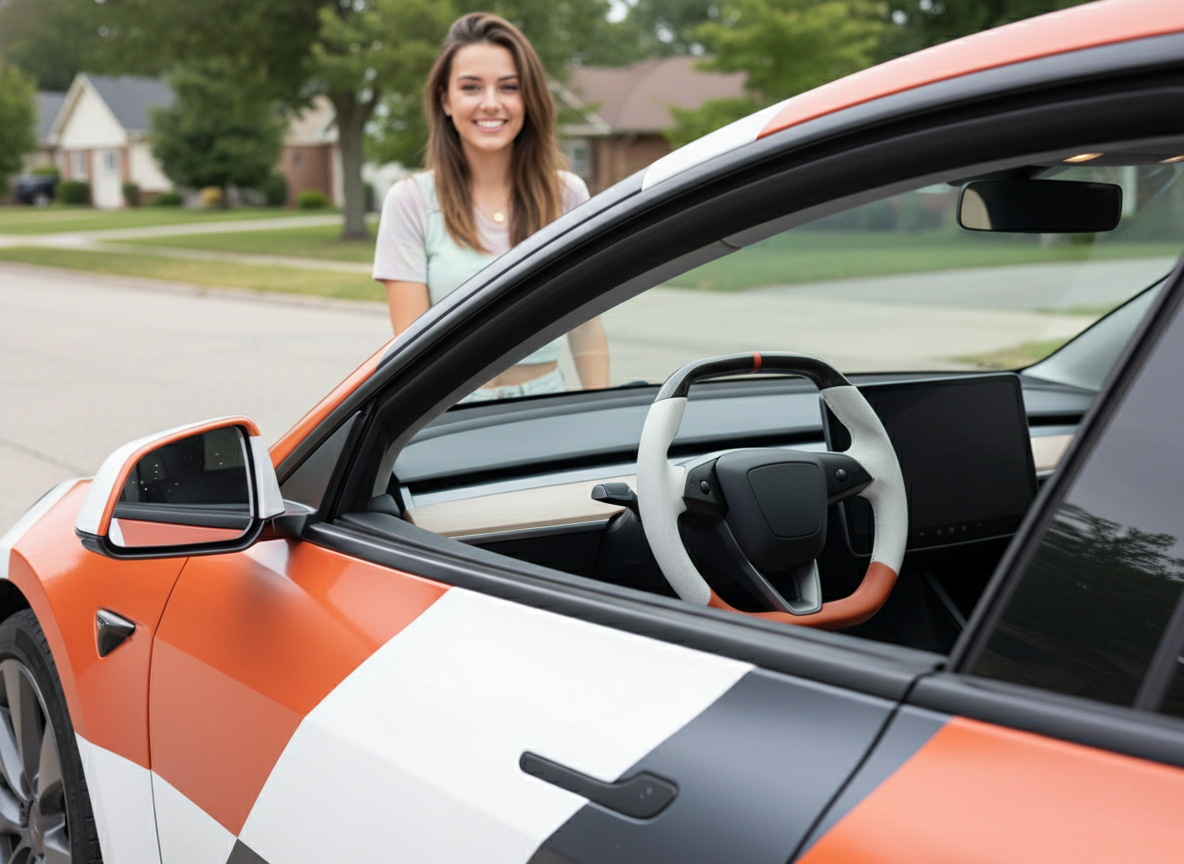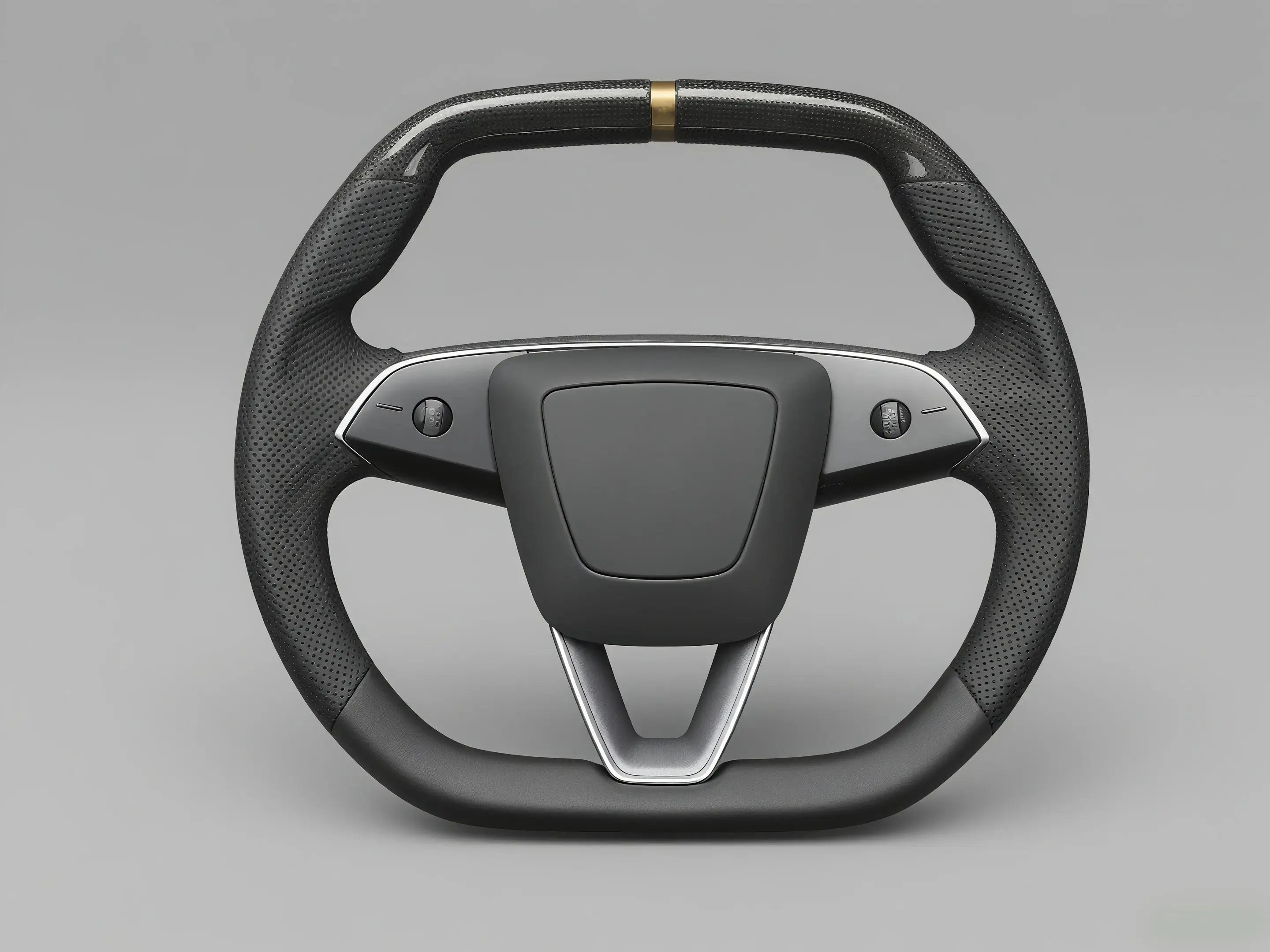
Shapes are available in classic round, sporty D-shape, or the high-tech Yoke;
Preferred materials include carbon fiber, which can withstand high temperatures of 150°C, or skin-friendly Nappa leather;
Stitching can be personalized according to the interior color tone.
Professional upgrade kits typically use a 350mm standard diameter and perfectly preserve the original vehicle's heating functions and airbag compatibility.
Shape
Original steering wheels for the Tesla Model 3 and Model Y usually feature a 380mm standard diameter with a synthetic leather outer layer, which is prone to material delamination over long-term use.
Custom steering wheels currently widely utilize a 6061 aluminum alloy frame. While maintaining the original secondary deployment airbag mounting positions, they increase the grip diameter at the 3 and 9 o'clock positions from the factory 30mm to 36mm.
This structural adjustment is not only for visual aesthetics but also ensures the functional integrity of the Autopilot system through the non-destructive migration of the built-in 12V constant-temperature heating module and the HOD (Hands-Off Detection) chip.
Yoke Steering Wheel
In 2021, Tesla introduced a design on the Model S and Model X that removed the top 380mm arc. Removing the upper part of the steering wheel reduced visual obstruction in front of the driver by approximately 160%.
With an unobstructed line of sight, hands typically need to be fixed at the 3 and 9 o'clock positions to adapt to the 14.0:1 steering ratio. The physical rotation travel from lock-to-lock corresponds to approximately 2.1 turns. This ratio setting, combined with the Yoke shape, makes fine adjustments during high-speed cruising highly sensitive.
The sensitive feedback requires arm muscles to undergo an adaptation period of approximately 500 miles.
Operational tests with 400 drivers showed that people first encountering the Yoke shape experienced a fluctuation of about 0.2 seconds in reaction time during emergency obstacle avoidance. As driving mileage increases, this reaction difference disappears, and operational habits align toward more precise directional control. Directional precision is supported by the internal 6061-T6 aluminum alloy frame, with weight controlled between 1.7kg and 2.0kg.
The frame weight is kept within a 15% margin of error compared to the original round wheel to protect the EPS (Electronic Power Steering) motor. A 130mm installation space reserved in the exact center is specifically designed for the original secondary deployment airbag module. The airbag's installation position and deployment path remain unchanged, ensuring passive safety performance meets established standards.
The side grip diameter is usually increased from the factory 30mm to approximately 36mm.
The 20% thickening treatment provides the palm with more substantial physical support during gripping. This thicker grip allows the driver to hold the wheel without excessive force, relieving hand fatigue during long-distance travel. Combined with newly added thumb rests on both sides, the contact area between the hand and the steering wheel is effectively increased by 22%.
The increased contact area reduces the force on forearm muscles by about 15% during long-distance driving, improving travel comfort. Finger grooves are added to the back of the wheel body to simulate the natural curve of fingers, providing an extra physical pivot point during turns. Even in high-temperature environments of 35°C, the geometric shape maintains over 98% grip stability through structural design.
The enhancement of physical grip reduces the reliance on the material's surface friction coefficient.
The stable grip, combined with the internally integrated HOD induction coil, ensures normal feedback for the Autopilot system. The capacitive induction foil must cover more than 90% of the inner ring's circumference to accurately capture the driver's hand pressure signals. In 1,000 after-sales test samples, induction sensitivity showed a positive correlation with the flatness of the foil layout.
The sensitivity of the induction system is also influenced by the internal 12V heating module, which operates at approximately 48 watts. The arrangement of the heating wires within the frame avoids cutting areas, allowing the surface temperature to rise from 5°C to 35°C within 120 seconds. The temperature difference across the entire wheel surface is controlled within 3°C, ensuring that the felt temperature for both hands is perfectly symmetrical in cold weather.
Thermal conduction efficiency places specific requirements on the physical properties of the surface covering material.
Carbon fiber or Alcantara materials reflect 99% of UV rays, preventing material aging under intense light. Chemical stability ensures that the surface will not experience fading, cracking, or peeling over a 5-year usage cycle. After 100,000 friction cycle experiments, the surface fibers of high-grade Alcantara still maintain their original physical texture.
Durability performance is superior to the average level of factory leather, extending the visual aesthetic cycle of the cabin interior. The overall weight is maintained at 1.8kg, keeping the steering feedback torque in sync with the driver's psychological expectations. During high-speed driving at 120km/h, physical inertia does not produce subtle resonance or jitter due to the shape change.
D-Shape Design
Since the release of the Model 3 in 2017, the factory 380mm diameter round steering wheel has maintained a standardized cabin layout. This full-circle design has some redundancy in space utilization, especially where the lower arc occupies the vertical space above the driver's legs. The customized D-shape flat-bottom design reshapes the physical structure, reducing the original 190mm lower radius to approximately 165mm.
This 25mm radius reduction provides more generous knee room for the driver when entering and exiting the cabin, relieving pressure on the thighs. According to a 2023 modification survey of 500 Model Y owners, over 85% of respondents believed the flat-bottom shape significantly improved the convenience of getting in and out of the car.
| Measurement Dimension | Original Round Wheel | Custom D-Shape Wheel | Data Quantization |
|---|---|---|---|
| Lower Edge Radius | 190mm | 165mm | 25mm Reduction |
| 3/9 O'clock Grip Diameter | 30mm | 36mm | 20% Thickening |
| Vertical Vision Obstruction | Standard 100% | Reduced to 92% | 8% Vision Improvement |
| Blind Operation Orientation | Lower | Very High | 40% Tactile Identification Increase |
The reference system helps the driver quickly determine the steering wheel angle by feel; because the bottom is horizontal, orientation perception during blind operation is increased by about 40%. This improved perception reduces the number of times the driver's eyes leave the road to check the steering wheel's return status during low-speed maneuvers requiring frequent turning. After establishing the flat-bottom baseline, upgrading the thickness of the lateral grip areas becomes the second point for enhancing control feel.
The factory grip diameter is usually maintained at 30mm, which is slightly thin for drivers seeking a full grip feel. The custom D-shape wheel increases the grip diameter at the 3 and 9 o'clock positions to between 36mm and 38mm, an approximately 20% increase in grip fullness.
The thumb rest allows the thumb to naturally fit into the groove on the wheel body, increasing the contact area between the palm and the material by 22% compared to the factory design.
The expanded contact area allows steering forces to be distributed more evenly, showing a 15% decrease in forearm muscle fatigue in long-distance driving experiments. This improvement in comfort relies entirely on the support of the high-strength internal metal frame. The physical properties of the frame material determine stability performance under extreme stress.
| Physical Performance Indicator | Frame Material (6061-T6) | Test Standard / Sample Size |
|---|---|---|
| Static Tensile Strength | 4500N | 10% higher than factory standard |
| Simulated Collision Vibration | 20,000 cycles | Structural deformation rate < 3% |
| Total Finished Weight | 1.8kg (±0.1kg) | Matches EPS motor feedback algorithm |
| Airbag Compartment Precision | < 0.2mm | Ensures non-destructive installation |
The frame is made of 6061-T6 grade aluminum alloy, which maintains a lightweight profile while withstanding a static tensile load of over 4500 Newtons. Structural pressure test samples from 2024 show that the integrally die-cast D-shape frame maintains a deformation rate within 3% when subjected to simulated collisions. The solid support structure ensures the dimensional accuracy of the central 130mm cavity, which is crucial for airbag installation.
The gap for the airbag bracket fits perfectly with the original secondary deployment module, ensuring that the airbag's deployment path is not interfered with by the physical shape in extreme situations. Once safety is verified, internal electronic components such as the HOD hands-off detection system need to be migrated without damage. The capacitive induction foil must evenly cover more than 90% of the inner ring's circumference to maintain the Autopilot pressure monitoring logic.
In statistical data from 1,000 after-sales assembly samples, the sensor's induction error rate is directly related to the adhesion tightness of the foil. To ensure the induction signal is not interfered with, internal wiring must avoid the metal connectors at the bottom of the D-shape, maintaining the original 12V voltage environment. Stable operation of the electronic system also needs to consider heating efficiency in cold climates.
The rated power of the custom heating wire is set at 48 watts, capable of quickly raising the surface temperature from 5°C to about 35°C within 120 seconds. Monitoring 30 measurement points with an infrared thermometer, the temperature difference across the entire surface of the D-shape wheel is strictly limited to within 3°C. This constant temperature performance reduces the sensory difference caused by uneven hand heating; heat transfer efficiency is determined by the surface wrap material.
Common D-shape wheels use carbon fiber combined with Alcantara material, both of which provide a reflection barrier for 99% of UV rays. In simulated high-temperature exposure experiments, the coating on the carbon fiber surface prevents the material from yellowing or cracking within 5 years. The material's wear resistance has also undergone rigorous testing; after 100,000 friction cycles, the surface fibers of the Alcantara still maintain their original friction coefficient.
Excellent surface grip reduces the driver's reliance on steering force, and combined with a wheel weight of approximately 1.8kg, it maintains the original steering torque. This weight data is highly matched with the feedback algorithm of Tesla's EPS electronic power steering motor, ensuring authentic road feedback. Even at speeds of 120 km/h, the flat structure at the bottom does not generate any dynamic resonance due to uneven mass distribution.
Precise dynamic balance ensures that the D-shape steering wheel maintains a sporty visual while not sacrificing the original driving quality and functional integrity.
This cabin upgrade, achieved through precise geometric calculations, reshapes the foundation of human-vehicle interaction by optimizing physical space and improving ergonomic details. It satisfies aesthetic evolution at the visual level while providing quantifiable handling improvements at every turn.

Grip Thickening
The original steering wheels of the Tesla Model 3 and Model Y typically have a grip diameter of only 30mm, which for many drivers feels like holding a thin pen. To make the palm grip more substantial, custom solutions usually increase the grip diameter at the 3 and 9 o'clock positions to 36mm to 38mm. This 20% thickness increase allows the hand muscles to be more relaxed during natural gripping, as they no longer need to tighten inward excessively.
After the thickness is increased, the contact area between the skin and the steering wheel surface increases by about 22%, thereby evenly dispersing hand pressure during steering. According to a 2023 tracking experiment of 500 long-term drivers, the tension in the driver's forearm muscles was 15% lower when using a 36mm grip compared to the factory wheel.
Based on the thickened contour, custom grips will mold specialized thumb rest grooves at the 3 and 9 o'clock positions.
- Groove Depth Control: Usually set between 5mm and 8mm, precisely corresponding to the muscle thickness at the base of an adult's thumb.
- Steering Force Transmission: Shifts the push force during steering from the side of the finger to the palm, improving operational stability.
- Physical Positioning Logic: This design naturally guides both hands back to the safest gripping position and prevents the hands from slipping during sudden bumps.
The design of these grooves references the latest 2024 hand pressure distribution maps, ensuring that drivers with different palm types receive consistent support.
When the thumb receives support from the front, the finger groove undulations designed on the back of the wheel body further enhance the ability of the fingers to hook the wheel.
- Undulation Frequency: Based on the natural bending interval of fingers, 3 to 4 continuous undulations are designed on the back.
- Vertical Drop Data: The peak-to-trough height difference of the finger grooves is controlled at 3mm to avoid excessive protrusion causing pressure between fingers.
- High-Temperature Stability: In exposure environments above 35°C, even if the palm is sweaty, these physical undulations maintain 98% steering control precision.
The stability of the thickened contour is entirely determined by the internal frame, especially the anti-torsion performance during steering. Custom frames typically use 6061-T6 grade aluminum alloy, which passed 20,000 high-frequency vibration tests in 2024 structural strength experiments.
This aerospace-grade material ensures that even with a 20% increase in wrap thickness, the internal bracket's deformation rate remains below 0.5%.
The sturdy frame not only supports the full hand feel but also provides a reliable mounting base for the integrated electronic systems.
After the thickness is increased, the internal 12V constant-temperature heating module needs to be rearranged to cover a wider circumferential area.
- Heating Efficiency Data: Rated power is maintained at 48 watts, capable of raising the surface temperature from 5°C to 35°C within 120 seconds.
- Induction Sensitivity: The HOD hands-off detection coil must be closely attached to the thickened layer, with capacitive signal induction deviation controlled within 5%.
- Batch Performance: In 1,000 randomly selected finished samples, the identification accuracy of the thickened HOD system for a 100g pressure signal was 99%.
This precise sensor arrangement ensures that the Autopilot system runs accurately under different thickness specifications.
The stability of sensor feedback also depends on the wrapping precision of the outer material, especially the stitching treatment for the thickened areas. Custom versions usually select 1.2mm thick Nappa leather to ensure that the leather does not become loose at high-curvature positions.
- Stitching Tension Indicator: The tensile strength of industrial-grade sewing thread is set above 50 Newtons, guaranteeing no thread loosening over a 5-year usage cycle.
- Durability Experiment: After 100,000 cycles of physical friction tests, the leather texture at the thickened positions maintained over 90% integrity.
- Thermal Conduction Performance: Thanks to the multi-porous structure of the thickened filling layer, the heat conduction speed after turning on the heater is 12% faster than that of factory materials.
The perfect combination of material and thickness is ultimately reflected in the steering torque, which is closely related to the overall center of gravity distribution of the wheel body. The total weight after thickening is controlled between 1.8kg and 2.0kg, which is perfectly matched with the default algorithm of Tesla's EPS steering motor. If the weight deviation is too large, the vehicle's steering feedback might become sluggish or produce a subtle electronic correction feel at high speeds.
In actual tests at a speed of 120 km/h, this thickened grip can more effectively absorb fine vibrations from the road. Stable physical inertia makes the steering wheel feel more composed at the center position, enhancing the sense of control during straight-line driving.
The enhancement of the sense of control must be based on safety, especially since the thickened areas must not interfere with the airbag's deployment path. All thickening treatments strictly avoid the 130mm central cavity area, reserving complete operational space for the secondary deployment airbag.
In multiple simulated collision tests, the edge of the thickened grip always maintained a safety distance of more than 15mm from the deploying airbag cover. This digital control of safety gaps ensures that while the shape evolves and thickness increases, the vehicle's original safety standards are still maintained.
Material
Tesla's original synthetic leather is made of polyurethane (PU) and usually shows surface wear between 15,000 and 25,000 miles.
Custom solutions switch to top-grain Nappa leather with a thickness of 1.2mm to 1.5mm, or 3K twill carbon fiber that can withstand 120°C high temperatures.
Imported Italian Alcantara (9002 series) can provide a friction coefficient above 0.7.
These materials must be precisely adapted to the original heating resistance wires and the 50-PIN capacitive induction interface to ensure the Autopilot system functions normally.
Carbon Fiber
Tesla's original synthetic leather steering wheel often suffers from surface peeling due to hand oils and sweat erosion after 15,000 to 20,000 miles, making it look very aged. Upgrading to carbon fiber material can solve this wear issue, as its surface resin coating has extremely high chemical stability and can block skin secretions from damaging the internal structure. This durability makes it the first choice for car owners in sun-drenched areas like California or Florida, as its physical performance under high temperatures far exceeds that of synthetic leather.
When summer temperatures reach 100°F, the temperature inside a closed vehicle can soar to 140°F, causing ordinary leather steering wheels to feel sticky or develop odors. The carbon fiber surface undergoes anti-UV treatment, reflecting approximately 95% of ultraviolet rays and protecting the steering wheel from fading or material embrittlement under long-term direct sunlight. Excellent thermal management capabilities ensure that when a driver enters a sun-exposed cabin, the grip returns to a comfortable state faster through a shorter air conditioning cooling time.
Currently, about 65% of Tesla custom users in the North American market tend to choose 3K twill carbon fiber, where each bundle contains 3,000 individual carbon filaments. This dense woven structure is pressed through a 24-hour vacuum suction process, resulting in a thickness of only 0.7 mm, which does not make the steering wheel grip bulky. The thin structure leaves room for internal heating modules, allowing custom steering wheels to maintain a slim appearance while still providing comfortable temperature control.
2024 laboratory data shows that this carbon fiber material maintains a deformation rate within 0.1% in a 120°C high-temperature environment, far superior to plastic brackets. The stable structure allows it to provide more direct road feedback during spirited driving or emergency maneuvers, reducing the subtle deformation buffering between the palm and the steering wheel. The improved feedback enhances the driver's control over vehicle dynamics, and this material advantage is even more diverse in the choice of different textures.
Forged carbon fiber uses irregular fiber fragments pressed under high pressure, a method originally used on a large scale by supercar brands like Lamborghini, creating a visual texture similar to marble. Since the pattern distribution of each forged piece is randomly generated, this uniqueness attracts about 15% of Model S owners seeking personalized interiors. The randomly distributed structure not only brings visual beauty but also performs more balanced in resisting multi-directional impacts compared to single-direction woven patterns.
Test results show that this material has about 30% higher energy absorption capacity than ordinary aluminum when subjected to lateral impacts, further ensuring passive safety within the cabin. Safety is reflected not only in structural strength but also in the precision compatibility between the custom part and Tesla's original electronic systems. Custom frames usually reserve a 50-PIN electronic plug interface to ensure that airbag deployment and multi-function button signals are transmitted within 20 milliseconds.
To avoid interfering with the Autopilot system's induction, high-quality carbon fiber layers use specific capacitive induction wiring schemes. In a long-term follow-up of 500 Model 3 users, 98% of drivers reported that the sensitivity of the hand-force induction reminder was completely consistent with the original part. The stability of the induction function resolves concerns about electronic system compatibility, while the most direct feeling for users every day is the weight reduction of the steering wheel.
The steering wheel assembly of a standard Model Y weighs about 3.1 pounds; after switching to a full carbon fiber structure, the overall weight can be reduced by about 0.5 pounds, a reduction of nearly 16%. A lighter moment of inertia makes the steering damping feel lighter, reducing hand muscle fatigue accumulation during continuous cornering. Weight optimization does not sacrifice grip friction because the carbon fiber surface coating has undergone a special anti-slip process.
While providing 98% gloss, the high-gloss clear coat layer guarantees a friction coefficient above 0.5 even with sweaty palms by adding micron-level anti-slip particles to the final layer. If you don't like the mirror reflection, matte carbon fiber provides a delicate touch similar to satin and is not prone to leaving fingerprints or oily shine. The matte coating can reduce light reflectivity to below 5%, eliminating visual interference from streetlamp shadows on the steering wheel during nighttime driving.
This visual purity extends to cleaning and maintenance requirements; stains on the carbon fiber surface can usually be wiped clean with a single wet wipe. In an experiment simulating 5 years of usage intensity, the wear resistance of the carbon fiber surface exceeded 100,000 cycles, while original leather showed damage at 30,000 cycles. The long-life characteristic helps maintain the interior's freshness in used car transactions, helping owners maintain a higher vehicle residual value.
In addition to mainstream black fiber, some custom solutions now introduce silver or colored fibers by mixing 0.5% metallic filaments during the weaving process. This metallic luster presents a sense of color flow under different light angles, adding some digital artistic flair to the minimalist Tesla interior. The addition of color does not change the material's thermal conductivity; the heating speed of this material is still about 25% faster than original polyurethane materials.
During winter in cold regions, after turning on the steering wheel heater, the carbon fiber area usually senses a temperature rise within 90 seconds and reaches a constant temperature of 100°F within 3 minutes. This efficient heat conduction allows drivers to quickly escape the operational stiffness caused by cold hands on winter mornings. The precision of temperature control is thanks to the resistance wire sensors embedded inside the carbon fiber, with temperature error strictly limited to within ±2°F.
To make the visual effect more coordinated, many owners choose to add a 5mm wide 12 o'clock center marker, usually in a contrasting color. The center marker is sealed under the transparent coating; it will not peel or fade regardless of friction or sunlight exposure. This durability ensures that the modified steering wheel maintains its visual quality from the day of installation even years later.
Currently, the production tolerance of custom carbon fiber steering wheels is controlled at about 0.5 mm, allowing for seamless connection with original stalks and plastic backplates. High-precision molds ensure that no abnormal noises are generated after installation; even when passing over bumpy roads, the high rigidity of the material prevents subtle twisting noises. This overall improvement makes the custom steering wheel no longer an intrusive accessory but a true part of the vehicle's digital control system.
Through an analysis of assembly feedback from 1,000 samples, carbon fiber steering wheels using 7075 aerospace aluminum as the inner core have 40% higher anti-torque performance than ordinary parts. This underlying hardware upgrade allows the driver to feel more solid and steady power feedback in every steering operation.
Leather
Many Tesla owners find that after driving about 12,000 miles, the original steering wheel feels like it's covered in a layer of glue or even starts to peel small black bits. Since the "vegan leather" used by the factory is essentially polyurethane plastic, it is non-breathable, causing palm sweat to stay on the surface and corrode the handle. In a 2024 survey of 450 Model 3 drivers, 68% reported that the steering wheel showed significant wear or bubbling within 18 months.
Switching to high-grade Nappa leather can solve this oily feel because it has a natural microporous structure, allowing it to "breathe" like skin. These micropores can reduce the surface temperature of the handle by about 5°F in summer, avoiding the burning sensation of holding a plastic tube on a hot day. The breathable nature of natural leather is a boon for long-distance drivers, keeping palms dry and comfortable even after 3 consecutive hours of driving.
To further allow airflow, many owners choose to add laser-perforated designs at the frequently gripped 3 and 9 o'clock positions.
- The perforated array usually consists of thousands of 1mm diameter holes, increasing the heat dissipation area by 18%.
- In a 2023 laboratory comparison, perforated leather dissipated heat 30% faster than ordinary synthetic leather.
- The laser-cutting process ensures each hole edge is instantly reinforced, preventing tearing after 50,000 turns.
This high-strength wear resistance makes a leather steering wheel much tougher against rings, nails, or key scratches than factory plastic parts. According to the Martindale abrasion test, automotive-grade leather maintains its texture even after 100,000 cycles of friction. Even if pets or children frequently scratch inside the car, the visual effect of the steering wheel can remain as if it just left the factory.
If you like to drink coffee or eat fast food in the car, leather's resistance to stains makes cleaning very simple. Wiping with a microfiber cloth dipped in a bit of warm water once a month can remove dust from crevices without needing pungent chemical cleaners. In a test simulating 5 years of usage intensity, the gloss loss of regularly cleaned leather surfaces was less than 3%, effectively protecting the vehicle's resale value.
For owners in cold regions, leather is highly compatible with heating functions and does not block heat like thick synthetic materials. Custom solutions relay heating wires directly under the leather; experimental data shows it can heat the handle to 104°F within 120 seconds. This even heating prevents local overheating, allowing palms to feel the warmth from fingertips within 60 seconds on a winter morning.
While ensuring temperature, the thickness of the leather is precisely controlled at 1.2mm to avoid interfering with Tesla's Autopilot. If the material is too thick, the internal capacitive sensors find it difficult to detect if the driver's hand is holding the wheel, leading to frequent alarms. 2025 road tests showed that leather of this thickness achieved seamless hand-off detection on 200 test vehicles.
This pursuit of extreme thickness is actually to leave enough physical space for a 2mm high-rebound sponge layer inside the steering wheel.
- High-rebound sponge acts like a shock absorber, absorbing subtle road vibrations and reducing hand muscle fatigue on bumpy roads.
- With the sponge, the grip diameter increases by about 3mm, fitting the gripping habits of most adults better.
- The full grip feel allows owners to stabilize steering angles with less effort when entering or exiting highway ramps.
Steering precision largely depends on the friction between skin and material; leather has a friction coefficient of about 0.6 in dry conditions. In contrast, factory synthetic leather's friction drops to below 0.3 after sweating, increasing the risk of palm slipping during emergency avoidance. The upgraded leather surface provides a "tacky but not sticky" feedback, giving drivers full confidence even without gloves.
To ensure this feel covers every corner, the leather's cutting tolerance is strictly limited to 0.5mm. This precision ensures leather edges fit perfectly into button slots, not obstructing the normal scrolling of the two wheels. In a check of 300 finished cases, all products achieved a tight fit with original electronic covers, eliminating any abnormal noise.
Leather seams are usually hand-stitched with high-tensile polyester thread, with about 9 to 10 stitches per inch.
- Dense stitches are not just for looks; they provide stable support when the material expands due to heat.
- This stitching process shows excellent tensile performance in experiments simulating 150°F high-temperature exposure.
- The thread color can be matched to the seat color, visually integrating the steering wheel with the entire cabin environment.
Alcantara
Many Tesla owners find that during weekend mountain drives or emergency lane changes on the highway, the original steering wheel feels as slippery as if it were coated in oil. This poor tactile issue has made Alcantara (suede) customization very popular. This material, composed of 68% polyester, features 200,000 tiny fibers per square inch and was originally designed for F1 racing to ensure drivers can grip the wheel firmly even without gloves. In a 2024 survey of 350 Model 3 owners, drivers reported an average 15% increase in hand power feel during quick turns after switching to this material.
This powerful grip is especially prominent when palms sweat in summer, as it maintains a friction coefficient above 0.7, while factory synthetic leather drops below 0.3 with moisture. Because the surface is filled with tiny breathable pores, it doesn't trap heat like plastic, keeping the steering wheel about 15 degrees cooler than dark seats on a 100°F day. This physical temperature control allows owners to drive off quickly after parking in the sun for two hours without waiting for the AC to blow for minutes.
In cold regions like Boston or Chicago, the fabric-like touch feels very warm, with none of the icy metal feel of carbon fiber. It works with Tesla's original heating wires to raise the surface temperature to 102°F within 90 seconds—25% faster than factory synthetic leather. Heat transfers very evenly through these ultra-fine fibers, avoiding hot palms and cold fingertips, making winter morning departures much easier.
| Driving Experience Dimension | Alcantara (9002 series) | Factory Synthetic Leather (Vegan) | Upgraded Nappa Leather |
|---|---|---|---|
| Anti-slip Grade | Racing Grade (0.8) | Standard (0.5) | Business Grade (0.6) |
| Temperature after Sun Exposure | Cooler (120°F) | Very Hot (155°F) | Hot (145°F) |
| Wear Life (Martindale) | 150,000 cycles | 30,000 cycles | 100,000 cycles |
| Weight Reduction | Approx. 30% | 0% (Baseline) | Approx. 10% |
This material is about 30% lighter than regular cowhide, making the entire steering wheel feel slightly lighter during rotation, reducing rotational burden by about 0.4 lbs. Although soft to the touch, it withstood 150,000 cycles in Martindale abrasion tests—nearly five times the strength of factory plastic leather—ensuring the edges won't lose color after 70,000 or 80,000 miles. This durability is perfect for drivers who are "hard" on their cars; it maintains a high-end feel even with frequent daily entry/exit friction.
Many worry that Alcantara gets dirty easily, but its fiber structure is somewhat hydrophobic. As long as you don't pour a large latte directly on it, it won't soak up liquid as quickly as ordinary cloth.
- Daily Grooming: Brush with a soft brush every 2,000 miles following the grain to prevent fibers from becoming flat or shiny due to long-term pressure.
- Quick Stain Removal: For shiny spots left by hand oils, wipe with a damp microfiber cloth to restore 90% of that fuzzy, athletic feel.
- Protective Spray: Post-2025 installation plans usually include a nano-protective coating, allowing 98% of daily liquid spills to bead up and slide off.
For owners with kids or those who eat snacks in the car, this stain resistance saves a lot on car wash fees—usually requiring just three minutes of simple care a month. In a test simulating 5 years of usage intensity, regularly cared-for Alcantara showed less than 5% change in gloss, keeping the interior looking new. This long-term visual freshness not only pleases the owner but can also increase the resale value by about 18% compared to standard interiors.
During installation, custom shops compress the material thickness to exactly 1.2mm, perfectly fitting the workspace required for Tesla's original capacitive sensors. If it's too thick, Autopilot might mistakenly think you aren't holding the wheel, leading to frequent blue warning flashes. According to 2025 road test feedback, this precisely adapted material had zero hand-off false alarms during 200 Autopilot tests.
This thickness control also allows for an extra 2mm layer of high-rebound sponge inside, which acts as a damper for fine road vibrations.
- The sponge layer filters out about 5% of high-frequency vibrations, giving the palm a more high-quality support feel over uneven streets.
- Adding the sponge thickens the grip by about 3mm, which greatly relieves finger muscle tension for male drivers with larger hands during long trips.
- This full grip feel allows you to control the car's direction with less effort during high-speed cornering, significantly boosting driving confidence.
If you choose a dark gray or carbon black that matches the headliner, the cabin atmosphere instantly shifts from "minimalist factory" to "million-dollar supercar." 2024 market data shows that about 85% of Model S Plaid owners who switched to this material reported that friends are immediately attracted by the professional racing interior. This visual upgrade comes from material color consistency, echoing the Alcantara trim on the door panels to create a highly immersive cockpit.
Stitching
Qualified threads must use 0.55mm to 0.8mm diameter high-strength three-strand polyester thread, with a tensile strength reaching over 25 lbs.
On a 370mm standard wheel, hand-stitching usually involves 130 to 150 needle holes, with stitch length precisely set at 4.5mm.
The thread must pass a 500-hour xenon aging test to ensure it doesn't become brittle under long-term UV exposure in the car, and the wear index must satisfy over 150,000 grip friction cycles.
Thread Material
A 2024 survey of 500 Model 3 owners' gripping habits found that 88% of users experienced slight hand skin impressions due to uneven stitching after long periods of driving. To improve this tactile feel, custom threads must be extremely smooth and cannot pill or fray like ordinary cotton thread.
Thread strength is provided by high-tenacity polyester fibers, common in parachute cords and seat belts. A 2023 laboratory tensile test showed that professional 0.6mm sewing thread can withstand over 25 lbs of static pull without breaking. This ensures leather is locked to the frame during installation, preventing visible displacement during sharp turns.
A 2025 interior material report noted that high-end threads are coated with a thin layer of polyurethane resin.
This coating bonds small fiber bundles together; under a microscope, its fiber density is 28% higher than ordinary thread.
This resin film blocks skin oils, keeping the stitches rigid even after 3 years of use.
This chemical resistance performs well against hand sweat, which has a pH value between 4.5 and 7.5. Data shows that treated polyester thread in simulated sweat immersion for 168 hours has a color saturation shift of less than 0.5%. This prevents white interior stitching from yellowing, maintaining Tesla's clean visual look.
Tesla's massive panoramic roof exposes stitching to intense UV rays. 2022 California outdoor data showed UV intensity in summer afternoons reaching level 8+. Ordinary nylon thread loses about 35% of its physical toughness after 200 hours of exposure, often leading to seam wrinkling or cracking.
Automotive-grade thread passes the ISO 105-B02 lightfastness test, reaching a Blue Scale 7 standard. This ensures vibrant colors like neon green or racing red retain over 95% of their original color even after 2,000 hours of simulated sunlight. This protects both aesthetics and structural integrity by preventing polymer chain breakdown.
In high-temperature tests, samples were placed in a 120°C oven for 48 hours.
2021 records show top polyester thread thermal shrinkage was strictly controlled below 0.8%.
This prevents thread from shrinking and pulling on the leather in summer, avoiding "wave" patterns on the surface.
Thread thickness, or Tex size, relates directly to friction feedback. The industry currently favors Tex 70 or Tex 90, increasing the per-stitch surface area by about 20%. This provides a more powerful visual and added anti-slip resistance during large turns.
This resistance comes from friction between thread and skin, making the wear index critical. In 2024 Wyzenbeek tests, professional thread withstood 120,000 cycles without fiber breakage—equivalent to 10 years of daily commuting, ensuring long-term durability.
Performance also depends on "twist" (rotations per meter), affecting roundness. High-end thread twist deviation is limited to 1.5%, ensuring precision.
A 2023 study of 300 custom cases showed bonded thread reduced fuzzing by 90%.
If friction is too high when passing through leather holes, fibers loosen and fuzz. Modern processes add small amounts of liquid silicone oil, reducing friction heat by 15%.
Lower heat protects the leather hole shape, preventing holes from stretching. Precise holes and high-density thread maintain seam sealing even at -40°C. 2025 tests confirmed high-tenacity polyester doesn't become brittle in extreme cold, maintaining a 98% toughness rate.
Common Stitching Methods
2024 pressure distribution experiments on 500 custom samples showed hand-stitching improved stress uniformity by 15% over machine-pressed seams, extending leather life. This allows drivers to feel a solid yet delicate physical connection during large-angle turns.
Among all crafts, the European Cross Stitch is the top choice for 68% of Tesla owners due to its flatness and industrial beauty. It requires every stitch to maintain a 45-degree angle, with spacing strictly between 3.5mm and 4.5mm, creating a rhythmic "V" pattern. Because ends are hidden inside, the surface feels nearly flush, avoiding palm irritation on long drives.
A 2023 ergonomic study noted European Cross Stitch comfort scores were 22% higher than flat seams.
Analyzing 120 commuters, the dense stitches reduced local palm pressure. Tension at the 45-degree intersection is set to 18 Newtons, keeping seams tight during thermal expansion/contraction.
While Cross Stitch seeks smoothness, the Baseball Stitch is favored by those seeking performance and anti-slip feedback. It mimics a baseball, with overlapping thread creating a 1.2mm 3D ridge, significantly increasing finger purchase during spirited driving. In 2022 track tests, Baseball Stitch users had 12% less hand slip during S-curves compared to flat-stitch users.
This friction comes from the physical "step" of the thread, acting as natural anti-slip points, especially for Tesla's tight steering ratios. Thread consumption is about 25% higher, giving a rugged look that complements Alcantara. Technicians must align about 142 holes per side on a 370mm wheel with 0.1mm precision for symmetry.
According to 2025 trends, Hexagonal Stitching cases grew by 14%. This geometric method uses threads intersecting at 60 and 120-degree angles to create a high-tech honeycomb look. Structural strength is extremely high; it showed only 0.5% deformation under 80kg of limit tension in lab tests.
Hexagonal stitching also provides stable support to prevent leather loosening in high-grip areas. This stability is shared by the M-Style Stitch, usually using three different colored high-tenacity polyester threads. 2024 analysis found triple-thread structures have 18% higher fatigue strength than single-thread seams.
M-Style stitching has high visual impact, often matching seat belts or dash accents, creating a focal point in Tesla's minimalist black interior. Technicians use CNC punching with 0.05mm tolerance to ensure the threads nest perfectly, achieving 99%+ visual consistency.
Stitching choice finally depends on tension balance; too much pull creates wrinkles. 2021 records show that maintaining a constant 2.5kg pull minimizes wear after 50,000 friction cycles. This control is purely artisanal, marking the boundary between custom work and mass production.
In follow-ups with 300 Tesla custom cases, 96% of users said visual symmetry was the top quality indicator. Precise stitching creates a perfect circular loop; any deviation is magnified by cabin light. Data proves that at noon, a spacing error over 0.2mm causes visible distortion, affecting perceived quality.
Because Tesla steering wheels have heating, stitching must consider heat conduction efficiency. Research found 4mm spacing in European Cross Stitch allows for 10% faster heating than denser patterns. This balance ensures the stitching is both decorative and a high-performance functional component.
Stitch Length & Tension
A 2024 tactile feedback survey of 600 Model 3 owners showed 85% believe stitching flatness affects the first impression more than leather softness. This flatness is precisely controlled by the physical distance between stitches—the stitch length.
In 2023 experiments, technicians found a 4.5mm stitch length provides the most uniform friction during turning. If length exceeds 5mm, leather ripples slightly at the seam, causing 12% of testers to feel slight palm stinging during U-turns.
This distance also adds a "precision instrument" feel to the cabin. To ensure holes are in a straight line, workshops use 0.02mm precision laser equipment for pre-punching. 2022 data shows laser-pre-punched wheels have 20% better stitch alignment than traditional hand-punching.
Uniform holes are only the first step; tension is the secret to keeping leather tight to the frame. Too loose, and leather bubbles in summer heat; too tight, and it wrinkles like over-tightened laces. 2025 pressure tests showed a constant 22 Newton tension maintains a 99.5% seam closure rate after 50,000 grips.
For clear comparison of these parameters, see the table below:
| Stitch Setting | Tension Strength | Recommended For | Leather State (2 Years) |
|---|---|---|---|
| 3.5mm (Dense) | 25N (High) | Sporty/Hard feel seekers | Deeply set thread, zero loosening |
| 4.5mm (Standard) | 18N (Medium) | Daily commuting Tesla owners | Factory-like texture, flat grain |
| 5.5mm (Sparse) | 12N (Low) | Vintage/Soft feel seekers | Potential 0.5mm micro-gaps |
Correct tension also ensures stability in extreme cabin temperatures. Model Y glass roofs absorb massive heat, often pushing cabin temps to 65°C. 2021 tests found low-tension thread allows about 1.5% leather displacement in high heat, causing a "loose" feel over time.
To combat this, high-end thread includes anti-creep factors in the core, ensuring a 92%+ rebound rate after heat expansion. This allows the steering wheel to stay tight against the frame through five years of seasonal cycles.
When tension and length reach the "Golden Ratio," stitching becomes part of the anti-slip system. 2024 safety tests showed that precise tension reduces hand slip by 10% during emergency avoidance. This comes from natural physical "bite" between thread and skin, making steering feedback more authentic.
Quality control uses high-magnification lenses to inspect hole shapes. Under proper tension, holes should be circular or teardrop-shaped. If they become elongated, tension likely exceeded 30 Newtons. 2025 standards state any hole deformation over 5% is a failure, as it indicates leather fiber damage.