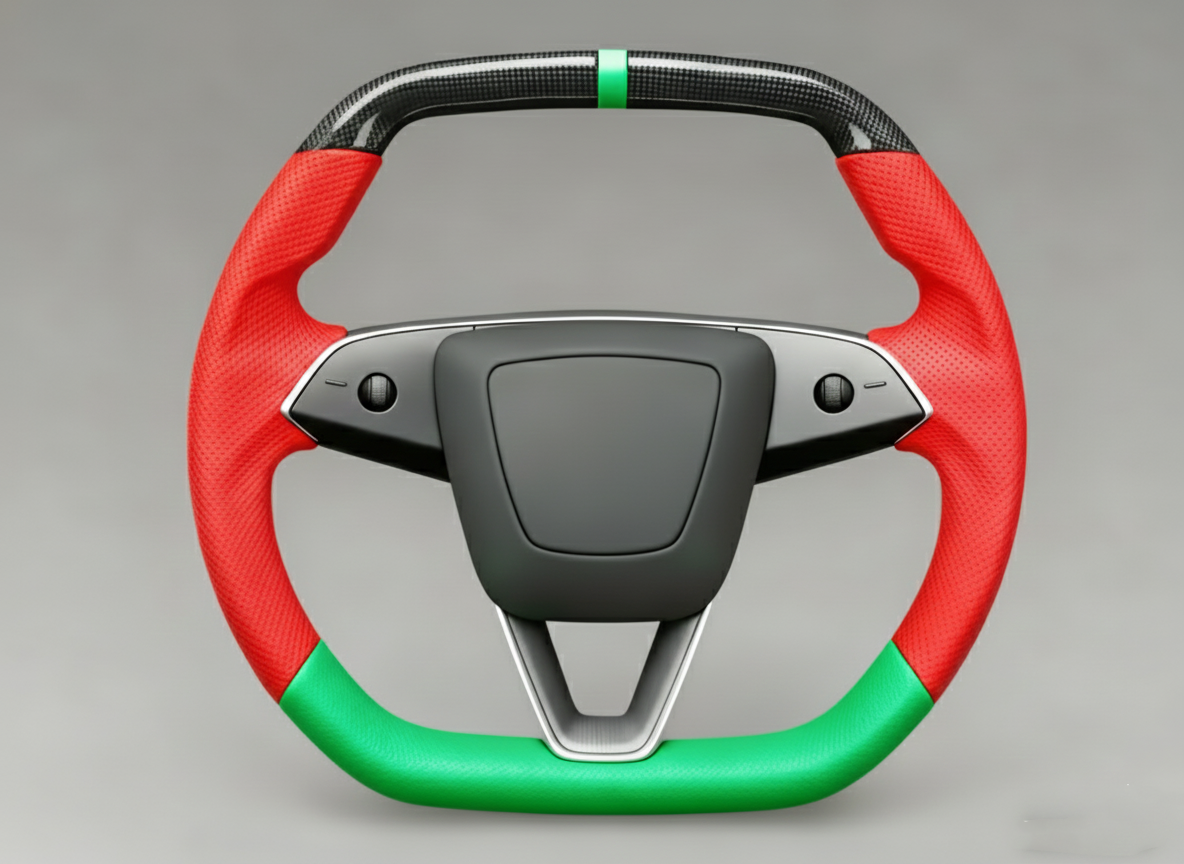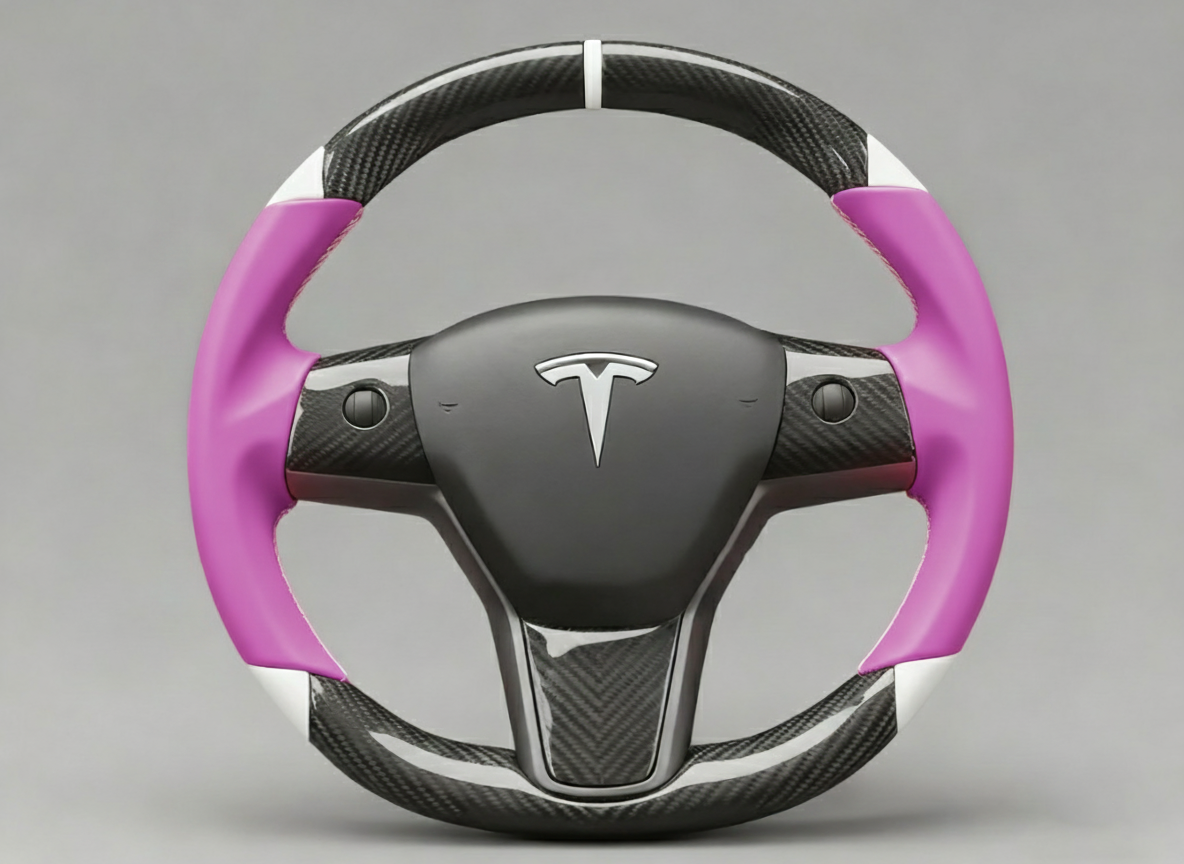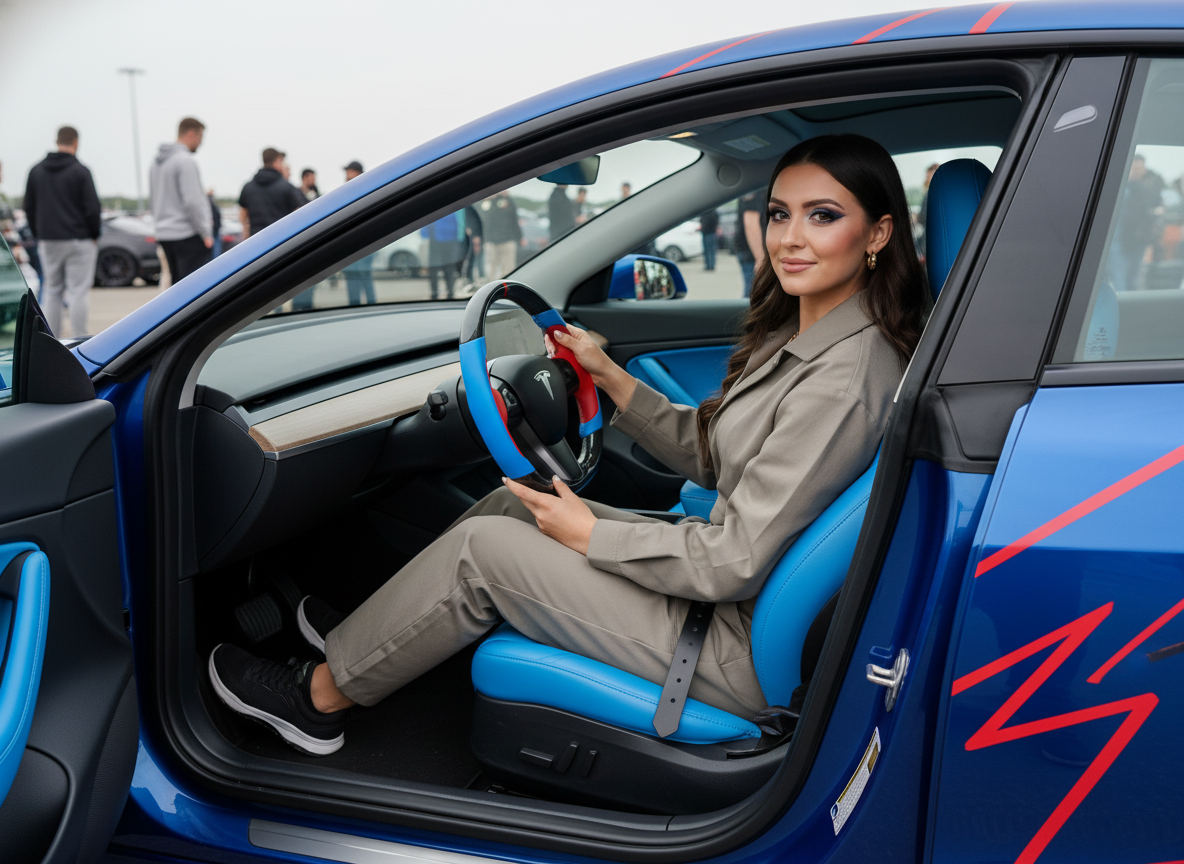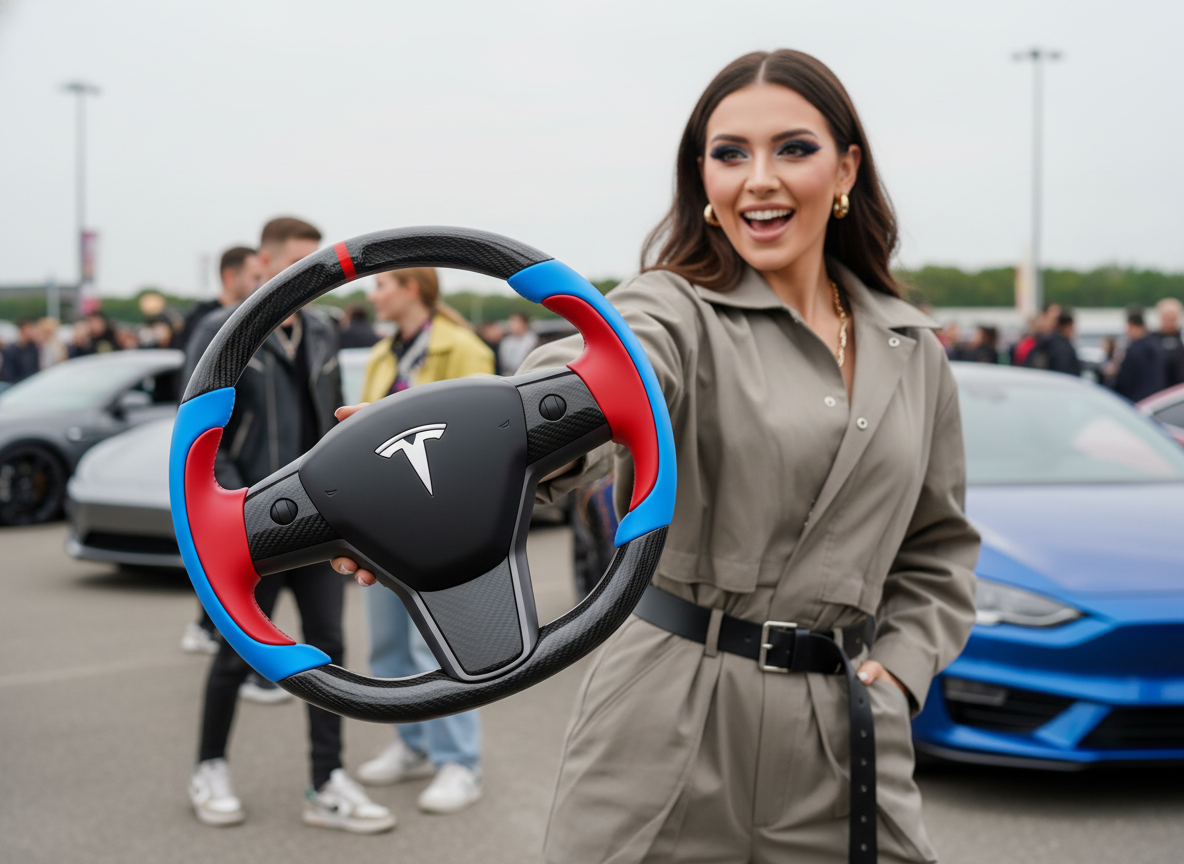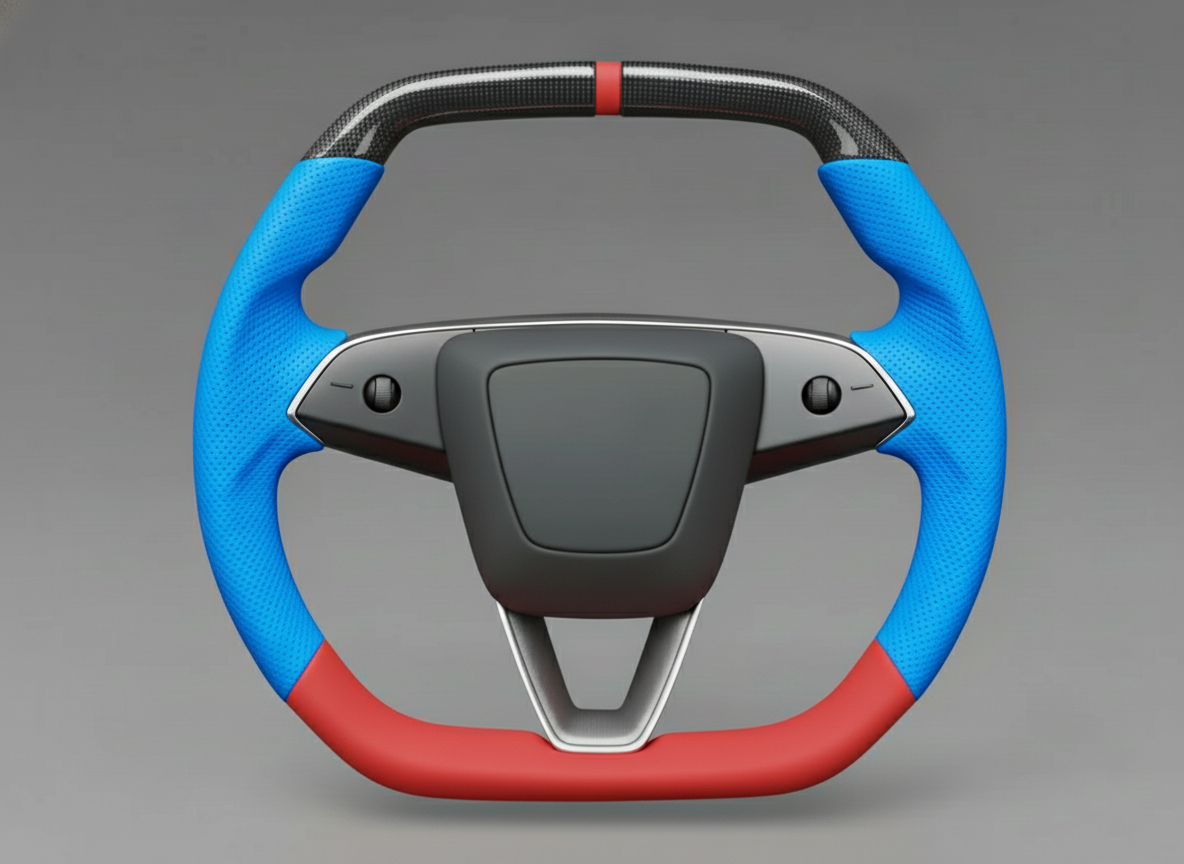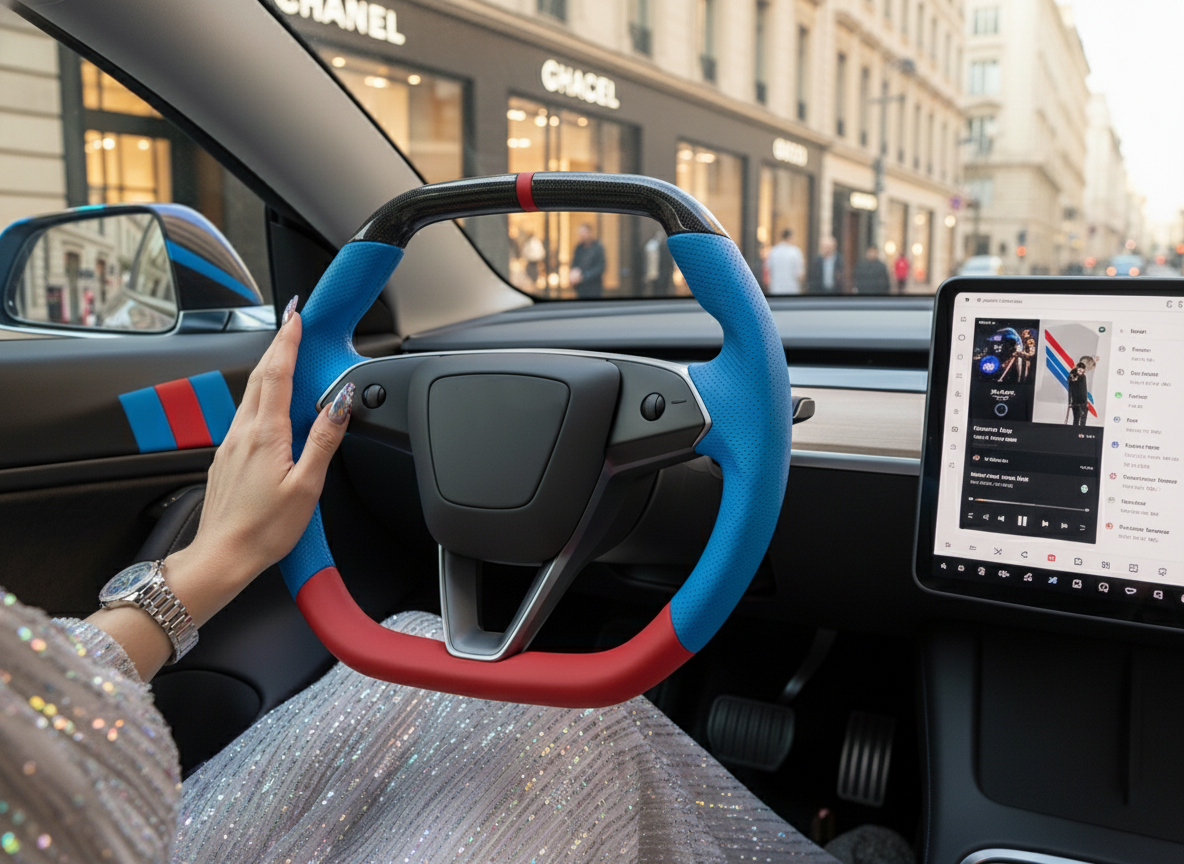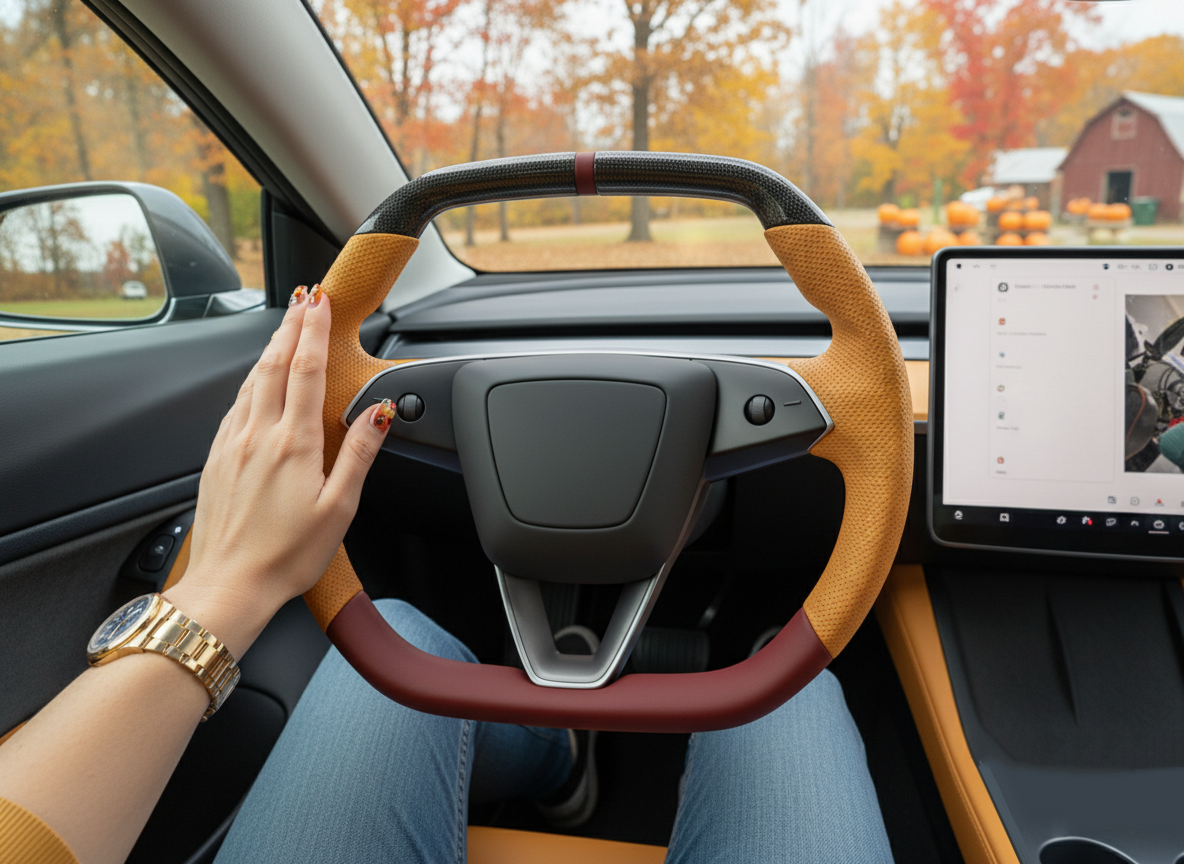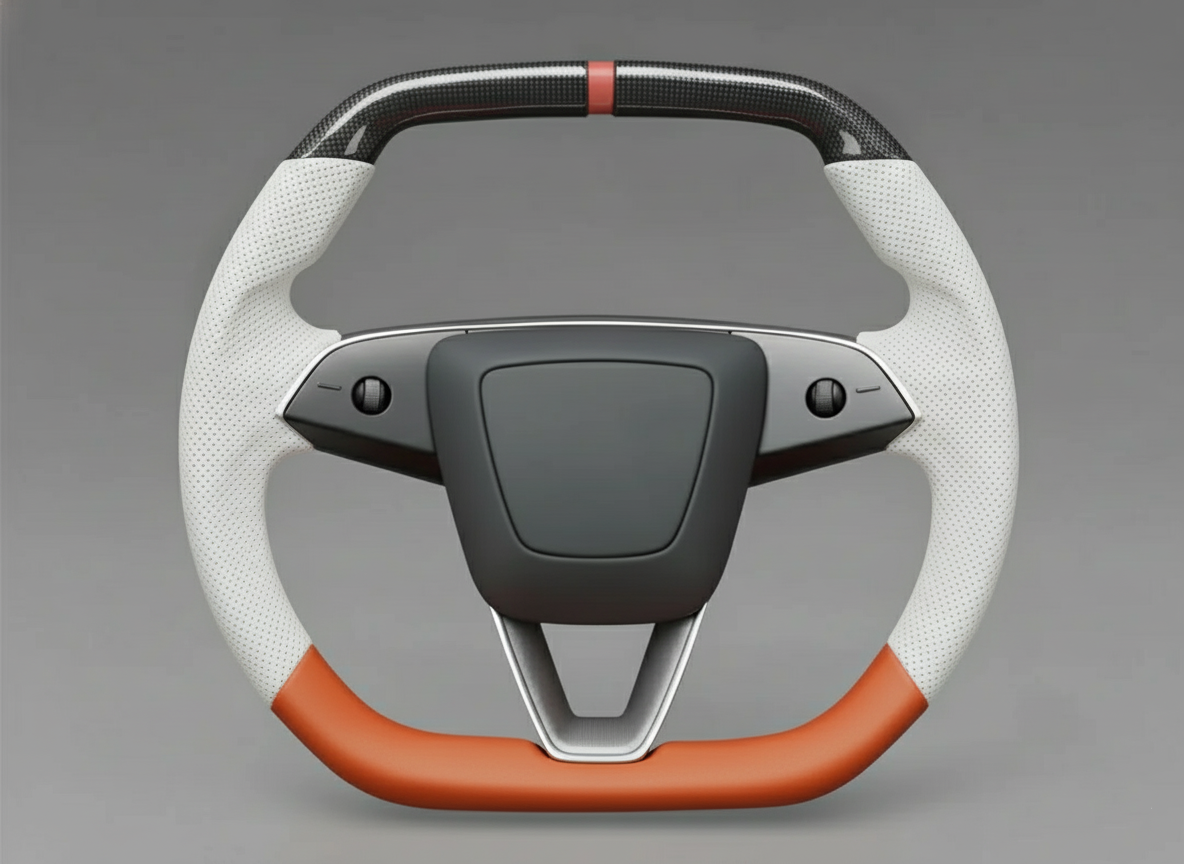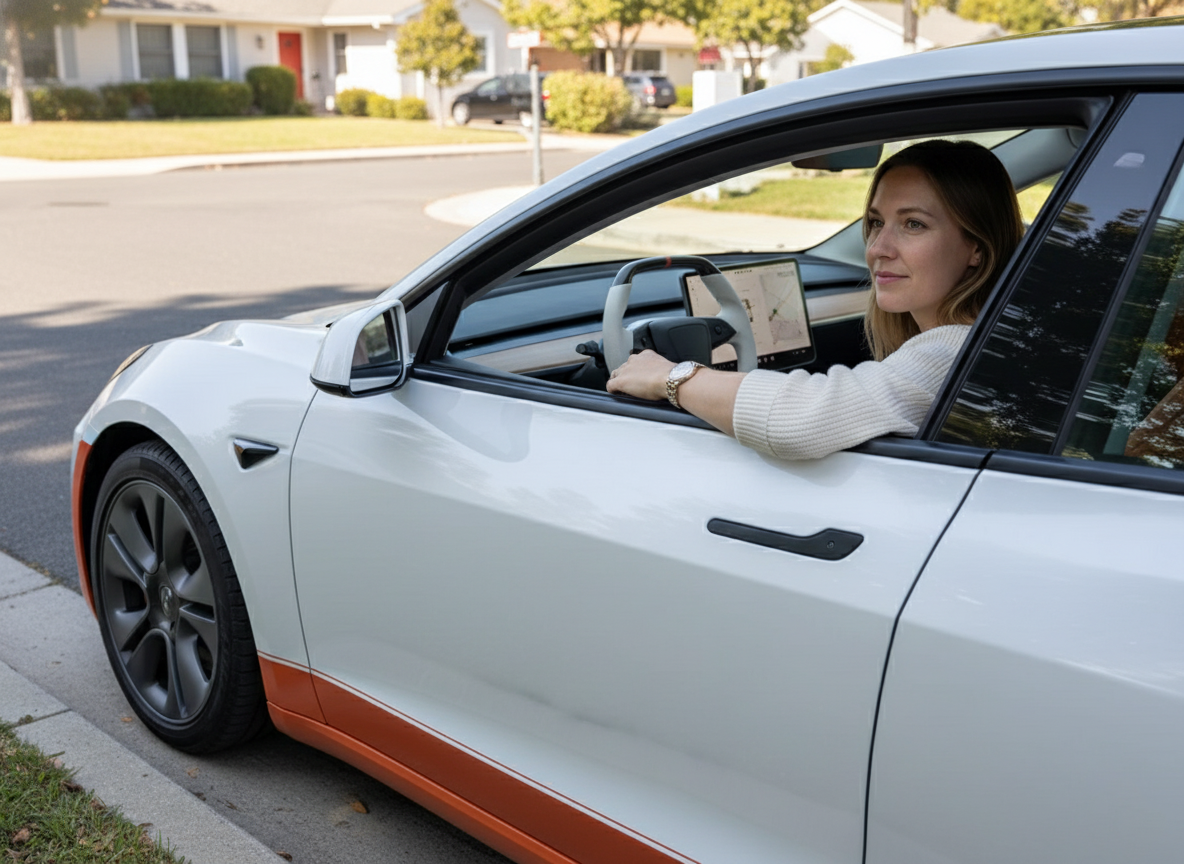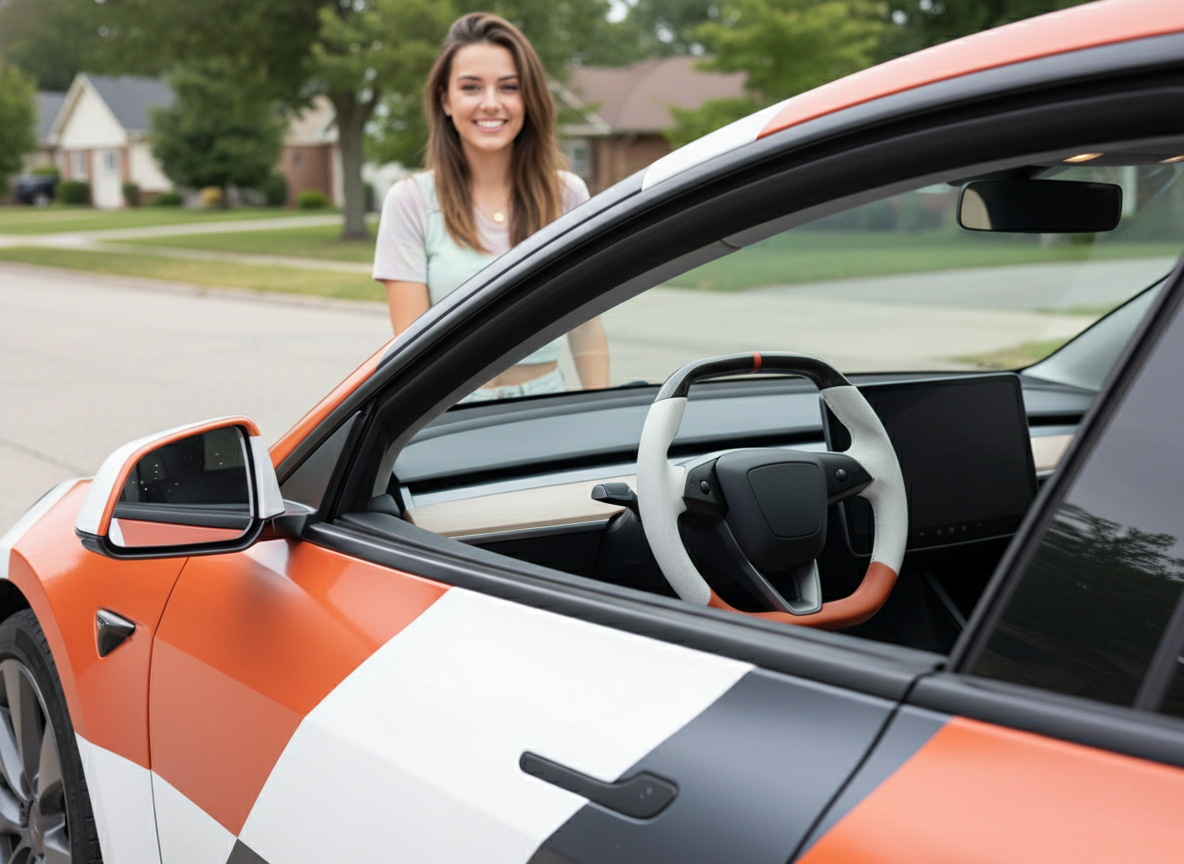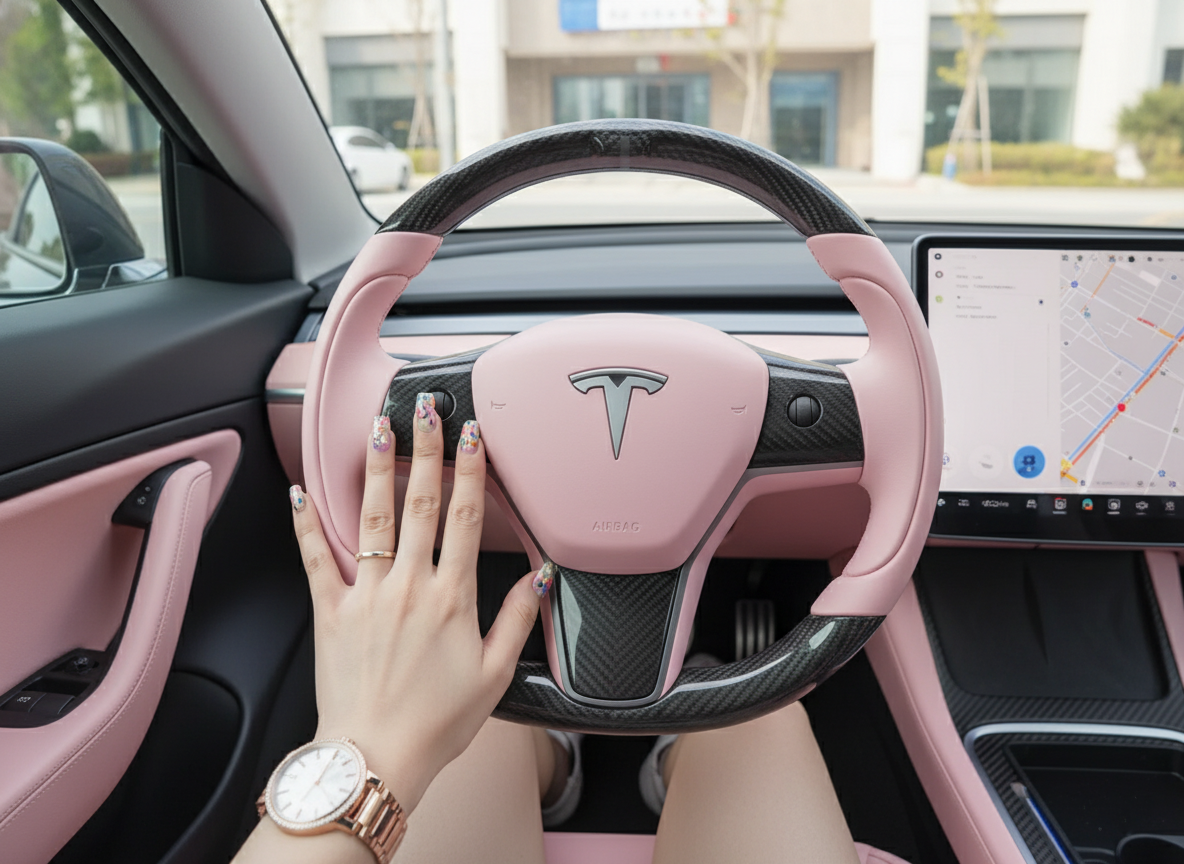
Recommendation for daily use: Select the 360mm Flat-Bottom model, which releases about 3cm of legroom.
For ultimate visibility: Choose the Yoke steering wheel, but ensure the heating module interface matches your vehicle.
Installation Warning: When modifying, you must use a T25 wrench to transplant the airbag non-destructively after disconnecting the power, ensuring that the AP (Autopilot) driver assistance functions continue to operate normally.
Flat-Bottom
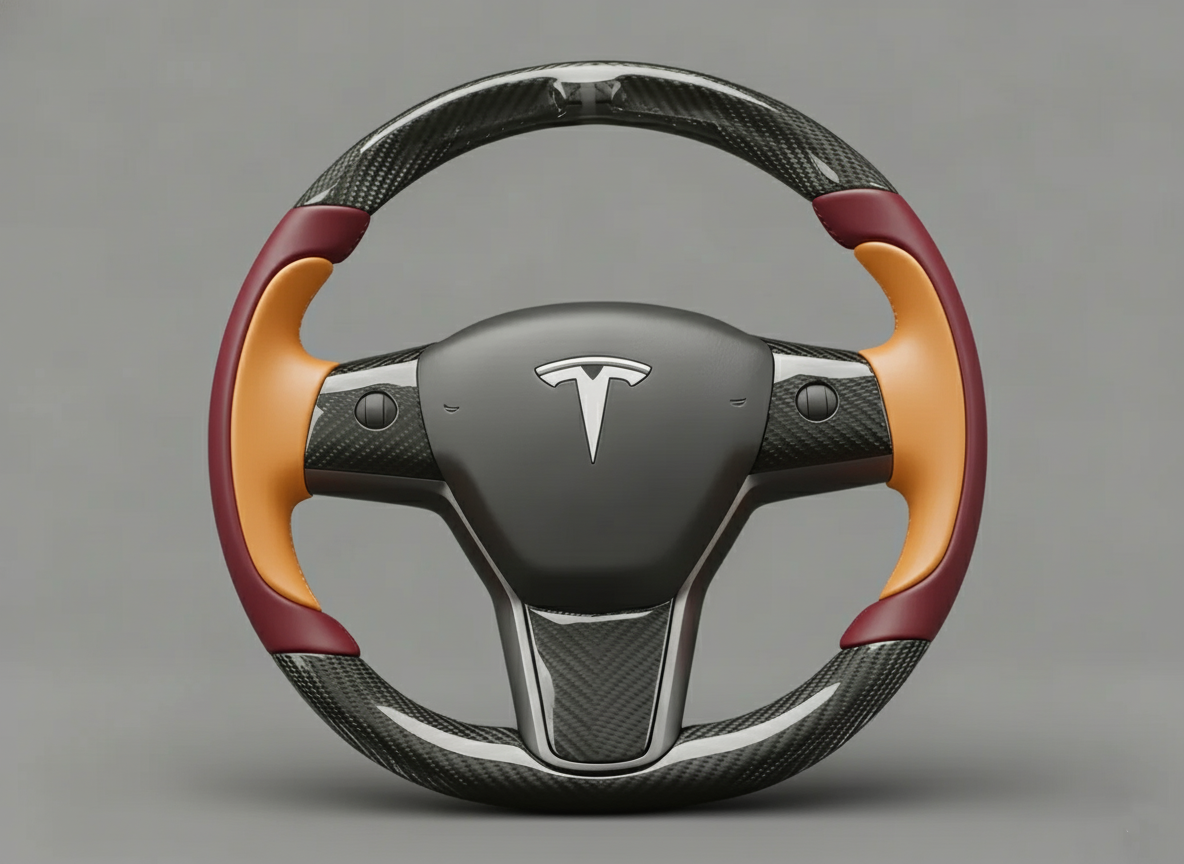
While retaining the Model 3 factory horizontal width of 350mm, the Flat-Bottom steering wheel directly increases vertical legroom for the driver by flattening the bottom arc by 35-45mm.
Compared to the aggressive Yoke, it does not require a 1-2 week muscle memory reshaping period. It is the most balanced solution for both 0-60mph spirited driving and daily commuting.
A qualified modification steering wheel should be manufactured based on the OEM Magnesium-Aluminum Alloy Skeleton. It allows for the perfect transplantation of the original Airbag Unit and scroll wheel controls, must support the factory 360-degree heating function, and installation time is usually controlled within 20 minutes.
Material Combination Comparison
Carbon Fiber for Hard Areas
Carbon Fiber is currently the only top choice, but there is a massive craftsmanship gap behind the words "Carbon Fiber."
-
Pre-preg / Dry Carbon Process:
This is the standard for high-end custom wheels. It uses T300 or T700 grade carbon cloth produced by Japan's Toray, pre-impregnated with resin, and cured at high temperatures in an Autoclave at 120°C - 130°C.- Weight: 30%-40% lighter than wet carbon of the same volume.
- Thickness: The resin coating is very thin, providing a stronger texture without feeling like it's wrapped in thick plastic.
- Yellowing: High-quality dry carbon surfaces are sprayed with high-grade Anti-UV Clear Coat. Even under exposure in high UV areas like California or Australia, it remains clear and transparent for 3-5 years without the resin turning yellow or cloudy.
-
Weave Pattern Selection:
- 3K Twill (2x2): The most classic carbon fiber pattern, with interwoven black and grey. It is completely consistent with the pattern of the Tesla Performance spoiler, offering the strongest visual integrity.
- Forged Carbon: Made by chopping carbon fiber and pressing it under high pressure, presenting a chaotic, marble-like pattern. This material is common on Lamborghini models, has more reflective surfaces, and offers high visual impact.
Glossy vs. Matte Coating
The Clear Coat covering the carbon fiber is not just a protective layer, but a light management layer.
-
Glossy:
The surface is as smooth as a mirror. Although it looks more premium visually and highlights the deep 3D effect of carbon fiber, under direct noon sunlight, the top of the steering wheel may reflect strong light into the driver's eyes or form reflections on the inside of the windshield. -
Matte:
Matting agents are added to the clear coat, creating a silky diffuse reflection texture. The touch feels similar to the frosted glass back of an iPhone Pro series. It completely eliminates glare interference and does not easily leave fingerprint oil stains, making it a more pragmatic choice currently.
Leather for Grip Areas
The 3 o'clock and 9 o'clock positions on both sides directly bear the grip force of the palms. Soft materials must be used here to wrap the heating pads (if equipped) and the energy-absorbing layer.
| Material Name | Source & Specs | Friction Coefficient | Maintenance Difficulty | Data & Characteristics |
|---|---|---|---|---|
| Alcantara | Imported from Alcantara SpA, Italy | Extremely High | High | Composed of 68% Polyester + 32% Polyurethane. You must look for color code #9002 (Dark Grey), which is the only color that matches the Model 3 dashboard trim and door panels with zero color difference. It has strong sweat absorption, but after long-term contact with hand sweat and oils, it is prone to "matting" or hardening. It needs cleaning with a wet towel and a special soft brush every 2-3 weeks. |
| Nappa Leather | European Imported Top Grain Leather | Medium | Low | The surface is lightly coated, providing a delicate and warm touch. Being real leather, it has natural pores, offering better breathability than factory material. Although not as grippy as Alcantara, its abrasion resistance is more than 3 times higher, suitable for owners driving over 20,000 miles annually. |
| Perforated | Physical Process Treatment | High | Medium | Whether Nappa or Vegan leather, perforation is recommended. Standard 1mm spacing perforation increases surface friction by about 15% and allows heat from the heating function to penetrate faster. |
Stitching Color and Style
All stitching should use high-strength Bonded Polyester Filament, such as the German Amann Serafil series, to prevent fading or breaking due to sun exposure.
- Stitching Style: Cross-stitch or Euro-stitch, commonly used in European cars, are mainstream. These two methods pull the two pieces of leather tightly flat without leaving raised ridges in the grip area, avoiding hand abrasion during long drives.
-
Color Match:
- Black Interior: Recommend using Black or Cool Grey stitching to keep it understated.
- White Interior: Must use Pure White thread. Note that it requires regular cleaning as hand stains easily turn white thread black.
- Performance Version: Most owners choose Red stitching to echo the red brake calipers.
Thermal Conductivity Differences
The physical heat capacity properties of the materials will drastically change the contact experience in winter and summer.
- Carbon Fiber Area: Carbon fiber composites have high thermal conductivity. After summer sun exposure, the surface temperature of the top carbon fiber area can easily exceed 70°C, making it extremely hot to touch; in cold winter, carbon fiber feels close to metal, very icy.
- Heating Coverage: Even if the Heated Steering Wheel function is selected, in current aftermarket solutions, heating wires are usually only laid in the side Leather/Alcantara areas. The upper and lower carbon fiber parts cannot be heated. In winter, you must strictly keep your hands at the 3 and 9 o'clock positions for warmth; once you touch the top carbon fiber, the temperature difference will be very obvious.
Skeleton and Safety
Using OEM Skeleton is the Safest
Currently, 95% of high-quality modified steering wheels on the market are produced based on the "Core Exchange" model.

Manufacturers must first purchase used factory Tesla Model 3 steering wheels, manually strip off the original Vegan Leather and polyurethane foam layer, retaining only the internal metal skeleton.
- Magnesium-Aluminum Alloy Material: The factory Tesla skeleton uses high-pressure die-cast MgAl (Magnesium-Aluminum) Alloy. The density of this material is about 1.8g/cm³, 30% lighter than pure aluminum, but its tensile strength can reach over 230 MPa.
- Non-Replicability: The cost of manufacturing a magnesium alloy die-casting mold that meets automotive grade strength usually exceeds $50,000. To control costs, the vast majority of third-party factories will only use ordinary gravity-cast aluminum alloys.
-
Physical Property Differences:
- OEM Magnesium Alloy: Undergoes plastic deformation (bending) to absorb energy when subjected to severe impact.
- Aftermarket Aluminum Casting: Internally often contains gas pockets (Porosity), and is prone to snapping directly when under excessive stress, creating sharp metal fractures.
Central Spline Engagement
The only medium connecting the steering wheel to the Steering Column is the central Spline. This is the data point with the highest risk coefficient in modification.
- Bolt Torque: The standard tightening torque for the Model 3 steering wheel center bolt is 50 Nm (37 lb-ft).
- Tolerance Control: The processing tolerance of the factory spline is controlled within 0.02mm. If a skeleton from an aftermarket mold is used, the spline tooth profile tolerance is often amplified to 0.1mm or more.
-
Wear Consequences:
- Early Stage: After locking to 50 Nm, due to insufficient metal hardness, the aftermarket spline will have a layer "eaten" away by the steel teeth of the steering column.
- Mid Stage: After 5,000 miles of road vibration and steering stress, extremely minute play will appear at the steering wheel center.
- Late Stage: In emergency avoidance maneuvers (Moose Test), the massive torque may instantly strip the soft aluminum alloy teeth, causing the steering wheel to spin freely on the steering column, leading to an instant loss of vehicle control.
Airbag Alignment
The Airbag Module is fixed to the skeleton by two spring clips on the back; space here is calculated in millimeters (mm).
- Floating Gap: The airbag is actually "suspended" in the center of the steering wheel, and it also serves as the trigger switch for the Horn. The normal floating travel is about 3-5mm.
-
Foam Interference: Inferior modified wheels, when re-wrapping leather, often encroach on the airbag module installation slot due to excessive leather thickness or uneven foam filling.
- Consequence A: The airbag gets stuck, making the horn extremely hard to press, or it doesn't spring back after pressing.
- Consequence B: The gap between the airbag cover and the steering wheel edge is uneven (e.g., left side 2mm, right side 5mm), severely affecting visual quality.
Collision Energy Absorption
The design of the factory skeleton includes specific Crumple Zones.
| Zone | OEM Design Logic | Inferior Aftermarket Modification Risk |
|---|---|---|
| 3/9 O'clock Spokes | Designed with grooves to weaken strength, allowing downward bending under 3000N impact force. | Extra steel bars are welded to increase styling rigidity, making the skeleton too hard; it cannot bend upon impact, directly injuring the driver's ribs. |
| Bottom Flat Cut Area | Factory is round. Modification requires cutting metal and re-welding the crossbeam. | Welding craftsmanship is substandard (e.g., cold solder joints). Under the reaction force of airbag deployment, the weld breaks, and the lower part flies out causing secondary injury. |
Electronic Harness Channels
The interior of the Model 3 steering wheel skeleton is like a maze, with pre-reserved channels for the Wiring Harness.
-
Grounding Issues: Many electronic failures (e.g., horn not working, buttons malfunctioning) stem from overly thick painting on the skeleton. The steering wheel skeleton itself is part of the vehicle's GND (Ground) loop.
- Standard Process: After repainting with anti-rust paint, the paint at screw holes must be precisely sanded off to expose the metal shine, ensuring conductivity.
- Modification Hazard: Ignoring the sanding step leads to poor grounding of the scroll wheel control module, causing frequent errors in the trip computer.
- Heating Wire Short Circuit: If the heating function is selected, power wires need to pass through sharp edges on the skeleton. The factory skeleton has Chamfer treatment at holes, but on the modified Flat-Bottom area, if metal Burrs from cutting/welding are not cleaned, vehicle vibration will cause the wire insulation to be cut, triggering a short circuit.
Racing Style
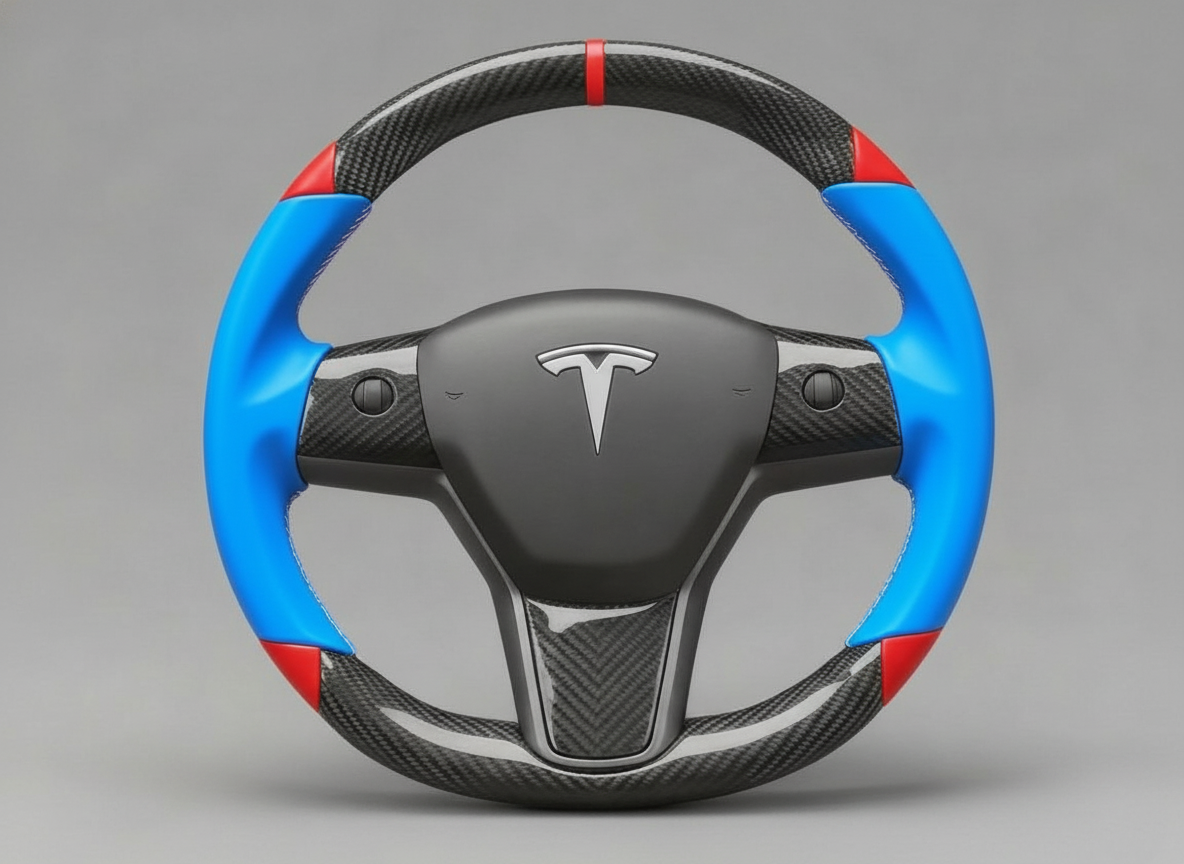
Structurally, this often uses T700 Dry Carbon Fiber to replace the factory top and bottom arcs, paired with Alcantara or Nappa Perforated Leather on the sides. Deep 15mm Thumb Grooves are designed at the 3 and 9 o'clock positions to lock hand placement.
This type of modification retains the 370mm outer diameter width, ensuring torque remains unchanged, while perfectly compatible with the factory airbag module, scroll wheel harnesses, and Autopilot vibration motor. High-end versions support the non-destructive plug-in of the factory 3-stage heating function.
Structural Reshaping
Thickening the Grip
Most drivers feel the factory Model 3 steering wheel grip is on the thin side, which can easily lead to hand fatigue during long drives. The most significant physical change in Racing Style steering wheels is the increased circumference of the grip.
-
Size Comparison:
The factory wheel diameter is usually around 32mm. Racing style modifications typically increase this figure to 36mm to 39mm. -
Filling Process:
This thickening is not achieved by simply adding thicker leather, but by re-molding a higher density Polyurethane or Epoxy Resin base layer over the metal skeleton. -
Contact Area:
The added 4-7mm diameter increases the contact area between the palm and the steering wheel by about 15%. A larger contact surface means the driver can transmit the same torque with less Grip Force during steering, reducing tension in small muscle groups of the hand.
Bottom Flattening Treatment
This design originated from F1 and GT racing cars, intended to make room for the driver's legs in a cramped cockpit. On the Model 3, this structure changes the vertical dimensions of the steering wheel.
-
Vertical Height Reduction:
The standard round steering wheel vertical diameter is about 370mm. After flattening the bottom, the vertical height is usually reduced to 345mm - 355mm. -
Legroom Gain:
This change provides an extra 20mm - 40mm of physical space above the driver's thighs. For users over 185cm tall or those who habitually set the seat low and steering wheel low, this effectively prevents the thighs from rubbing against the lower edge of the wheel, especially when entering/exiting or using "Easy Entry" mode. -
Blind Operation Reference:
The flat-bottom structure provides a physical tactile baseline. When performing multi-turn centering maneuvers in a parking lot, the palm touches the flat bottom, allowing the driver to instantly judge whether the steering wheel is currently 180 degrees inverted or centered without looking at the dashboard.
| Measurement Dimension | Factory Standard (OEM) | Racing Style (Flat-Bottom) | Difference Value |
|---|---|---|---|
| Horizontal Outer Diameter | 370mm | 370mm | 0mm (Maintains Torque) |
| Vertical Outer Diameter | 370mm | ~350mm | -20mm |
| Grip Circumference | ~100mm | ~118mm | +18mm |
| Bottom Shape | Circular Arc | Straight Flat | Geometric Change |
Reshaping the Grip Area
The cross-section of the factory steering wheel at the 3 and 9 o'clock positions (common grip area) is round. Racing Style steering wheels reshape this area into an irregular oval or Pistol Grip shape.
-
Cross-section Geometry Change:
Modification technicians flatten the front of the grip and widen the sides, making the cross-section close to a rounded rectangle. This shape conforms better to the Natural Palmar Arch when the hand is closed. -
Thumb Groove Depth:
Above the horizontal Spokes, Thumb Grooves with a depth of 10mm - 15mm are molded.- The factory wheel is very shallow here, almost a smooth transition.
- The deepened grooves allow the thumb pad to be fully embedded. When the vehicle undergoes lateral cornering forces above 0.8G, this groove serves as a force-bearing fulcrum, preventing the hand from sliding up and down.
-
Hand Guidance:
This structure forcibly guides the driver to maintain a standard 3-9 o'clock grip. The webbing of the thumb is locked by the physical structure, ensuring hands are always in the optimal position to control stalks and scroll wheels.
Backside Finger Groove Optimization
The Backside of the steering wheel is an area many ignore but is extremely practical. The back of the factory Model 3 steering wheel is a smooth arc, lacking tactile feedback.
-
Wavy Ridges:
Racing style steering wheels usually mold 3 to 4 continuous wavy Finger Ridges on the back of the 3 and 9 o'clock grip areas. -
Finger Alignment:
The spacing of these ridges is usually between 15mm - 20mm, corresponding to the positions of the middle finger, ring finger, and pinky finger. -
Grip Stability:
When fingers hook onto these ridges, it's like hooking a trigger. This design increases vertical friction. When palms are sweaty or when wearing racing gloves, these physical ridges on the back provide an extra mechanical interlock structure, making steering input more precise.
Skeleton Retention and Safety
Despite drastic changes in external shape, the internal metal Skeleton responsible for connecting to the steering column and carrying the airbag must remain factory spec.
-
OEM Magnesium Alloy Skeleton:
High-quality Racing modified wheels are manufactured based on the OEM Magnesium-Aluminum Alloy Skeleton. Their center hole positions and Splines completely match the steering column, requiring no adapters. -
Energy Absorbing Structure:
The factory skeleton features a specific deformation energy absorption design. In a severe collision, the steering wheel skeleton will crumple along a preset path to protect the driver's chest. Inferior third-party "cast" skeletons are often too hard or too brittle to achieve this function. Therefore, structural reshaping usually refers to additions and subtractions to the Foam Layer and Wrapping Layer outside the original metal skeleton, never involving cutting or welding the metal skeleton itself.
Carbon Fiber Material Specs
Common Weave Patterns
The carbon cloth used for Model 3 steering wheel modification is mainly provided by suppliers like Toray for raw filaments, then woven in factories.
-
3K 2x2 Twill Weave:
This is the most classic carbon fiber look. Each carbon fiber Tow contains 3000 (3K) filaments. 2x2 refers to the weaving method: one warp yarn crosses over two weft yarns, then under two weft yarns.
This weave creates the iconic 45-degree diagonal visual texture on the surface. Compared to Plain Weave, twill has better flexibility and is easier to wrap around complex curved surfaces of the steering wheel without pattern breakage or distortion at corners. -
Forged Carbon:
This technology was first popularized by Lamborghini on the Sesto Elemento model. It does not use long fiber weaving but cuts carbon fiber filaments into 6mm - 12mm Chopped Strands, mixes them with resin, and presses them in a high-pressure mold.
Visually resembling marble veins, the chaotic pattern distribution of every steering wheel is random and unique. Since the fiber direction is isotropic, its strength is relatively even at all angles, but its main advantage lies in the unique matte or semi-matte visual texture. -
1x1 Plain Weave:
Appears like a checkerboard, with warp and weft yarns interlacing one over one. This weave is very tight and structurally the most stable, but has extremely poor drape/pliability. Therefore, it is rarely used to wrap the entire round wheel body, usually appearing only on the bottom Trim of the steering wheel or very few custom flat areas.
Dry Carbon vs. Wet Carbon
Many low-priced products appear to be carbon fiber on the surface, but the process is completely different.
-
Wet Carbon / Overlay Process:
Most steering wheels in the $300 - $500 range use this process. Technicians apply epoxy resin directly to the rubber foam layer of the factory steering wheel, stick a layer of carbon cloth, and then brush on multiple layers of clear coat.- Increased Thickness: This method increases the grip diameter by 2mm - 3mm. If heating wires are added on top of this, the feel will be very bulky.
- Weight: Due to high resin content and retention of the factory internal structure, the finished weight is usually 10% - 15% heavier than the factory wheel.
-
Dry Carbon / Pre-preg Process:
High-end custom builds (usually priced at $800+) use Pre-preg. The carbon cloth is impregnated with resin at a golden ratio of 60:40 at the factory and stored under refrigeration.- Autoclave Curing: During production, it is placed in a mold and put into an Autoclave, cured under 6 bar pressure and 120°C high temperature. Vacuum bags suck out excess air and resin.
- Texture: The finished product is extremely thin, usually less than 1mm thick, fitting directly onto the skeleton. This process clearly shows the 3D effect of every carbon filament, is extremely lightweight, and has a far lower probability of resin aging under long-term sun exposure compared to wet carbon due to extremely low resin content.
Resin and Clear Coat Layers
Carbon fiber itself is black; the "brightness" and "feel" you see on the steering wheel depend entirely on the Epoxy Resin and Clear Coat covering it.
-
UV Stability:
The steering wheel sits under the windshield, constantly exposed to direct sunlight. Cheap Polyester Resin will Yellow under UV radiation within 6-12 months, turning the originally deep black carbon fiber into an ugly brownish-black.
High-spec products must use Anti-UV Epoxy Resin and be sprayed with automotive-grade 2K Urethane Clear Coat on the surface. -
Mirror Flatness:
Quality Gloss Carbon coatings undergo 10-15 layers of spraying and polishing. Observed under light, the surface should be as flat as water, without "Orange Peel" or tiny Pinholes.
Difference Between Matte and Gloss
Beyond aesthetics, Matte and Gloss have data-backed differences in physical properties.
| Characteristic Dimension | Gloss (Bright/Shiny) | Matte (Frosted) |
|---|---|---|
| Gloss Units | > 90 GU (High Reflection) | < 10 GU (Low Reflection) |
| Driving Interference | May cause glare under strong light | Almost no reflection, pure vision |
| Tactile Feedback | Smooth, feels Sticky with sweat | Dry, delicate grainy feel |
| Anti-Fingerprint | Poor, fingerprint magnet | Excellent, oil stains not obvious |
| Maintenance Difficulty | Easy, wipe with microfiber cloth | Harder, cannot wax, needs special cleaner |
Thermal Conductivity Performance
The thermal conductivity of carbon fiber composites differs from metal or leather. In the Model 3 cabin environment, this characteristic directly affects the contact experience.
-
Heating Speed:
The Specific Heat Capacity of carbon fiber parts is relatively low. When parked outdoors in summer, black carbon fiber absorbs heat extremely fast, with surface temperatures rising to 65°C - 75°C within 15 minutes. -
Cooling Speed:
The good news is carbon fiber also dissipates heat quickly. Blowing the AC at the steering wheel, glossy carbon fiber usually cools down to a touchable temperature within 2-3 minutes, while leather parts with thick internal foam layers need longer to dissipate accumulated heat. -
Heating Function Compatibility:
If the heating function is selected, note: Carbon fiber parts usually do not contain heating pads. Heating wires can only be laid in the side leather or Alcantara areas.
Grip Material Comparison
The Tribology of Alcantara
Many mistakenly think Alcantara is "suede" or natural leather, but it is actually a premium synthetic material composed of 68% Polyester and 32% Polyurethane.
Invented by Japanese scientist Miyoshi Okamoto, it is now mainly produced by Alcantara S.p.A in Italy.
-
Micron-level Locking Effect:
The surface of Alcantara is covered with microfibers with a diameter less than 0.005mm. When you hold the steering wheel, the micro-texture of the palm skin creates a physical "Interlocking" effect with these standing microfibers.- Coefficient of Friction (CoF): In dry conditions, Alcantara's CoF can reach 1.0 - 1.1, while ordinary smooth leather is usually between 0.6 - 0.7. This means less grip force is needed to apply the same steering torque.
- Moisture Gain: Unlike leather which gets slippery when wet, Alcantara is slightly hydrophilic. When palms sweat, the sweat is absorbed into fiber gaps, and friction doesn't drop off a cliff; instead, it becomes slightly more "tacky" due to increased humidity.
-
Track Grade Application:
This is why GT3 race cars and high-performance street cars (like Porsche GT series) standardize on this material. If you frequently drive wearing Nomex Racing Gloves, Alcantara is the only choice, as fabric-on-fabric friction far exceeds fabric-on-leather.
The Heat Flow of Perforated Leather
Perforated Leather is the product of precise stamping processes applied to whole Nappa cowhide or high-grade Vegan Leather.
-
Hole Physical Specs:
Standard Racing steering wheel perforation usually employs a 1mm hole diameter, with Pitch (spacing) controlled at 3mm - 5mm. -
Air Exchange Mechanism:
These micro-holes are not just decoration. When the palm grips the wheel tight, a closed high-humidity, high-heat micro-environment forms between skin and leather. Perforation breaks this barrier, allowing air circulation.- Evaporation Efficiency: This structure increases the leather's surface area, raising the sweat evaporation rate by about 30% compared to smooth leather. For users who drive without gloves and have sweaty hands, perforated leather effectively avoids that "cold, clammy" discomfort.
-
Tactile Hardness:
Since perforation breaks the continuity of the leather, the tensile tension of the leather drops slightly, making perforated areas feel Softer than unperforated smooth leather. When fingers press down hard, the foam layer's rebound feedback is more direct.
Surface Temperature Data
The large glass roof of the Model 3 creates a greenhouse effect. Two materials perform very differently under extreme temperatures.
-
Thermal Conductivity Difference:
Leather has higher density and heat capacity. After 1 hour of summer sun exposure, black leather surface temperature can reach 65°C - 70°C, causing pain or even low-temperature burns upon direct contact.
Alcantara, due to its fluffy fiber structure, contains a lot of air (a good insulator), resulting in very low thermal conductivity. Under the same conditions, its surface temperature is usually 10°C - 15°C lower than leather. -
Winter Touch:
By the same principle, in cold weather, leather feels like a block of ice because it draws heat away from hands quickly. Alcantara feels relatively mild—"warm in winter, cool in summer." If your Model 3 doesn't have the heated steering wheel option, Alcantara is much friendlier than leather in winter.
Wear and Aging Cycle
This is a time cost that must be considered when choosing materials. All grip materials are consumables, but they degrade differently.
| Material Type | Initial State | After 6 Months (No Care) | After 2 Years (No Care) | Restoration Solution |
|---|---|---|---|---|
| Alcantara | Pile standing, deep color | Fibers matted by oils, flattened (Matting) | Hardens, becomes shiny, friction lost | Use special cleaner + soft brush to fluff up pile |
| Nappa Perforated Leather | Matte texture, clear grain | Frequently touched areas start to Shine slightly | Coating wears off, becomes high gloss | Use leather cleaner to degrease; hard to restore matte |
| Vegan Leather | Uniform grain, feels harder | Very little change, strong stain resistance | Surface coating may start Peeling | Irreparable, requires re-wrapping |
Maintenance and Cleaning Difficulty
If you choose a Racing Style steering wheel, you must be mentally prepared for maintenance, especially with Alcantara.
-
Alcantara's Oil Dilemma:
This material is a "Hand Oil Magnet." Natural oils secreted by the human body and hand lotions will coat the microfibers, causing them to mat down and stick together, forming an ugly appearance similar to smooth plastic.- Maintenance Frequency: Recommended cleaning every 2000 miles or every two months.
- Operation Method: Must use dedicated fabric cleaner (like Sonax Alcantara Cleaner), gently scrub in circles with a soft toothbrush to lift dirt out of fibers, and finally blot dry with a damp microfiber cloth.
-
Perforated Leather Usability:
Leather maintenance is relatively simple. Modern automotive leather surfaces have a polyurethane Top Coat that blocks stains from penetrating the dermis.- Cleaning Pores: The only trouble lies in those thousands of tiny holes. If lotion-based Leather Conditioner is used, it easily clogs the holes, turning into white residue that is very hard to clean. It is recommended to use only water-based spray cleaners/conditioners.
- Stain Resistance: For users who eat in the car or have sunscreen on their hands, leather (especially black) wipes clean with a wet wipe, offering a very high margin for error.
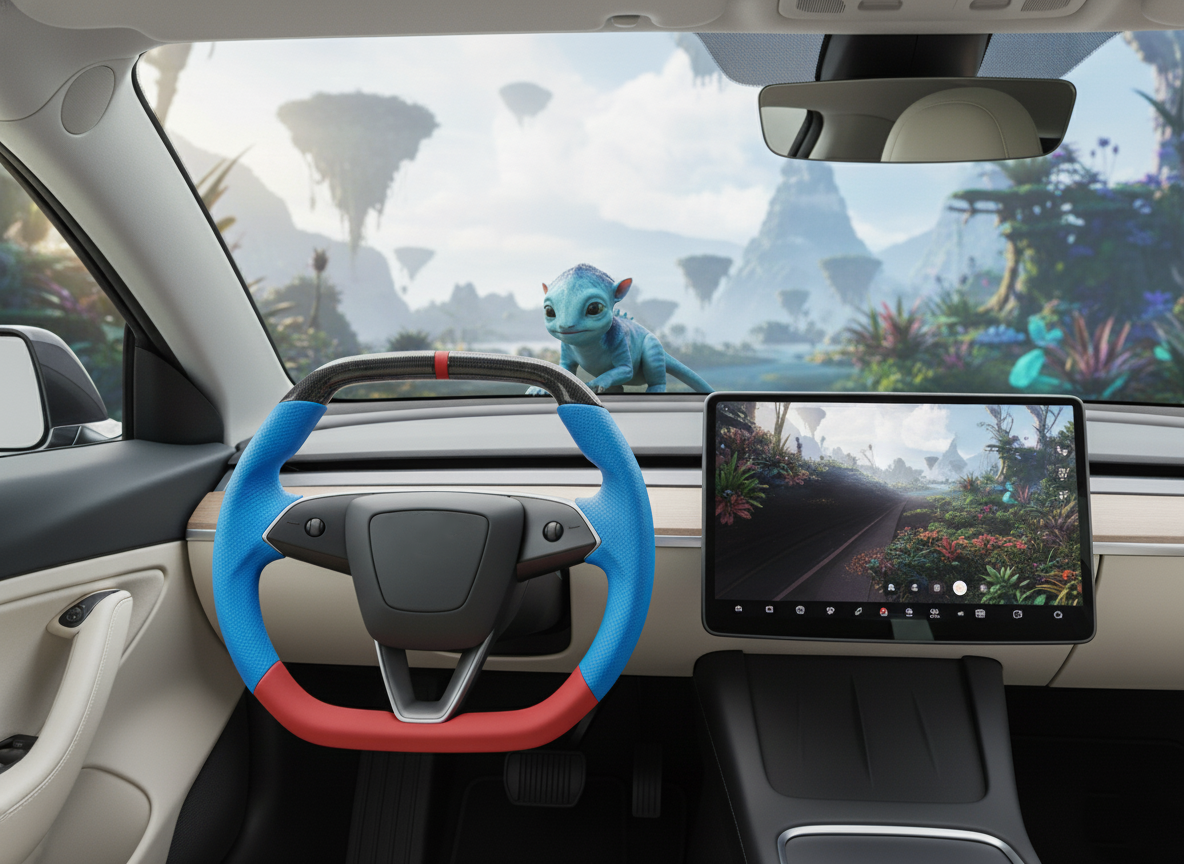
Yoke Steering Wheel
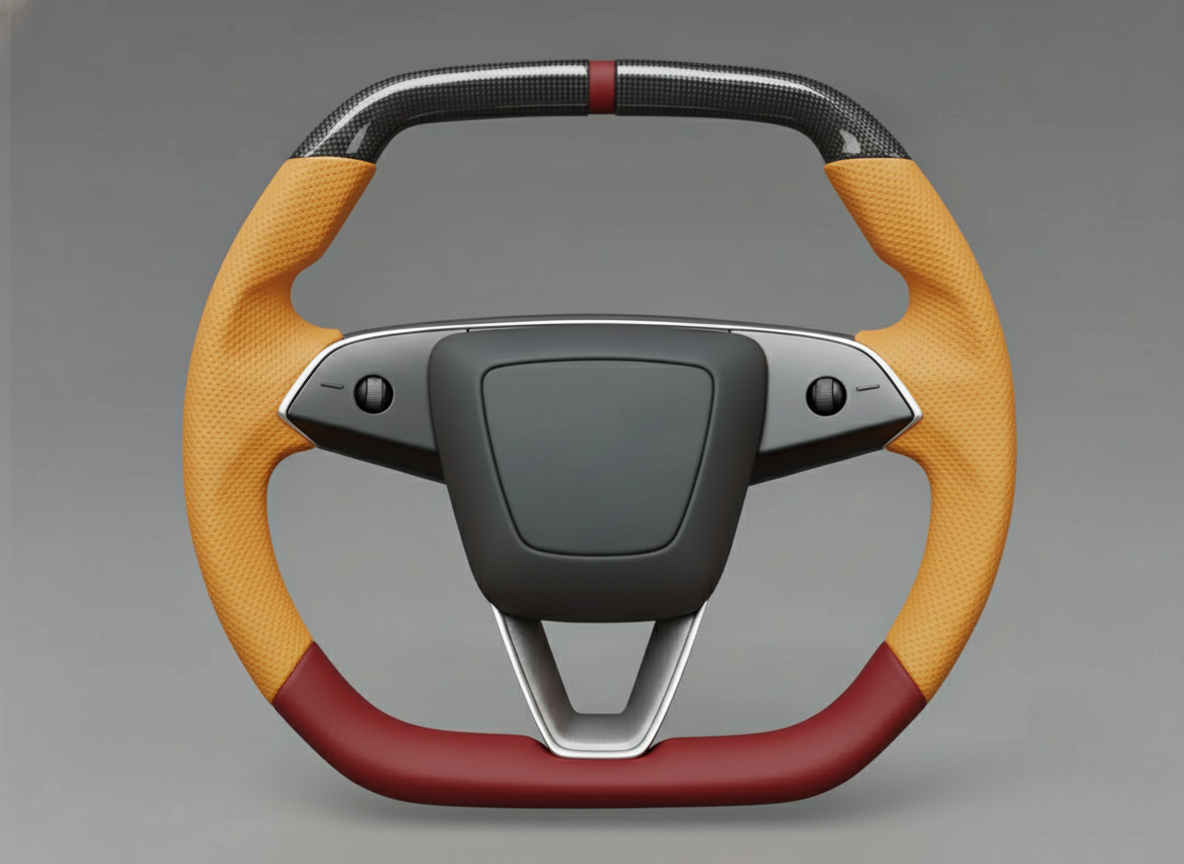
The Yoke steering wheel removes the rim from the traditional steering wheel at the 11 o'clock to 1 o'clock positions, adopting a rectangular or trapezoidal structure, with width usually maintained between 350mm to 370mm.
This design eliminates approximately 30% of visual obstruction to the front instrument area, making it particularly suitable for Model 3 owners who have installed a Mini Dashboard or HUD (Head-Up Display).
In terms of materials, high-end modification parts usually use Toray T700 Dry Carbon Fiber to replace the factory steel skeleton wrapping layer, and thicken the grip diameter to 32mm-34mm to increase contact area.
Since the Model 3 steering ratio is fixed at 10.0:1 (non-Steer-by-Wire), drivers need to adapt to a 2.0 to 2.25 turn lock-to-lock range during low-speed U-turns, unable to perform "palm steering" operations like with a traditional round steering wheel.
Unobstructed View
Upper Rim Removal
The most radical physical change in the Yoke steering wheel is the complete excision of the arc section between 11 o'clock and 1 o'clock on the traditional round steering wheel.
The standard Model 3 factory steering wheel diameter is about 365mm, with a top rim thickness usually between 30mm and 35mm.
For the driver, this solid structure forms a permanent semi-circular blind spot in the front line of sight.
When swapped for a Yoke style, the space originally occupied by the top rim becomes a completely transparent visual channel.
Depending on the driver's sitting height, the Vertical Field of View usually increases by 5 to 8 degrees.
This reduction in physical structure makes the visual picture, originally cut off by the upper edge of the steering wheel, complete.
All space between the lower edge of the windshield and the dashboard is now within direct view.
Seamless Dashboard Adaptation
The Model 3 only has a Center Console Display and no instrument cluster (Cluster) directly in front of the driver.
Many owners choose to install aftermarket auxiliary screens ranging from 3.5 inches to 10.25 inches.
These screens are usually fixed on top of the Steering Column.
When using a round steering wheel, viewing these added screens presents an obvious physical conflict:
- Obstruction Issue: If the steering wheel is adjusted to a comfortable height, the upper rim often cuts across the screen, blocking speed or battery information.
- Compromised Adjustment: To see the screen clearly, drivers have to adjust the steering wheel extremely high (like driving a bus) or extremely low (rubbing thighs), destroying standard ergonomics.
The Yoke's flat-top open design solves this physical conflict.
Regardless of the steering wheel height adjustment, the area above the steering column is completely open.
You can install a 9-inch Linux strip screen or a Mini Dashboard, and your line of sight can read data directly over the handle without needing to lower your head or adjust your sitting posture to find a viewing angle.
Angle of View to the Road
The Tesla Model 3 has a low front end design, with the Frunk lines dipping significantly.
In standard settings, when the driver looks at the road through the windshield, the closest visible ground distance is usually limited by the dashboard height and the upper edge of the steering wheel.
After removing the upper half, the lower edge of the line of sight is no longer limited by the steering wheel rim, but extends directly to the front edge of the dashboard. This visual extension is evident in the following scenario data:
| Scenario | Round Steering Wheel View | Yoke Steering Wheel View | Quantified Difference |
|---|---|---|---|
| Following in Straight Line | Visible up to front car's bumper | Visible up to where front car's tires touch ground | Viewing distance brought closer by approx. 1.5 meters |
| Right Turn Assist | Rim blocks right front corner curb | Right front corner curb completely visible | Blind spot reduced by approx. 20% |
| Road Debris | Need to crane neck to see close low obstacles | Can scan without moving sitting posture | Reaction time shortened |
This change in field of view is akin to switching from the narrow window of a commercial airliner to the bubble canopy of a fighter jet, with no horizontal lines interfering with vision within the front 180-degree sector.
Increased Seating Freedom
For drivers over 180cm tall, to avoid blocking the view of the road, the factory round steering wheel often needs to be adjusted to the highest setting.
However, this leads to arms being suspended for long periods during long drives, easily causing shoulder muscle fatigue (Deltoid muscle fatigue).
The Yoke allows drivers to lower the steering wheel significantly. Since there is no top rim blocking the view, you can adjust the steering wheel down by 3cm to 5cm, positioning it closer to the legroom area.
- Elbow Support: With the steering wheel lowered, the driver's elbows can rest naturally on the door armrest and the center console armrest.
- Wrist Angle: The angle of the wrist relative to the forearm is flatter, conforming to Neutral Body Posture standards, reducing pressure on the carpal tunnel area.
Driving Operation Differences
Steering Ratio Unchanged
The Model 3 steering ratio is fixed around 10.0:1.
This means regardless of whether you hold a round wheel or a Yoke, the ratio of front wheel turning angle to steering wheel turning angle is locked.
To turn the wheels from lock-to-lock, you still need to turn the steering wheel about 2.0 to 2.25 turns (totaling 720° to 810°).
You must accept a physical fact: during low-speed sharp turns, your hands cannot stay at the 3 and 9 o'clock positions like a race car driver forever.
Because the steering wheel rotation angle will exceed 180°, arms will cross and knot.
The Yoke does not turn a Model 3 into an F1 car; it merely changes the shape of the grip without changing the physical stroke of the steering rack.
Can't Grab 12 O'clock
For most drivers, muscle memory is the hardest thing to change. When reversing into a spot or correcting in a straight line, many subconsciously reach for the 12 o'clock position of the steering wheel.
With a Yoke installed, this position is air.
- Grabbing Air Reaction: Within the first 48 to 72 hours of use, when the brain processes emergency reversing or sharp turn commands, the hand will instinctively reach for the top, resulting in grabbing empty air.
- One-Handed Palm Steering Failure: Many experienced drivers are used to pressing the palm on top of the steering wheel for "washing machine style" U-turns. This operation is completely impossible on a Yoke. The top of the Yoke is open, and the sides are discontinuous, offering no circular track for the palm to slide.
U-Turn Technique Change
When making a U-turn in parking lots, U-bends, or narrow roads, since you cannot use the traditional "hand-over-hand" method easily, you need to learn a new way of turning the wheel.
| Operation Phase | Traditional Round Wheel Action | Yoke Required Action | Action Analysis |
|---|---|---|---|
| Start | Hands at random positions | Forced 3 o'clock / 9 o'clock | Starting position must be fixed, otherwise leverage point is wrong |
| Turn 90° | Arms follow movement | Arms follow movement | Wrist angle is still in comfort zone |
| Turn >180° | Top hand lets go, grabs 12 o'clock | Bottom hand lets go, grabs lower side edge | Must grab the side or bottom frame of the Yoke |
| Return to Center | Palm friction slides wheel back | Hand grips side, follows movement back | Cannot rely on palm friction to let wheel slide, must grip it |
When performing a 540° (one and a half turn) maneuver, the action looks more like operating an aircraft yoke or "handling" a rectangular object rather than turning a wheel.
You need to grab the Yoke at the 5 o'clock and 7 o'clock positions to relay, which requires more precise hand-eye coordination than turning a round wheel.
Highway Cruising is Effortless
When speed exceeds 80 km/h entering highway cruising state, the Yoke's advantages begin to show. At this time, steering corrections are usually between ±5° to ±10°, requiring absolutely no hand position changes.
- Gravity Drop: Due to the removal of the upper weight, plus the fact that modified wheels are usually heavier than factory (if solid metal skeletons are used), the Yoke has a lower center of gravity.
- Resting Posture: With Autopilot on or driving straight, you can rest your left elbow on the door armrest, with left fingers gently hooking the bottom left corner of the Yoke (about 7 o'clock position).
Autopilot Weight Distribution
Tesla's Autopilot system relies on the Torque Sensor on the steering wheel to detect if the driver is holding the wheel. The system detects not grip strength, but Rotational Torque.
- Torque Change: The shape of the Yoke results in a longer horizontal lever arm. When your hand rests at the 3 or 9 o'clock position, the natural downward force from the hand's weight is more easily recognized by the sensor as "human torque."
- Reduced False Alarms: Compared to a round wheel, the torque leverage effect generated when resting a hand on the Yoke edge is more pronounced. This means you don't need to deliberately "jiggle" the steering wheel to tell the system you are there; just letting the weight of one hand hang naturally on one side of the wheel is usually enough to satisfy the Autopilot detection threshold, reducing the frequency of the blue flashing reminder.
Stalk Operation Distance
The Model 3's turn signal stalk (left) and gear selector stalk (right) are fixed to the steering column and do not rotate with the steering wheel.
When using a Yoke, hand positions are fixed at 3 and 9 o'clock, which actually brings fingers closer vertically to the stalks.
- Middle Finger Operation: While gripping the Yoke, extending the left middle finger is usually enough to directly touch the turn signal stalk without the palm leaving the grip.
- Accidental Touch Risk: During spirited driving or large steering angle maneuvers, due to the irregular outer edge of the Yoke, protruding corners may sometimes sweep across the stalk area.
Webbing Grip Feel
The cross-section design of the Yoke handle is usually more ergonomic than the factory round wheel.
The factory round wheel section is elliptical, while high-quality Yokes (especially those with finger groove designs) are usually molded at the 3 and 9 o'clock positions.
- Thumb Groove: There is a groove area on the front for the thumb to press.
- Back Finger Position: There are wavy ridges on the back for the index and middle fingers to grip.
When changing lanes at high speed, you don't need to grip tightly; just locking the webbing of the thumb into the groove allows for precise control of the steering angle.
Data shows this design can reduce grip strength requirements by about 20%, preventing palm stiffness during long drives.