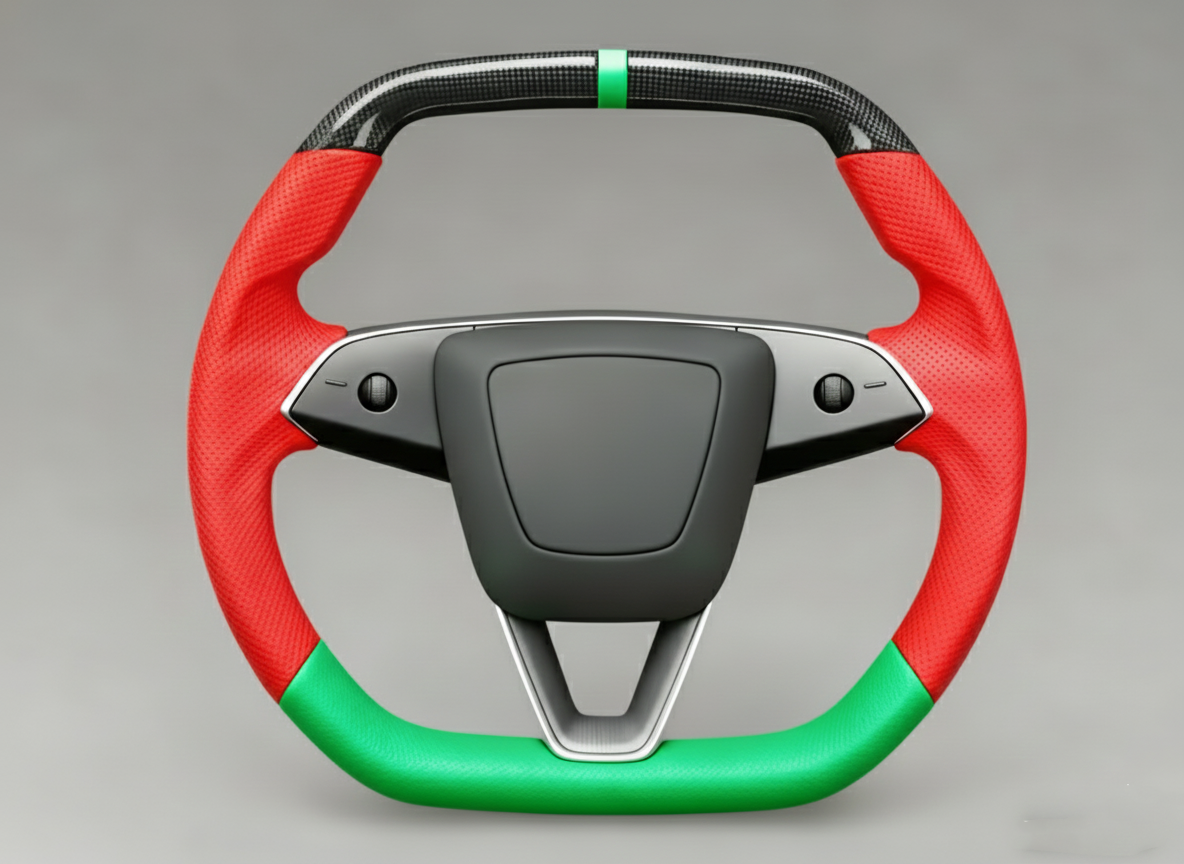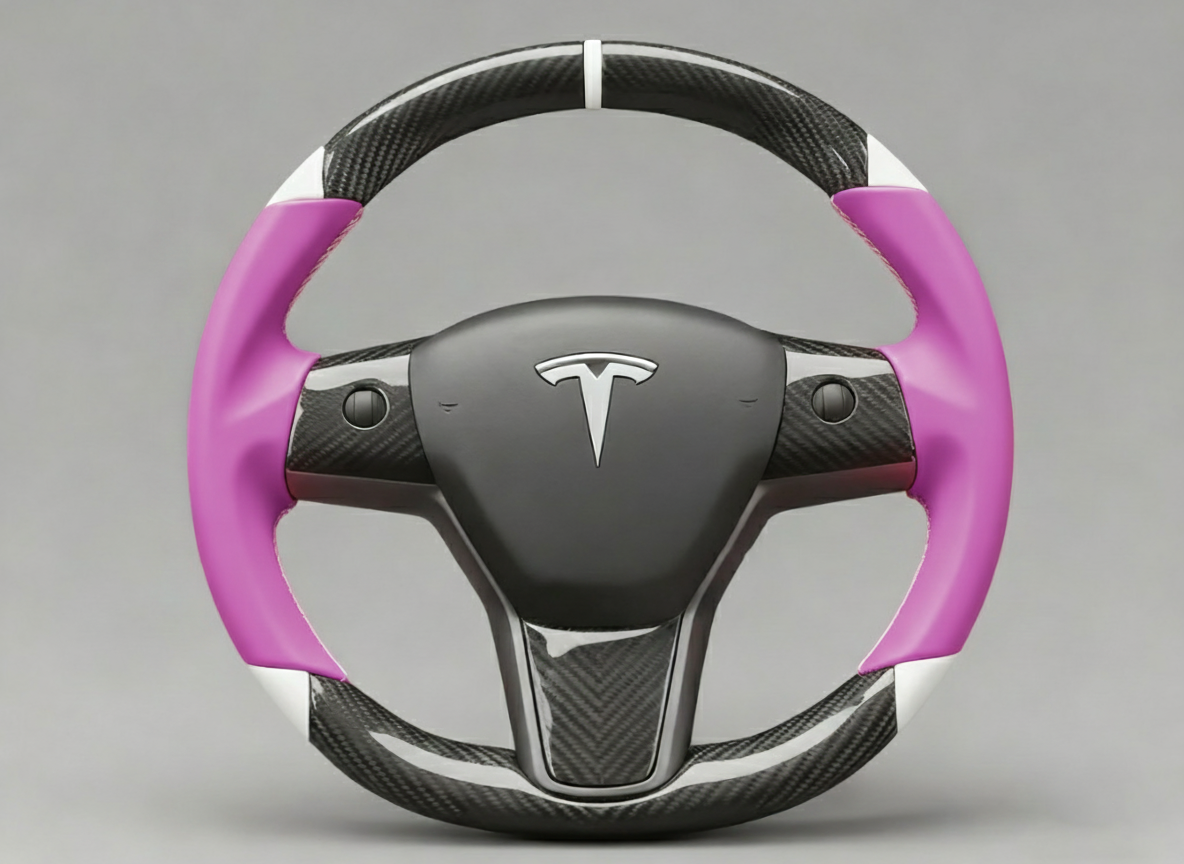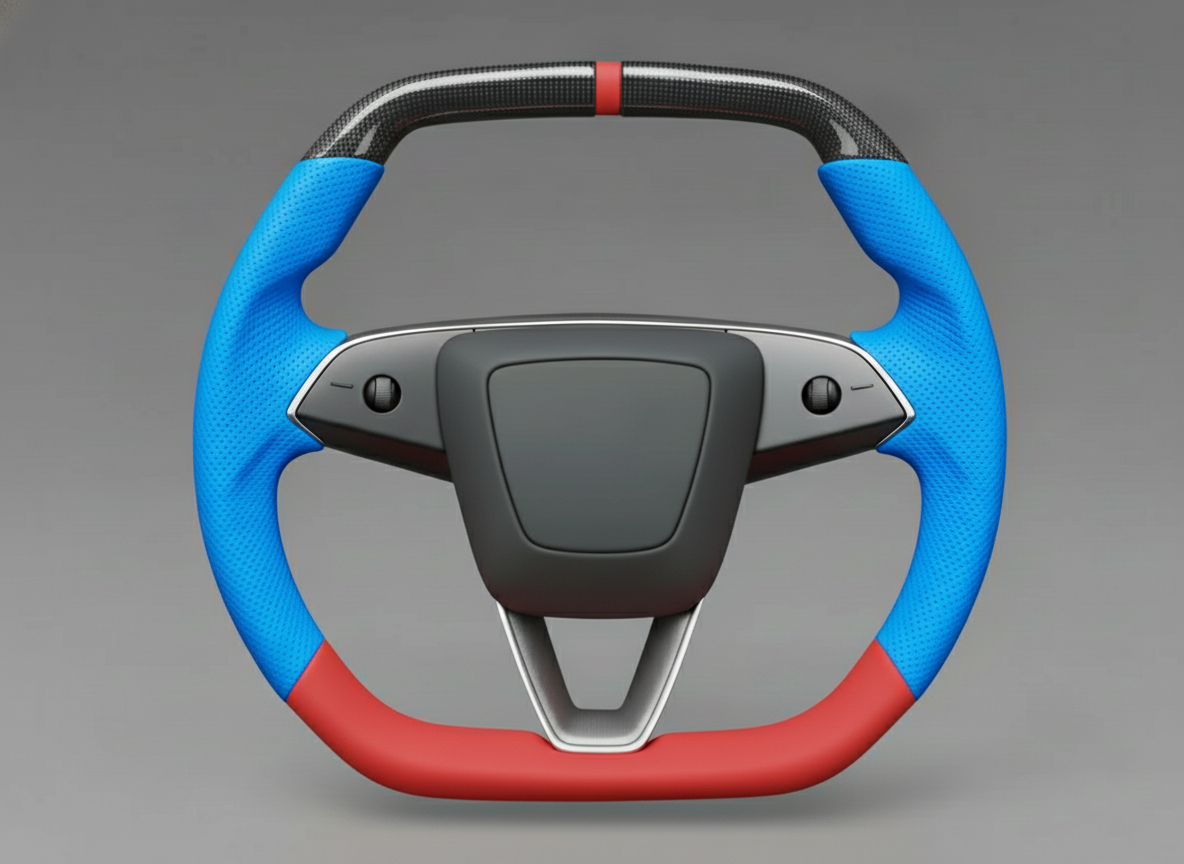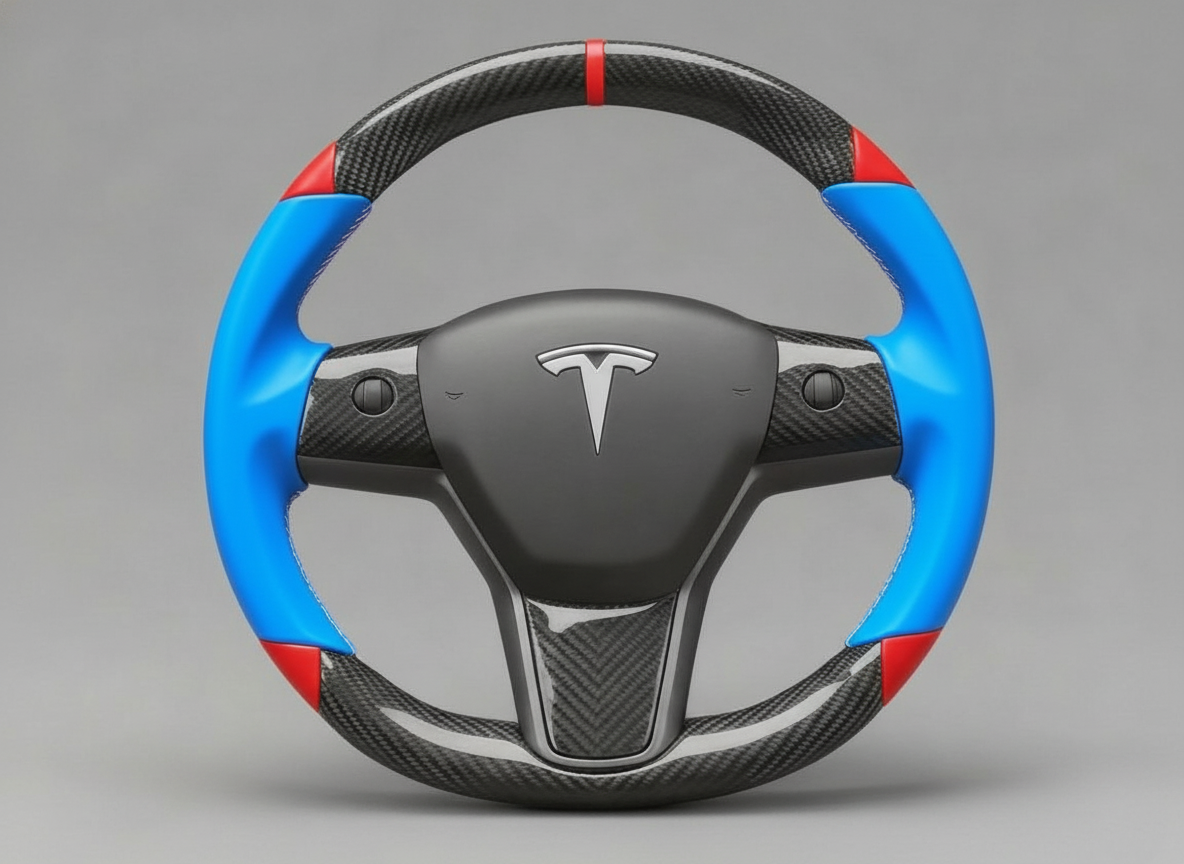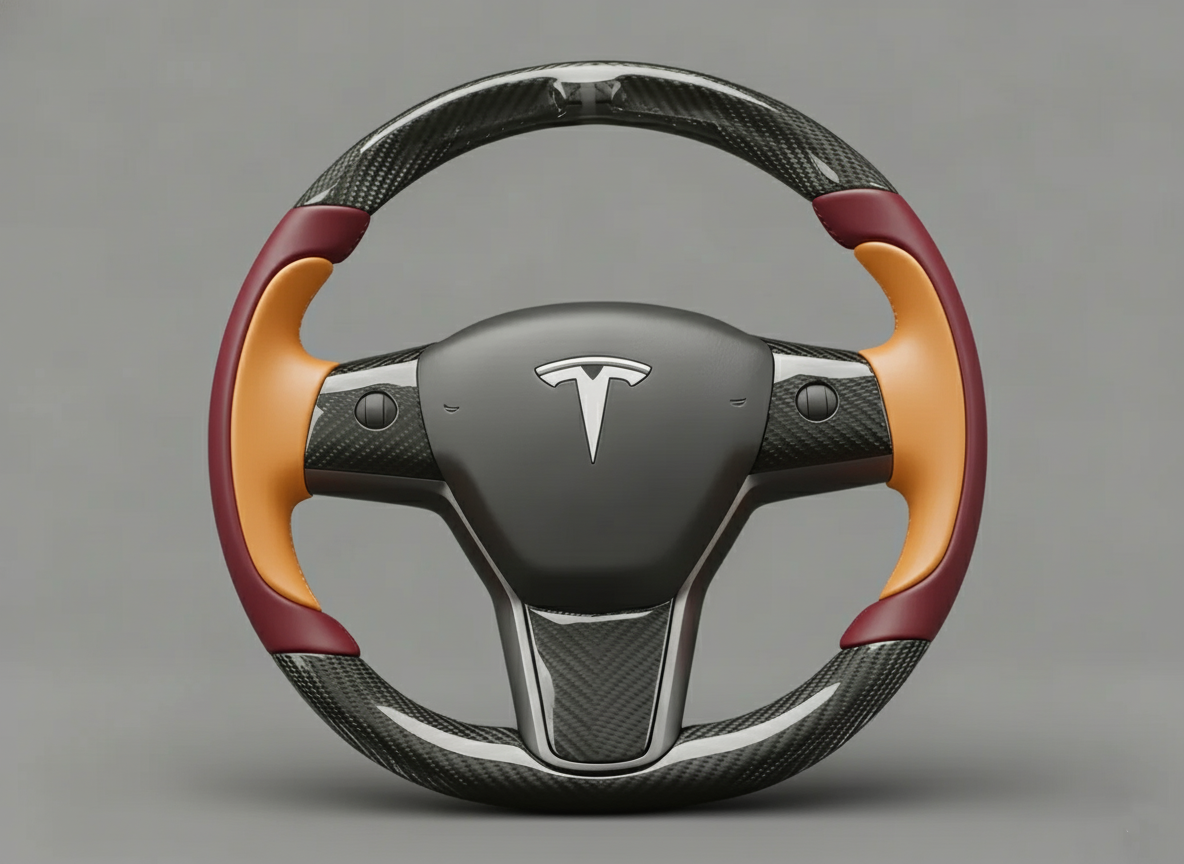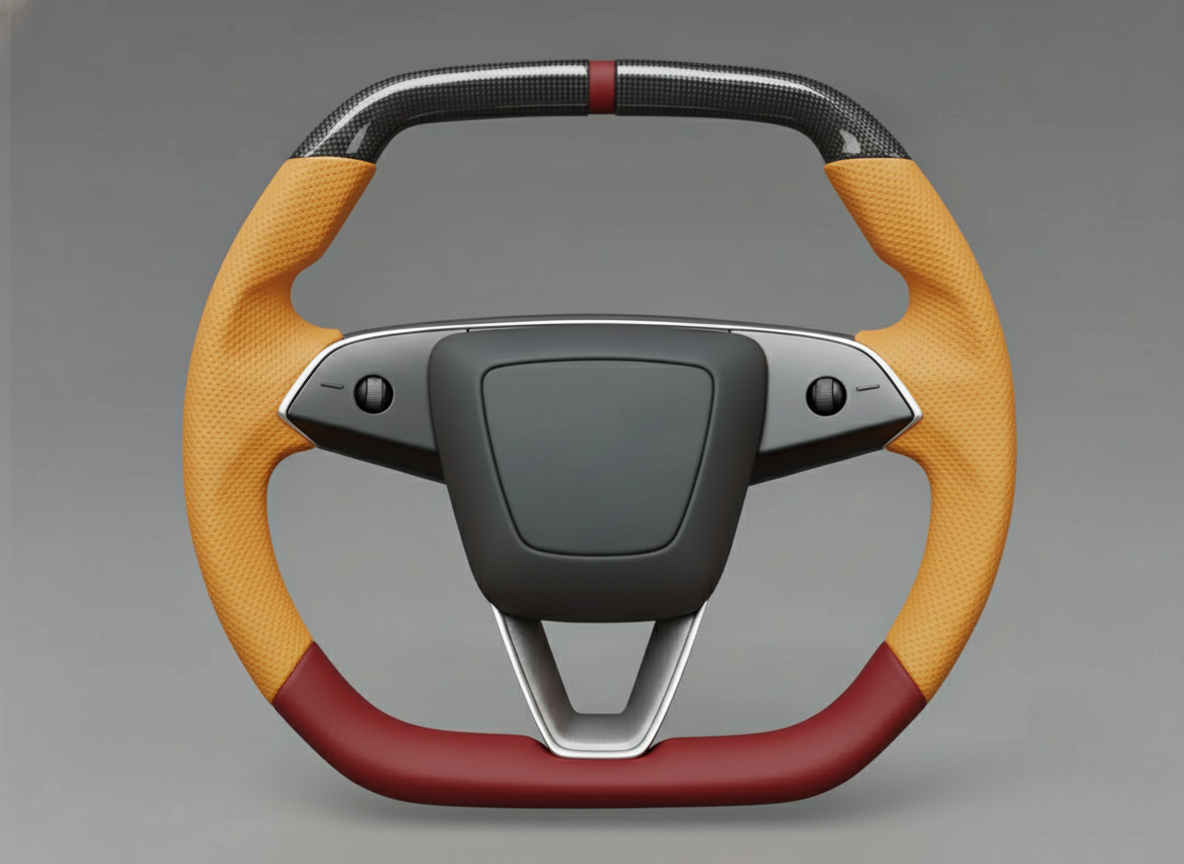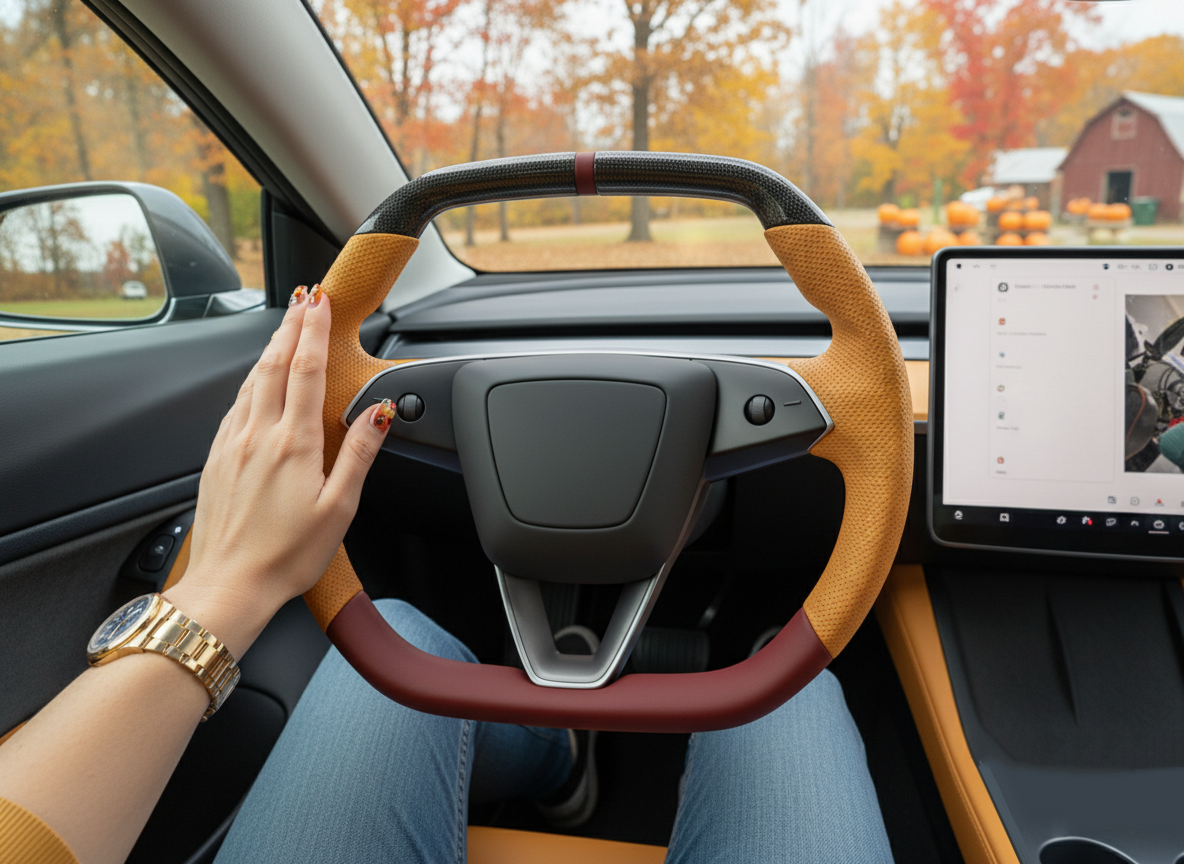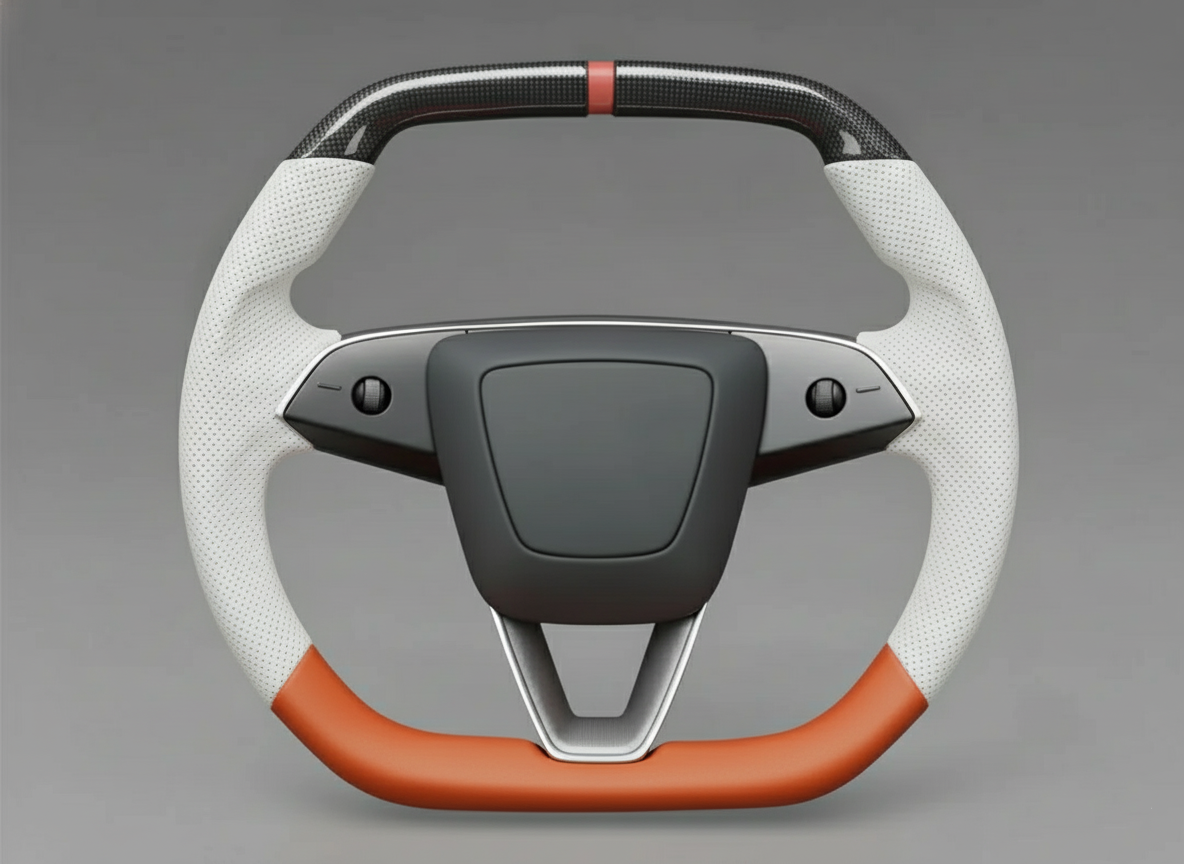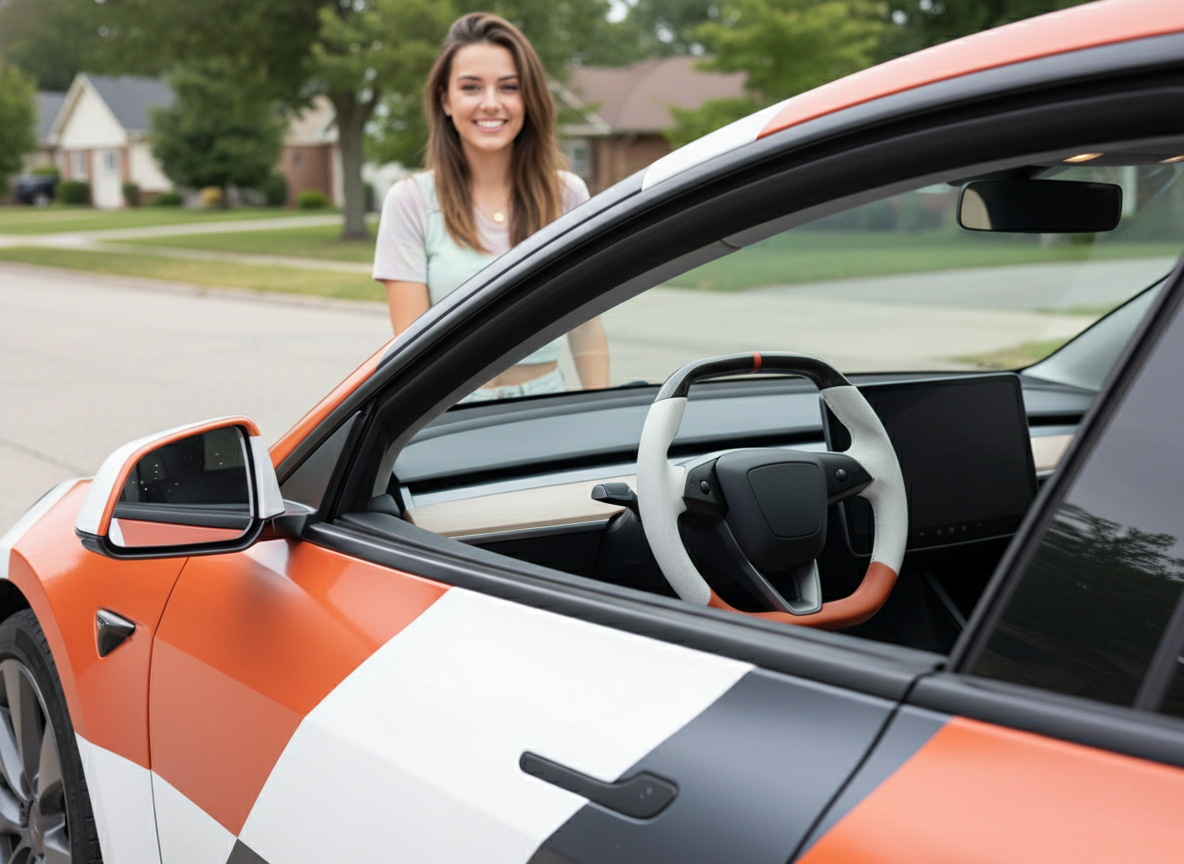
Model 3 Highland aftermarket steering wheels are generally safe, provided the original airbag module is retained and products matching the 2024+ model are selected.
Most high-end modifications support the original vehicle's airbag interface and heating functions, with installation completed in approximately 20-30 minutes.
If the airbag deployment channel is covered or incompatible parts are used, airbag deployment efficiency may decrease; therefore, it is recommended to choose brands that offer a 1-year warranty and OEM airbag-compatible designs.
Airbag Compatibility
The driver's airbag for the Model 3 Highland is a SRS (Supplemental Restraint System), with a deployment time typically within approximately 30 milliseconds, secured to a metal bracket via the central steering wheel airbag module.
Most aftermarket steering wheels do not provide a new airbag; instead, they continue to use the original Tesla Airbag Module.
Therefore, the steering wheel must remain consistent with the original vehicle's airbag mounting points, screw holes, deployment space, and wiring harness interfaces.
If the installation structure deviation reaches 2–3mm, the airbag deployment path may be affected, and the vehicle may also display SRS warning or Airbag fault prompts.
Original Airbag
The overall diameter of the airbag module is typically between 120–130mm, with a thickness of about 25–30mm. The module internally contains a gas inflator, a folded airbag cushion, an igniter, and a metal housing. When a vehicle collision occurs, the system determines the trigger conditions within approximately 15–20 milliseconds and completes airbag deployment within about 30–40 milliseconds.
Tesla Model 3 driver airbag modules are supplied by global automotive safety suppliers and are integrated with the vehicle's SRS control unit.
Once the igniter is triggered, the propellant burns and releases high-pressure gas within about 3–5 milliseconds. The gas enters the airbag cushion through a diffusion structure, causing the airbag to expand rapidly. During the deployment phase, internal pressure usually reaches 20–30 kPa, and the fully deployed volume of the airbag cushion is about 60–70 liters, used to protect the driver's head and chest areas.
Most vehicle airbags use Nylon 66 high-strength fiber fabric, with fiber densities typically ranging from 420–630 denier. The fabric surface is usually coated with silicone or polyurethane to improve airtightness and reduce gas leakage. The seams of the airbag cushion use high-strength industrial sewing thread, with typical tensile strengths exceeding 200 N, which can withstand the tension brought by the instantaneous expansion of the airbag.
| Airbag Component | Typical Parameters | Functional Description |
|---|---|---|
| Airbag module | Diameter 120–130mm | Integrates airbag cushion and gas inflator |
| Gas inflator | 3–5ms ignition | Produces high-pressure gas |
| Airbag fabric | Nylon 66 | Withstands deployment pressure |
| Deployment volume | 60–70L | Forms a buffer space |
The airbag module is connected to the vehicle's electronic system via the SRS Control Unit (Airbag ECU). This control unit is usually located in the central structural area of the vehicle and monitors changes in vehicle deceleration through impact sensors. The sampling frequency of modern vehicle impact sensors can reach over 1000 Hz, which means 1000 samples per second.
Airbag control units monitor circuit resistance continuously to ensure system integrity before deployment.
The resistance range for most driver airbags is approximately 2–3 ohms. If the resistance exceeds the normal range, for example, above 5 ohms or below 1 ohm, the vehicle will record a fault code and display an Airbag warning on the instrument cluster. This monitoring is typically performed multiple times per second to ensure stable circuit status.
The airbag module is connected to the steering wheel via mounting bolts. The steering wheel airbag for the Model 3 Highland is usually secured with Torx T30 bolts. The bolt spacing is approximately 70–75mm. The metal bracket thickness is about 3–4mm, used to withstand the impact force generated at the moment of collision. During a collision, the steering wheel will bear pressure from the driver's body, which can reach several thousand Newtons.
The airbag housing is typically designed with preset tear seams. When the internal pressure of the airbag rises, the housing will split along the preset lines, allowing the airbag cushion to deploy toward the driver. The deployment angle is usually slightly upward, at about 10–20°.
The airbag cushion is designed with vent holes. When the driver's body contacts the airbag, gas is released through these vent holes, causing the airbag to gradually soften. The venting process is usually completed within about 100–200 milliseconds, which reduces rebound and lowers the force on the neck.
The venting process allows the airbag to absorb energy during occupant contact.
The SRS system of the Tesla Model 3 usually works in coordination with seat belt pretensioners. The pretensioners tighten the seat belt in the early stages of a collision, typically within about 15 milliseconds. Subsequently, the airbag deploys, providing extra buffer space for the driver. The combination of the two can reduce the impact force on the driver's chest and head.
The gas inflator requires high-temperature, vibration, and sealing tests. The propellant must remain stable for ignition after long-term storage. Automakers typically require airbag modules to maintain stable performance over a 10–15 year service cycle, so airbag components need to pass multiple durability tests, including environmental trials within a temperature range of -40°C to 85°C.
Aftermarket Steering Wheels
The airbag module for the Model 3 Highland has a diameter of approximately 125 mm and is connected to the steering wheel's metal bracket via two Torx mounting bolts. Most aftermarket steering wheels maintain the same installation depth, typically within the 28–32 mm range, to ensure the airbag housing fits perfectly. If the installation depth deviation exceeds approximately 3 mm, a gap may occur between the airbag housing and the steering wheel cover, potentially altering the deployment path at the moment of expansion.
Tesla's collision detection system typically operates through multiple body accelerometers, with the ECU determining whether to trigger the airbag within approximately 15 milliseconds. Subsequently, the igniter detonates the gas inflator, and the airbag completes deployment between approximately 30–40 milliseconds. If the central structure of the steering wheel alters the stress points of the original airbag housing, the rupture direction of the housing may shift during deployment; therefore, aftermarket steering wheels must retain the original housing's rupture line positions.
Vehicle safety components in the European and North American markets must satisfy regulatory tests such as FMVSS 208, including frontal impact, occupant protection, and airbag deployment timing tests. Airbag production is typically completed by automotive supply chain manufacturers, such as Autoliv, ZF, or Joyson Safety Systems. Since ordinary modification shops find it difficult to complete the full crash testing process, aftermarket steering wheels usually only replace the external shell structure and grip materials.
The original steering wheel frame uses a die-cast aluminum alloy structure with a thickness typically around 4 mm. Most high-end aftermarket versions utilize a CNC aluminum frame, weighing approximately 900–1100 g. While maintaining structural rigidity, a high-density foam layer is added to the outer layer of the steering wheel with a thickness of about 6–8 mm, which is then wrapped in leather or Alcantara.
The airbag module housing for the Model 3 Highland has a height of approximately 55–60 mm. If the central cover plate of the steering wheel is designed too thin, the housing may protrude after installation. Conversely, if the space is too deep, the airbag housing may have room to move after the mounting screws are tightened. Most mature products maintain an installation tolerance of about 1–2 mm, ensuring both smooth installation and the prevention of module wobbling.
The resistance of Tesla's airbag igniter is typically within the range of approximately 2.0–3.0 ohms. When the vehicle starts, the ECU performs a circuit check; if an abnormal resistance value is detected, an Airbag fault or SRS warning will appear on the instrument cluster or center display. Modifying the steering wheel does not change the airbag resistance, but if the wiring harness interface is not fully inserted during installation, the system may record a fault code.
The 12V system of the Model 3 controls the safety modules; it is recommended to disconnect the battery and wait 10–15 minutes before removing the airbag. This allows the SRS system capacitors to discharge, reducing the risk of accidental triggering. During installation, use a Torx tool to release the clips through the holes on the back of the steering wheel; the airbag module will pop out from the front, and then the two safety plugs can be disconnected.
When purchasing an aftermarket steering wheel, users typically focus on several specific parameters, as these data points directly reflect the airbag compatibility design:
-
Supported airbag module diameter range (approx. 120–130 mm)
-
Airbag mounting depth (approx. 30 mm)
-
Central metal bracket thickness (3–5 mm)
-
Airbag mounting bolt specifications (Torx T30 or M5)
-
Overall steering wheel weight (900–1200 g)
-
Connection method with the OEM clock spring
These dimensions determine whether the airbag module can maintain a stable connection with the steering wheel structure.
Aftermarket steering wheels vary significantly in appearance design, such as flat-bottom or yoke style. These changes are primarily concentrated in the grip areas, while the airbag mounting zone typically retains the OEM shape. Even if the steering wheel diameter is adjusted from 380 mm to 360 mm, the central airbag area remains consistent.
Following installation, some modification shops check the SRS system status via diagnostic equipment. Tesla's diagnostic system can read safety module data, including airbag circuit status and fault records. If the system has not recorded new fault codes, it indicates that the airbag circuit connection is normal. Some shops also perform a steering wheel torque test to ensure the central bolt reaches a tightening force of approximately 50–60 Nm.
In European and North American Tesla community forums, most users report that as long as the steering wheel is designed to be OEM airbag compatible, the airbag system usually functions without issues. Problems typically arise with low-quality products, such as misaligned airbag bracket welding or offset screw hole positions. Even a deviation of only 2 mm may require forced adjustment during installation, and such products are prone to loosening during long-term use.
Warranty
Most Model 3 Highland aftermarket steering wheels offer a 12–24 month limited warranty, covering manufacturing issues such as structural integrity, stitching, carbon fiber layering, and electronic interfaces.
In North American and European markets, mainstream brands typically promise a 1-year standard warranty or a 2-year extended warranty.
The warranty generally applies only to the product itself, such as frame deformation, leather cracking, or button failure, and does not include accidents, modification damage, or incorrect installation.
Common Warranty Coverage
The warranty for aftermarket Model 3 Highland steering wheels is typically a limited product warranty, with a duration often of 12–24 months. In the North American aftermarket parts market, about 70% of brands offer a 1-year warranty, and about 20–25% of brands offer a 2-year structural warranty. Warranty coverage is primarily aimed at manufacturing defects, such as metal frame welding issues, carbon fiber layer separation, leather wrap cracking, or electronic module failure.
The interior of the Model 3 Highland steering wheel typically uses a high-strength steel or aluminum alloy frame, about 3–4 mm thick. The frame must withstand the impact load generated by airbag deployment, bearing hundreds of kilograms of instantaneous impact force within about 30–40 ms. If cracks appear in the weld points or structural deformation occurs, manufacturers usually provide a replacement. Frame issues have a low incidence in after-sales cases, typically less than 5%.
Carbon fiber structures are also covered under warranty. Most modification steering wheels use 2×2 twill carbon fiber or forged carbon. The carbon fiber layer is usually made of 3–5 layers of fiber cloth superimposed and cured with epoxy resin. The warranty typically covers:
- Surface resin cracks
- Carbon fiber layer separation
- Coating peeling
Under normal conditions, the temperature resistance range of carbon fiber parts is about -30°C to 120°C. If the curing temperature is insufficient during production, cracks may appear on the surface within 6–12 months, which is why most manufacturers include this issue in the warranty.
The warranty period for leather or Alcantara wraps is typically shorter. Common materials for modification steering wheels include Nappa leather, perforated leather, or Alcantara. The wrap thickness is usually 0.8–1.2 mm, with a stitch spacing of about 3–4 mm. The warranty generally covers:
- Stitch breakage
- Early cracking
- Adhesive layer peeling
Leather will experience wear during use, so many manufacturers only provide a 6–12 month wrap warranty.
Electronic components are another common category for warranty. The Highland steering wheel includes:
- Left and right scroll wheel control modules
- Multi-function buttons
- Heating elements
- LED indicators
Button modules typically use micro switches, with a lifespan of about 100,000 clicks. If buttons fail within a short period, it is usually considered a manufacturing defect.
Some European modification brands note in product descriptions:
"Electronic components are covered for 12 months under normal use conditions."
This indicates that electronic component warranties are generally for one year.
The heating function is common in Highland steering wheels. The steering wheel heating system typically uses resistive heating wires with a power of about 25–35 W. When the ambient temperature is below 10°C, the system noticeably raises the surface temperature.
| Component Type | Common Issues | Typical Warranty Period |
|---|---|---|
| Metal frame | Welding cracks, structural deformation | 12–24 months |
| Carbon fiber shell | Coating cracks, fiber layer separation | 12–24 months |
| Leather or Alcantara | Stitch loosening, early cracking | 6–12 months |
| Button module | Button failure, scroll wheel sticking | 12 months |
| Heating element | Heating wire breakage or partial heating failure | 12 months |
Warranty claims typically require the order record and product serial number. Some brands engrave a laser serial number on the internal frame of the steering wheel, usually 8–12 characters long. The after-sales team confirms the production batch via the serial number. If a batch of products has material issues, the manufacturer can quickly locate them using the serial number.
Most after-sales processes require users to provide:
- Order number
- Product photos
- Installation date
- Fault video
This information is used to determine whether the issue is a manufacturing defect. The review process is typically completed within 24–72 hours.
Some brands provide a replacement program, where they send a new steering wheel first and then ask the user to return the old part. International logistics usually takes 5–10 business days. For a steering wheel component weighing about 3 kg, cross-border shipping costs are generally between 40–80 USD, and some brands will cover this cost.
The warranty range typically does not include the vehicle's electronic systems or airbag modules. The airbag system of the Model 3 Highland is a vehicle safety component, for which Tesla is responsible. Aftermarket steering wheel manufacturers are generally only responsible for the structure and wrap. If the airbag module is damaged during installation, the repair costs must usually be borne by the user.
Furthermore, warranty terms usually list some exclusions, such as vehicle accidents or abnormal use. Modification market statistics show that in all warranty claims, about 25–35% of cases are judged to be due to human factors, including incorrect installation, excessive torque, or wiring harness damage. Manufacturers typically inspect the bolt holes, frame, and interfaces during review to confirm the cause of the damage.
The entire after-sales cycle is usually completed within 7–14 days. If factory repair is required, the cycle may extend to 3–4 weeks. For most brands, the proportion of new replacements is higher than repairs, as steering wheels are integrated structural parts, and repair costs often approach the cost of a new product.
Relationship with Original Airbag System
The vehicle uses a single-stage driver's frontal airbag module, installed in the center of the steering wheel and secured by metal clips on both sides. The original airbag module weight is typically between 1.6–1.9 kg, with a diameter of about 165–175 mm. If the aftermarket steering wheel maintains the same mounting dimensions, clip positions, and module depth, the airbag can be reused directly.
The airbag module is connected to the vehicle's safety system via the SRS (Supplemental Restraint System) control unit. The internal wiring harness of the Model 3 steering wheel typically includes 2 airbag trigger lines, 1 ground line, and multiple control signal lines. The trigger line resistance value is usually in the 2.0–3.0 ohm range, and the SRS control module continuously detects this resistance.
The Highland refreshed model continues the airbag module structure used by Tesla in early versions of the Model 3, but the steering wheel shape and wrap structure have been adjusted. The interior of the steering wheel still uses an aluminum alloy or high-strength steel frame as the load-bearing structure. The frame thickness is generally 3–4 mm, used to secure the airbag module and withstand the impact of the airbag's instantaneous deployment. When the airbag deploys, the internal gas inflator fills the bag in about 30–40 ms, with instantaneous pressure exceeding 200 kPa; frame stiffness directly affects module stability.
During a vehicle collision, the SRS control unit combines data from multiple sensors to decide on airbag triggering. The Model 3 safety system typically includes:
- Front Impact Sensor
- Central car body acceleration sensor
- Steering wheel airbag trigger circuit
- Seat belt pretensioner signals
- SRS Control Unit
Sensor sampling frequency is typically hundreds of times per second or more. If deceleration is detected to have reached the set threshold, the system sends a trigger current to the airbag module within approximately 15–30 ms.
The central cavity depth of the original steering wheel is approximately 45–50 mm; if the aftermarket structure changes this depth, the airbag deployment angle will be affected. The airbag deploys at a speed of about 250–300 km/h, so the steering wheel surface structure must leave enough space for the airbag; otherwise, the airbag may interfere with the wrap materials.
The fixation method for the airbag module typically uses a dual-spring clip structure. During installation, the clips are released through two holes on the back of the steering wheel. The metal clip width is generally about 18–20 mm. If an aftermarket steering wheel does not precisely replicate this structure, the airbag module may become loose or difficult to install.
Regarding structural design, higher-quality modification steering wheels typically use CNC machined metal frames. Frame dimensions need to remain consistent with the OEM, including:
- Airbag module mounting hole distance: approximately 70–75 mm
- Central mounting shaft hole diameter: approximately 18 mm
- Rear mounting bolt positions consistent with the original vehicle
- Module mounting depth error controlled within ±1 mm
If the error is too large, the airbag module may shift during deployment.
The Model 3 steering wheel internally uses yellow safety connectors (SRS connectors). This connector is designed as an error-proof structure; the plug can only be removed by sliding the clip after it is locked. The circuit terminals are usually made of tin-plated copper, with contact resistance generally below 10 milliohms. If a poor-quality wiring harness is used on the modified steering wheel, rising contact resistance may trigger an SRS fault code.
There is also a component inside the steering wheel called the clock spring, located inside the steering column. This component allows for the circuit connection to be maintained while the steering wheel rotates. The Model 3 clock spring typically supports a rotation range of about 5 turns. If the modified steering wheel changes the mounting angle or structural thickness, it may cause the clock spring position to shift, thereby affecting harness tension.
The original Tesla steering wheel weight is typically 2.8–3.2 kg. Carbon fiber modified steering wheels can usually reduce weight by 0.5–0.8 kg, but the frame must still maintain original strength. Some high-quality modification brands perform Finite Element Analysis (FEA) to simulate airbag deployment loads and confirm that the frame will not deform.
The vehicle's electronic system performs an SRS self-test procedure upon ignition. This process typically lasts 2–3 seconds. If the steering wheel harness connection is normal, the airbag indicator light on the dashboard will turn off after the self-test. If there is an issue with the interface, the system will record an SRS fault code and display it in the diagnostic system.
Several practical details must be noted during installation:
- Airbag module plugs must be completely locked
- Steering wheel mounting bolt torque is approximately 50 Nm
- The 12V battery power must be disconnected for about 10 minutes before installation
- Avoid electrostatic discharge when disassembling the airbag module
These steps are clearly stated in Tesla's official maintenance documents.
Modification market statistics show that in over 90% of Model 3 steering wheel replacement cases, the original airbag module is still used. The airbag system itself rarely has problems; most warning messages come from poor harness contact or unlocked interfaces.
Installation Method
The mounting structure for the Model 3 Highland steering wheel is essentially identical to the early Model 3; the steering wheel is secured to the steering column via a central splined steering shaft and locked with a central bolt. This bolt is typically an M12 high-strength bolt, and the tightening torque recommended in the Tesla service manual is about 50 Nm. Before disassembling the steering wheel, the vehicle's 12V battery should be disconnected for at least 10 minutes to avoid accidental triggering of the airbag system. The installation process typically takes 20–40 minutes, and technicians familiar with Tesla structures can complete it within 30 minutes.
The back of the Highland steering wheel has two release holes on either side, containing a spring-loaded metal clip structure. Inserting a tool of approximately 3 mm in diameter into the holes to push the clips will cause the airbag module to pop out from the center of the steering wheel. The module weight is typically 1.6–1.9 kg. After the airbag is removed, the yellow SRS safety connector must be disconnected; this connector has a sliding locking device that needs to be pulled up before removal.
Once the airbag is removed, the central mounting bolt of the steering wheel is visible. This bolt is typically removed using a 10 mm or 12 mm hex socket. After the bolt is removed, the steering wheel remains stuck on the steering shaft splines and requires slight left-to-right shaking to remove. The spline structure diameter is about 18 mm, designed to prevent the steering wheel from sliding under high torque.
Before installing the aftermarket steering wheel, the original components must be transferred. The Highland steering wheel contains several removable modules:
- Left and right scroll wheel control modules
- Multi-function button assemblies
- Heating circuit interface
- Airbag mounting spring assembly
- Steering wheel wiring harness
These modules are secured by Torx screws, typically T20 or T25. When disassembling, the screw positions should be recorded as the lengths often differ, such as 8 mm and 10 mm lengths.
Once the module transfer is complete, the new steering wheel can be installed. The installation sequence is typically:
- Align the steering shaft splines with the central hole of the steering wheel
- Install the central mounting bolt and tighten to about 50 Nm
- Connect the steering wheel wiring harness
- Insert the airbag module connector
- Press the airbag module until the clips lock
During this process, the steering wheel position must remain aligned forward. Although the splines have an error-proofing design, a deviation of 1–2 teeth can still occur. If the steering wheel is offset by one tooth, the steering wheel may be skewed by about 5–7° when the vehicle is driving straight.
After installation, the 12V battery needs to be reconnected and the vehicle started. The vehicle performs an SRS system self-test, usually lasting 2–3 seconds. The airbag indicator light on the dashboard turns off after the self-test is complete.
Internal space in the steering wheel is limited, and harness length is typically 15–20 cm. If the harness is pressed against the frame edge during installation, friction may occur during steering. Long-term use could lead to wear of the insulation layer, so it is necessary to ensure the harness routing is consistent with the OEM.
After installation, steering wheel functions must be checked, including scroll wheel control, button feedback, and heating function. The power of the steering wheel heating system is about 25–35 W, and heating can be clearly felt when the ambient temperature is below 10°C. If the heating function fails after installation, it is usually because the interface is not fully inserted.
Some owners choose to upgrade to an LED shift indicator or carbon fiber trim parts when modifying the steering wheel. Such components usually require an additional power line connected to the steering wheel control module. Installation must avoid interfering with the original SRS wiring, as airbag circuits use independent safety circuits.
In the North American Tesla aftermarket, about 60% of steering wheel upgrades are completed by modification shops, with the rest installed by the owners themselves. Labor costs for professional modification shops are usually 80–150 USD. Installation time is typically controlled within 30–45 minutes.
Factors affecting installation quality mainly concentrate on three aspects:
- Whether the central bolt torque meets the standard of approximately 50 Nm
- Whether the airbag module clips are completely locked
- Whether the steering wheel splines are correctly aligned
If these conditions are met, the installation method for an aftermarket Model 3 Highland steering wheel is essentially consistent with the OEM, and the vehicle's steering system and airbag module typically function normally.
Build Quality
For Model 3 Highland owners, the build quality of the steering wheel is directly reflected in the materials, structure, and assembly precision.
High-quality aftermarket steering wheels typically use 6061-T6 aluminum or high-strength steel frames, with the surface being Nappa leather or Alcantara, and a stitch density of about 6–8 stitches/cm.
Reliable products generally have installation tolerances controlled within ±0.2 mm and pass over 50,000 steering durability tests.
Structural Materials
The steering system generates 2–5 Nm of continuous steering torque during normal driving, which can exceed 8 Nm during emergency maneuvers. The steering wheel frame needs to remain rigid while perfectly matching the Tesla steering column splines. Original steering wheels usually use high-strength steel stamped frames; some aftermarket products use 6061-T6 aluminum alloy, with a yield strength of about 240 MPa, striking a balance between weight and strength.
The original Tesla steering wheel total weight is about 1.6–1.9 kg, with the frame structure typically accounting for 40%–50%. Some aftermarket steering wheels reduce the overall weight to around 1.4 kg via an aluminum alloy frame. Weight changes affect the steering feel because the steering wheel's moment of inertia is related to mass distribution.
| Structural Component | Common Material | Density | Strength Range |
|---|---|---|---|
| Internal frame | High-strength steel | 7.8 g/cm³ | 350–550 MPa |
| Internal frame (Lightweight) | 6061-T6 aluminum | 2.7 g/cm³ | 240–310 MPa |
| Surface decoration | Carbon fiber composite | 1.6 g/cm³ | 500 MPa+ |
Many aftermarket steering wheel frames have thicknesses between 3.5–5 mm. When thickness is below 3 mm, micro-deformations are more likely to occur under frequent steering and changing temperature environments. Manufacturers typically add reinforcing ribs to the inner side of the frame, increasing flexural rigidity by 15%–25%.
The typical diameter of the Tesla steering column spline is about 17 mm, with approximately 36 teeth. The steering wheel's central hole needs to fit perfectly with the splines. CNC-machined aftermarket products typically maintain a size error of ±0.05 mm, while low-cost cast parts may have errors reaching ±0.3 mm. When the size error is too large, a slight axial clearance may appear after the steering wheel is installed.
Most steering wheel frames use M5 or M6 high-strength bolts to secure the airbag module. Bolt materials are generally 10.9 grade alloy steel, with a tensile strength of about 1000 MPa. Mounting hole positions need to maintain high precision; otherwise, the airbag module will shift after installation. If the deviation exceeds 0.4 mm, uneven gaps may appear after the airbag module is installed.
To control vibration and noise, some steering wheel frames add a buffer layer between the metal structure and the outer material. Common materials are EVA or PU foam, with a density of about 60–90 kg/m³. This buffer layer is typically 2–4 mm thick, with the primary role of absorbing hand pressure and reducing the transmission of frame vibrations. If the buffer layer density is insufficient, the grip area of the steering wheel is prone to local collapse after 1–2 years of use.
Internal vehicle temperatures can reach above 65°C under direct summer sunlight. The expansion coefficient of aluminum alloy frames in this temperature range is about 23 μm/m·K, while for steel structures it is about 12 μm/m·K. If the material expansion difference is too large, it can cause slight stretching of the wrap materials. Some manufacturers reserve 0.1–0.2 mm of material expansion space during the design phase.
There are also clear differences in frame manufacturing processes. Common processing methods include stamping, CNC milling, and casting.
| Manufacturing Method | Precision Range | Application Characteristics |
|---|---|---|
| Stamped steel structure | ±0.1 mm | Common OEM solution |
| CNC aluminum alloy machining | ±0.05 mm | High-end aftermarket product |
| Aluminum alloy casting | ±0.3 mm | Lower cost |
The surface roughness of CNC-machined frames is typically controlled at around Ra 1.6 μm. Lower roughness can reduce friction wear between the wrap material and the metal.
Structural materials also affect the stress behavior of the steering wheel at the moment of airbag deployment. Airbag deployment is completed within 20–30 milliseconds, and the instantaneous impact force can reach several thousand Newtons. The steering wheel frame must maintain structural integrity while providing a stable mounting point for the airbag module. High-strength steel frames can typically withstand instantaneous loads of over 10 kN in impact tests.
Manufacturers usually perform cycle durability tests when developing steering wheel structures. Test equipment simulates the driver's steering movements, at approximately 30–40 rotations per minute. A complete test typically reaches 50,000–80,000 cycles. If there is stress concentration in the frame welding or connection structure, fine cracks may appear within 30,000 cycles in cycle tests.
The steering wheel diameter is usually about 370–380 mm, and weight distribution needs to be as uniform as possible. If the weight deviation of a carbon fiber decorative plate on one side exceeds 20 g, a slight inertia difference may occur during high-speed steering. Some manufacturers perform dynamic balance detection during the assembly phase, similar to wheel hub balance calibration.
In the aftermarket, price differences between different structural materials are also significant. Manufacturing costs for ordinary steel structure steering wheels are typically in the 80–120 USD range, while CNC aluminum alloy frame products can reach 180–250 USD. The price difference mainly comes from material costs and processing time, as CNC machining one frame typically requires 30–45 minutes of machine time.
Material & Durability
During daily driving, contact time between the palm and the steering wheel typically accounts for over 70% of driving time, with an average grip pressure of about 15–30 N per drive. In urban driving environments, a steering wheel undergoes approximately 20,000–30,000 steering maneuvers per year.
Nappa leather is commonly found in the supply chains of high-end European car interiors. The leather thickness is typically 1.1–1.3 mm, and after chrome tanning, the abrasion resistance grade can reach 30,000–40,000 Martindale cycles. Under normal driving conditions, the touch area usually maintains a relatively stable surface structure for 5–7 years.
Automotive-grade Nappa leather typically requires 4–6 surface coating processes, including a dyeing layer, a protective layer, and an anti-UV layer. UV testing is usually conducted under a UV-B 340 nm light source for 96 consecutive hours, simulating about 2–3 years of sunlight exposure. If the protective layer thickness is insufficient, the surface may fade within 18–24 months.
| Surface Material | Average Thickness | Abrasion Resistance Grade | Common Service Life |
|---|---|---|---|
| Nappa leather | 1.1–1.3 mm | 30k–40k Martindale | 5–7 years |
| Alcantara | 0.8–1.0 mm | 25k–35k Martindale | 3–5 years |
| Synthetic leather | 0.6–0.9 mm | 15k–25k Martindale | 2–4 years |
The static friction coefficient of Alcantara is typically 0.6–0.8, higher than the 0.4–0.6 of most leather materials. Higher friction provides greater grip stability in intense driving environments.
Alcantara fiber diameter is about 10–20 microns, with a structure similar to microfiber fabric. Fabric density typically reaches 800 g/m². This structure provides high friction while maintaining a degree of breathability. During long drives, the steering wheel surface temperature is usually 2–3°C lower than leather.
The pH value of human palm sweat is typically 4.5–6.5, and long-term contact will alter the surface coating structure. Some material tests simulate an artificial sweat environment for 24–48 hours to observe color changes and surface softening.
When a vehicle is parked in the sun, internal temperatures can reach 60–70°C. Nappa leather can maintain its flexibility within this temperature range, whereas some low-cost synthetic leathers may experience surface hardening above 55°C. Manufacturers typically conduct 72-hour high-temperature aging tests to evaluate if the material develops cracks.
| Test Type | Test Condition | Common Standard |
|---|---|---|
| High-temp aging | 70°C for 72 hours | No surface cracks |
| Low-temp flexibility | -20°C bending test | No surface breakage |
| UV testing | 96 hours UV-B | Color change ≤ Level 3 |
Steering wheel wrap materials are typically fixed to the frame via PU adhesive or epoxy, with a bonding layer thickness of about 0.2–0.4 mm. The adhesive layer may soften in high-temperature environments, so heat resistance grades typically require stability above 80°C.
In adhesion tests, the wrap material is subjected to about 30–50 N of tension. If the adhesive quality is low, local delamination may occur in environments with long-term temperature changes. Some tests perform 10,000 bending cycles to observe if the material develops wrinkles.
Dark-colored leather typically maintains better stability in ASTM G154 UV testing, while light-colored materials are more prone to color changes. Experimental data shows that the color change grade of light-colored leather after a 3-year sunlight exposure simulation test is about Level 3–4.
Durability comes not only from the material itself but also from the surface texture. Automotive-grade leather typically has an embossing depth of 0.2–0.4 mm. Embossing can disperse friction forces, making wear distribution more uniform. If the surface is too smooth, friction-concentrated areas are more likely to show shiny zones within 2–3 years.
| Surface Texture Type | Embossing Depth | Wear Distribution |
|---|---|---|
| Fine-grain leather | 0.2 mm | Uniform |
| Coarse-grain leather | 0.4 mm | Friction dispersion |
| Smooth leather | <0.1 mm | Prone to shiny areas |
As driving mileage accumulates, steering wheel surface wear is primarily concentrated at the 3 and 9 o'clock positions. After the vehicle has been used for 80,000–100,000 km, these two areas typically show the most obvious changes. When the material abrasion resistance grade is high, wear usually manifests as a slight change in gloss rather than cracks or peeling.
In European automotive supply chain testing, steering wheel materials typically need to complete 40,000 friction cycles. The test equipment uses 12 N of contact pressure and a wool friction head to simulate palm friction. After the test, the color change grade must remain within Level 3.
Stitching Process
The stitch density of common car steering wheels is about 6–8 stitches/cm, and a full steering wheel wrap typically contains 900–1200 stitches. If the stitch spacing expands to below 4 stitches/cm, the stress points on the wrap material decrease, and local loosening or surface wrinkling is more likely to occur after long-term grip.
In automotive interior production lines, steering wheel stitching is typically completed by industrial-grade twin-needle sewing equipment. Stitching speeds are generally maintained at 1500–2200 stitches/minute. A stable stitching speed ensures consistent stitch spacing; if speed fluctuates by more than 20%, significant differences in stitch tension may occur.
The stitch material itself also affects long-term stability. Most car steering wheels use Nylon 66 or polyester fiber thread, with a thread diameter typically between 0.3–0.5 mm. The tensile strength of Nylon 66 is about 75–90 MPa, and for polyester fiber it's about 60–80 MPa.
- Nylon 66 stitching
- Tensile strength: 75–90 MPa
- Moisture absorption: approx. 4%
- Abrasion resistance grade: approx. 30,000 friction cycles
- Polyester fiber stitching
- Tensile strength: 60–80 MPa
- Moisture absorption: approx. 0.4%
- Higher anti-UV performance
Steering wheel stitching typically uses a lock stitch structure. This structure is formed by two threads, upper and lower, interlocking to form a lock knot inside each stitch. The lock structure remains stable when subjected to 20–30 N of continuous tension. If a single-thread chain structure is used, loose threads are more likely to appear in long-term stretching environments.
Car steering wheel stitching tests typically involve 5000 bending cycles. The test equipment simulates grip maneuvers with bending angles of 30°–45°. After the test, no thread breakage or obvious loosening is allowed.
Industrial sewing machines typically set the thread tension in the 150–250 cN range. When tension is too low, the thread forms a slight wave on the surface; when tension is too high, the leather material is pulled tight, and fine cracks may appear after a period of use.
Stitching layout typically forms a continuous seam along the inner side of the steering wheel. The seam length is about 110–120 cm. Under a density of 6 stitches/cm, the entire seam contains approximately 660–720 stitches. High-density stitching can disperse the material stress, reducing the pressure on a single stitch by about 15–20%.
In abrasion tests, stitching areas typically undergo 20,000 friction cycles. The test uses 9 N of contact pressure to simulate palm friction. If the stitching material's abrasion resistance is insufficient, obvious burrs will appear on the surface fibers after the friction test.
The needle hole diameter for leather steering wheels is typically about 0.8–1.0 mm. If the needle hole spacing is less than 1.5 mm, the leather structure may be weakened. A reasonable spacing is usually 1.8–2.2 mm, which maintains stable fixation without weakening the material strength.
| Stitching Parameter | Common Range |
|---|---|
| Stitch spacing | 6–8 stitches/cm |
| Thread diameter | 0.3–0.5 mm |
| Needle hole diameter | 0.8–1.0 mm |
| Seam length | 110–120 cm |
Automotive-grade dyed fibers need to pass the ISO 105-B02 lightfastness test. Under 72 hours of UV irradiation, the color change grade is generally required to stay above Level 4. If dyeing stability is insufficient, the stitching color may change significantly within 12–18 months of long-term sunlight exposure.
In European automotive interior test standards, stitching also undergoes tensile testing. A single stitch bears 30–40 N of tension for 10 seconds during the test. No breakage or obvious displacement of the seam is allowed after the test.
In long-term use environments, the steering wheel surface is affected by sweat. The salt content of human sweat is about 0.9%, and long-term contact can affect the surface structure of the stitching. Nylon fibers typically need to maintain a 48-hour immersion test in artificial sweat, and the decrease in tensile strength after the test generally does not exceed 10%.
As vehicle mileage increases, seam area wear is typically concentrated at the 3 and 9 o'clock positions. After driving 80,000–120,000 km, the number of friction contacts for the stitching in these areas may exceed 200,000.
The automotive interior supply chain typically requires stitch spacing errors to be controlled within ±0.3 mm. When the spacing error expands to ±1 mm, the unevenness of the seam becomes clearly visible to the naked eye. Stable stitch spacing requires maintaining constant feeding speed and needle speed during production.